A linear motion component supplier in Lyon, France in robotics and automation has a hardened steel carriage block whose ground ways and mounting face must be left as they are while its edges are broken. SurfacePolish supplies finishing machines, media and compounds across borders and offers a free sample trial: representative blocks travel to Xiamen and return with observations plus a proposed media, compound and cycle direction for the buyer's own evaluation. This brief is written for a buyer in Lyon working on robotics and automation; it describes equipment, media and a scoped sample review, not a local polishing service.
Which surfaces on the part are functional, such as bearing bores, dowel holes, seal lands, ground mounting faces and threads, and which are only cosmetic?
What is the size and mass spread inside one part family, and does one machine have to cover both a heavy casting and a small gripper jaw?
How much of the incoming contamination, cutting oil, machining chip and handling damage is expected to be removed by finishing rather than by an earlier operation?
Batch composition is a process variable. Mixing aluminium and stainless parts in one charge spreads aluminium fines onto the stainless and leaves a dull grey film; leaving small steel fasteners loose among aluminium housings produces impact marks and ferrous contamination. Decide the mix, the maximum mass per batch and whether delicate parts need compartments. Decide as well how a batch is identified, with a traveller carrying part numbers, alloy, machine, media charge, compound, cycle time and inspection result, so a finished lot can be traced back to the settings that produced it. Then record honestly what the parts arrived with, because cutting oil, coolant, machining chips, a previous blasting residue or a handling scratch all change what one cycle can achieve and are easy to attribute to the wrong cause later.
Rotary barrel finishing is the gentle end of the range. Parts tumble in a closed drum, usually with plastic or light ceramic media and a generous compound flow, so direct impact is limited and small fragile components such as spools, pins, bushings and screw-machine parts survive. Cycles are long and the drum hides the work while it runs. Magnetic finishing works differently: a small charge of pin-shaped or fine media is driven by a moving field into narrow gaps, small bores and fine internal radii that tumbling media cannot enter, which suits precise items such as orifice plates, small valve spools and fine slot arrays. Its working envelope is small, the pins are a lodging risk in the features they are chosen to reach, and the surface signature differs from tumbling, so a roughness value from one route does not transfer to the other.
| Machine route | Where it fits | What it will not do |
|---|---|---|
| Vibratory finishing machine, bowl type | General deburring and refinement of machined housings, plates and brackets that fit and can tumble without racking, with easy mid-cycle inspection | Continuous part-on-part contact and no access to deep internal passages; thin plates and finished mounting faces need separation |
| Barrel finishing machine, rotary barrel tumbling | Gentle deburring of small fragile parts and mixed batches of screw-machine components with a generous compound flow | Long cycles, no visibility while running, and internal features can collect media and compound that must be retrieved at unload |
| Magnetic finishing machine | Fine deburring and light refinement of small precise features such as small bores, narrow slots and fine internal radii | Small working envelope that excludes housings and long parts, with pin media that can lodge in the fine features it reaches |
| Grinding finishing machine | Taking off a heavy machining burr, dross or a defined stock layer before a refinement pass on robust steel and stainless work | High removal energy cuts functional edges fast and demands a tighter assessment of what may be removed and how much |
Steel media produces the brightest appearance of the common charges and the highest contact pressure, and it brings a contamination question with it. On aluminium it can embed iron-bearing fragments that show up later as rust spots or as particles in a wiped sample, so a shop that runs both materials needs a changeover discipline, dedicated charges or a different route for the aluminium work. Separation at unload matters as much as the choice: steel media is dense, retains in blind holes and slots, and can only be recovered magnetically if the equipment and the procedure are set up for it. The compound has to keep the charge clean and inhibit corrosion on the parts. A bright result from a steel charge is an observation about a surface, not evidence about cleanliness or fitness for a downstream process.
| Media | Best fit | Watch out for |
|---|---|---|
| Magnetic finishing pins and fine magnetic media | Small precise items such as spools, orifice plates, small valve parts and fine slot arrays where tumbling media cannot reach the feature | Limited working envelope, pins lodge in the same fine features they are chosen to reach, and the surface signature differs from tumbling |
| Plastic cylinders and cones in a harder, denser grade | Longer cycles on mixed batches of small fittings and screw-machine parts where a repeatable light edge break is wanted without ceramic impact | Can float or segregate by shape in a bowl, and cylindrical forms can wedge in slots, keyways and cross-drillings |
| Fine ceramic or porcelain shapes in a small size class | Edge blending and surface refinement after a cutting stage, and reaching tighter external geometry on machined housings and brackets | Small sizes enter and retain in tapped holes and fine slots, and media wear shrinks the charge so the finish drifts over its life |
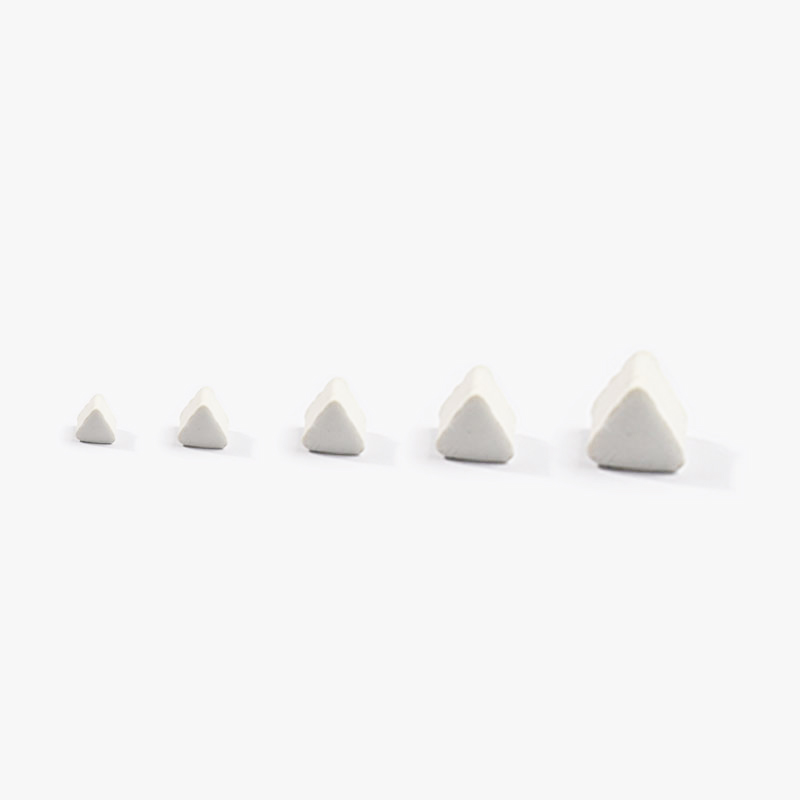
| Heavy-cut ceramic, angle-cut triangles in a coarse size class | Removing a substantial milled or turned burr from open external edges and pockets on steel and stainless automation parts before a refinement stage | Cuts functional edges and corners aggressively, leaves a coarse surface on aluminium, and lodges in slots whose width approaches the media section |
Contamination failures are quiet and are often attributed to the wrong operation. Aluminium fines left in a machine, a charge or a sump transfer onto stainless parts as a grey smear in the next batch. Iron from steel media, from a machine that has held carbon steel or from a tool used on both transfers to stainless and shows as pinpoint rust spots that appear hours or days later. Hard or high-chloride rinse water and slow drying leave mineral rings and haze on aluminium. A compound that is too aggressive darkens aluminium or attacks a freshly cut edge. The controls are procedural: segregate or dedicate media by material family, define and record the changeover, control rinse water and drying, and inspect after a defined dwell time rather than immediately. Left unchecked, these defects surface after the parts have moved on.
| Failure mode | Likely cause | How to catch it |
|---|---|---|
| A ceramic, plastic or steel medium lodged in a tapped hole, keyway, cross-drilling or seal groove | Media size class too close to the opening, a charge that has worn or fractured into smaller pieces, or a retention feature that was never mapped | Count the charge in and out where practical, pin or thread gauge every hole, borescope the smallest passages at an agreed angle, and rinse through a filter for a visual check |
| Burr remaining inside a cross-drilled intersection or an internal corner | Media too large to enter the intersection, part orientation that shields the feature, or a cycle stopped before that feature was reached | Borescope the intersection at a fixed angle, compare with a first-article reference, and use a pin or probe to feel for a lip on sampled parts |
| Grey aluminium smear transferred onto stainless parts in a shared batch | Aluminium fines retained in media, compound or the machine sump after an aluminium lot, with no purge before the stainless lot | Check stainless surfaces under angled light for a dull grey film, review the changeover record, and inspect the charge and sump for retained fines |
| Rust spotting on stainless parts appearing hours or days after finishing | Ferrous transfer from steel media, a machine or tooling that has held carbon steel, or insufficient corrosion inhibition and drying | Inspect after a defined dwell time rather than immediately, look for pinpoint spots on and near edges, and trace the media and machine history for the lot |
The Lyon conurbation is the chemical and process-industry capital of France: AXELERA, the national competitiveness cluster for chemistry, process industries and environment, is headquartered at Solaize in the Lyon chemical corridor and reports 411 member organisations, 700 labelled and financed projects and EUR 2,5 billion of project financing, with founding members Arkema, CNRS, Engie, IFP Energies nouvelles, Suez and Syensqo. The city itself counted 27 316 establishments at the end of 2024 (3,4 % in industry) and 343 084 jobs at the place of work in 2023, so the operating plants sit in the surrounding industrial-port corridor on the Rhone while Lyon concentrates engineering, R&D and headquarters functions. The Rhone axis is also France's second largest industrial river corridor, running south to the Grand Port Maritime de Marseille, whose 2024 container traffic grew 9 % to 1,45 MEVP.
For this brief the relevant part of that base is automation: The Lyon-area chemistry and process-industry ecosystem includes a dedicated 'usine eco-efficiente' (eco-efficient plant) strategic axis covering industrial process and plant efficiency, and Minalogic covers the Auvergne-Rhone-Alpes Industrie du Futur theme that supports automation projects in the region.
Process-industry and equipment manufacturing in the Lyon corridor involve large welded and machined components - pump and valve bodies, heat-exchanger parts, reactor and vessel internals, and stainless assemblies - where weld dressing, edge rounding and pickling-free surface preparation directly affect corrosion behaviour and cleanability. Because much of the output is stainless and alloy steel, surface contamination and residual heat tint are functional concerns, not cosmetic ones. Lyon's mechanical subcontracting and machine-building base also deburrs high-mix small parts, so media selection and process repeatability matter as much as machine throughput.
A buyer in Lyon should first decide whether the finishing step is a weld-dressing/corrosion-preparation operation on large assemblies or a high-volume small-part deburring operation, because those two answers lead to different machine types, media and - most importantly - different fixture and handling requirements.
Freight context: Port Edouard Herriot (Lyon, Rhone-Saone axis), Lyon-Saint Exupery Airport, Grand Port Maritime de Marseille (Fos) as the sea gateway. Lyon is served by the Rhone-Saone waterway and its own river terminal at Port Edouard Herriot, and by Lyon-Saint Exupery airport; sea freight for the region typically lands at Marseille-Fos or via the northern ports and moves up by rail or road, so inland-container logistics is the planning item. The Marseille port authority reported container traffic up 9 % in 2024 to 1,45 MEVP, confirming the southern gateway's capacity for containerised machinery.
For imports from outside the EU the declarant must file a customs declaration whose form and content are fixed by the Union Customs Code and its implementing provisions; French Customs identifies classification, origin and value as the three fundamental notions and makes the common/national tariff consultable via RITA. The customs authority is the Direction generale des douanes et droits indirects (DGDDI), which also runs the Info Douane Service for formalities questions. Buyers should expect to need an EORI number and an EU VAT treatment, because customs and tax authorisations are handled together (SOPRANO). For machinery, the CE marking and the applicable EU product-safety directives are the compliance gate items to settle before shipment, and the French market surveillance authority is the DGCCRF; the tariff rate itself must be confirmed per HS code in RITA or the EU Access2Markets tariff tool, since it varies by machine type.
France applies the EU common commercial policy, so industrial machinery arriving from China enters under the Union Customs Code and the Common Customs Tariff rather than under any bilateral French regime; the EU has no free-trade agreement with China, so no preferential duty rate applies and normal third-country duties are due on the customs value. Importers classify the machine in the tariff nomenclature and lodge a customs declaration; French Customs publishes the common and national tariff through its RITA online service and states that three notions are fundamental: the tariff classification of the product, its origin or destination, and the value of the goods.
SurfacePolish supplies from Xiamen, China. The buyer's own destination rules, conformity marking, tariff classification and documentation responsibilities stay with the buyer; confirm them against the authorities named above before ordering.
Acceptance has to exist before a trial, in the drawing and the purchase specification, not as a verbal understanding afterwards. Name each controlled surface separately, because a bearing bore, a mounting land and an external cover will not respond to one media charge in the same way. State the parameter, the cut-off length, the measurement direction and the number of readings at each location. Where an edge limit applies, express it as a maximum radius or a required chamfer at a named feature rather than as a word such as deburred. Add the cleanliness requirement the part must meet and the method by which it will be judged, and say which faces are exempt. Settling those points early avoids the common dispute in which a supplier reports a surface and a buyer rejects on a feature that was never written down.
Send parts that represent the real range rather than one convenient sample. Include the part with the tightest hole, slot or cross-drilling, the thinnest unsupported section, the functional surface that must not be touched, and at least one part in its normal as-received condition with the usual burr, chips and cutting oil. Cover every alloy and temper in the family, because aluminium and stainless behave differently under the same charge. Add a coupon of the same material with a known starting roughness so a measurement can be compared before and after. Supply a marked-up drawing naming the controlled surfaces, edge limits and any cleanliness requirement, and a short note on what the part does in service. Several pieces let more than one stop point be examined; one part answers one question.
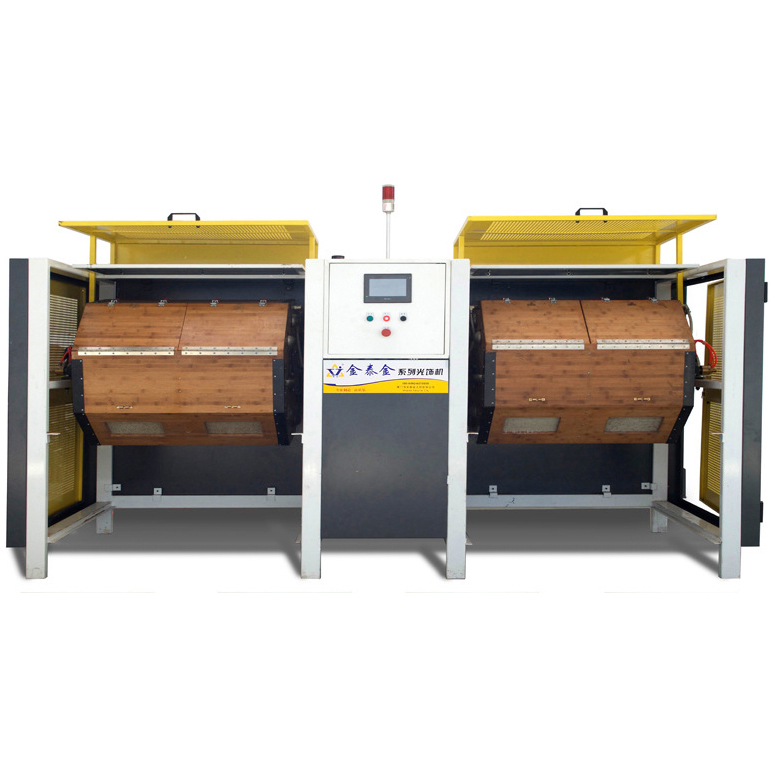
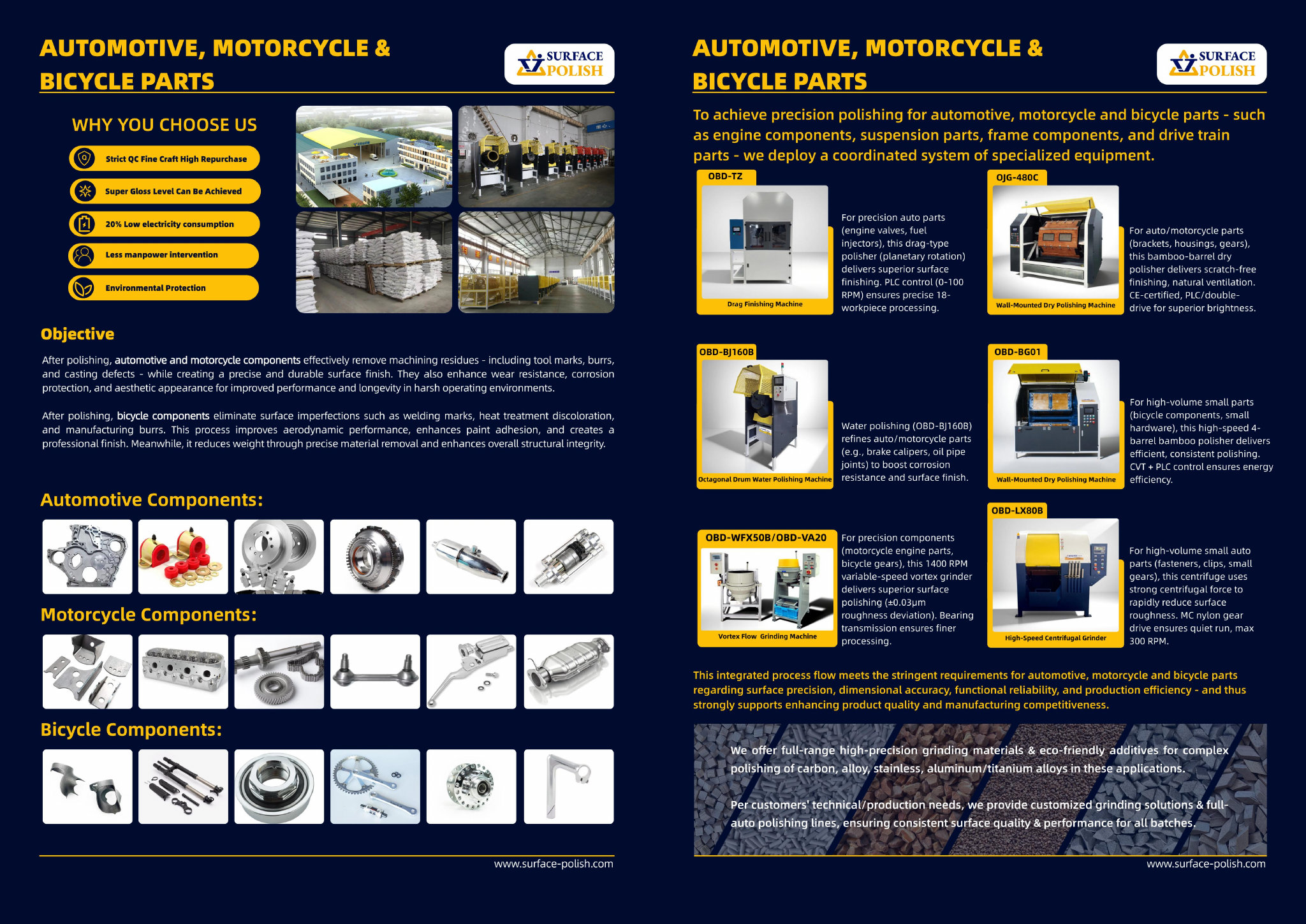
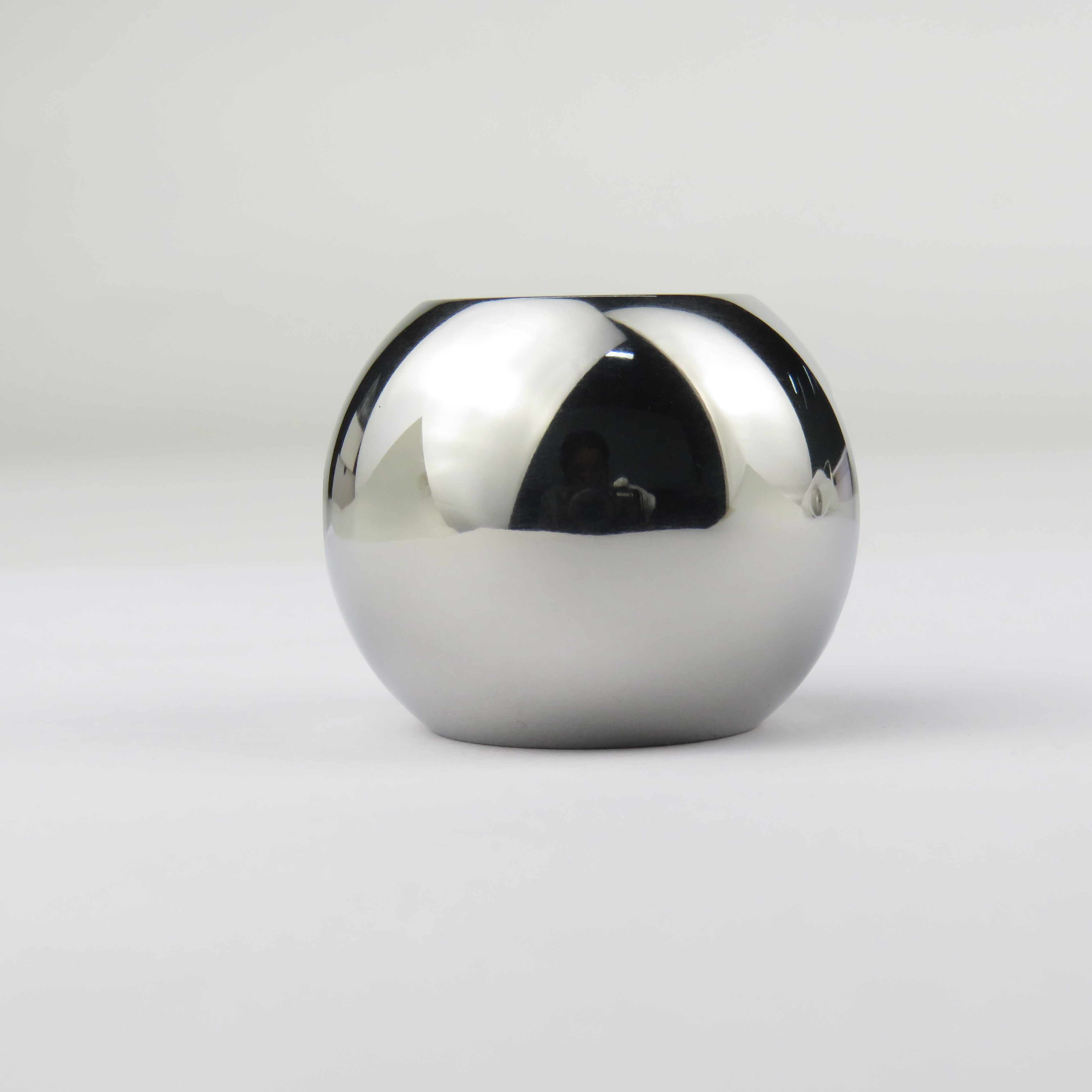
Cycle time depends on the starting burr, the alloy and temper, the media size class, the compound and how much edge refinement is wanted, so no figure can be quoted in advance. A part that needs only a light edge break runs very differently from one that must shed a milled burr or a recast layer before refinement, and a two-stage route has to count both stages. The useful approach is to test one or two defined stop points on representative parts and record what changed at each. SurfacePolish does not promise cycle times or capacity; treat any timing on returned parts as an observation from that run rather than a production commitment.
They can, but not without a changeover discipline, because the failure is contamination rather than damage. Aluminium fines retained in media, compound or a machine sump transfer onto stainless as a dull grey smear, and iron from steel media or carbon steel work shows up on stainless as rust spotting that appears hours or days later. Practical controls are dedicated or segregated media charges, a purging routine for the machine and sump, a compound change where needed, and a record of when the changeover happened. Where the volumes justify it, separate machines or separate charges are simpler than a cleaning procedure. Only you can decide which arrangement is acceptable for your own contamination control.
A bore cannot be protected by the cycle alone; it is protected by what is decided before the cycle. Masking or plugging the bore, keeping the part out of contact with heavy neighbours, choosing a lighter route and shortening the cycle all reduce the load the bore sees, but none of them guarantees a dimension. That is why the bore must be measured before and after at the same points, with a bore gauge or CMM, and compared with the drawing limit. SurfacePolish does not promise a tolerance or a result; the trial reports what was observed on the parts tested, and the dimensional acceptance decision stays with your own metrology and quality functions.
Use Lyon, France as the destination on the enquiry and state whether the deliverable is equipment, media and compound, a representative sample review or a line concept. A destination does not imply local stock, a local service point or a local delivery time.
A Lyon buyer would specify surface condition against ISO/NF EN surface-texture standards and the EN 13445 / EN 1090 and pressure-equipment regimes where vessels and steel structures are involved, with ISO 9001 or IATF 16949 depending on the customer chain. In the chemical and energy supply chain, material conformity and traceability (3.1/3.2 inspection certificates) are usually demanded alongside roughness and cleanliness limits.
Sources were retrieved on 2026-09-29 and describe the local industrial and trade context only. They do not evidence any SurfacePolish project, shipment, installation or service in Lyon.
The buyer needs the milled and tapped edges broken lightly without removing material from the ground ways or softening the mounting face condition.
Send the material, dimensions, approximate weight, batch quantity, the incoming condition and photographs of the difficult features. Mark which features must not be contacted by media and state how the result will be inspected. This form carries source reference PSEO-0520; quote it if you prefer an additional manual reference.
Open the SurfacePolish enquiry form Email a prepared enquiry
No price, lead time, certification or result is promised here. Confirm whether a sample trial is available for the specific part and what the trial can and cannot show.
Page PSEO-0520 · revised 2026-09-29 · cross-border equipment, media and scoped sample review. City context is sourced and cited above.
Use this local checker to identify missing part and inspection information. It prepares a technical-review brief; it does not approve a machine, process recipe or production result.
Complete the part details to prepare a review brief.
Email : info@surface-polish.com


 IPv6 network supported


 +86-592-2381506