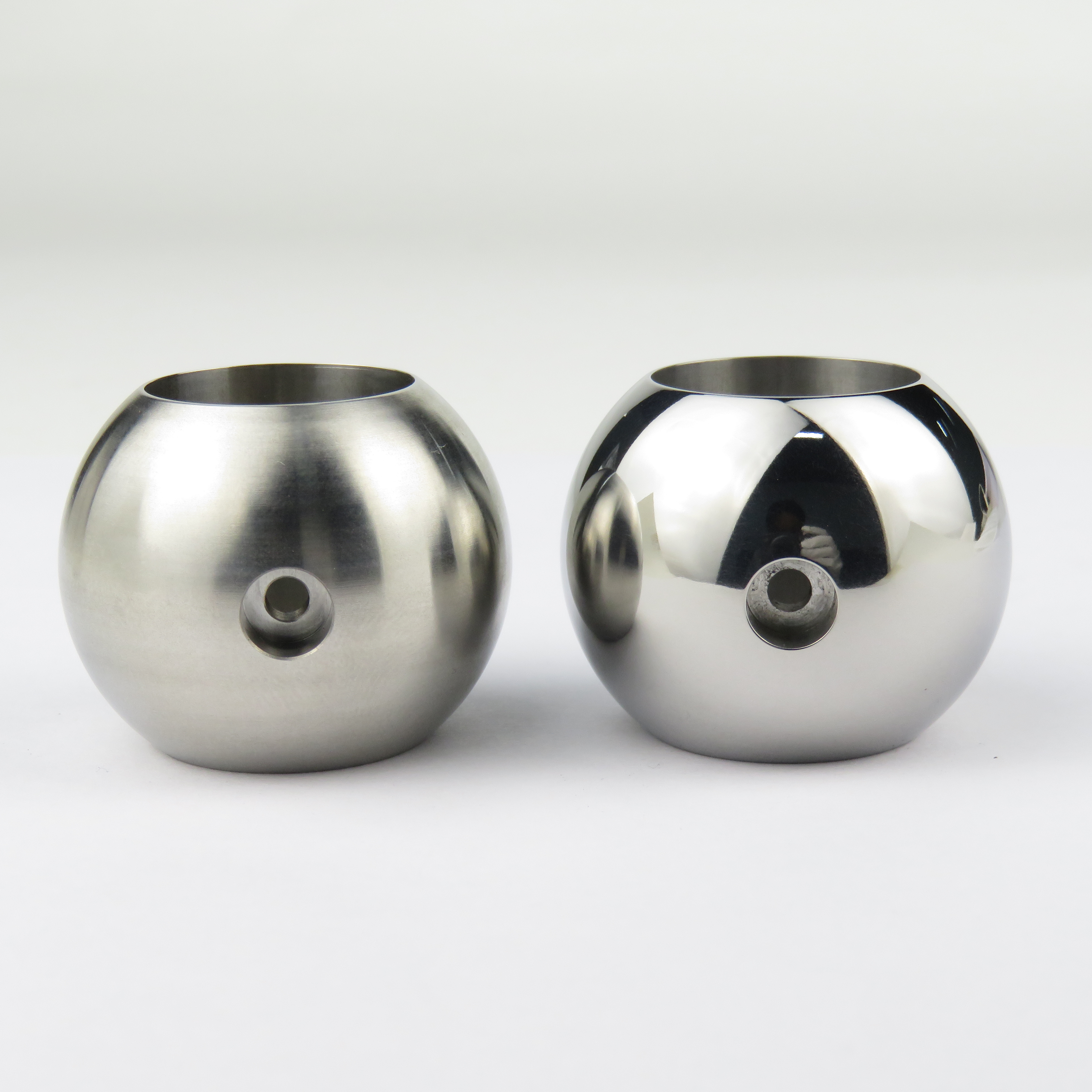
A precision turned parts supplier in Toronto, Canada in robotics and automation has a mixed batch of small stainless bushings and pins that need a consistent edge break without media trapped in the cross-holes. SurfacePolish supplies finishing machines, media and compounds across borders and offers a free sample trial: a representative batch travels to Xiamen and returns with observations and a proposed media, compound and cycle direction for the buyer to compare. This brief is written for a buyer in Toronto working on robotics and automation; it describes equipment, media and a scoped sample review, not a local polishing service.
What does the finishing step actually have to deliver before the next operation, whether that is assembly, anodising, painting or a functional test, and who defines that requirement?
Which alloys and tempers run through the shop, and how will media, machines and compounds be purged between aluminium, stainless and steel work?
What is the size and mass spread inside one part family, and does one machine have to cover both a heavy casting and a small gripper jaw?
Automation work mixes scales in a way that catches buyers out. The same shop may finish a 40 kg robot base casting and a 30 g gripper jaw, and a machine sized for the casting will over-work the jaw. Load ratio, the mass of parts against the mass of the charge, is the variable that usually decides whether small parts come out even or rounded. Screen the family on its extremes: the heaviest part, the largest envelope, the thinnest unsupported wall and the smallest part that must meet the same appearance. Long linear-axis beams and thin cover plates distort under their own weight in a deep bed, while heavy castings need a chamber large enough to keep them moving. A shortlist built on the average part will miss both ends of the range.
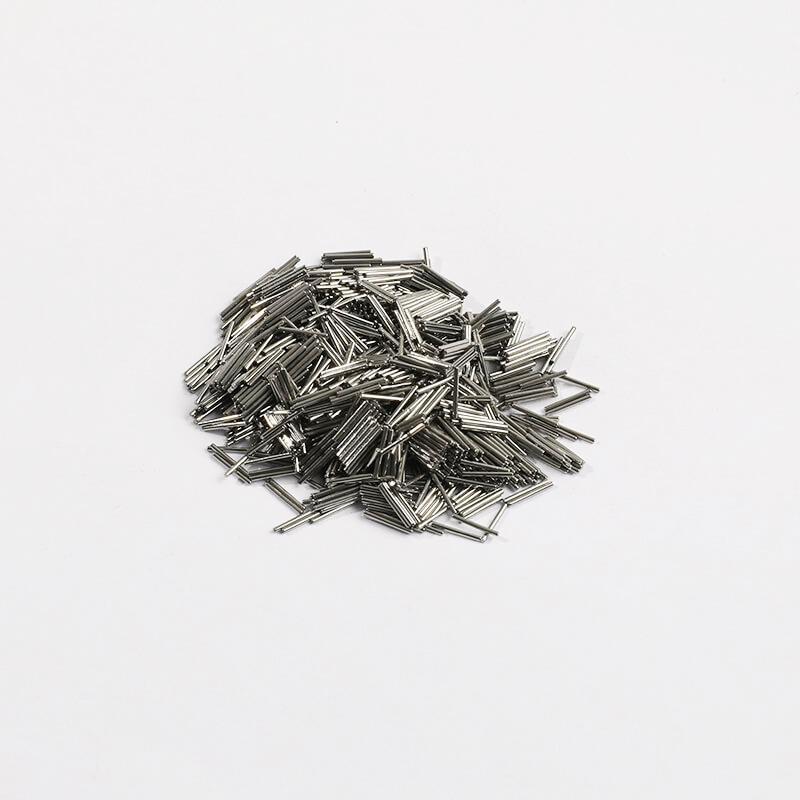
The material family of the media sets how much energy reaches the part. Plastic media is lighter and is the conservative choice for aluminium housings, thin cover plates and machined faces that must not be peened, at the cost of a slower cut and a shorter media life. Ceramic cuts harder and holds its shape longer, which suits removing a machining burr from steel and stainless parts and blending edges, but it marks soft aluminium and rounds functional edges faster. Steel media burnishes to a bright appearance and works well on stainless, and it is the wrong starting point for aluminium because it transfers iron and can leave spotting that appears later. Wear behaviour differs across all three: ceramic shrinks and generates sludge, plastic deforms and floats differently, and steel can fracture into slivers.
| Media | Best fit | Watch out for |
|---|---|---|
| Steel media, including balls and shaped pins | Bright finishing and edge blending on stainless automation components where appearance and a burnished surface matter | Transfers iron to aluminium and carbon steel, needs a corrosion-inhibiting compound, and must be separated magnetically or by screen at unload |
| Fine ceramic or porcelain shapes in a small size class | Edge blending and surface refinement after a cutting stage, and reaching tighter external geometry on machined housings and brackets | Small sizes enter and retain in tapped holes and fine slots, and media wear shrinks the charge so the finish drifts over its life |
| Aluminium oxide grinding media in a dense ceramic bond | Heavier stock removal or a more consistent cut on robust steel and stainless parts with thick edges and a defined layer to remove | High removal energy rounds functional edges quickly and is a poor match for thin aluminium plates, cast housings and bore lips |
| Heavy-cut ceramic, angle-cut triangles in a coarse size class | Removing a substantial milled or turned burr from open external edges and pockets on steel and stainless automation parts before a refinement stage | Cuts functional edges and corners aggressively, leaves a coarse surface on aluminium, and lodges in slots whose width approaches the media section |
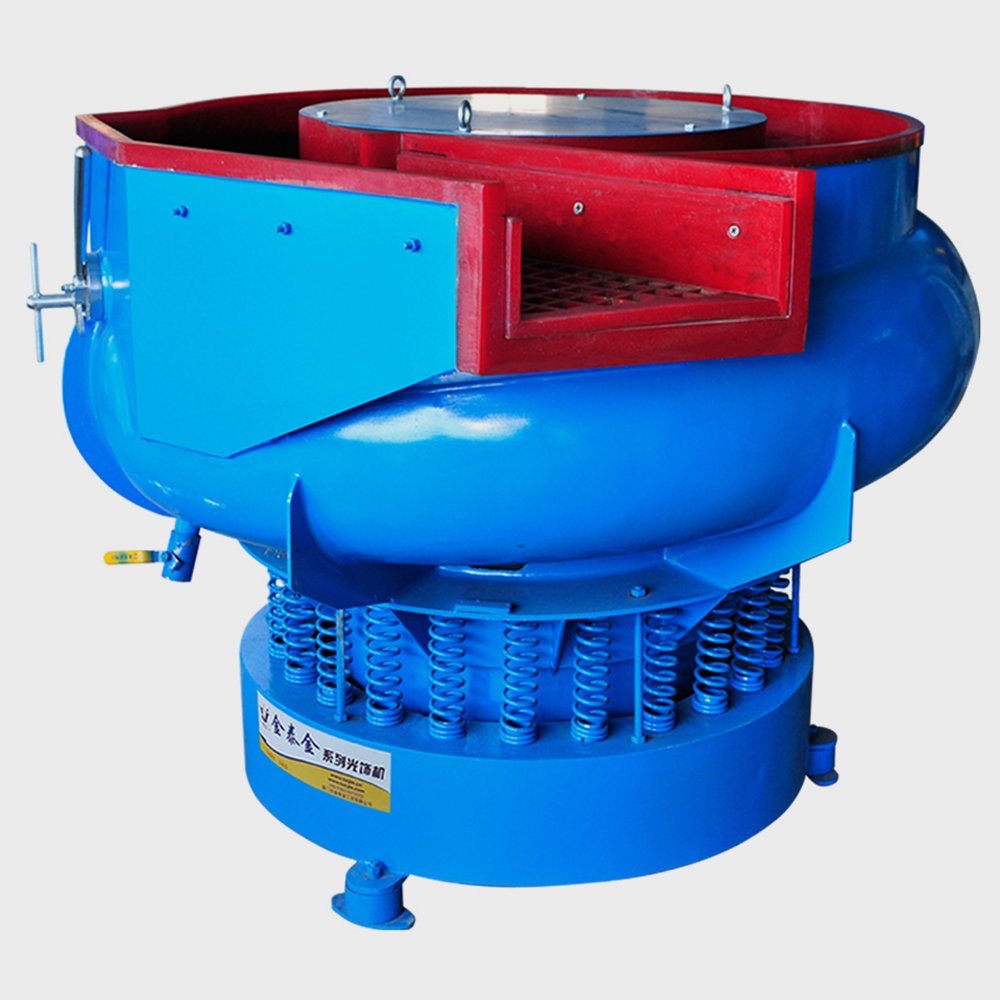
Long parts and heavy parts both fall outside a round bowl. A tub vibrator uses a rectangular chamber, so the working length extends along one axis while the bed stays shallow, which suits linear-axis beams, long manifolds and welded frames that cannot tumble end over end. The part is immersed or supported rather than turned, which removes bending risk from a divider, but energy per unit area is lower and a heavy burr takes longer. A grinding finishing machine works the other way, using higher removal energy to take off a defined layer or a heavy machining burr before refinement. That route cuts functional edges quickly and needs a tighter assessment of what may be removed. The deciding questions are part length, mass, how the part can be supported, and whether the critical face can be presented to the media at all.
| Machine route | Where it fits | What it will not do |
|---|---|---|
| Disc finishing machine | Fast, high-energy edge breaking and surface refinement on small robust parts and uniform batches of gripper jaws, blocks and fittings | High impingement and edge-loss risk on thin, soft or aluminium parts, and the geometry must suit the disc working gap |
| Centrifugal barrel finishing machine | Small precise parts and short cycles with high contact pressure, such as spools, small inserts and compact machined components | Rounds edges and can distort thin unsupported sections quickly; results are sensitive to charge weight, speed and stop time |
| Dry polishing machine and dryer | Removing residual moisture after a wet cycle and reducing water spotting on aluminium and stainless surfaces with pockets and threads | A finishing step only; a dry part can still carry compound film, fines and media dust, so it is not a cleanliness release |
| Grinding finishing machine | Taking off a heavy machining burr, dross or a defined stock layer before a refinement pass on robust steel and stainless work | High removal energy cuts functional edges fast and demands a tighter assessment of what may be removed and how much |
Contamination failures are quiet and are often attributed to the wrong operation. Aluminium fines left in a machine, a charge or a sump transfer onto stainless parts as a grey smear in the next batch. Iron from steel media, from a machine that has held carbon steel or from a tool used on both transfers to stainless and shows as pinpoint rust spots that appear hours or days later. Hard or high-chloride rinse water and slow drying leave mineral rings and haze on aluminium. A compound that is too aggressive darkens aluminium or attacks a freshly cut edge. The controls are procedural: segregate or dedicate media by material family, define and record the changeover, control rinse water and drying, and inspect after a defined dwell time rather than immediately. Left unchecked, these defects surface after the parts have moved on.
| Failure mode | Likely cause | How to catch it |
|---|---|---|
| Thin plate, cover or housing distorted, bowed or dimensionally drifted after the cycle | Tumbling load on an unsupported thin section, part-on-part contact, or heat and pressure from a high-energy route | Measure flatness, wall thickness and critical dimensions at the same marked points as the pre-process baseline, on a surface plate or CMM |
| Rust spotting on stainless parts appearing hours or days after finishing | Ferrous transfer from steel media, a machine or tooling that has held carbon steel, or insufficient corrosion inhibition and drying | Inspect after a defined dwell time rather than immediately, look for pinpoint spots on and near edges, and trace the media and machine history for the lot |
| Impact marks, dents or a peened, rippled appearance on a visible aluminium face | Charge mass or load ratio too high, light parts left loose among heavy neighbours, or a soft alloy run on a route chosen for steel parts | Look for repeating mark patterns under angled light, compare a part run loose with the same part compartmentalised, and review the batch mix and load recorded for the lot |
| Burr remaining inside a cross-drilled intersection or an internal corner | Media too large to enter the intersection, part orientation that shields the feature, or a cycle stopped before that feature was reached | Borescope the intersection at a fixed angle, compare with a first-article reference, and use a pin or probe to feel for a lip on sampled parts |
Toronto is Canada's largest city economy and its industrial base is concentrated in food and beverage manufacturing, life sciences and medical manufacturing, and a very large technology sector, with municipal industrial land policy actively directed at keeping manufacturing in the city. The Toronto region houses what the City describes as the greatest concentration of food and beverage manufacturers in Canada, employing more than 64,000 workers, and the city itself accounts for more than half of that workforce. The life sciences base is research- and hospital-anchored: the sector employed 30,490 people in Toronto in 2023 and contributed CAD 3.6 billion to GDP, with pharmaceuticals and medical instrument and equipment manufacturing making up a substantial share of the jobs. The City supports industrial investment through the Economic Development and Growth in Employment (EDGE) Incentive program, whose first recipient was a beverage manufacturer expanding by 62,000 square feet with CAD 18.1 million of construction investment, and it also maintains a discounted Industrial Water Rate program for manufacturers. Technology is the other pillar, with the City citing 289,000 technology workers and describing Toronto as the largest technology hub in Canada and third largest in North America.
For this brief the relevant part of that base is automation: The City of Toronto is funding manufacturing automation and expansion directly, including a repayable-style incentive package supporting 24/7 automated operation of new aluminium and glass beverage lines and a separate industrial water rate discount for manufacturers.
Food and beverage manufacturing in the Toronto region runs stainless steel filling, mixing, conveying and packaging lines where surface finish and cleanability are functional requirements, not cosmetic ones, and where weld dressing and edge break on fabricated stainless are recurring production steps. The life sciences base includes medical instrument, equipment and supplies manufacturing and implant-adjacent device work, which drives burr-free edges, controlled surface roughness and documented cleaning of parts. Add the automotive-tier and machine-building suppliers that sit in the same industrial land base, and Toronto's deburring demand is concentrated in stainless process equipment, device components and machined parts rather than in heavy capital-intensive finishing lines.
Before buying, a Toronto buyer should settle who carries the equipment certification for Canadian electrical safety and who verifies that the machine's guarding and dust or fume control meet Ontario requirements, because a machine that is compliant in its country of manufacture is not automatically acceptable on an Ontario plant floor. The second question is whether a wet process is even appropriate: if the plant holds a discounted Industrial Water Rate or is inside a food-grade environment, the choice between wet and dry finishing media, and the associated effluent and drying steps, should be decided against the utility and sanitation constraints, not only against cycle time.
Freight context: Port of Toronto (Toronto Port Authority), Billy Bishop Toronto City Airport, Toronto Pearson International Airport, CN and CPKC rail corridors. The Port of Toronto is a working inland port directly adjacent to downtown, running 50 acres of bonded, 24-hour-secured paved terminal space with about 1,800 metres of berthing and Seaway-depth berths, and it handled more than 2.16 million metric tonnes of cargo on 167 vessels in 2025. Its 2025 inbound bulk mix included 751,353 tonnes of road salt, 575,898 tonnes of sugar, 714,843 tonnes of cement and 79,079 tonnes of steel products, which shows the port is a bulk gateway rather than a container gateway; a finishing machine arriving from Asia would more plausibly be containerised through a coastal port and moved inland by rail or truck, while sample parts and media can move by air.
The customs authority is the Canada Border Services Agency (CBSA), and importers of commercial goods must work through the CBSA Assessment and Revenue Management (CARM) system, which is where registration, the duties-and-taxes calculator, advance rulings and national customs rulings, and the commercial accounting declaration (CAD) are handled. Documentation expectations are explicit: "You must provide proof of country of origin when you import goods into Canada and, in some cases, your goods must also be clearly marked", the invoice or sales receipt must carry "a complete description of the goods", "the selling price" and "any conditions and terms of the sale", and the value for duty must be declared in Canadian currency only. Duties and taxes are layered rather than single: customs duty on the tariff item, the Goods and Services Tax calculated on the duty-paid value, and potentially excise duty, excise tax, surtax or safeguard measures. Importers must also clear non-tariff gates: goods must be admissible, some goods need permits, certificates or inspections from other federal departments that the CBSA applies on their behalf, controlled goods under the Defence Production Act require consultation with the CBSA and Global Affairs Canada before import, and "Goods manufactured or produced wholly or in part by forced or prison labour are prohibited from entering Canada", with due diligence resting on the importer. For electrical machinery, the practical conformity route in Canada is certification of the product to Canadian electrical safety standards by an accredited certification body rather than a self-declared CE-style mark; buyers should confirm the specific certification body and mark required before shipment. For a first shipment of a finishing machine or a media/compound sample lot, the fastest way to remove classification and valuation uncertainty is to use the CARM portal to request an advance ruling for tariff classification and origin.
China is one of Canada's ten principal merchandise trading partners and the second-largest single-country source of Canadian imports after the United States: Statistics Canada reported CAD 5,369 million of balance-of-payments imports from China in January 2025, against a CAD 2,299 million bilateral merchandise deficit that month. Canada has no free trade agreement with China, so Chinese-origin industrial machinery enters under the Most-Favoured-Nation (MFN) tariff column of the Canadian Customs Tariff; the preferential treatments listed in the tariff (CUSMA/UST and MXT, CETA/CEUT, CPTPP/CPTPT, UKT, KRT and others) do not include China, and preferential rates require proof of origin plus the applicable shipping rules, so a China-origin machine cannot claim them. Tariff classification is mandatory work, not a formality: vibratory, barrel, centrifugal and disc finishing machines are classified in Chapter 84 ("Nuclear reactors, boilers, machinery and mechanical appliances; parts thereof") according to the function of the machine, and the ten-digit Canadian tariff item drives both the duty rate and the statistics. A further landed-cost risk sits outside the tariff schedule: under the Special Import Measures Act (SIMA), the CBSA and the Canadian International Trade Tribunal may apply anti-dumping and countervailing duties to named goods, so a buyer should check the measures-in-force list for the specific product before assuming the MFN rate is the final duty.
SurfacePolish supplies from Xiamen, China. The buyer's own destination rules, conformity marking, tariff classification and documentation responsibilities stay with the buyer; confirm them against the authorities named above before ordering.
Ask for a record that says what was actually done, rather than one that asserts a result. A useful batch record lists the part numbers and quantities in the lot, the machine used, the media type and size class, the charge mass and its age since the last screen or top-up, the compound product and dose, the rinse water source, the cycle time and any interruption, plus the inspection results and the lot disposition. Request the media and compound data sheets offered by the supplier. Where aluminium and stainless run in the same shop, ask for the changeover note covering media purge, machine cleaning and compound replacement. This is process documentation from a finishing operation, not a certificate of compliance with any standard, and it supports the buyer's own traceability.
Scale-up is mostly about holding what produced the trial result. In production that means a media charge kept at a target mass, screened on a schedule with undersize and broken pieces removed and fresh media added to a recorded level. Compound should be metered to a concentration rather than poured by eye, and rinse water quality should be known and stable. Every lot needs an identity: part numbers, quantity, machine, media charge, compound, cycle time, operator, inspection result and disposition. Where the same machine handles aluminium and stainless, define the changeover, including media purge, machine cleaning and compound replacement, and record when it happened. Cycle counting is a simple control that is often skipped: a charge that has run a known number of hours can be scheduled for replacement before wear starts producing lodged media or a drifting finish.

SurfacePolish does not coat, anodise or paint parts, and no finishing cycle here should be treated as a coating preparation specification. A coating or anodising step usually makes residue, smut and embedded debris more visible rather than less, and a compound film left in a bore becomes your problem at the next operation. Define what your own coating process requires and how you will verify it, then ask for the parts to be checked against that requirement. A trial can report what was observed on the tested surfaces and the settings used, but the fitness of a surface for a downstream coating step is your own process decision.
Ask for a record that identifies what was done rather than one that asserts a result. A useful record lists the part numbers and quantities in the lot, the machine used, the media type and size class, the charge mass and its age since the last screen or top-up, the compound and dose, the rinse water source, the cycle time, any interruption, the inspection results and the lot disposition. Request the media and compound data sheets. Where aluminium and stainless are processed on the same site, ask for the changeover note covering media purge, machine cleaning and compound replacement. This is finishing process documentation, not a certificate of compliance.
A trial shows what a given machine, charge and setting did to the parts tested, which is useful evidence but not a sizing study. Machine size depends on the largest envelope and mass in the family, the smallest part that must meet the same appearance, the load ratio you intend to run, and how many stages the part needs. Those are planning questions that belong in a line-concept discussion alongside the trial result. A part tested on a small machine may behave differently in a larger chamber, and a part run in a full production load may come out differently from one run in a light trial batch. Record both the settings and the load.
Use Toronto, Canada as the destination on the enquiry and state whether the deliverable is equipment, media and compound, a representative sample review or a line concept. A destination does not imply local stock, a local service point or a local delivery time.
A Toronto buyer will normally anchor on Canadian electrical safety certification of the machine and control panel, Ontario's Occupational Health and Safety Act and its industrial regulations for guarding and lockout, and the buyer's own customer specifications for surface roughness and cleanliness. The City of Toronto's own industrial water rate and incentive programs also show that process utility and environmental constraints feature in local manufacturing decisions.
Sources were retrieved on 2026-09-29 and describe the local industrial and trade context only. They do not evidence any SurfacePolish project, shipment, installation or service in Toronto.
The buyer needs a repeatable edge break and a uniform appearance across the mixed batch without media lodging in the cross-holes.
Send the material, dimensions, approximate weight, batch quantity, the incoming condition and photographs of the difficult features. Mark which features must not be contacted by media and state how the result will be inspected. This form carries source reference PSEO-0110; quote it if you prefer an additional manual reference.
Open the SurfacePolish enquiry form Email a prepared enquiry
No price, lead time, certification or result is promised here. Confirm whether a sample trial is available for the specific part and what the trial can and cannot show.
Page PSEO-0110 · revised 2026-09-29 · cross-border equipment, media and scoped sample review. City context is sourced and cited above.
Use this local checker to identify missing part and inspection information. It prepares a technical-review brief; it does not approve a machine, process recipe or production result.
Complete the part details to prepare a review brief.
Email : info@surface-polish.com


 IPv6 network supported


 +86-592-2381506