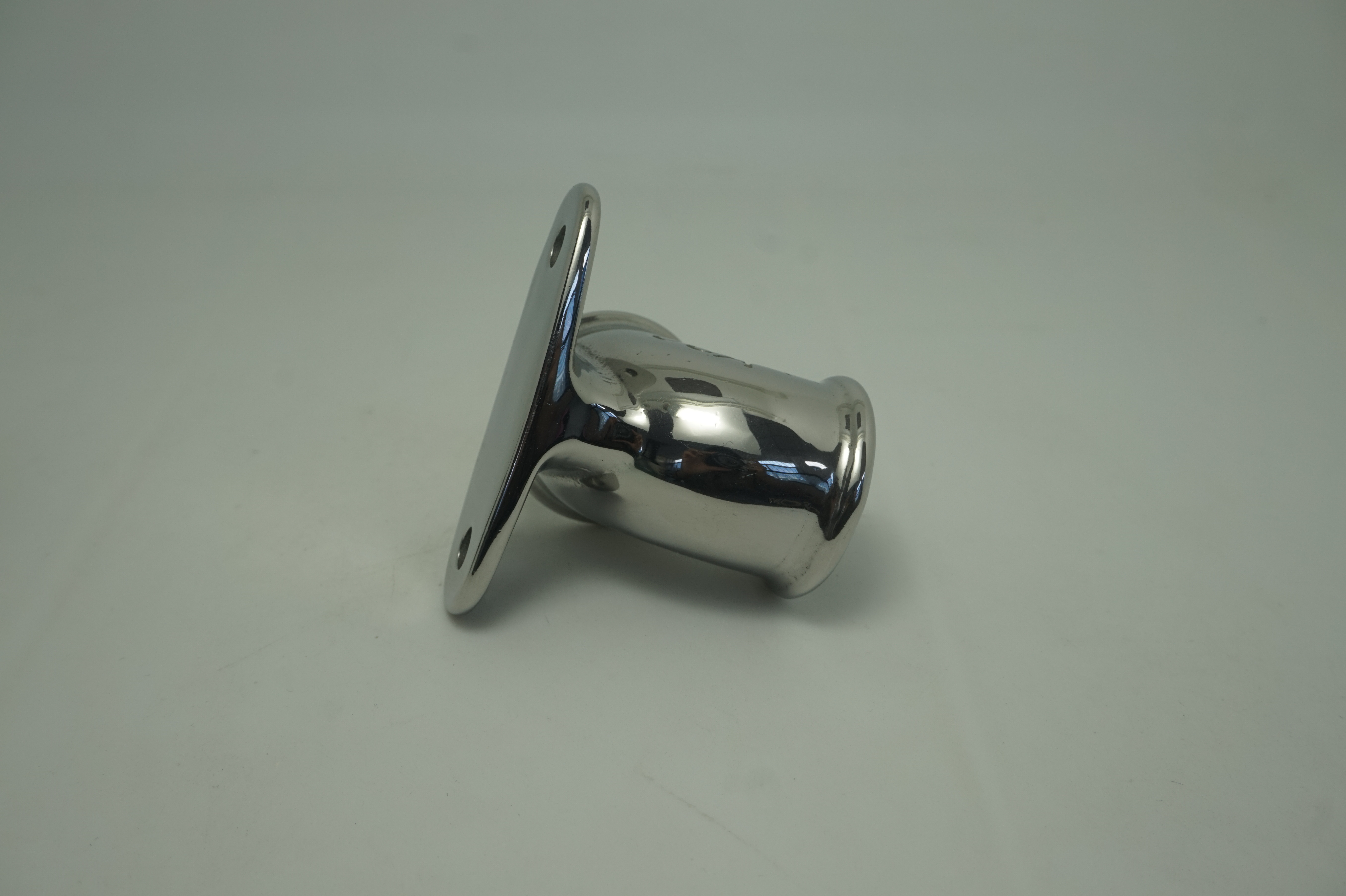
A welding and metalwork fabricator in Vadodara, India working in robotics and automation has welded stainless pedestal brackets whose fillet welds and laser-cut edges need dressing while the machined base face stays flat. SurfacePolish supplies finishing machines, media and compounds across borders and runs a free sample trial, sending representative weldments to Xiamen and returning them with observed results and a proposed route for the buyer's review. This brief is written for a buyer in Vadodara working on robotics and automation; it describes equipment, media and a scoped sample review, not a local polishing service.
Which alloys and tempers run through the shop, and how will media, machines and compounds be purged between aluminium, stainless and steel work?
Which surfaces on the part are functional, such as bearing bores, dowel holes, seal lands, ground mounting faces and threads, and which are only cosmetic?
What does the finishing step actually have to deliver before the next operation, whether that is assembly, anodising, painting or a functional test, and who defines that requirement?
Begin with a marked-up drawing rather than a part family name. On a robot joint housing, an actuator body or a gripper base plate, the surfaces that carry function form a short and severe list: bearing bores and their shoulders, dowel and pin holes that set position, seal grooves, ground mounting lands, clamp faces and threaded holes. Every one of those needs a decision before a medium is chosen, whether it is masked, plugged, finished to a stated limit or deliberately left as machined. The cosmetic list is usually longer, covering external webs, covers, ribs and visible faces that only have to look even. Separating the two lists prevents the most common error in this work, which is selecting a charge by part size and then discovering that it has been working a bearing seat that had to stay round.
Disc finishing machines and centrifugal barrel machines deliver far more energy per unit of time than a bowl. A disc machine works the gap between rotating discs, which suits batches of small robust parts such as gripper jaws, mounting blocks and machined brackets where a consistent edge break is wanted quickly. Centrifugal barrel finishing multiplies the effective gravity acting on the charge, so cycles shorten and contact pressure rises sharply, which suits small precise parts and can round a thin section or deform a soft aluminium wall within a short over-run. Both routes depend on charge weight, speed, fill level and stop time being held to a record. They are a poor match for thin-walled housings, long beams and any part whose functional edge or bore lip must keep a tight radius.
| Machine route | Where it fits | What it will not do |
|---|---|---|
| Vibratory finishing machine, bowl type | General deburring and refinement of machined housings, plates and brackets that fit and can tumble without racking, with easy mid-cycle inspection | Continuous part-on-part contact and no access to deep internal passages; thin plates and finished mounting faces need separation |
| Dry polishing machine and dryer | Removing residual moisture after a wet cycle and reducing water spotting on aluminium and stainless surfaces with pockets and threads | A finishing step only; a dry part can still carry compound film, fines and media dust, so it is not a cleanliness release |
| Centrifugal barrel finishing machine | Small precise parts and short cycles with high contact pressure, such as spools, small inserts and compact machined components | Rounds edges and can distort thin unsupported sections quickly; results are sensitive to charge weight, speed and stop time |
| Barrel finishing machine, rotary barrel tumbling | Gentle deburring of small fragile parts and mixed batches of screw-machine components with a generous compound flow | Long cycles, no visibility while running, and internal features can collect media and compound that must be retrieved at unload |
The material family of the media sets how much energy reaches the part. Plastic media is lighter and is the conservative choice for aluminium housings, thin cover plates and machined faces that must not be peened, at the cost of a slower cut and a shorter media life. Ceramic cuts harder and holds its shape longer, which suits removing a machining burr from steel and stainless parts and blending edges, but it marks soft aluminium and rounds functional edges faster. Steel media burnishes to a bright appearance and works well on stainless, and it is the wrong starting point for aluminium because it transfers iron and can leave spotting that appears later. Wear behaviour differs across all three: ceramic shrinks and generates sludge, plastic deforms and floats differently, and steel can fracture into slivers.
| Media | Best fit | Watch out for |
|---|---|---|
| Fine ceramic or porcelain shapes in a small size class | Edge blending and surface refinement after a cutting stage, and reaching tighter external geometry on machined housings and brackets | Small sizes enter and retain in tapped holes and fine slots, and media wear shrinks the charge so the finish drifts over its life |
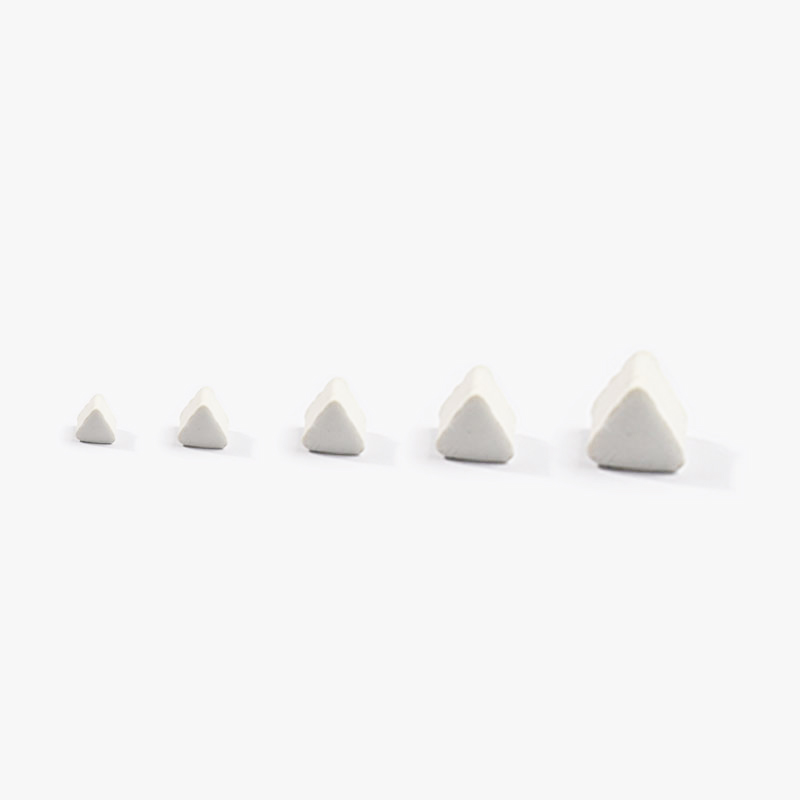
| Heavy-cut ceramic, angle-cut triangles in a coarse size class | Removing a substantial milled or turned burr from open external edges and pockets on steel and stainless automation parts before a refinement stage | Cuts functional edges and corners aggressively, leaves a coarse surface on aluminium, and lodges in slots whose width approaches the media section |
| Steel media, including balls and shaped pins | Bright finishing and edge blending on stainless automation components where appearance and a burnished surface matter | Transfers iron to aluminium and carbon steel, needs a corrosion-inhibiting compound, and must be separated magnetically or by screen at unload |
| Plastic cylinders and cones in a harder, denser grade | Longer cycles on mixed batches of small fittings and screw-machine parts where a repeatable light edge break is wanted without ceramic impact | Can float or segregate by shape in a bowl, and cylindrical forms can wedge in slots, keyways and cross-drillings |
Too much energy does not leave a smooth surface; it deforms one. Impingement shows as bright impact marks, dents on thin cover plates, flattened corners and a rippled or peened appearance on aluminium faces that should be flat. It comes from a heavy or dense charge, a high load ratio, a part that is too large a fraction of the load, or light parts left loose among heavy neighbours. A soft aluminium housing run in the same charge as steel brackets will show the marks first. Checking means looking for repeating mark patterns on exposed faces, comparing a part run loose with the same part compartmentalised, and reviewing the batch record for the mix and load that produced the lot. The practical fixes are separation, a lighter route, a shorter cycle and a charge sized to the part rather than to the chamber.
| Failure mode | Likely cause | How to catch it |
|---|---|---|
| Burr remaining inside a cross-drilled intersection or an internal corner | Media too large to enter the intersection, part orientation that shields the feature, or a cycle stopped before that feature was reached | Borescope the intersection at a fixed angle, compare with a first-article reference, and use a pin or probe to feel for a lip on sampled parts |
| Threads rounded, galled or opened out by edge finishing | Media working the thread crest during a long or high-energy cycle, with no plugging or masking on the hole | Run go and no-go thread gauges on every sampled hole, inspect the crest at magnification, and confirm that plugs or masks were fitted and removed |
| Water spotting, mineral rings or haze left after wet processing and drying | Hard or high-chloride rinse water, slow or uneven drying, or parts stacked wet so moisture is trapped in pockets and threads | Inspect dried parts under angled light for rings and haze, check the rinse water source and the drying method, and confirm that pockets and tapped holes drain before packing |
| Colour change or darkening on an aluminium face after the cycle | Compound chemistry unsuitable for aluminium, no effective corrosion inhibitor, or a delay between finishing and drying | Compare the finished face with an unprocessed coupon of the same alloy under the agreed light, and review the compound product, dose and rinse sequence for the lot |
Vadodara's economy is described by its district administration as based mainly on fertilisers, cotton textiles, machine tools, pharmaceuticals, chemicals, biotechnology, engineering, glass and dairy, and the same page states that over 35% of India's power transmission and distribution equipment manufacturers plus an estimated 800 ancillaries supporting power-sector manufacturing and engineering are located in Vadodara. Gujarat Alkalies and Chemicals Limited (GACL), established in 1973 in Vadodara, lists Vadodara and Coelho complexes with an address at Ranoli in the district, and Alembic Pharmaceuticals records starting tincture and alcohol manufacturing at Vadodara in 1907. The city therefore combines a chemical and petrochemical base with power-equipment, machine-tool and pharmaceutical manufacturing.
The nearest part of that base to this brief is energy: The district administration states that over 35% of India's power transmission and distribution equipment manufacturers, and an estimated 800 ancillaries supporting power-sector manufacturing and engineering, are located in Vadodara.
Vadodara's combination of power-transmission equipment, machine tools, chemicals and pharmaceuticals produces machined and cast metal parts — gears, housings, enclosures, switchgear components — where burrs and edge condition matter for assembly, electrical clearances and coating or plating adhesion. Surface finish on sealing and mating faces is a standard inspection point for power-equipment ancillaries, and hygienic parts in the pharmaceutical supply chain add a cleanliness requirement. Process choice therefore depends on whether the part is a casting, a machined steel component or a stainless hygienic part, and on whether the buyer needs edge control alone or a defined finish value.
A Vadodara buyer should settle whether acceptance is edge condition on a machined component or a specified finish on a sealing or mating face, and confirm on sample parts that the chosen media and compound will not damage coatings, plating or machined tolerances.
Freight context: Vadodara Airport (Harni Airport), Airports Authority of India. AAI maintains the Vadodara (Harni) airport page, which includes a cargo entry. For sea freight the Gujarat industrial belt is served by the state's port network and inland container depots to the west; imported machines and sample parts are cleared under the standard Indian customs procedure at the port or airport of entry, with BIS compliance checked where the product is notified.
India classifies every imported item in the ITC(HS) schedule, a compilation of codes for all merchandise for export and import whose Schedule I lays down the import policy regime for each item, maintained at 8-digit level under the First Schedule of the Customs Tariff Act, 1975 and aligned at 6 digits with the WCO Harmonized System (c1, c3). Importability is judged by the policy in force on the date of import, and when a policy moves from free to restricted, goods already committed through an irrevocable commercial letter of credit opened before the change can still be imported up to the balance quantity, value and period in that ICLC (c4). Preferential customs treatment is available only through the preferential trade agreements, free trade agreements, CECAs and CEPAs that India notifies and that are in operation (c5), so Chinese-origin industrial machinery is assessed at the applicable rate of the customs tariff rather than under any India-China preferential rate; India's commerce leadership has separately pointed to exports under free trade pacts growing faster than imports (c12). For capital goods specifically, DGFT operates the Export Promotion Capital Goods (EPCG) scheme, whose stated objective is to facilitate import of capital goods for producing quality goods and services (c7), which Indian firms use when they want duty relief on imported plant against an export obligation.
An Importer-Exporter Code (IEC) issued by DGFT is a key business identification number which is mandatory for exports or imports, and since the introduction of GST the IEC number is the same as the PAN of the firm (c6). The post-incorporation clearance list published by Invest India includes the IEC, a Customs- Special Valuation Branch reference and the grant of a Bureau of Indian Standards (BIS) licence, and it names the Central Board of Excise and Customs among the agencies in the framework (c10). The Foreign Trade Policy fixes the mandatory import documents as a bill of lading / airway bill / lorry receipt / railway receipt, a commercial invoice cum packing list and a bill of entry, with additional documents or NOCs possible for goods subject to product-specific compliance (c3); it also states that domestic laws, rules, orders, technical specifications and environmental, safety and health norms applicable to domestically produced goods apply mutatis mutandis to imports unless specifically exempted (c2), which is the basis on which a BIS quality-control order can bite on imported machinery. A landed-cost plan therefore needs the correct ITC(HS) classification and the basic customs duty and IGST that follow from it, plus the IEC, the bill of entry documentation and any BIS licence or registration obligation, and a related-party import can additionally be pulled into special customs valuation.
SurfacePolish supplies from Xiamen, China. The buyer's own destination rules, conformity marking, tariff classification and documentation responsibilities stay with the buyer; confirm them against the authorities named above before ordering.
Acceptance has to exist before a trial, in the drawing and the purchase specification, not as a verbal understanding afterwards. Name each controlled surface separately, because a bearing bore, a mounting land and an external cover will not respond to one media charge in the same way. State the parameter, the cut-off length, the measurement direction and the number of readings at each location. Where an edge limit applies, express it as a maximum radius or a required chamfer at a named feature rather than as a word such as deburred. Add the cleanliness requirement the part must meet and the method by which it will be judged, and say which faces are exempt. Settling those points early avoids the common dispute in which a supplier reports a surface and a buyer rejects on a feature that was never written down.
A trial can only be read against a documented starting point, so record the incoming condition before shipping. Photograph each critical feature at a fixed scale, measure roughness at marked locations with the instrument, cut-off and direction noted, check edge condition with a radius gauge or comparator, and record mass and critical dimensions. Note the as-received burr, existing scratches, cutting oil or coolant and the condition of any tapped hole. Keep one piece unprocessed as the baseline. When the parts come back, compare them against those records rather than against memory or photographs taken on a different day under different light. That pairing is also how the buyer distinguishes a change produced by the process from a feature the material already carried.
Ask for a record that identifies what was done rather than one that asserts a result. A useful record lists the part numbers and quantities in the lot, the machine used, the media type and size class, the charge mass and its age since the last screen or top-up, the compound and dose, the rinse water source, the cycle time, any interruption, the inspection results and the lot disposition. Request the media and compound data sheets. Where aluminium and stainless are processed on the same site, ask for the changeover note covering media purge, machine cleaning and compound replacement. This is finishing process documentation, not a certificate of compliance.
No. SurfacePolish supplies finishing machines, media and compounds across borders and runs a free sample trial on parts shipped to the factory in Xiamen. We do not design, integrate, program or commission robotic cells or automated handling lines, and no robotic polishing cell is offered here. What can be discussed is the part itself, the features that must be protected and the finishing step, and which loose-part machine and media route is worth testing. How parts are presented, loaded, unloaded and transferred is engineering scope you define and verify, and any machine or medium suggestion remains a starting point for your evaluation in Vadodara.
A bore cannot be protected by the cycle alone; it is protected by what is decided before the cycle. Masking or plugging the bore, keeping the part out of contact with heavy neighbours, choosing a lighter route and shortening the cycle all reduce the load the bore sees, but none of them guarantees a dimension. That is why the bore must be measured before and after at the same points, with a bore gauge or CMM, and compared with the drawing limit. SurfacePolish does not promise a tolerance or a result; the trial reports what was observed on the parts tested, and the dimensional acceptance decision stays with your own metrology and quality functions.
Use Vadodara, India as the destination on the enquiry and state whether the deliverable is equipment, media and compound, a representative sample review or a line concept. A destination does not imply local stock, a local service point or a local delivery time.
BIS is India's national standards body, and BIS describes its certification scheme as basically voluntary in nature, with compliance made compulsory for a number of products by the Central Government. Power-equipment and chemical buyers in Vadodara additionally work to their own inspection and material specifications and, in the power sector, commonly align requirements with Indian Standards and IEC publications as general industry practice.
Sources were retrieved on 2026-09-29 and describe the local industrial and trade context only. They do not evidence any SurfacePolish project, shipment, installation or service in Vadodara.
The buyer wants the weld spatter and cut edges dressed and the visible faces blended without cutting into the machined mounting face.
Send the material, dimensions, approximate weight, batch quantity, the incoming condition and photographs of the difficult features. Mark which features must not be contacted by media and state how the result will be inspected. This form carries source reference PSEO-1000; quote it if you prefer an additional manual reference.
Open the SurfacePolish enquiry form Email a prepared enquiry
No price, lead time, certification or result is promised here. Confirm whether a sample trial is available for the specific part and what the trial can and cannot show.
Page PSEO-1000 · revised 2026-09-29 · cross-border equipment, media and scoped sample review. City context is sourced and cited above.
Use this local checker to identify missing part and inspection information. It prepares a technical-review brief; it does not approve a machine, process recipe or production result.
Complete the part details to prepare a review brief.
Email : info@surface-polish.com


 IPv6 network supported


 +86-592-2381506