A decorative screen manufacturer in Arnhem, Netherlands supplying architectural metalwork uses 2.5 m lengths of 25 x 25 x 0.9 mm stainless tube, and the flat faces dent and the lengths twist whenever the parts are run loose in a batch. SurfacePolish supplies finishing machines, media and compounds across borders and runs a free sample trial on sections shipped to Xiamen. This brief is written for a buyer in Arnhem working on architectural metalwork; it describes equipment, media and a scoped sample review, not a local polishing service.
Which faces of each profile are actually seen when installed, from what distance and under what light, and which faces can be finished to a coarser standard without it showing?
What is the longest length in the order, and how will it be supported, carried and packed at every stage between finishing, fabrication and installation?
Which wall thickness and section shape in the order is most likely to distort, and what fixture, cradle or support will protect it?
The surface you receive already carries a direction of texture from the mill, from a prior brush line or from a fabricator's earlier pass. Finishing can change the amplitude and the scale of that texture and can impose a new direction, but erasing a deep existing grain means removing real wall thickness, which is rarely acceptable on a visible architectural profile. Note the direction of the incoming texture along the length, its pitch, and whether the tube is bright annealed, pickled or mill finish. A pickled or matte mill surface hides small process variation that a bright surface reveals immediately. Send the worst-looking incoming length rather than the best one, because the finish a line has to hold is set by the roughest material that regularly arrives, not by the sample kept aside as a reference.
The shape of the working media sets the character of the surface as much as its size does. Spheres and other rounded shapes produce overlapping craters, which read as a soft, slightly dimpled surface and work against a linear brushed appearance. Angle-cut triangles, cylinders, cones and other elongated shapes strike along their axis and leave a more linear pattern, which is what architectural tube usually needs. Where a weld seam or a deep longitudinal scratch must be cut back, the aggressiveness comes from the contact geometry and the media mass rather than from extra speed. For a run that has to show a consistent direction, choose a shape class whose marks align with the intended grain direction, and then keep that class stable as the media wears.
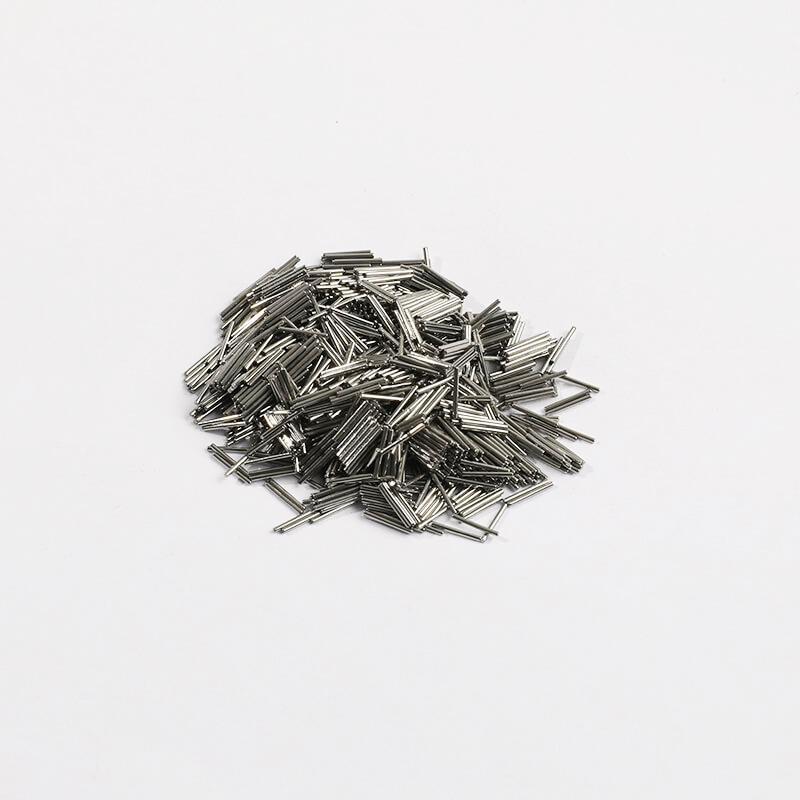
| Media | Best fit | Watch out for |
|---|---|---|
| Grinding media, alumina-based | Higher material removal where a mill seam, a joint weld or a deep transit scratch has to be cut back before refining. | Aggressive on thin wall, can over-round edges and change cross-section geometry, and needs tight depth control. |
| Steel media, pins and balls | Bright, strongly linear appearance on stainless where a higher-lustre finish is wanted on accessible faces. | Heavy, needs tight compound control to stay clean and separated, and any iron-bearing debris is a contamination question the buyer has to define and verify. |
| Plastic media, cylindrical | Light surface refinement on thin rectangular sections where holding the shape matters more than cutting power. | Little cut power, and the size class changes quickly as the media wears, which shifts the texture pitch over a run. |
| Ceramic media, cylinders and other elongated shapes | Linear, directional refinement of the visible faces of round and rectangular profiles after the seam has been cut back. | Flat sides and ends mark differently, and the length-to-diameter ratio limits how far the media reaches into a shallow cove. |
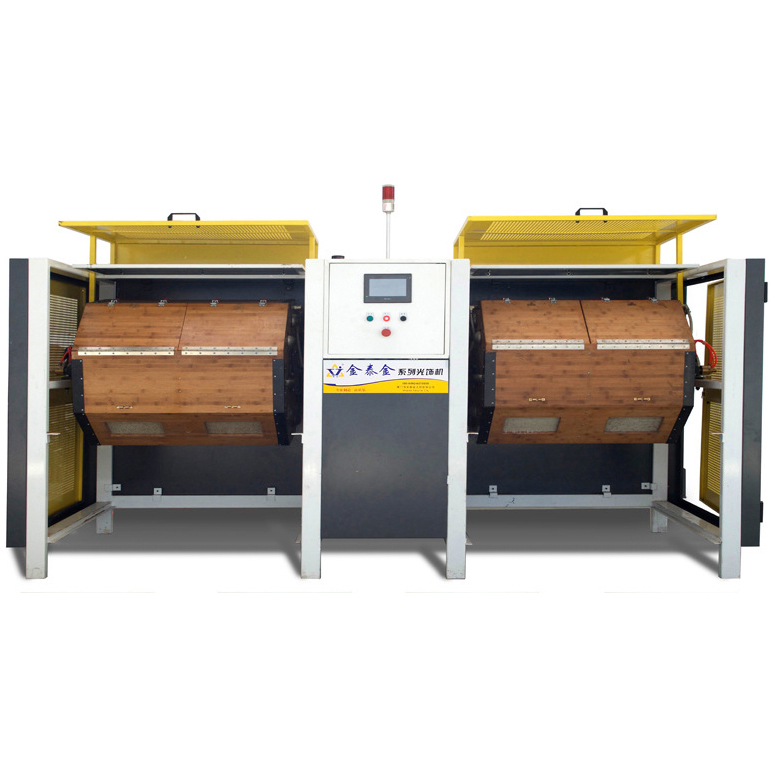
A conventional vibratory bowl moves its load around a circular path in a chamber whose diameter sets the maximum part length. Extending that chamber to take a six-metre length stops being practical, because the volume grows far faster than the usable length. The deeper problem is the bed. A long tube lying in a bowl is either too large a fraction of the load, in which case the media cannot circulate around it, or it is dragged and struck by the rest of the load in a way that produces local marking rather than an even longitudinal texture. The geometry, not the power, is the limitation. This is the practical reason long architectural sections are run in a tub or on a dedicated longitudinal arrangement rather than in a general-purpose bowl.
| Machine route | Where it fits | What it will not do |
|---|---|---|
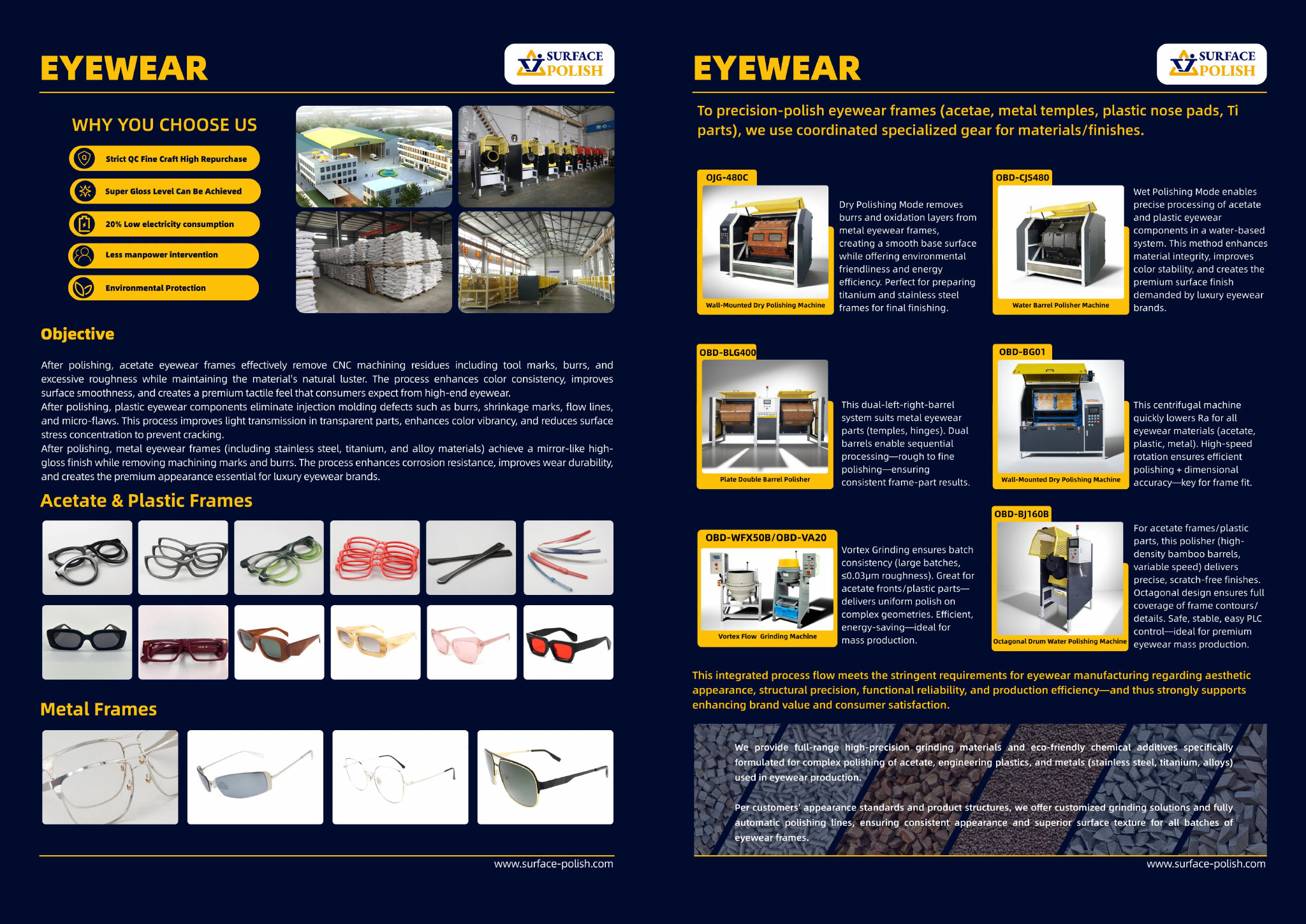
| Centrifugal barrel finishing machine | High-speed finishing of small precise parts, including where a bright appearance is required on a compact geometry. | Chamber geometry and high contact forces rule it out for long, thin-wall or easily marked sections. |
| Tub vibrator | Long and large parts such as architectural tube and profiles, where the process length has to extend along the part. | Bed depth and fixture design decide whether thin sections survive, and fluid flow has to be checked at the far end of the chamber. |
| Grinding finishing machine | Higher material removal where a mill seam, a joint weld or a deep scratch has to be cut back before surface refinement. | Removal is aggressive, so depth control and wall thickness limits have to be set before the cycle is run. |
| Barrel finishing machine, rotary barrel tumbling | Gentle, precise batch processing of small parts, finials, sleeves and short connector pieces. | Part length and part-on-part contact restrict it to short fittings rather than long architectural runs. |
Straight scratches running along the length are the signature defect of tube finishing. They come from three places: the incoming coil or straightener, media or swarf dragged along the surface during the cycle, and the handling between operations, when a finished length slides over a steel support. The first cannot be removed without cutting back real wall, so it has to be identified before the cycle is set. The second is controlled by media cleanliness, compound filtration and keeping the bed free of tramp metal. The third is controlled by padded cradles and a rule that nothing finished ever touches bare metal. Detection is by raking light along the axis at a low angle; a scratch invisible under diffuse light can be the first thing an occupier sees on a sunlit elevation.
| Failure mode | Likely cause | How to catch it |
|---|---|---|
| Loss of ovality or out-of-round section | A load applied across the wall during the cycle or while the part sits in a rack. | Measure the diameter across two axes at several stations along the length with a caliper or micrometer. |
| Flat spot or thinning at a dressed weld | Too much material removed in one place while chasing the weld toe, usually with too coarse a medium or too much pressure. | Measure wall thickness with an ultrasonic gauge across the dressed area, and lay a straightedge over the joint to reveal a flat. |
| Orange peel mottling on the visible face | Over-working with a coarse medium, or excessive pressure on a soft or thin section, which deforms the surface rather than cutting it. | Reflect a straight edge or a linear light source in the surface, and take a roughness reading at the same spot to show the divergence between number and appearance. |
| Shade change or discolouration at a welded area | The heat-affected zone responds differently to the same media and compound cycle than the parent metal. | Compare the area with adjacent metal under the agreed light and distance, and photograph it with a scale alongside the retained reference. |
Arnhem's industrial identity is cleantech and energy. Cleantech Park Arnhem, formerly Industriepark Kleefse Waard (IPKW), is a 90-hectare business park for companies working on clean technology across four themes: energy, materials, mobility and human capital. The park generates 6.6 million kWh of electricity a year from 24,000 solar panels and 8.5 million kWh from wind power, runs a bioheat installation, provides 96 electric-vehicle charging points, and is a co-founder of Connectr, a collaboration between education, government and industry; the hydrogen cluster involves partners including HyGear, HAN Automotive and the municipality of Arnhem. Oost NL is the regional development agency for Gelderland and Overijssel, the two provinces in which Arnhem sits.
The nearest part of that base to this brief is energy: Cleantech Park Arnhem states that companies on the park work on generating, storing, distributing and efficiently using energy, including smart energy grids and storing energy in batteries or hydrogen, and that it is a co-founder of the Connectr energy-transition collaboration.
Cleantech and hydrogen technology work at Kleefse Waard involves stainless and aluminium components for electrolysers, pressure systems, valves, heat exchangers and battery modules, where cleanliness, edge quality and surface condition affect sealing, welding and corrosion performance. Mobility and battery work adds machined parts where burrs must be removed without altering critical dimensions.
A buyer should settle whether parts are pre-weld and pre-coating (where a defined Ra plus freedom from burrs and contamination is essential) or finished parts needing a functional or cosmetic edge radius, and whether hydrogen or pressure service imposes additional cleanliness limits on the process.
Freight context: Cleantech Park Arnhem (former Industriepark Kleefse Waard), 90 hectares. Arnhem has no seaport; it is an inland industrial location served by road and rail, with the port of Rotterdam as the nearest deep-sea gateway for machinery arriving from outside the EU. Imported machines must still be declared to Dutch Customs at the point of entry and the importer needs an EORI number.
The Netherlands applies the EU's common commercial policy, so imports of Chinese industrial machinery enter under EU customs rules and WTO tariff treatment rather than under a bilateral EU-China free-trade agreement; the European Commission also maintains trade-defence measures on selected Chinese product categories, and China is a WTO member. EU-China trade in goods reached EUR 732 billion in 2024, and in 2025 manufactured goods were 97.3% of EU imports from China, with machinery and vehicles alone accounting for 54.4% — the single largest category. Chinese finishing machines, media and compounds therefore arrive in a very large, well-established EU import stream, and the buyer should expect MFN duty plus trade-defence measures where a specific product is covered.
Goods entering the Netherlands from outside the EU must be declared to Dutch Customs (Douane, part of the Belastingdienst); the importer needs an EORI number, import duty is calculated on the customs value (goods value plus transport and insurance to the EU external border), and import VAT is paid at the border unless an article 23 permit or a fiscal representative is used. CE marking is mandatory for most machinery placed on the EEA market: the Machinery Regulation replaced the Machinery Directive and manufacturers must comply with the new requirements by 20 January 2027. The importer must verify that the conformity assessment was carried out correctly, that CE marking is applied properly, that the technical file is present and complete, and that the user manual is supplied in the correct language; the manufacturer's EC Declaration of Conformity must be kept. Dutch companies imported over EUR 140 billion of machinery and appliances in 2024, 24% of total Dutch goods imports.
SurfacePolish supplies from Xiamen, China. The buyer's own destination rules, conformity marking, tariff classification and documentation responsibilities stay with the buyer; confirm them against the authorities named above before ordering.
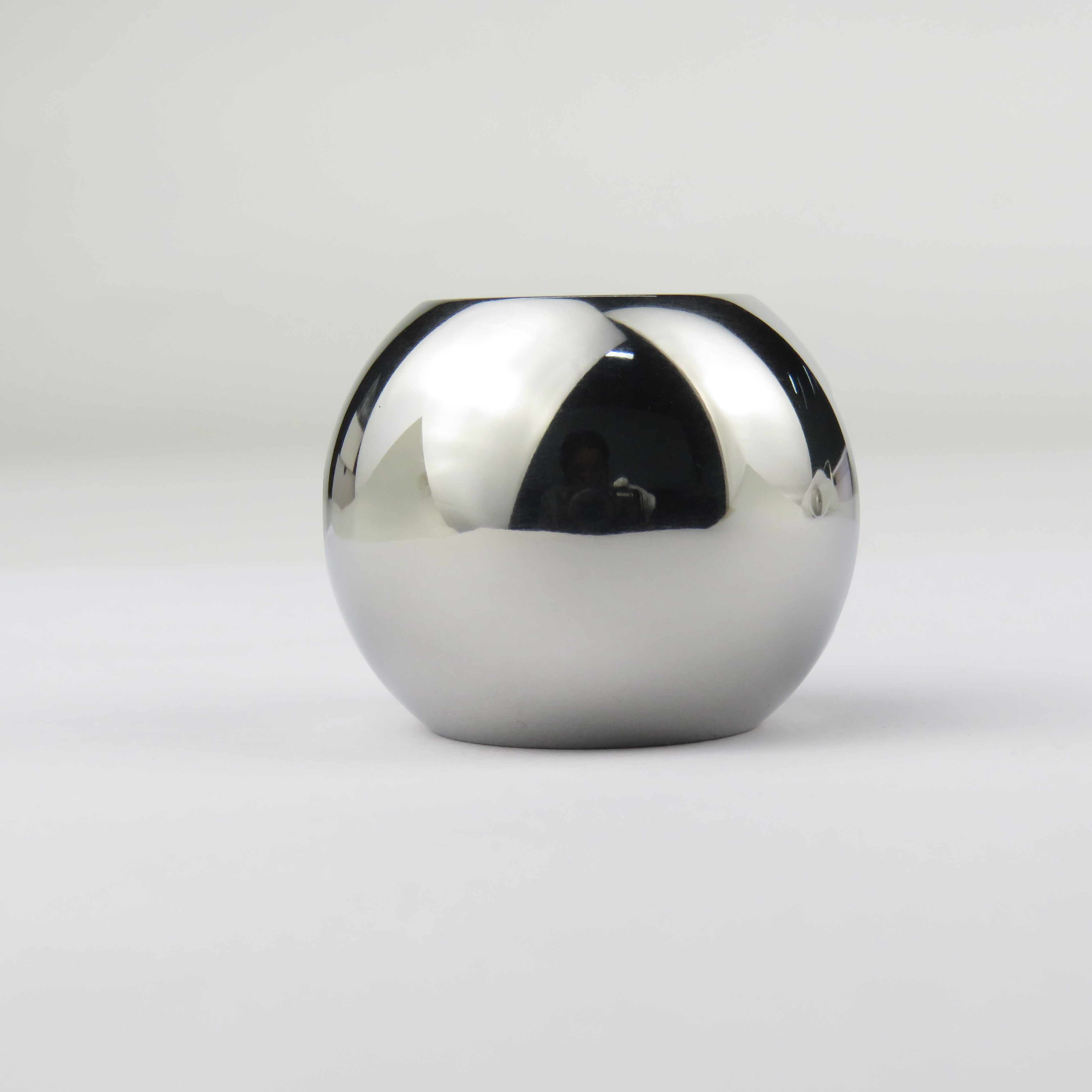
An architectural finish is graded by what an observer sees, so the acceptance standard has to name the viewing distance and the light. A panel that looks uniform from three metres can show every mark from half a metre, and a finish assessed under direct sun reads differently from one assessed under diffuse daylight or a linear light source. Agree the distance for the closest inspection the installed part will receive, the lighting condition, and the viewing angle, then write them into the finish callout. A practical arrangement is a physical reference panel accepted once by the buyer, kept in controlled storage, and used as the comparison standard. Numerical limits can sit beside it, but the panel is what a dispute is actually settled against.
A sample trial observes the parts that were tested, under the settings that were used, on the day they were run. It cannot establish that the same appearance will hold over a long production run, because media wears, compound concentration drifts and the incoming material changes. It cannot establish throughput, cost per part, or cycle time on the buyer's own order mix. It cannot prove that a finish will satisfy a client, an architect or a building inspector, because that judgement belongs to the buyer's own acceptance process. It cannot qualify the process for any regulated application. What it can do is show what a given media, compound and cycle direction does to a specific part, which is a reasonable basis for the next decision.
Lay the lengths end to end as they will be installed, under the light and at the distance agreed for acceptance, and look along the run rather than at each piece separately. A direction reversal or a change in texture pitch that is invisible on a single length usually shows immediately at the joint. The planning side matters more than the inspection: mark the grain direction on every length and keep the orientation through fabrication, packing and despatch. Where the finished parts come from different batches, compare each against the retained reference panel under the same conditions.
Support the profile rather than letting it lie loose. Cradles shaped to the section, dividers or compartments that keep lengths apart, end plugs that hold the open section, and controlled orientation in the bed all reduce the load a flat face sees. Rectangular sections are more exposed than round ones because a flat face has no hoop stiffness across its width, so the thinnest wall in the order should set the fixture design. Send the thinnest and widest section you use, not an average one, so the trial is run against the part most likely to distort.
Length is a handling question before it is a finishing question. Long architectural sections are run in a tub or on a dedicated longitudinal arrangement rather than a round bowl, and the practical limit depends on the chamber length, the supports available and how the length is packed for shipping. For a trial, send cut sections from the production material and one full-length piece where bend or end effects could matter, so the arrangement is chosen against the real part rather than an average. Parts travel to our factory in Xiamen, and we do not process anything in Netherlands or Arnhem.
Use Arnhem, Netherlands as the destination on the enquiry and state whether the deliverable is equipment, media and compound, a representative sample review or a line concept. A destination does not imply local stock, a local service point or a local delivery time.
Buyers here would reference the CE machinery regime (Machinery Regulation from 20 January 2027) and the Dutch/EN-ISO surface-finishing standards published by NEN, such as NEN-EN-ISO 2080. Hydrogen and pressure-equipment projects typically add their own material, cleanliness and traceability requirements on top of those base standards.
Sources were retrieved on 2026-09-29 and describe the local industrial and trade context only. They do not evidence any SurfacePolish project, shipment, installation or service in Arnhem.
The flat faces dent and the lengths twist whenever they are run loose together, and the buyer cannot accept that geometry loss.
Send the material, dimensions, approximate weight, batch quantity, the incoming condition and photographs of the difficult features. Mark which features must not be contacted by media and state how the result will be inspected. This form carries source reference PSEO-0667; quote it if you prefer an additional manual reference.
Open the SurfacePolish enquiry form Email a prepared enquiry
No price, lead time, certification or result is promised here. Confirm whether a sample trial is available for the specific part and what the trial can and cannot show.
Page PSEO-0667 · revised 2026-09-29 · cross-border equipment, media and scoped sample review. City context is sourced and cited above.
Use this local checker to identify missing part and inspection information. It prepares a technical-review brief; it does not approve a machine, process recipe or production result.
Complete the part details to prepare a review brief.
Email : info@surface-polish.com


 IPv6 network supported


 +86-592-2381506