A fabricator in Bordeaux, France working on architectural metalwork needs an even satin grain along 5.8 m of 316 stainless handrail tube, 42.4 mm diameter at 2.0 mm wall, without bowing the thin wall or marking the face seen from above. SurfacePolish supplies finishing machines, media and compounds across borders and runs a free sample trial on parts shipped to Xiamen. This brief is written for a buyer in Bordeaux working on architectural metalwork; it describes equipment, media and a scoped sample review, not a local polishing service.
How much of the incoming mill seam, joint weld or transit scratch must be removed, and what minimum wall thickness has to remain after that removal?
Which wall thickness and section shape in the order is most likely to distort, and what fixture, cradle or support will protect it?
What is the longest length in the order, and how will it be supported, carried and packed at every stage between finishing, fabrication and installation?
Not every face of a profile deserves the same effort. On a wall-mounted handrail the top and the outward face are read from standing height and from an angle, while the underside and the face against the wall are largely out of view. On a cladding mullion the sun-facing plane carries the reflection and the returns do not. Build a simple exposure map: which face, viewed from where, under what light, at what distance. That map settles where the tighter finish is specified and where a coarser one is honest. It also prevents over-finishing hidden faces, which costs cycle time and raises the risk of distortion on thin sections, and it tells the finishing supplier which face must be protected in every rack and stillage.
A balustrade or handrail job is never only long runs. It also contains cut-to-length spindles, elbows, brackets, base plates, ball finials and short connector sleeves, often in the same alloy and finish. Those parts are a poor fit for a longitudinal arrangement and a good fit for batch equipment, where a large number of small identical parts can be processed together with controlled part-on-part contact. Treating the two populations as one route is a common planning error: the runs are under-processed because the settings were chosen for the fittings, or the fittings are over-worked and lose their edges. Screen the order into long runs and small fittings, then specify the media class separately for each, even where the final appearance has to read the same.
| Machine route | Where it fits | What it will not do |
|---|---|---|
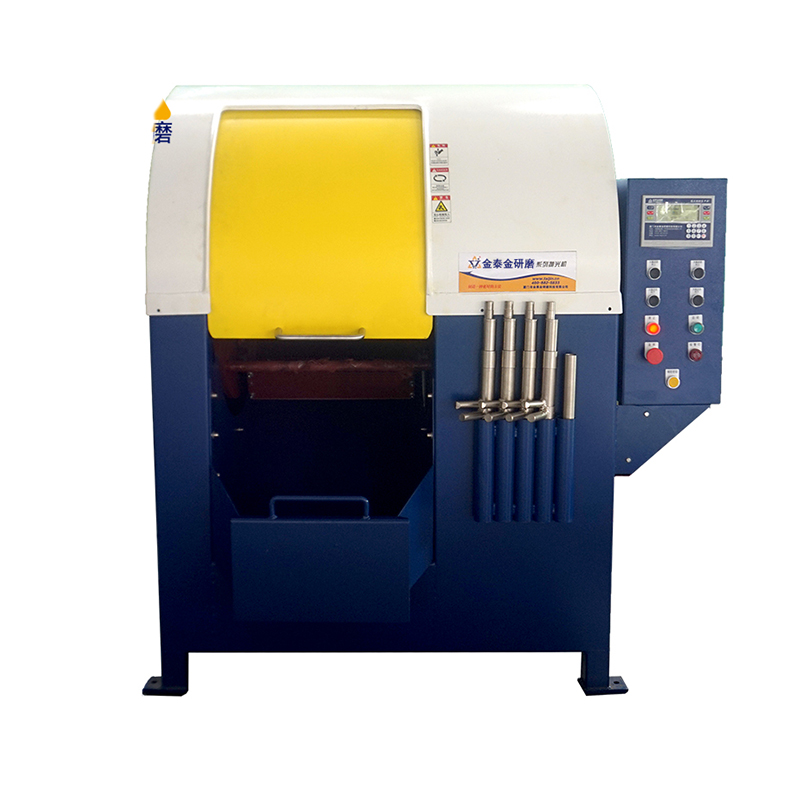
| Vibratory finishing machine, bowl type | General edge blending and surface refinement on brackets, base plates, cut spindles and other small fittings. | Chamber diameter caps the part length, and a long tube cannot be worked evenly in the circular bed. |
| Magnetic finishing machine | Small precise parts and localised areas that are difficult to reach with loose media in a conventional chamber. | Size and mass limits keep it away from architectural lengths and large diameter profiles. |
| Centrifugal barrel finishing machine | High-speed finishing of small precise parts, including where a bright appearance is required on a compact geometry. | Chamber geometry and high contact forces rule it out for long, thin-wall or easily marked sections. |
| Dry polishing machine and dryer | Post-wet drying and dry luster work, particularly where a hollow section must come out clean and dry inside. | Dry routes cut less than wet media, and dust control and media separation need planning. |
The compound carries cut debris away, keeps the media from loading, and buffers the chemistry against the metal. For stainless work the choice sits between mildly acidic, neutral and alkaline families, with the selection driven by the alloy, the incoming surface and the buyer's own residue limits rather than by a fixed rule. The behaviour that matters most on tube is rinsing. A compound that clings inside a six-metre bore will bleed out later onto a visible face and read as a stain or a patch. Pick a family that rinses cleanly, specify the rinse stages and the drying step, and agree how the interior of a sample length will be checked after the trial rather than assuming it is clean.
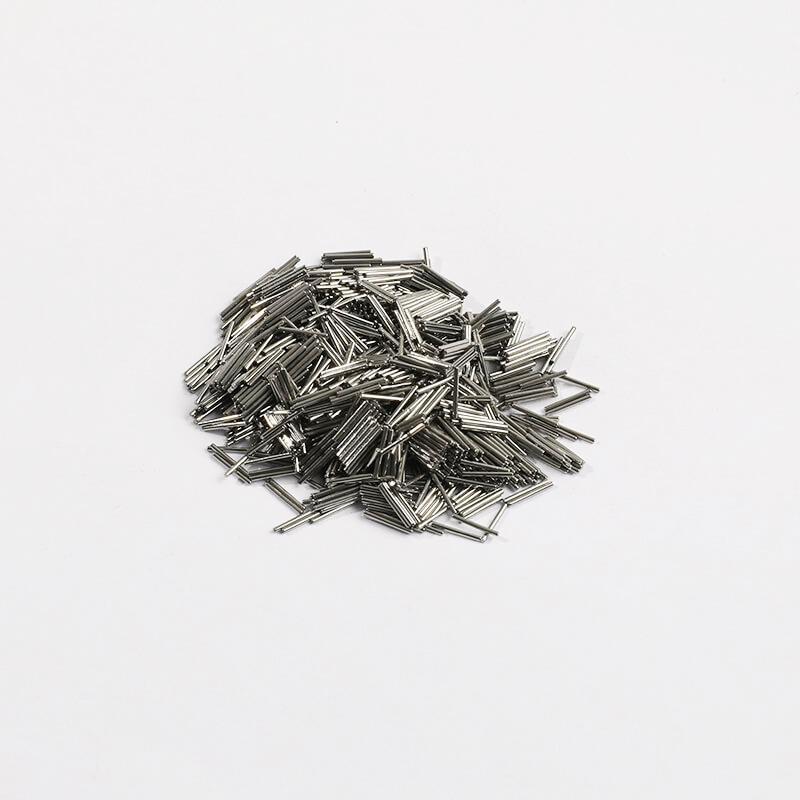
| Media | Best fit | Watch out for |
|---|---|---|
| Plastic media, cylindrical | Light surface refinement on thin rectangular sections where holding the shape matters more than cutting power. | Little cut power, and the size class changes quickly as the media wears, which shifts the texture pitch over a run. |
| Grinding media, alumina-based | Higher material removal where a mill seam, a joint weld or a deep transit scratch has to be cut back before refining. | Aggressive on thin wall, can over-round edges and change cross-section geometry, and needs tight depth control. |
| Steel media, pins and balls | Bright, strongly linear appearance on stainless where a higher-lustre finish is wanted on accessible faces. | Heavy, needs tight compound control to stay clean and separated, and any iron-bearing debris is a contamination question the buyer has to define and verify. |
| Dry media, walnut shell and corn cob | Dry polishing and support for post-wet drying, particularly where a hollow section must not stay wet or carry residue inside. | Low cutting power, and dust generation and media separation need managing in the surrounding area. |
Two welds matter on architectural tube: the longitudinal mill seam left by the tube maker, and the circumferential weld a fabricator makes when a length is joined to a fitting or to another length. Dressing either one means removing metal, and the risk is always the same. Too little leaves a visible band that reads as a line down the elevation; too much thins the wall and can leave a flat spot or a heat-affected zone that later shows as a different shade. The workable approach is to establish how much of the seam crown is to be removed, check it on a sectioned sample or with a depth gauge, and confirm that the wall at the dressed area still meets the buyer's requirement. Dressing is not a polishing step; it is a controlled removal step.
| Failure mode | Likely cause | How to catch it |
|---|---|---|
| Loss of ovality or out-of-round section | A load applied across the wall during the cycle or while the part sits in a rack. | Measure the diameter across two axes at several stations along the length with a caliper or micrometer. |
| Flat spot or thinning at a dressed weld | Too much material removed in one place while chasing the weld toe, usually with too coarse a medium or too much pressure. | Measure wall thickness with an ultrasonic gauge across the dressed area, and lay a straightedge over the joint to reveal a flat. |
| Visible band or line along the mill seam | The seam crown was not cut back evenly, or the media class was too small to reach the seam root without over-working the surrounding surface. | Look along the seam line under raking light from both sides, and measure the remaining crown with a depth gauge on a sectioned sample. |
| Shade change or discolouration at a welded area | The heat-affected zone responds differently to the same media and compound cycle than the parent metal. | Compare the area with adjacent metal under the agreed light and distance, and photograph it with a scale alongside the retained reference. |
Bordeaux combines an Atlantic port economy with an aerospace and defence industrial base: the Port de Bordeaux operates seven specialised terminals along the Gironde estuary and Garonne, receives close to a thousand vessels a year, and states that the industrial-port complex accounts for 8 620 jobs, with a stated strategic aim of building a new industrial-port model around energy transition. INSEE counted 14 432 establishments in the commune at the end of 2024, 3,2 % in industry, and 211 556 jobs at the place of work in 2023. The wider Gironde industrial base includes aeronautics and defence (Dassault Aviation, Thales and ArianeGroup sites around Merignac, Saint-Medard-en-Jalles and Le Haillan), naval and yacht refit activity in the port, and food and wine-related manufacturing.
The nearest part of that base to this brief is food: The port's core and future traffic lines and the Bordeaux/Gironde trade economy include food and wine-related flows, with the port organised as a multi-terminal commercial port along the estuary.
Aerostructures, space hardware and defence equipment built in the Bordeaux area need controlled edge quality on machined and formed parts, deburring of fluid and pneumatic components, and surface preparation for bonding and coating, all with the traceability that EN 9100 work demands. The port's naval refit and yacht activity adds a second, very different requirement - large-surface preparation, weld dressing and finish on hulls and superstructures in a marine corrosion environment. Food and wine equipment in the region adds stainless fabrication where surface roughness and residue-free cleaning matter hygienically.
A Bordeaux buyer should settle whether the finishing operation supports a bonded or coated surface, because in that case surface chemistry and cleanliness, not just roughness, decide whether the process is acceptable - and those parameters must be specified before a machine or media is selected.
Freight context: Port de Bordeaux (7 terminals: Bassens, Bacalan, Le Verdon, Blaye, Pauillac, Ambares, Bordeaux), Bordeaux-Merignac Airport. The port operates 24 hours a day, 365 days a year and states that its seven specialised terminals along the Gironde and Garonne receive close to a thousand vessels a year, with the industrial-port complex supporting 8 620 jobs. For equipment imports this means the machine can be landed directly on the estuary at Bassens or Verdon and moved by road, with Bordeaux-Merignac handling urgent parts and media samples.
The French national standards body is AFNOR (Association francaise de normalisation), which coordinates French participation in standardisation and publishes the NF and NF EN standards that transpose ISO and CEN work; AFNOR also runs the certification activity attached to many of those standards. A French buyer of finishing equipment would normally reference ISO/NF EN surface-texture standards for roughness and profile parameters, ISO/NF EN cleanliness or residue specifications for critical parts, and management-system or sector schemes such as ISO 9001, IATF 16949 for automotive and EN 9100 for aerospace.
The working language of French industrial procurement is French: tenders, drawings, inspection plans and technical dossiers are normally issued and answered in French, and quotations that omit French documentation slow down qualification. Buyers qualify a machine against a written specification and expect traceable material certificates, machine safety documentation and, where applicable, a CE declaration of conformity and a risk assessment; acceptance is often staged (documentary review, factory acceptance test, then commissioning). Payment and documentation norms are conventional EU practice: euro invoicing, SEPA or SWIFT bank transfer, Incoterms agreed in writing, and customs paperwork (commercial invoice, packing list, transport document, proof of origin where a preference is claimed) prepared for the declarant or customs representative. Because customs and tax authorisations are handled jointly through SOPRANO, non-EU sellers are normally advised to sell to an established French/EU importing entity rather than to act as importer of record themselves.
SurfacePolish supplies from Xiamen, China. The buyer's own destination rules, conformity marking, tariff classification and documentation responsibilities stay with the buyer; confirm them against the authorities named above before ordering.
A roughness reading on tube has to be taken with the same care as one on a flat coupon, and usually more. State the location by distance from a reference end, the traverse direction relative to the grain, and the cut-off and evaluation length, and keep them the same for the first article and for production checks. Along the grain and across the grain give different values on the same surface, so a reading that does not say which direction it was taken in cannot be compared with anything. Curvature limits how a skid or a shoe can sit on the surface, particularly on small-diameter tube, and a reading taken with a poorly seated pickup is not evidence. Repeat the measurement at several stations along the length, because the ends of a part often differ from the middle.
A sample trial observes the parts that were tested, under the settings that were used, on the day they were run. It cannot establish that the same appearance will hold over a long production run, because media wears, compound concentration drifts and the incoming material changes. It cannot establish throughput, cost per part, or cycle time on the buyer's own order mix. It cannot prove that a finish will satisfy a client, an architect or a building inspector, because that judgement belongs to the buyer's own acceptance process. It cannot qualify the process for any regulated application. What it can do is show what a given media, compound and cycle direction does to a specific part, which is a reasonable basis for the next decision.
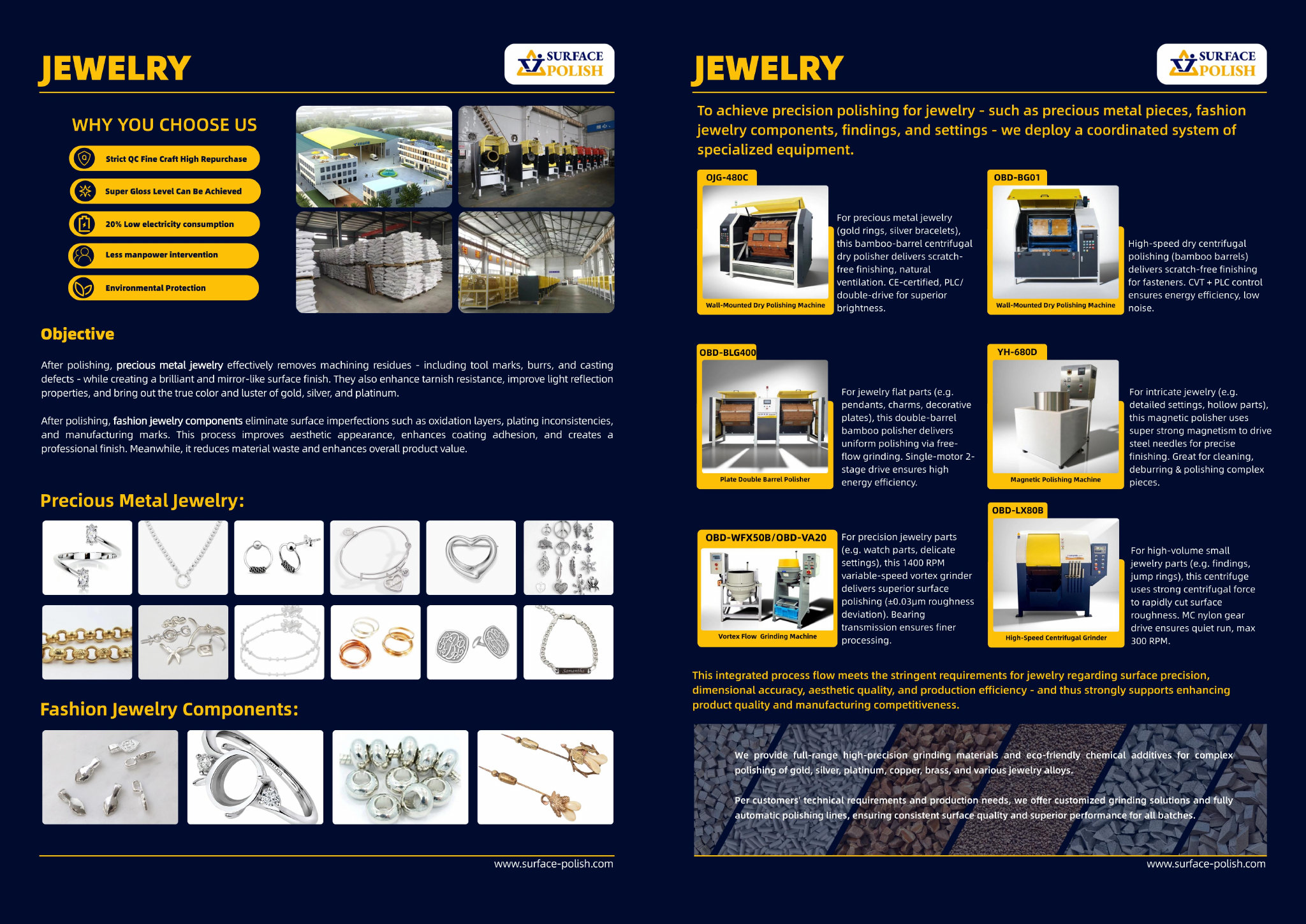
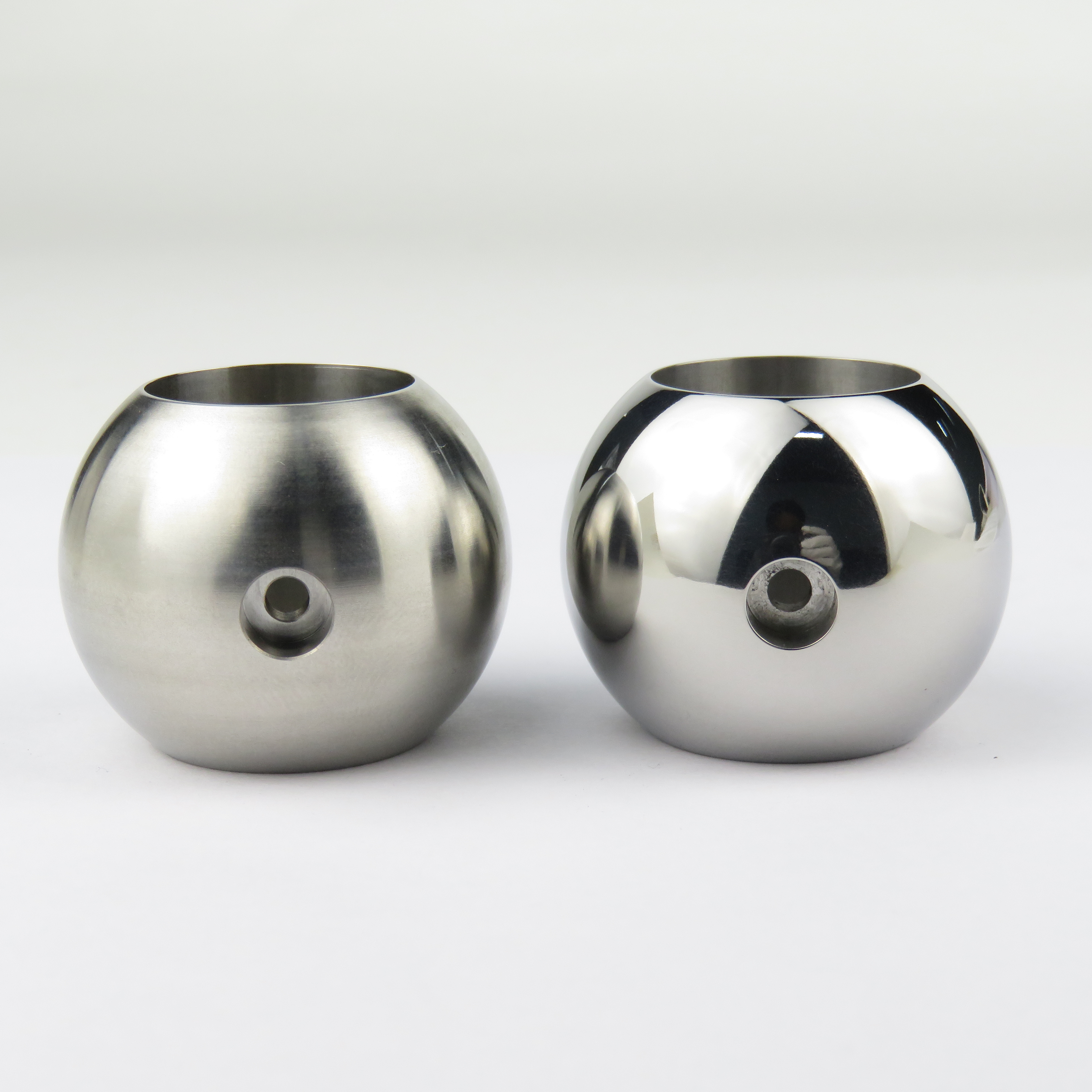
Directional satin textures usually come from elongated or angular media rather than spheres. Angle-cut triangles and cylinders strike along their axis and leave a linear pattern, while rounded shapes produce overlapping craters that read soft and slightly dimpled. The size class then has to reach the root of a mill seam or the cove of a rectangular profile without lodging in the bore or a fixing hole. Media selection is confirmed against the actual part in a trial, because the incoming grain, the wall thickness and the visible face all shift the answer. Send sections from the production delivery and say which face must carry the grain.
No. SurfacePolish does not supply or carry out electropolishing. Where electrochemical treatment is part of the buyer's requirement, we treat it as a comparison point and as a reason to look at what a mechanical route can achieve on the same part, and we can discuss media, compound and machine options for that mechanical route. A mechanical finish should not be presented as equivalent to an electropolished surface, and the choice between the two, together with any specification that depends on it, belongs to the buyer's own engineering decision.
Length is a handling question before it is a finishing question. Long architectural sections are run in a tub or on a dedicated longitudinal arrangement rather than a round bowl, and the practical limit depends on the chamber length, the supports available and how the length is packed for shipping. For a trial, send cut sections from the production material and one full-length piece where bend or end effects could matter, so the arrangement is chosen against the real part rather than an average. Parts travel to our factory in Xiamen, and we do not process anything in France or Bordeaux.
Use Bordeaux, France as the destination on the enquiry and state whether the deliverable is equipment, media and compound, a representative sample review or a line concept. A destination does not imply local stock, a local service point or a local delivery time.
A Bordeaux buyer would reference ISO/NF EN surface-texture standards for finish and EN 9100 for aerospace and defence work, plus customer specifications for bonding, sealing and cleanliness; ISO 9001 is the general baseline and marine work is governed by classification-society and owner requirements on top. Material conformity certificates and process traceability are standard expectations in the aerospace and naval supply chains here.
Sources were retrieved on 2026-09-29 and describe the local industrial and trade context only. They do not evidence any SurfacePolish project, shipment, installation or service in Bordeaux.
The buyer needs an even satin grain along the whole length without bowing the thin wall or marking the face that will be seen from above.
Send the material, dimensions, approximate weight, batch quantity, the incoming condition and photographs of the difficult features. Mark which features must not be contacted by media and state how the result will be inspected. This form carries source reference PSEO-0577; quote it if you prefer an additional manual reference.
Open the SurfacePolish enquiry form Email a prepared enquiry
No price, lead time, certification or result is promised here. Confirm whether a sample trial is available for the specific part and what the trial can and cannot show.
Page PSEO-0577 · revised 2026-09-29 · cross-border equipment, media and scoped sample review. City context is sourced and cited above.
Use this local checker to identify missing part and inspection information. It prepares a technical-review brief; it does not approve a machine, process recipe or production result.
Complete the part details to prepare a review brief.
Email : info@surface-polish.com


 IPv6 network supported


 +86-592-2381506