A fabricator in Brescia, Italy working on architectural metalwork needs an even satin grain along 5.8 m of 316 stainless handrail tube, 42.4 mm diameter at 2.0 mm wall, without bowing the thin wall or marking the face seen from above. SurfacePolish supplies finishing machines, media and compounds across borders and runs a free sample trial on parts shipped to Xiamen. This brief is written for a buyer in Brescia working on architectural metalwork; it describes equipment, media and a scoped sample review, not a local polishing service.
Which faces of each profile are actually seen when installed, from what distance and under what light, and which faces can be finished to a coarser standard without it showing?
How much of the incoming mill seam, joint weld or transit scratch must be removed, and what minimum wall thickness has to remain after that removal?
What texture direction is required, and how will that direction be preserved and compared across lengths that are finished in different lots?
The surface you receive already carries a direction of texture from the mill, from a prior brush line or from a fabricator's earlier pass. Finishing can change the amplitude and the scale of that texture and can impose a new direction, but erasing a deep existing grain means removing real wall thickness, which is rarely acceptable on a visible architectural profile. Note the direction of the incoming texture along the length, its pitch, and whether the tube is bright annealed, pickled or mill finish. A pickled or matte mill surface hides small process variation that a bright surface reveals immediately. Send the worst-looking incoming length rather than the best one, because the finish a line has to hold is set by the roughest material that regularly arrives, not by the sample kept aside as a reference.
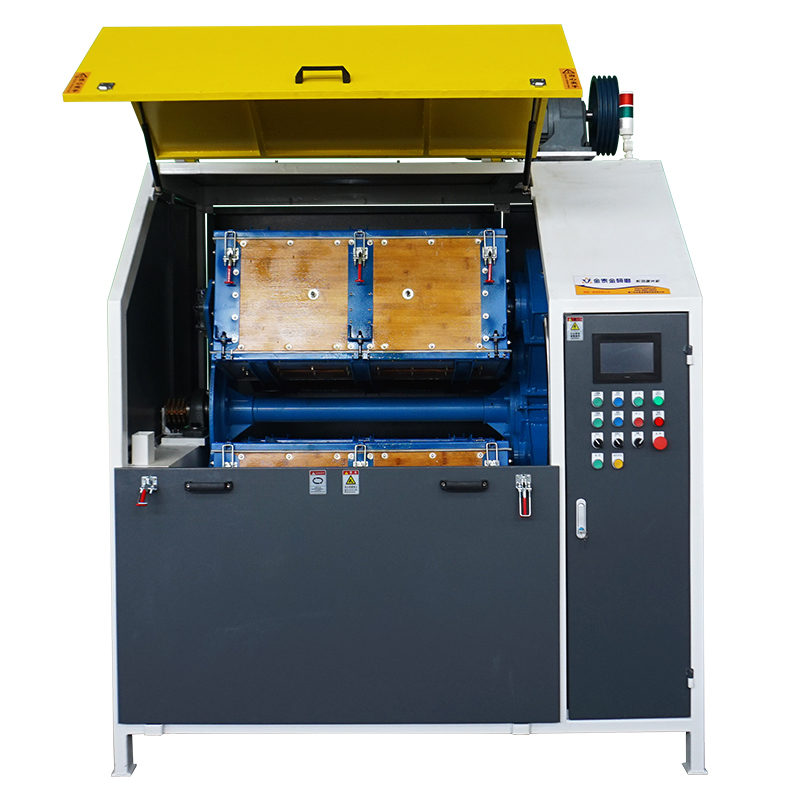
A tub vibrator uses a long rectangular chamber, so the process length can be extended along one axis while the bed depth stays modest. That allows a length to be carried through a media bed deep enough to work the visible face and shallow enough to keep the load moving. Decisions to settle with the equipment supplier are the usable chamber length against the longest part, whether lengths run one at a time or several end to end, how the part is supported so it does not ride on top of the media, and how the open ends are kept clear of media. A tub also tolerates the mid-length supports that thin rectangular sections need, which a circular chamber cannot accommodate without a purpose-built fixture.
| Machine route | Where it fits | What it will not do |
|---|---|---|
| Tub vibrator | Long and large parts such as architectural tube and profiles, where the process length has to extend along the part. | Bed depth and fixture design decide whether thin sections survive, and fluid flow has to be checked at the far end of the chamber. |
| Vibratory finishing machine, bowl type | General edge blending and surface refinement on brackets, base plates, cut spindles and other small fittings. | Chamber diameter caps the part length, and a long tube cannot be worked evenly in the circular bed. |
| Disc finishing machine | Fast, high-energy cycles for small to medium fittings and hardware where a short cycle is the priority. | The high energy that makes it fast will distort, mark or bend thin and long parts. |
| Barrel finishing machine, rotary barrel tumbling | Gentle, precise batch processing of small parts, finials, sleeves and short connector pieces. | Part length and part-on-part contact restrict it to short fittings rather than long architectural runs. |
Media must be small enough to reach the root of a seam or into the concave corner of a rectangular profile, and large enough not to lodge in the bore, in a drilled fixing hole or in a slotted channel. On small sections those two conditions conflict, and the resolution is usually to plug or cap the openings rather than to compromise the media. Where the visible face has a shallow cove, a smaller media class gives better access but wears faster and produces a shorter texture pitch. Where the profile is open, a larger class cuts more evenly and separates more easily. Decide the size against the tightest feature that must be finished and the smallest opening that must stay clear, and state both in the trial request.
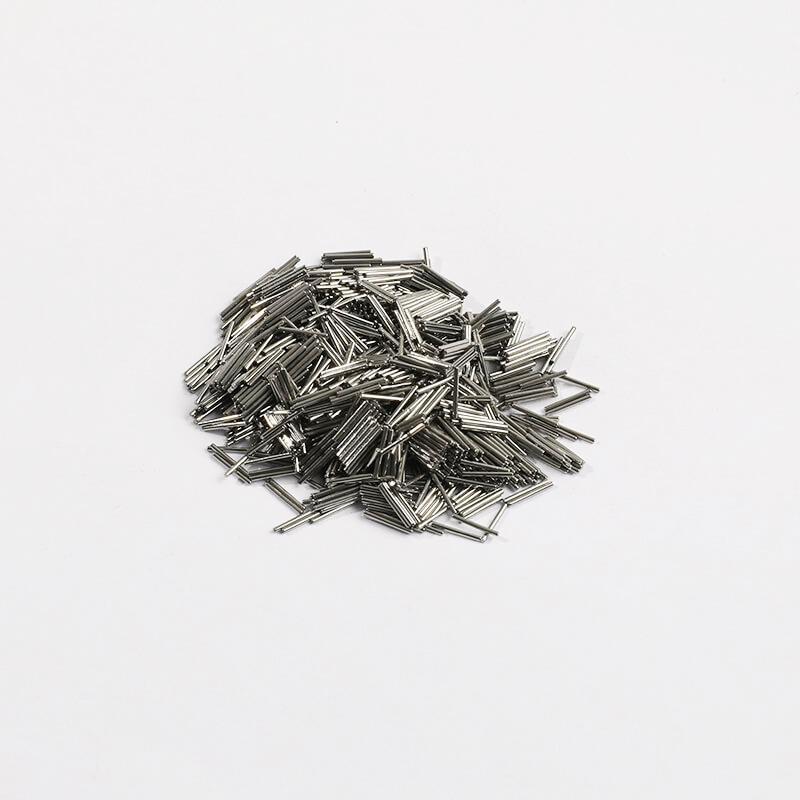
| Media | Best fit | Watch out for |
|---|---|---|
| Grinding media, alumina-based | Higher material removal where a mill seam, a joint weld or a deep transit scratch has to be cut back before refining. | Aggressive on thin wall, can over-round edges and change cross-section geometry, and needs tight depth control. |
| Plastic media, cones and triangles | Gentle work on thin-wall sections and softer alloys, and where marking or distortion is the main risk to be managed. | Slower cut and shorter media life, with limited effect on a deep scratch or a heavy seam. |
| Plastic media, cylindrical | Light surface refinement on thin rectangular sections where holding the shape matters more than cutting power. | Little cut power, and the size class changes quickly as the media wears, which shifts the texture pitch over a run. |
| Ceramic media, angle-cut triangles | Heavier cutting and seam removal on stainless tube and profiles, where a directional linear texture on the visible face is wanted. | Wears down and changes effective size class, generates sludge, and can over-round thin sections or chip on sharp edges. |
Two welds matter on architectural tube: the longitudinal mill seam left by the tube maker, and the circumferential weld a fabricator makes when a length is joined to a fitting or to another length. Dressing either one means removing metal, and the risk is always the same. Too little leaves a visible band that reads as a line down the elevation; too much thins the wall and can leave a flat spot or a heat-affected zone that later shows as a different shade. The workable approach is to establish how much of the seam crown is to be removed, check it on a sectioned sample or with a depth gauge, and confirm that the wall at the dressed area still meets the buyer's requirement. Dressing is not a polishing step; it is a controlled removal step.
| Failure mode | Likely cause | How to catch it |
|---|---|---|
| Dents and part-on-part nibbling | Parts running loose together in the load, or a finished part contacting a bare support or another length. | Inspect the contact line between parts with side lighting, and run a straightedge over the damaged area to judge depth. |
| Twist along the length | Differential working of opposite faces, or clamping and stacking that loads the section unevenly. | Rest the length on a reference surface and compare the angular orientation of the two end sections with a square. |
| Compound residue weeping from a hollow section | Incomplete rinsing of the interior, or a drying step that does not reach inside a closed section. | Stand the length on end over a clean cloth for a set period, then inspect the bore interior for residue after drying. |
| Orange peel mottling on the visible face | Over-working with a coarse medium, or excessive pressure on a soft or thin section, which deforms the surface rather than cutting it. | Reflect a straight edge or a linear light source in the surface, and take a roughness reading at the same spot to show the divergence between number and appearance. |
Brescia is one of Lombardy's most industrial provinces. The Camera di Commercio di Brescia reports that industrial production in the province grew 2.6% year on year in the second quarter of 2026, above the Lombardy average of 2.1%, with industry turnover up 5.7% on the year and export orders up 8.9%. Foreign sales carry the local economy: the chamber's economy report estimates that 45.2% of the province's value added derives from exports and that exports cover 173.8% of imports. The chamber's manufacturing surveys break the local industrial fabric into steel (siderurgia), mechanical engineering (meccanica), food (alimentari), chemicals and rubber-plastics, and its 2026 investment survey shows food, transport equipment and steel among the branches that invested most in 2025.
The nearest part of that base to this brief is machinery: The Camera di Commercio di Brescia's manufacturing survey explicitly stratifies the local industrial sample by merceological sector into Siderurgia, Meccanica, Alimentari, Chimica and Gomma-Plastica.
A production mix built on steel, metalworking, mechanical engineering and food processing generates a continuous flow of parts that need deburring, edge rounding, descaling or a controlled surface before assembly, coating or sale. In that kind of metalworking supply chain, metal treatment and surface finishing sit upstream of assembly, so cycle time, media wear and the ability to reproduce the same finish from batch to batch are the practical qualification issues - which is why consumable cost per part, rather than machine price alone, is normally the deciding number for a steel-working buyer.
The first question is whether the requirement is metallurgical and functional (removing scale and burrs, establishing an edge radius on a forged or machined steel part) or visual, and how the works will verify it on incoming inspection - because a steel-working buyer needs a process window that holds across changing part geometry and batch size, not a single demonstration part.
Freight context: Aeroporto di Brescia (airport of national interest per ENAC), Road and rail freight (no commercial seaport in the province). Brescia has no commercial seaport in the province; the national civil aviation authority ENAC lists Brescia among Italy's airports of national interest, and the province's heavy export orientation (45.2% of value added, exports covering 173.8% of imports) means freight moves mainly by road and rail to EU gateways. Non-EU machinery or sample parts therefore clear customs at their EU point of entry and are then trucked to Brescia.
Italy applies the EU's common commercial policy to imports from China, so Chinese industrial machinery enters under the EU Common Customs Tariff, where the duty rate depends on the type and origin of the goods and the working tariff is TARIC. Istat's August 2026 extra-EU trade release records a 16.0% year-on-year increase in Italian purchases from China, alongside strong growth from India, OPEC and Mercosur, so China remains one of the fastest-growing sources of Italian imports. Anti-dumping and other trade-defence measures apply case by case to specific product categories rather than to finishing machinery in general, so the applicable rate must be checked against the specific commodity code before a quotation is finalised.
The national standards body is UNI - Ente Italiano di Normazione, a private non-profit association founded over a century ago, which develops, publishes and disseminates voluntary technical standards and adopts the European and international standards as Italian editions. For finishing work the operative references are the surface-texture series UNI EN ISO 21920-1:2022, which fixes how the surface state (roughness, waviness, primary profile) is indicated on technical product documentation, and UNI EN ISO 21920-2:2022, which defines the terms, definitions and parameters used with profile methods. Machinery safety requirements come from the EU machinery legislation rather than from UNI alone: Machinery Directive 2006/42/EC applies to machinery placed on the EU market before 20 January 2027, after which Machinery Regulation (EU) 2023/1230 takes over.
SurfacePolish supplies from Xiamen, China. The buyer's own destination rules, conformity marking, tariff classification and documentation responsibilities stay with the buyer; confirm them against the authorities named above before ordering.
Grain direction is the most common reason a set of individually acceptable lengths is rejected as an assembly. Where two lengths butt at a joint, their texture direction has to run the same way, and the pitch and brightness have to be close enough that the joint does not read as a line. That is a planning decision made before the lengths are run, not a sorting decision made afterwards: define the grain direction on the drawing, mark the direction on every length, and keep the orientation through fabrication and despatch. Then inspect the lengths laid end to end as they will be installed, under the agreed light, rather than one at a time on a bench. A direction reversal that is obvious in an assembly can be invisible in a single part.
Send cut sections from the actual production material, roughly 300 to 500 mm long, taken from at least three places along the delivery rather than from one offcut, and cover every wall thickness and profile in the order. Add one full-length piece where bend, twist or end effects could matter, because a short coupon does not reproduce how a long, unsupported length behaves in a bed. Include one length in the condition that most often arrives: a mill seam, a fabricator's weld, a transit scratch. If the buyer has an existing part whose appearance is acceptable, send that as a reference too, with a note on where it was viewed from. Label every piece with profile, alloy, wall, provenance and what should be observed on it.
Directional satin textures usually come from elongated or angular media rather than spheres. Angle-cut triangles and cylinders strike along their axis and leave a linear pattern, while rounded shapes produce overlapping craters that read soft and slightly dimpled. The size class then has to reach the root of a mill seam or the cove of a rectangular profile without lodging in the bore or a fixing hole. Media selection is confirmed against the actual part in a trial, because the incoming grain, the wall thickness and the visible face all shift the answer. Send sections from the production delivery and say which face must carry the grain.
No. A sample trial produces observations on the parts that were tested under the settings used; it is not a guarantee of a roughness value, a surface class, an appearance or a repeatable production result. Media wear, compound concentration and the condition of incoming material all move the finish over a run. What we can do is show what a given media, compound and cycle direction did to your part, and describe what would need to be controlled to hold that result. Acceptance criteria and any promise made to a client or specifier remain your own.
It should name the texture direction, the faces that carry it, the roughness limit and its measurement conditions if a number is used, the reference panel and the viewing distance, and the faces that are exempt. Add what must be protected: threads, fixing holes, cut ends and machined lands. Where the finish cannot be expressed numerically, a numbered physical reference sample with a written description of its texture direction and appearance is far more useful than an adjective such as brushed or satin. Settling this before a trial is what allows the trial result to be measured against a real requirement.
Use Brescia, Italy as the destination on the enquiry and state whether the deliverable is equipment, media and compound, a representative sample review or a line concept. A destination does not imply local stock, a local service point or a local delivery time.
Finish is specified through UNI, the Italian standards body, whose Italian editions of the EN/ISO surface-texture series (UNI EN ISO 21920-1 and -2:2022) govern drawing indications and measurement parameters, and the Camera di Commercio di Brescia is the local body that issues the certificates of origin, export visas and free-sale attestations companies need for foreign trade. Machinery supplied into the province must also satisfy the EU machinery legislation.
Sources were retrieved on 2026-09-29 and describe the local industrial and trade context only. They do not evidence any SurfacePolish project, shipment, installation or service in Brescia.
The buyer needs an even satin grain along the whole length without bowing the thin wall or marking the face that will be seen from above.
Send the material, dimensions, approximate weight, batch quantity, the incoming condition and photographs of the difficult features. Mark which features must not be contacted by media and state how the result will be inspected. This form carries source reference PSEO-0437; quote it if you prefer an additional manual reference.
Open the SurfacePolish enquiry form Email a prepared enquiry
No price, lead time, certification or result is promised here. Confirm whether a sample trial is available for the specific part and what the trial can and cannot show.
Page PSEO-0437 · revised 2026-09-29 · cross-border equipment, media and scoped sample review. City context is sourced and cited above.
Use this local checker to identify missing part and inspection information. It prepares a technical-review brief; it does not approve a machine, process recipe or production result.
Complete the part details to prepare a review brief.
Email : info@surface-polish.com


 IPv6 network supported


 +86-592-2381506