A column-cover fabricator in Lyon, France for architectural metalwork handles 6 m lengths of 168 mm stainless tube at 3 mm wall and needs an even finish on the visible half without losing roundness or denting the wall in handling. SurfacePolish supplies finishing machines, media and compounds across borders and runs a free sample trial on cut sections and one full length shipped to Xiamen. This brief is written for a buyer in Lyon working on architectural metalwork; it describes equipment, media and a scoped sample review, not a local polishing service.
Will the finish be judged by a roughness number, by a physical reference panel, or by both, and who views the parts before they are accepted?
How much of the incoming mill seam, joint weld or transit scratch must be removed, and what minimum wall thickness has to remain after that removal?
Which faces of each profile are actually seen when installed, from what distance and under what light, and which faces can be finished to a coarser standard without it showing?
An elevation is normally assembled from lengths made and finished at different times, so the lot definition matters as much as the finish itself. Decide how parts are grouped into finishing lots: by profile, by wall thickness, by alloy heat, by incoming mill finish, or by the date the material arrived. Then decide how lot identity is preserved through finishing, fabrication and despatch, because a length that cannot be traced back to a lot cannot be compared with another length in a dispute. Where an order will be produced over several weeks, keep an unprocessed reference length from the first delivery in store, and keep a finished reference panel from the first accepted lot. Both are needed before anyone can argue about whether a later length matches.
A tub vibrator uses a long rectangular chamber, so the process length can be extended along one axis while the bed depth stays modest. That allows a length to be carried through a media bed deep enough to work the visible face and shallow enough to keep the load moving. Decisions to settle with the equipment supplier are the usable chamber length against the longest part, whether lengths run one at a time or several end to end, how the part is supported so it does not ride on top of the media, and how the open ends are kept clear of media. A tub also tolerates the mid-length supports that thin rectangular sections need, which a circular chamber cannot accommodate without a purpose-built fixture.
| Machine route | Where it fits | What it will not do |
|---|---|---|
| Centrifugal barrel finishing machine | High-speed finishing of small precise parts, including where a bright appearance is required on a compact geometry. | Chamber geometry and high contact forces rule it out for long, thin-wall or easily marked sections. |
| Disc finishing machine | Fast, high-energy cycles for small to medium fittings and hardware where a short cycle is the priority. | The high energy that makes it fast will distort, mark or bend thin and long parts. |
| Vibratory finishing machine, bowl type | General edge blending and surface refinement on brackets, base plates, cut spindles and other small fittings. | Chamber diameter caps the part length, and a long tube cannot be worked evenly in the circular bed. |
| Tub vibrator | Long and large parts such as architectural tube and profiles, where the process length has to extend along the part. | Bed depth and fixture design decide whether thin sections survive, and fluid flow has to be checked at the far end of the chamber. |
The compound carries cut debris away, keeps the media from loading, and buffers the chemistry against the metal. For stainless work the choice sits between mildly acidic, neutral and alkaline families, with the selection driven by the alloy, the incoming surface and the buyer's own residue limits rather than by a fixed rule. The behaviour that matters most on tube is rinsing. A compound that clings inside a six-metre bore will bleed out later onto a visible face and read as a stain or a patch. Pick a family that rinses cleanly, specify the rinse stages and the drying step, and agree how the interior of a sample length will be checked after the trial rather than assuming it is clean.
| Media | Best fit | Watch out for |
|---|---|---|
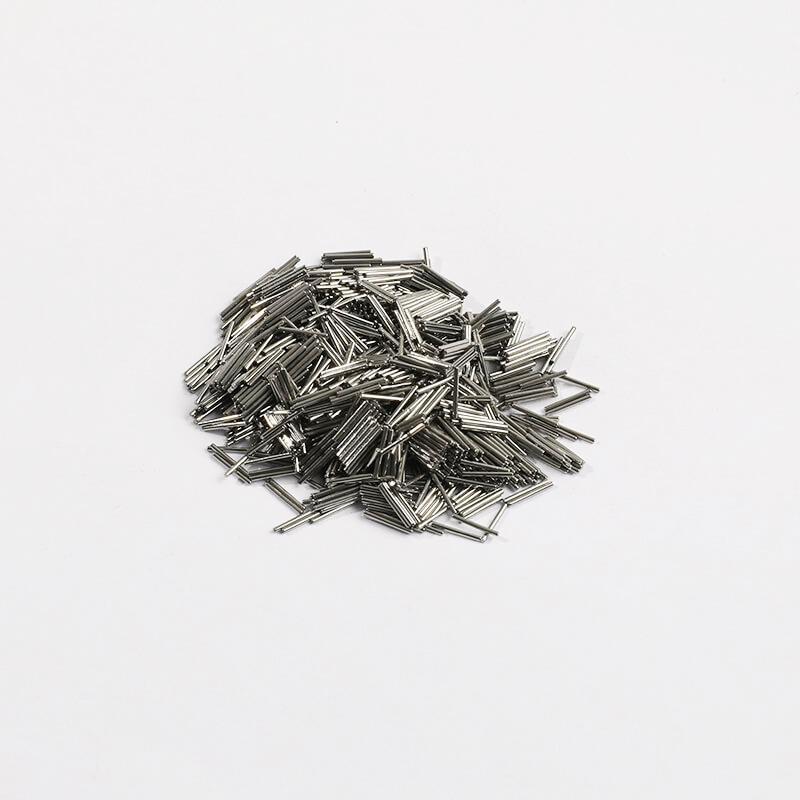
| Grinding media, alumina-based | Higher material removal where a mill seam, a joint weld or a deep transit scratch has to be cut back before refining. | Aggressive on thin wall, can over-round edges and change cross-section geometry, and needs tight depth control. |
| Plastic media, cylindrical | Light surface refinement on thin rectangular sections where holding the shape matters more than cutting power. | Little cut power, and the size class changes quickly as the media wears, which shifts the texture pitch over a run. |
| Dry media, walnut shell and corn cob | Dry polishing and support for post-wet drying, particularly where a hollow section must not stay wet or carry residue inside. | Low cutting power, and dust generation and media separation need managing in the surrounding area. |
| Steel media, pins and balls | Bright, strongly linear appearance on stainless where a higher-lustre finish is wanted on accessible faces. | Heavy, needs tight compound control to stay clean and separated, and any iron-bearing debris is a contamination question the buyer has to define and verify. |
Two welds matter on architectural tube: the longitudinal mill seam left by the tube maker, and the circumferential weld a fabricator makes when a length is joined to a fitting or to another length. Dressing either one means removing metal, and the risk is always the same. Too little leaves a visible band that reads as a line down the elevation; too much thins the wall and can leave a flat spot or a heat-affected zone that later shows as a different shade. The workable approach is to establish how much of the seam crown is to be removed, check it on a sectioned sample or with a depth gauge, and confirm that the wall at the dressed area still meets the buyer's requirement. Dressing is not a polishing step; it is a controlled removal step.
| Failure mode | Likely cause | How to catch it |
|---|---|---|
| Twist along the length | Differential working of opposite faces, or clamping and stacking that loads the section unevenly. | Rest the length on a reference surface and compare the angular orientation of the two end sections with a square. |
| Dents and part-on-part nibbling | Parts running loose together in the load, or a finished part contacting a bare support or another length. | Inspect the contact line between parts with side lighting, and run a straightedge over the damaged area to judge depth. |
| Longitudinal scratch running along the part axis | Incoming coil or straightener marks, media or swarf dragged along the surface during the cycle, or a finished length sliding over a bare support between operations. | View the surface under raking light at a low angle along the axis, compare the same station on several parts, and compare against the retained reference panel. |
| Orange peel mottling on the visible face | Over-working with a coarse medium, or excessive pressure on a soft or thin section, which deforms the surface rather than cutting it. | Reflect a straight edge or a linear light source in the surface, and take a roughness reading at the same spot to show the divergence between number and appearance. |
The Lyon conurbation is the chemical and process-industry capital of France: AXELERA, the national competitiveness cluster for chemistry, process industries and environment, is headquartered at Solaize in the Lyon chemical corridor and reports 411 member organisations, 700 labelled and financed projects and EUR 2,5 billion of project financing, with founding members Arkema, CNRS, Engie, IFP Energies nouvelles, Suez and Syensqo. The city itself counted 27 316 establishments at the end of 2024 (3,4 % in industry) and 343 084 jobs at the place of work in 2023, so the operating plants sit in the surrounding industrial-port corridor on the Rhone while Lyon concentrates engineering, R&D and headquarters functions. The Rhone axis is also France's second largest industrial river corridor, running south to the Grand Port Maritime de Marseille, whose 2024 container traffic grew 9 % to 1,45 MEVP.
The nearest part of that base to this brief is energy: AXELERA, the chemistry/process/environment competitiveness cluster based at Solaize in the Lyon area, lists Engie and IFP Energies nouvelles among its founding members and runs structured programmes on decarbonation and e-fuels.
Process-industry and equipment manufacturing in the Lyon corridor involve large welded and machined components - pump and valve bodies, heat-exchanger parts, reactor and vessel internals, and stainless assemblies - where weld dressing, edge rounding and pickling-free surface preparation directly affect corrosion behaviour and cleanability. Because much of the output is stainless and alloy steel, surface contamination and residual heat tint are functional concerns, not cosmetic ones. Lyon's mechanical subcontracting and machine-building base also deburrs high-mix small parts, so media selection and process repeatability matter as much as machine throughput.
A buyer in Lyon should first decide whether the finishing step is a weld-dressing/corrosion-preparation operation on large assemblies or a high-volume small-part deburring operation, because those two answers lead to different machine types, media and - most importantly - different fixture and handling requirements.
Freight context: Port Edouard Herriot (Lyon, Rhone-Saone axis), Lyon-Saint Exupery Airport, Grand Port Maritime de Marseille (Fos) as the sea gateway. Lyon is served by the Rhone-Saone waterway and its own river terminal at Port Edouard Herriot, and by Lyon-Saint Exupery airport; sea freight for the region typically lands at Marseille-Fos or via the northern ports and moves up by rail or road, so inland-container logistics is the planning item. The Marseille port authority reported container traffic up 9 % in 2024 to 1,45 MEVP, confirming the southern gateway's capacity for containerised machinery.
The French national standards body is AFNOR (Association francaise de normalisation), which coordinates French participation in standardisation and publishes the NF and NF EN standards that transpose ISO and CEN work; AFNOR also runs the certification activity attached to many of those standards. A French buyer of finishing equipment would normally reference ISO/NF EN surface-texture standards for roughness and profile parameters, ISO/NF EN cleanliness or residue specifications for critical parts, and management-system or sector schemes such as ISO 9001, IATF 16949 for automotive and EN 9100 for aerospace.
France applies the EU common commercial policy, so industrial machinery arriving from China enters under the Union Customs Code and the Common Customs Tariff rather than under any bilateral French regime; the EU has no free-trade agreement with China, so no preferential duty rate applies and normal third-country duties are due on the customs value. Importers classify the machine in the tariff nomenclature and lodge a customs declaration; French Customs publishes the common and national tariff through its RITA online service and states that three notions are fundamental: the tariff classification of the product, its origin or destination, and the value of the goods.
SurfacePolish supplies from Xiamen, China. The buyer's own destination rules, conformity marking, tariff classification and documentation responsibilities stay with the buyer; confirm them against the authorities named above before ordering.
A roughness reading on tube has to be taken with the same care as one on a flat coupon, and usually more. State the location by distance from a reference end, the traverse direction relative to the grain, and the cut-off and evaluation length, and keep them the same for the first article and for production checks. Along the grain and across the grain give different values on the same surface, so a reading that does not say which direction it was taken in cannot be compared with anything. Curvature limits how a skid or a shoe can sit on the surface, particularly on small-diameter tube, and a reading taken with a poorly seated pickup is not evidence. Repeat the measurement at several stations along the length, because the ends of a part often differ from the middle.
The first production batch is usually the best one, because the media charge is fresh and the fluid is at its set point. What changes over a run is media wear, which reduces cut and shifts the surface toward a finer and dimmer appearance; the build-up of swarf and fines in the fluid; and the arrival of material from a different heat or mill finish. Plan for it: a media top-up and screening routine with a defined interval, a fluid change criterion based on measurement rather than appearance, and a check length kept from each lot for comparison. Agree in advance what will be done if a later lot does not match the retained reference, so the decision is procedural rather than improvised.
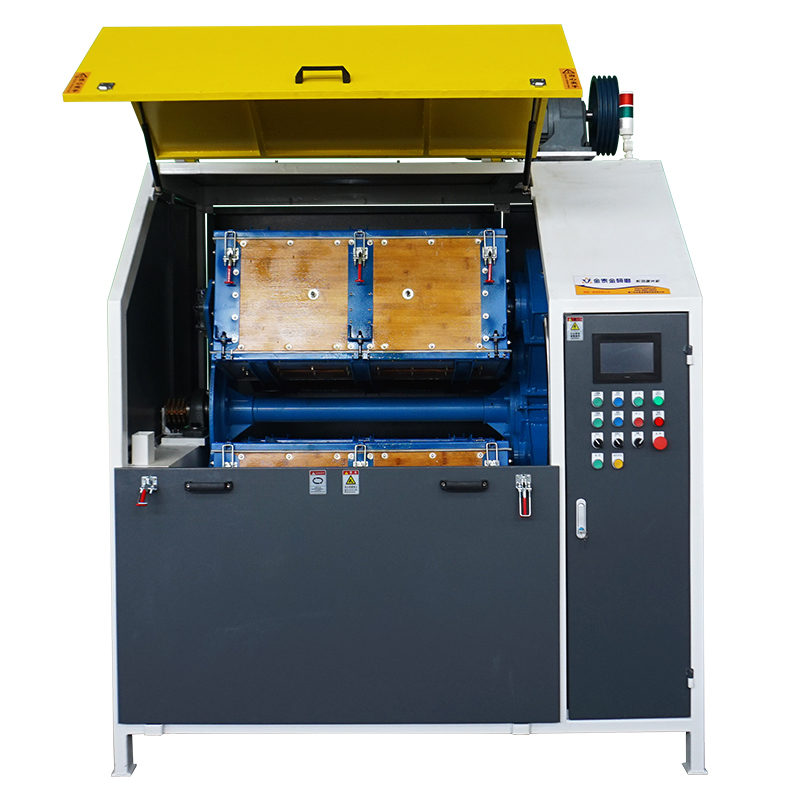
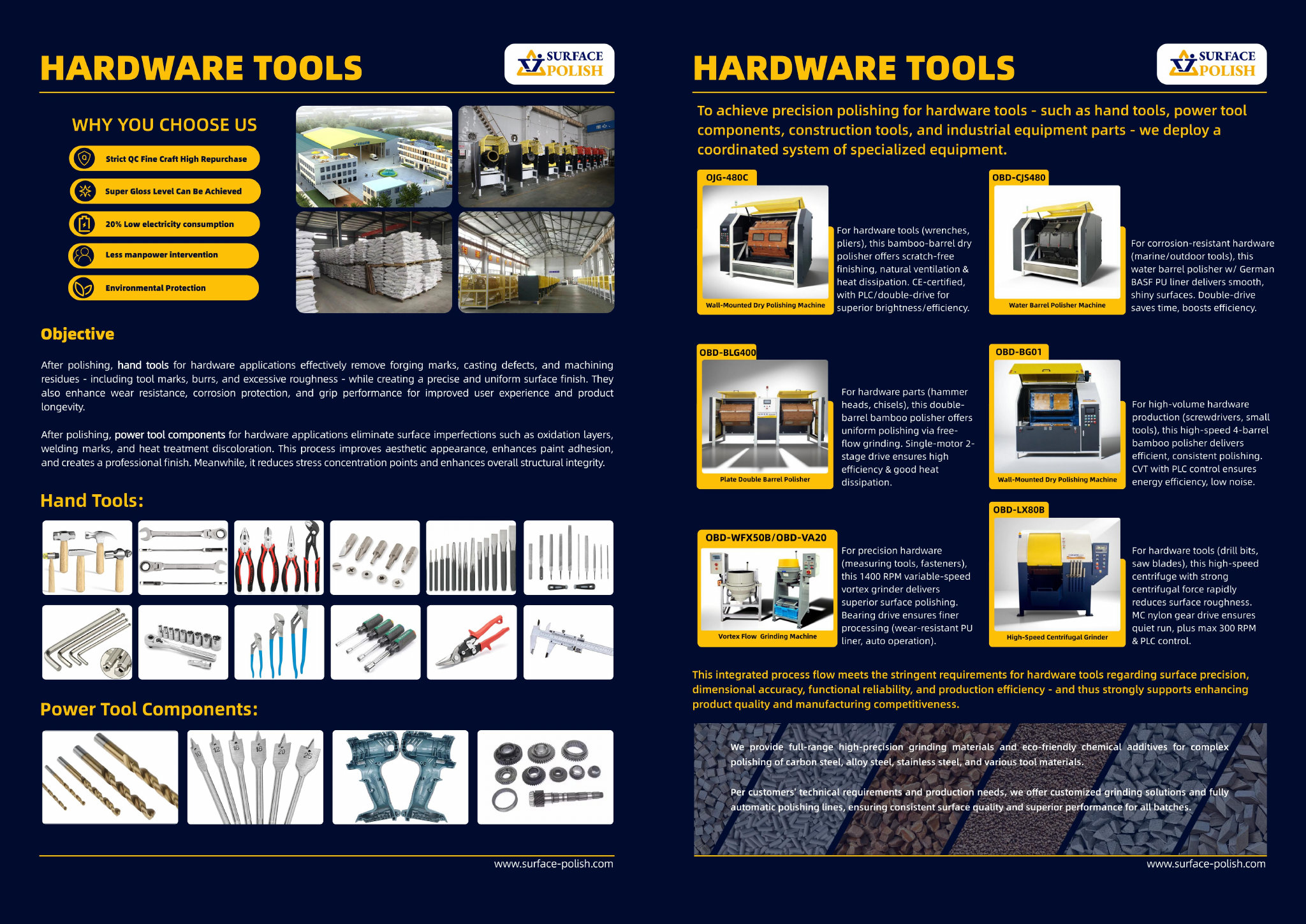
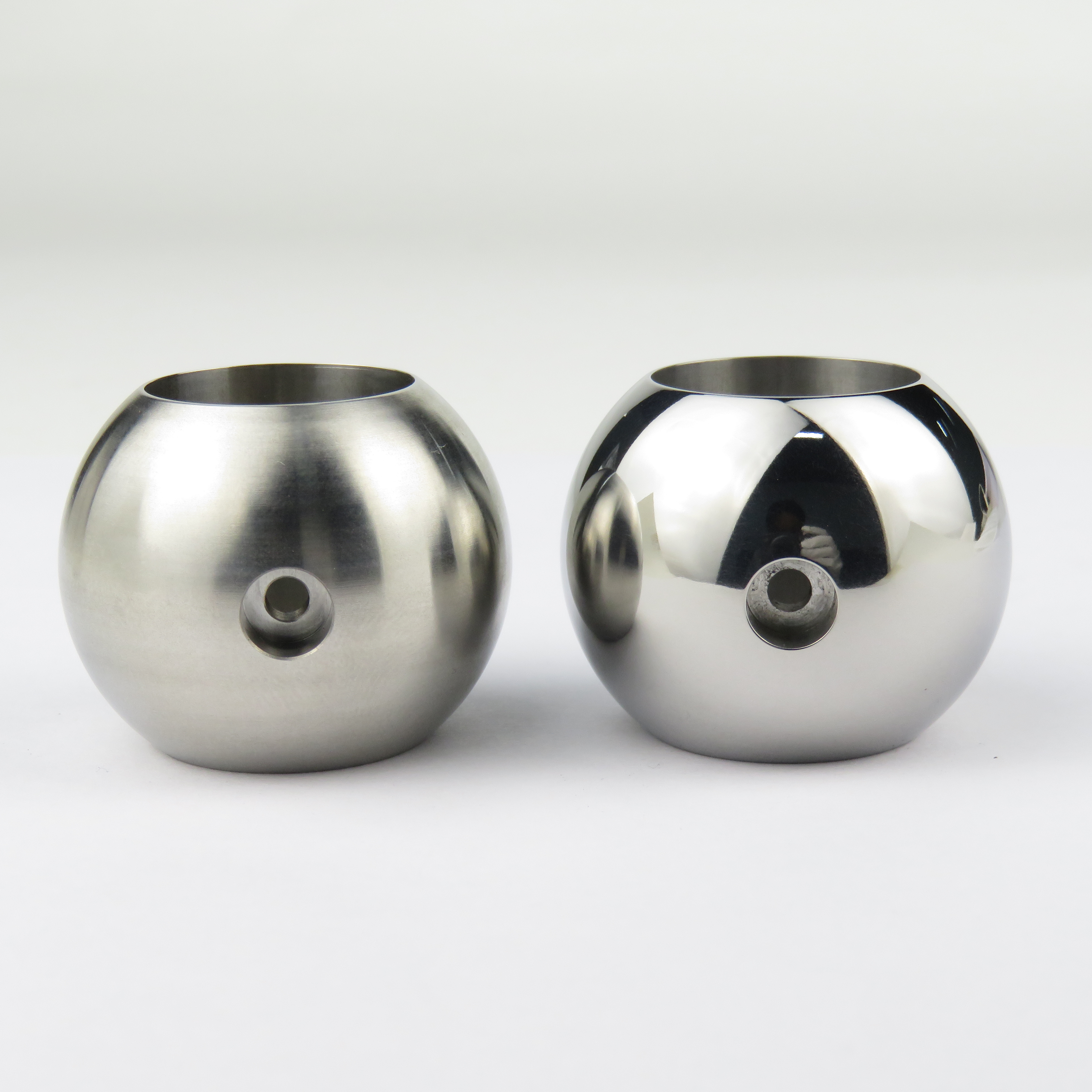
Length is a handling question before it is a finishing question. Long architectural sections are run in a tub or on a dedicated longitudinal arrangement rather than a round bowl, and the practical limit depends on the chamber length, the supports available and how the length is packed for shipping. For a trial, send cut sections from the production material and one full-length piece where bend or end effects could matter, so the arrangement is chosen against the real part rather than an average. Parts travel to our factory in Xiamen, and we do not process anything in France or Lyon.
A round bowl moves its load on a circular path in a chamber whose diameter caps the part length, and extending that chamber to take a six-metre length stops being practical. The deeper issue is the bed: a long tube occupies too much of the load for the media to circulate around it, so the part is dragged and struck instead of worked evenly. Long sections are better run in a tub, where the process length can be extended along one axis, or on a dedicated arrangement that moves the part or the heads along the length.
Directional satin textures usually come from elongated or angular media rather than spheres. Angle-cut triangles and cylinders strike along their axis and leave a linear pattern, while rounded shapes produce overlapping craters that read soft and slightly dimpled. The size class then has to reach the root of a mill seam or the cove of a rectangular profile without lodging in the bore or a fixing hole. Media selection is confirmed against the actual part in a trial, because the incoming grain, the wall thickness and the visible face all shift the answer. Send sections from the production delivery and say which face must carry the grain.
Use Lyon, France as the destination on the enquiry and state whether the deliverable is equipment, media and compound, a representative sample review or a line concept. A destination does not imply local stock, a local service point or a local delivery time.
A Lyon buyer would specify surface condition against ISO/NF EN surface-texture standards and the EN 13445 / EN 1090 and pressure-equipment regimes where vessels and steel structures are involved, with ISO 9001 or IATF 16949 depending on the customer chain. In the chemical and energy supply chain, material conformity and traceability (3.1/3.2 inspection certificates) are usually demanded alongside roughness and cleanliness limits.
Sources were retrieved on 2026-09-29 and describe the local industrial and trade context only. They do not evidence any SurfacePolish project, shipment, installation or service in Lyon.
The visible half needs an even finish while the roundness and the wall are held through every handling step.
Send the material, dimensions, approximate weight, batch quantity, the incoming condition and photographs of the difficult features. Mark which features must not be contacted by media and state how the result will be inspected. This form carries source reference PSEO-0517; quote it if you prefer an additional manual reference.
Open the SurfacePolish enquiry form Email a prepared enquiry
No price, lead time, certification or result is promised here. Confirm whether a sample trial is available for the specific part and what the trial can and cannot show.
Page PSEO-0517 · revised 2026-09-29 · cross-border equipment, media and scoped sample review. City context is sourced and cited above.
Use this local checker to identify missing part and inspection information. It prepares a technical-review brief; it does not approve a machine, process recipe or production result.
Complete the part details to prepare a review brief.
Email : info@surface-polish.com


 IPv6 network supported


 +86-592-2381506