A stair and balustrade supplier in New York, United States working on architectural metalwork has a mixed order of 200 cut spindles at 12 mm diameter and 900 mm long, plus 40 ball finials in the same alloy and finish. SurfacePolish supplies finishing machines, media and compounds across borders and runs a free sample trial on parts shipped to Xiamen. This brief is written for a buyer in New York working on architectural metalwork; it describes equipment, media and a scoped sample review, not a local polishing service.
How much of the incoming mill seam, joint weld or transit scratch must be removed, and what minimum wall thickness has to remain after that removal?
Which wall thickness and section shape in the order is most likely to distort, and what fixture, cradle or support will protect it?
What texture direction is required, and how will that direction be preserved and compared across lengths that are finished in different lots?
The surface you receive already carries a direction of texture from the mill, from a prior brush line or from a fabricator's earlier pass. Finishing can change the amplitude and the scale of that texture and can impose a new direction, but erasing a deep existing grain means removing real wall thickness, which is rarely acceptable on a visible architectural profile. Note the direction of the incoming texture along the length, its pitch, and whether the tube is bright annealed, pickled or mill finish. A pickled or matte mill surface hides small process variation that a bright surface reveals immediately. Send the worst-looking incoming length rather than the best one, because the finish a line has to hold is set by the roughest material that regularly arrives, not by the sample kept aside as a reference.
The compound carries cut debris away, keeps the media from loading, and buffers the chemistry against the metal. For stainless work the choice sits between mildly acidic, neutral and alkaline families, with the selection driven by the alloy, the incoming surface and the buyer's own residue limits rather than by a fixed rule. The behaviour that matters most on tube is rinsing. A compound that clings inside a six-metre bore will bleed out later onto a visible face and read as a stain or a patch. Pick a family that rinses cleanly, specify the rinse stages and the drying step, and agree how the interior of a sample length will be checked after the trial rather than assuming it is clean.
| Media | Best fit | Watch out for |
|---|---|---|
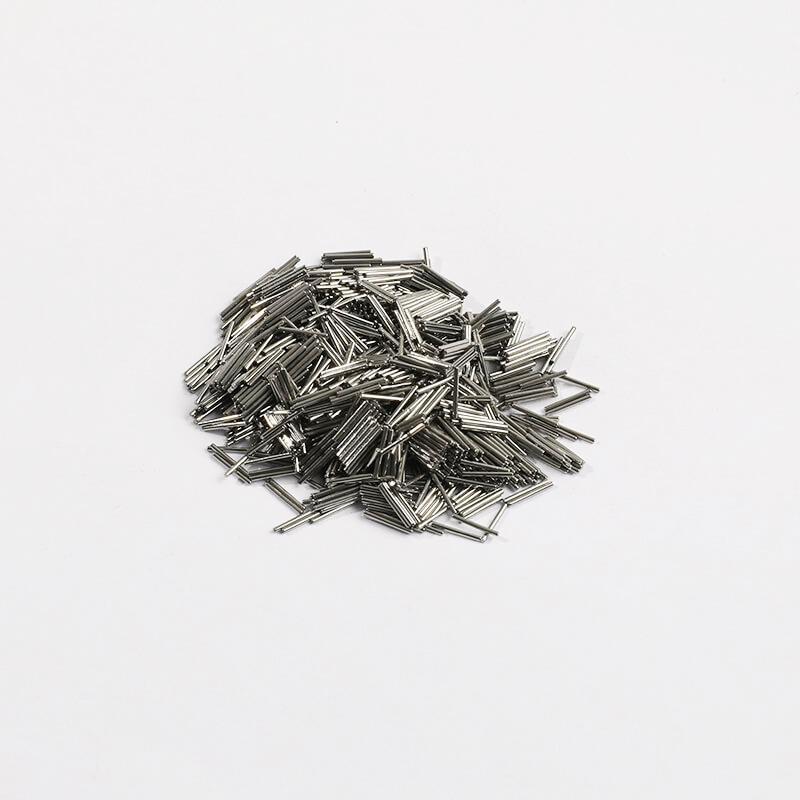
| Plastic media, cylindrical | Light surface refinement on thin rectangular sections where holding the shape matters more than cutting power. | Little cut power, and the size class changes quickly as the media wears, which shifts the texture pitch over a run. |
| Ceramic media, cylinders and other elongated shapes | Linear, directional refinement of the visible faces of round and rectangular profiles after the seam has been cut back. | Flat sides and ends mark differently, and the length-to-diameter ratio limits how far the media reaches into a shallow cove. |
| Ceramic media, angle-cut triangles | Heavier cutting and seam removal on stainless tube and profiles, where a directional linear texture on the visible face is wanted. | Wears down and changes effective size class, generates sludge, and can over-round thin sections or chip on sharp edges. |
| Steel media, pins and balls | Bright, strongly linear appearance on stainless where a higher-lustre finish is wanted on accessible faces. | Heavy, needs tight compound control to stay clean and separated, and any iron-bearing debris is a contamination question the buyer has to define and verify. |
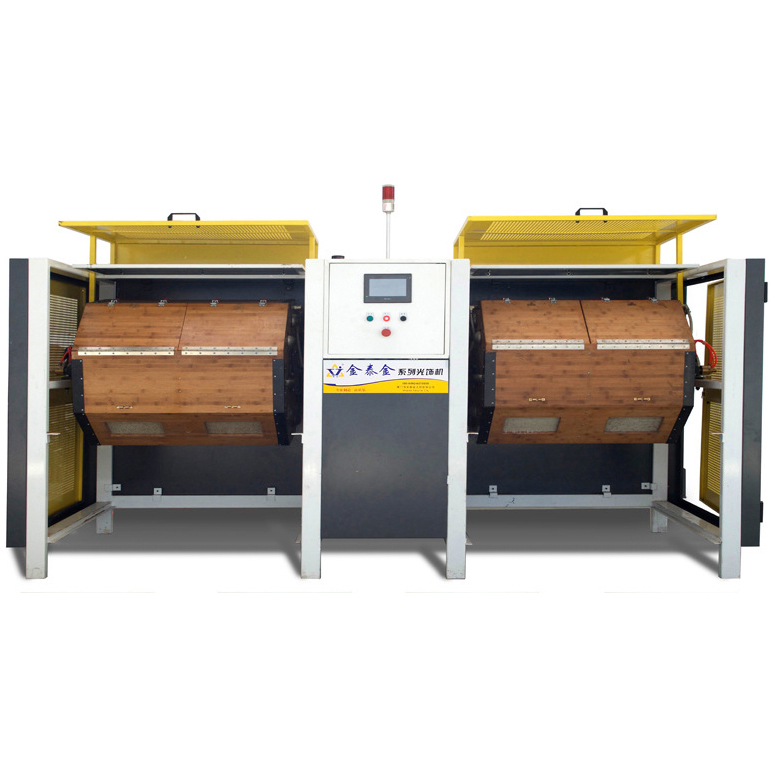
A conventional vibratory bowl moves its load around a circular path in a chamber whose diameter sets the maximum part length. Extending that chamber to take a six-metre length stops being practical, because the volume grows far faster than the usable length. The deeper problem is the bed. A long tube lying in a bowl is either too large a fraction of the load, in which case the media cannot circulate around it, or it is dragged and struck by the rest of the load in a way that produces local marking rather than an even longitudinal texture. The geometry, not the power, is the limitation. This is the practical reason long architectural sections are run in a tub or on a dedicated longitudinal arrangement rather than in a general-purpose bowl.
| Machine route | Where it fits | What it will not do |
|---|---|---|
| Magnetic finishing machine | Small precise parts and localised areas that are difficult to reach with loose media in a conventional chamber. | Size and mass limits keep it away from architectural lengths and large diameter profiles. |
| Centrifugal barrel finishing machine | High-speed finishing of small precise parts, including where a bright appearance is required on a compact geometry. | Chamber geometry and high contact forces rule it out for long, thin-wall or easily marked sections. |
| Dry polishing machine and dryer | Post-wet drying and dry luster work, particularly where a hollow section must come out clean and dry inside. | Dry routes cut less than wet media, and dust control and media separation need planning. |
| Disc finishing machine | Fast, high-energy cycles for small to medium fittings and hardware where a short cycle is the priority. | The high energy that makes it fast will distort, mark or bend thin and long parts. |
Thin-wall and rectangular profiles change shape during finishing more often than they change appearance. A length can bow along its axis, twist, lose its ovality, or take a local dent where it rested on a hard support or struck another part. Rectangular sections are the more vulnerable because the flat faces have no hoop stiffness to resist a load applied across the width. Check geometry the same way on every sample: place the length on a surface plate or a straight reference and measure the gap with a feeler gauge, measure the width across the flat at several stations, and compare the ends with a square. Record the incoming straightness first, otherwise a pre-existing bow is attributed to the finishing line and the argument cannot be settled.
| Failure mode | Likely cause | How to catch it |
|---|---|---|
| Shade change or discolouration at a welded area | The heat-affected zone responds differently to the same media and compound cycle than the parent metal. | Compare the area with adjacent metal under the agreed light and distance, and photograph it with a scale alongside the retained reference. |
| Twist along the length | Differential working of opposite faces, or clamping and stacking that loads the section unevenly. | Rest the length on a reference surface and compare the angular orientation of the two end sections with a square. |
| Orange peel mottling on the visible face | Over-working with a coarse medium, or excessive pressure on a soft or thin section, which deforms the surface rather than cutting it. | Reflect a straight edge or a linear light source in the surface, and take a roughness reading at the same spot to show the divergence between number and appearance. |
| Visible band or line along the mill seam | The seam crown was not cut back evenly, or the media class was too small to reach the seam root without over-working the surrounding surface. | Look along the seam line under raking light from both sides, and measure the remaining crown with a depth gauge on a sectioned sample. |
New York City's industrial base sits in planned industrial parks and industrial business areas rather than heavy plant. The Brooklyn Navy Yard is a 300-acre, city-owned industrial park managed by the Brooklyn Navy Yard Development Corporation, home to more than 550 businesses and approximately 13,000 workers, and the Corporation describes it as one of the City's most important industrial waterfront assets and leases space across industries from the arts to startups and advanced manufacturers. Made in NYC, an initiative of the Pratt Center for Community Development, counts a community of 1,900 New York City makers and manufacturers whose member directory is organised by product and service categories including advanced and specialty manufacturing, metal and jewellery, digital fabrication, wood and furniture, and food and beverage. The region's freight gateway is the Port of New York and New Jersey, which the Port Authority describes as the largest port on the East Coast and the second largest in the nation, and the New York Fed publishes regional economic indicators and monthly surveys covering 22 local areas of the Second District, which includes New York City.
The nearest part of that base to this brief is machinery: The Brooklyn Navy Yard leases to advanced manufacturers among a tenant base of more than 550 businesses and approximately 13,000 workers, and Made in NYC counts a community of 1,900 New York City makers and manufacturers.
New York's finishing demand is dominated by small and mid-size metalworking, fabrication and machining shops rather than one large plant, so the work is typically high-mix and low-volume: architectural and construction metalwork, food-equipment and food-service stainless, and machined or laser-cut components where deburring and edge control are the difference between a part that passes inspection and one that does not. Space, noise and effluent constraints in a dense city also push shops toward barrel, vibratory and disc finishing over processes with heavy waste streams.
The question to settle first is whether the shop is finishing architectural and construction metalwork, food-service stainless, or precision machined parts, because each needs a different balance of edge radius, burr removal and cleanliness - and in a dense city the choice is also constrained by floor space, noise and effluent limits.
Freight context: Port of New York and New Jersey (Port Newark, Elizabeth, Bayonne, Howland Hook, Red Hook), John F. Kennedy International Airport (JFK), Newark Liberty International Airport (EWR), ExpressRail intermodal terminals. The Port Authority of New York and New Jersey describes its port as the largest on the East Coast and the second largest in the nation, and the port's ExpressRail system provides dedicated on-dock rail for each major container terminal, aimed at inland markets including Chicago, the Ohio Valley and Eastern Canada. Imported machinery and sample parts would be entered through CBP at the seaport or at JFK/EWR, with country-of-origin marking and HTSUS classification as part of the entry file.
The United States has no single mandatory national finishing standard. The national standards system is voluntary and consensus-based, coordinated at national level by the American National Standards Institute (ANSI): ANSI published the United States Standards Strategy (USSS) 2025 on 6 January 2026, a strategy that 'guides how the U.S. develops standards and participates in international standardization', while the National Institute of Standards and Technology (NIST) is the federal measurement and standards agency and states that 'Technical standards keep us safe, enable technology to advance, and help businesses succeed.' In practice a buyer specifies surface finish, deburring, cleaning and coating requirements on the drawing or in the purchase order using the voluntary consensus standards maintained by bodies such as ASME and ASTM International and their ISO equivalents, and the acceptance criterion is the buyer's own specification rather than a government-issued finishing standard. Where a part is destined for a regulated product - pressure equipment, food-contact equipment, aerospace or medical devices - the relevant industry code or the customer's qualification requirement governs instead.
The United States has no free-trade agreement with China, so Chinese industrial machinery enters under normal-trade-relations (MFN) duty rates in the Harmonized Tariff Schedule of the United States plus any Section 301 duty that applies to the specific HTSUS subheading. USTR's four-year-review modification of the Section 301 China technology-transfer investigation imposed additional Section 301 duties or increased existing rates on certain Chinese products in strategic sectors, and created a temporary exclusion process for machinery used in domestic manufacturing: chapters 84 and 85 of the HTSUS, which cover most machinery used in manufacturing processes, are the chapters that were made eligible for exclusion requests. CBP still administers Section 301 China duties, the four-year-review increases and product exclusions. The IEEPA-based additional ad valorem duties of 2025 - including the reciprocal-tariff actions and the China synthetic-opioid supply-chain duties imposed under Executive Orders 14195 and 14257 - were ordered terminated by Executive Order 14389 of 20 February 2026 and, as soon as practicable, are no longer collected. A buyer should therefore price the MFN rate plus any applicable Section 301 rate and check whether the machine's exact subheading is covered by a current exclusion, rather than assuming either the 2025 IEEPA tariffs or a blanket China rate still applies.
SurfacePolish supplies from Xiamen, China. The buyer's own destination rules, conformity marking, tariff classification and documentation responsibilities stay with the buyer; confirm them against the authorities named above before ordering.
A six-metre length cannot be examined in every square millimetre, so the acceptance plan has to say where the checked zones are and how often they are checked. Define stations along the length, for example near each end and at one or two intermediate points, decide whether the visible face of every length is checked or only a percentage of the batch, and set the reaction when a station fails: quarantine the lot, measure the rest of the lot, and record the finding. Keep the first accepted length as a physical reference and re-photograph it under the agreed light whenever the lighting setup changes. Photographs taken on different days with different cameras are a poor substitute for the retained part, though they are useful supporting evidence when the setup is fixed.
Send cut sections from the actual production material, roughly 300 to 500 mm long, taken from at least three places along the delivery rather than from one offcut, and cover every wall thickness and profile in the order. Add one full-length piece where bend, twist or end effects could matter, because a short coupon does not reproduce how a long, unsupported length behaves in a bed. Include one length in the condition that most often arrives: a mill seam, a fabricator's weld, a transit scratch. If the buyer has an existing part whose appearance is acceptable, send that as a reference too, with a note on where it was viewed from. Label every piece with profile, alloy, wall, provenance and what should be observed on it.

Directional satin textures usually come from elongated or angular media rather than spheres. Angle-cut triangles and cylinders strike along their axis and leave a linear pattern, while rounded shapes produce overlapping craters that read soft and slightly dimpled. The size class then has to reach the root of a mill seam or the cove of a rectangular profile without lodging in the bore or a fixing hole. Media selection is confirmed against the actual part in a trial, because the incoming grain, the wall thickness and the visible face all shift the answer. Send sections from the production delivery and say which face must carry the grain.
No. A sample trial produces observations on the parts that were tested under the settings used; it is not a guarantee of a roughness value, a surface class, an appearance or a repeatable production result. Media wear, compound concentration and the condition of incoming material all move the finish over a run. What we can do is show what a given media, compound and cycle direction did to your part, and describe what would need to be controlled to hold that result. Acceptance criteria and any promise made to a client or specifier remain your own.
No. SurfacePolish is a cross-border supplier of finishing machines, media and compounds, and runs a free sample trial on parts the buyer sends. The tube, pipe and profiles remain the buyer's own material from their own mill or stockholder, and we do not verify its grade, mill certificate or corrosion performance. Keeping those roles separate matters, because the appearance a finishing line can reach is limited by the incoming material: its alloy, its hardness, its existing grain and the condition it arrives in. Send material from the actual delivery rather than a hand-picked offcut.
Use New York, United States as the destination on the enquiry and state whether the deliverable is equipment, media and compound, a representative sample review or a line concept. A destination does not imply local stock, a local service point or a local delivery time.
A New York buyer works in the US voluntary-consensus system coordinated by ANSI, with surface-finish, cleaning and coating requirements written into the drawing, purchase order or the building/food-service specification. New York City construction and food-service work adds local code and health-department requirements, and food-contact or medical work adds the customer's own material-conformity and cleanliness requirements on top.
Sources were retrieved on 2026-09-29 and describe the local industrial and trade context only. They do not evidence any SurfacePolish project, shipment, installation or service in New York.
The long spindles and the small finials need different handling, yet the finished appearance has to read the same on both.
Send the material, dimensions, approximate weight, batch quantity, the incoming condition and photographs of the difficult features. Mark which features must not be contacted by media and state how the result will be inspected. This form carries source reference PSEO-0047; quote it if you prefer an additional manual reference.
Open the SurfacePolish enquiry form Email a prepared enquiry
No price, lead time, certification or result is promised here. Confirm whether a sample trial is available for the specific part and what the trial can and cannot show.
Page PSEO-0047 · revised 2026-09-29 · cross-border equipment, media and scoped sample review. City context is sourced and cited above.
Use this local checker to identify missing part and inspection information. It prepares a technical-review brief; it does not approve a machine, process recipe or production result.
Complete the part details to prepare a review brief.
Email : info@surface-polish.com


 IPv6 network supported


 +86-592-2381506