A metalwork shop in Newcastle, Australia building architectural metalwork assemblies joins 1.5 m stainless tube to a cast elbow with a circumferential weld, and the joint has to disappear into the grain rather than read as a band. SurfacePolish supplies finishing machines, media and compounds across borders and runs a free sample trial on welded samples shipped to Xiamen. This brief is written for a buyer in Newcastle working on architectural metalwork; it describes equipment, media and a scoped sample review, not a local polishing service.
What is the longest length in the order, and how will it be supported, carried and packed at every stage between finishing, fabrication and installation?
Which wall thickness and section shape in the order is most likely to distort, and what fixture, cradle or support will protect it?
How much of the incoming mill seam, joint weld or transit scratch must be removed, and what minimum wall thickness has to remain after that removal?
Not every face of a profile deserves the same effort. On a wall-mounted handrail the top and the outward face are read from standing height and from an angle, while the underside and the face against the wall are largely out of view. On a cladding mullion the sun-facing plane carries the reflection and the returns do not. Build a simple exposure map: which face, viewed from where, under what light, at what distance. That map settles where the tighter finish is specified and where a coarser one is honest. It also prevents over-finishing hidden faces, which costs cycle time and raises the risk of distortion on thin sections, and it tells the finishing supplier which face must be protected in every rack and stillage.
A balustrade or handrail job is never only long runs. It also contains cut-to-length spindles, elbows, brackets, base plates, ball finials and short connector sleeves, often in the same alloy and finish. Those parts are a poor fit for a longitudinal arrangement and a good fit for batch equipment, where a large number of small identical parts can be processed together with controlled part-on-part contact. Treating the two populations as one route is a common planning error: the runs are under-processed because the settings were chosen for the fittings, or the fittings are over-worked and lose their edges. Screen the order into long runs and small fittings, then specify the media class separately for each, even where the final appearance has to read the same.
| Machine route | Where it fits | What it will not do |
|---|---|---|
| Dry polishing machine and dryer | Post-wet drying and dry luster work, particularly where a hollow section must come out clean and dry inside. | Dry routes cut less than wet media, and dust control and media separation need planning. |
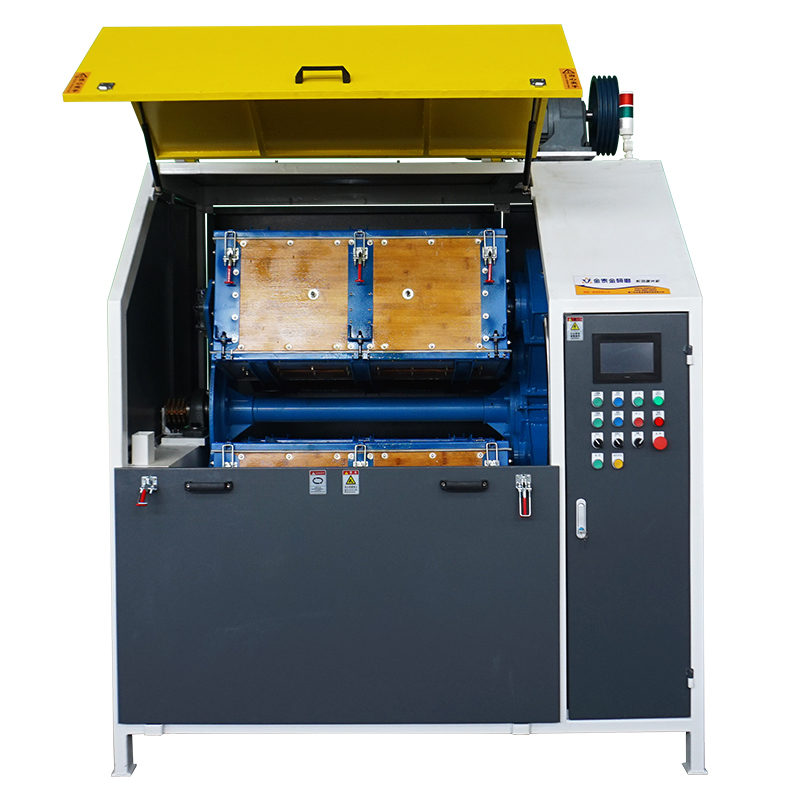
| Centrifugal barrel finishing machine | High-speed finishing of small precise parts, including where a bright appearance is required on a compact geometry. | Chamber geometry and high contact forces rule it out for long, thin-wall or easily marked sections. |
| Tub vibrator | Long and large parts such as architectural tube and profiles, where the process length has to extend along the part. | Bed depth and fixture design decide whether thin sections survive, and fluid flow has to be checked at the far end of the chamber. |
| Magnetic finishing machine | Small precise parts and localised areas that are difficult to reach with loose media in a conventional chamber. | Size and mass limits keep it away from architectural lengths and large diameter profiles. |
The compound carries cut debris away, keeps the media from loading, and buffers the chemistry against the metal. For stainless work the choice sits between mildly acidic, neutral and alkaline families, with the selection driven by the alloy, the incoming surface and the buyer's own residue limits rather than by a fixed rule. The behaviour that matters most on tube is rinsing. A compound that clings inside a six-metre bore will bleed out later onto a visible face and read as a stain or a patch. Pick a family that rinses cleanly, specify the rinse stages and the drying step, and agree how the interior of a sample length will be checked after the trial rather than assuming it is clean.
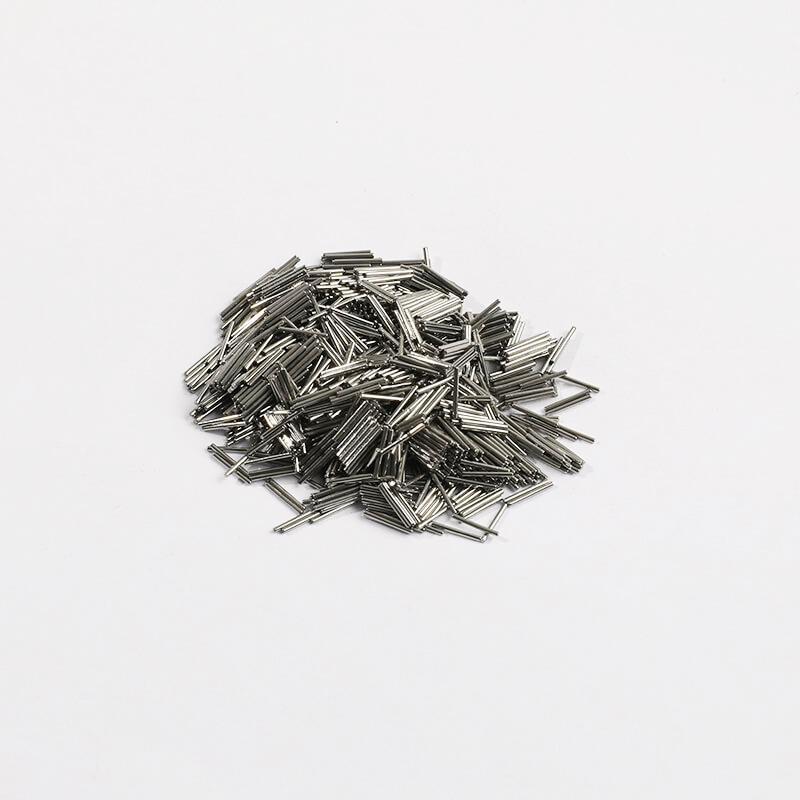
| Media | Best fit | Watch out for |
|---|---|---|
| Grinding media, alumina-based | Higher material removal where a mill seam, a joint weld or a deep transit scratch has to be cut back before refining. | Aggressive on thin wall, can over-round edges and change cross-section geometry, and needs tight depth control. |
| Steel media, pins and balls | Bright, strongly linear appearance on stainless where a higher-lustre finish is wanted on accessible faces. | Heavy, needs tight compound control to stay clean and separated, and any iron-bearing debris is a contamination question the buyer has to define and verify. |
| Plastic media, cones and triangles | Gentle work on thin-wall sections and softer alloys, and where marking or distortion is the main risk to be managed. | Slower cut and shorter media life, with limited effect on a deep scratch or a heavy seam. |
| Dry media, walnut shell and corn cob | Dry polishing and support for post-wet drying, particularly where a hollow section must not stay wet or carry residue inside. | Low cutting power, and dust generation and media separation need managing in the surrounding area. |
A surface can measure inside a roughness band and still fail visually. Orange peel, a mottled texture with a pitch of a few millimetres, appears when the surface is over-worked with a coarse medium or worked with too much pressure on a soft or thin section. Hazing is the diffuse, milky appearance that follows a fine but non-uniform cut. Both are geometry effects rather than amplitude effects, so a profilometer reading across them may be entirely acceptable while a reflection test shows a broken image. This is why an architectural finish cannot be accepted on a roughness number alone, and why a visual standard viewed under defined light at a defined distance has to sit beside the numeric one. Ra and appearance answer different questions.
| Failure mode | Likely cause | How to catch it |
|---|---|---|
| Hazy or milky patch with a dull reflection | Uneven cut, worn media in part of the chamber, or weak compound flow at the far end of a long tub. | Compare the near end and the far end of the same length, and check compound concentration and fluid flow at both ends of the chamber. |
| Dents and part-on-part nibbling | Parts running loose together in the load, or a finished part contacting a bare support or another length. | Inspect the contact line between parts with side lighting, and run a straightedge over the damaged area to judge depth. |
| Orange peel mottling on the visible face | Over-working with a coarse medium, or excessive pressure on a soft or thin section, which deforms the surface rather than cutting it. | Reflect a straight edge or a linear light source in the surface, and take a roughness reading at the same spot to show the divergence between number and appearance. |
| Longitudinal scratch running along the part axis | Incoming coil or straightener marks, media or swarf dragged along the surface during the cycle, or a finished length sliding over a bare support between operations. | View the surface under raking light at a low angle along the axis, compare the same station on several parts, and compare against the retained reference panel. |
Newcastle is the manufacturing and export centre of the Hunter, which the NSW Government describes as the largest regional economy in Australia, with a population of 774,587 and named key industries of advanced manufacturing, defence and aerospace, renewable energy, food and wine, tourism, education, mining and health care. The region's industrial identity was built on coal and heavy industry, and mining and energy remain foundational, but the current growth is in advanced manufacturing and defence: the NSW Government identifies Williamtown, the Hunter Energy Hub at Muswellbrook, the Port of Newcastle and the John Hunter Health Innovation Precinct as growth precincts. Newcastle Airport, 20 minutes north of the city, anchors a defence and aerospace hub with the Astra Aerolab precinct adjoining RAAF Base Williamtown, specialising in defence sustainment and manufacturing; the airport's terminal and runway upgrades are intended to open up air freight as well as tourism. The Port of Newcastle is described by the NSW Government as Australia's third-largest port and by the port authority as the largest port on the East Coast and Australia's oldest export port, and the Hunter's research base includes the CSIRO Energy Centre and the University of Newcastle.
The nearest part of that base to this brief is machinery: RDA Hunter records that the region is evolving from traditional heavy industry to high-value advanced manufacturing, and the NSW Government names advanced manufacturing among the Hunter's key industries alongside the Port of Newcastle and dedicated industrial land connected by road and rail.
The Hunter's advanced manufacturing and defence supply chains work in steel, aluminium and exotic alloys for mining equipment, rail, defence structures and aircraft sustainment components, where cut edges and weld-prep surfaces must be deburred and radiused before welding, coating or assembly. Components destined for defence sustainment work and for mining equipment operating in abrasive conditions are typically specified with defined edge condition and surface preparation requirements, and heavy plate and machined parts often need a finishing step that removes oxide and burrs without changing dimensions. Fabricators supplying both sectors also need to control media contamination between ferrous and aluminium work to avoid cross-metal corrosion.
A Hunter buyer should settle early whether the finishing step is being used for weld preparation, for edge radius control on a load-bearing or fatigue-critical defence or mining component, or simply for cosmetic clean-up, because those three cases imply different media, different process times and different inspection evidence.
Freight context: Port of Newcastle (largest port on the East Coast, Australia's oldest export port, operated landside by Port of Newcastle), Newcastle Airport (international terminal, Code E runway, adjoining Astra Aerolab and RAAF Base Williamtown), M1 Pacific Motorway and Hexham Straight road freight corridor; Sydney-Newcastle railway. RDA Hunter records the Port of Newcastle handling between 150 million and 166 million tonnes of trade annually with deepwater capacity currently operating at roughly 50%, plus significant industrial land connected by road and rail. Newcastle Airport's new international terminal, part of a $110 million expansion within a broader $250 million precinct investment, introduced swing-gate functionality and wide-body aircraft capability, and RDA Hunter states the improvements boost freight capability. Incoming finishing machines and sample parts can therefore arrive by sea through Newcastle or by air through Newcastle Airport, with the M1/Hexham Straight programme improving corridor reliability.
Australia and China are parties to the China-Australia Free Trade Agreement (ChAFTA), signed on 17 June 2015 and in force since 20 December 2015; the Australian Border Force maintains a dedicated ChAFTA page and working tariff schedule, and FTAs give importers a route to preferential rates of duty where the rules of origin are met. China was Australia's largest source of imports in 2025 at $130.2b, up 12.5% on 2024, and 56% (69,567) of Australian business importers traded at least once with China in 2020-21. A Chinese supplier of finishing machines, media or compounds is therefore shipping into Australia's single largest import stream, and preferential duty depends on origin documentation rather than on a blanket zero-tariff guarantee for every product line.
The Australian Border Force (ABF) is the customs authority and clears imported goods through customs; all goods arriving in Australia must be declared unless an exception applies, goods valued at up to A$1,000 can be imported without a formal import declaration, and entry is made through the Integrated Cargo System (Form B650 for sea or air cargo). Generally all goods imported into Australia are liable for duties and taxes unless an exemption or concession applies, and most imports are subject to 10% GST, so classification, customs valuation and any preferential tariff claim drive the landed cost; a licensed customs broker is the normal route for a first-time importer. Electrical equipment can fall under the Electrical Equipment Safety System, under which the first Australian supplier registers as a Responsible Supplier, holds an ABN, makes a Responsible Supplier Declaration and marks the equipment with the Regulatory Compliance Mark (RCM) in accordance with AS/NZS 4417.1 and AS/NZS 4417.2. Imported goods may also require a trade description naming the country of manufacture, and machinery that is not in-scope electrical equipment still has to meet state work health and safety duties covering plant.
SurfacePolish supplies from Xiamen, China. The buyer's own destination rules, conformity marking, tariff classification and documentation responsibilities stay with the buyer; confirm them against the authorities named above before ordering.
An architectural finish is graded by what an observer sees, so the acceptance standard has to name the viewing distance and the light. A panel that looks uniform from three metres can show every mark from half a metre, and a finish assessed under direct sun reads differently from one assessed under diffuse daylight or a linear light source. Agree the distance for the closest inspection the installed part will receive, the lighting condition, and the viewing angle, then write them into the finish callout. A practical arrangement is a physical reference panel accepted once by the buyer, kept in controlled storage, and used as the comparison standard. Numerical limits can sit beside it, but the panel is what a dispute is actually settled against.
If two media classes or two cycle settings are being compared, run them on adjacent cut sections from the same original length so the only difference is the variable under test. Keep the position in the load and the cycle length the same where possible, label the pieces before they are run, and have the returned parts judged together in one session under the agreed light rather than one at a time as they arrive. Where several people are judging, ask each to rank the pieces before discussing them, so the strongest opinion does not set the answer. A handful of sections can compare two settings; what cannot be compared is one section from a trial run one week against another run later under different conditions.
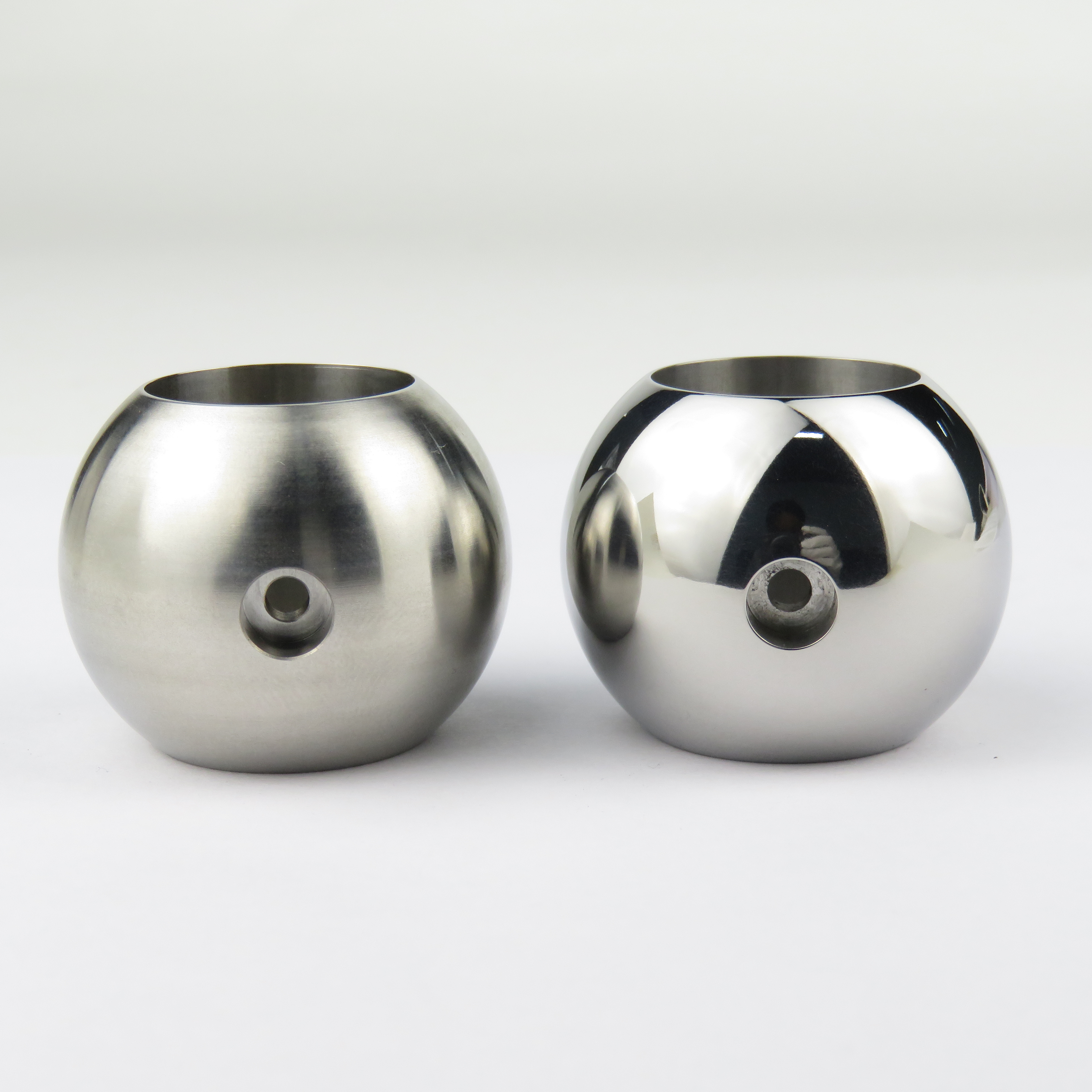
Lay the lengths end to end as they will be installed, under the light and at the distance agreed for acceptance, and look along the run rather than at each piece separately. A direction reversal or a change in texture pitch that is invisible on a single length usually shows immediately at the joint. The planning side matters more than the inspection: mark the grain direction on every length and keep the orientation through fabrication, packing and despatch. Where the finished parts come from different batches, compare each against the retained reference panel under the same conditions.
Support the profile rather than letting it lie loose. Cradles shaped to the section, dividers or compartments that keep lengths apart, end plugs that hold the open section, and controlled orientation in the bed all reduce the load a flat face sees. Rectangular sections are more exposed than round ones because a flat face has no hoop stiffness across its width, so the thinnest wall in the order should set the fixture design. Send the thinnest and widest section you use, not an average one, so the trial is run against the part most likely to distort.
No. SurfacePolish does not supply or carry out electropolishing. Where electrochemical treatment is part of the buyer's requirement, we treat it as a comparison point and as a reason to look at what a mechanical route can achieve on the same part, and we can discuss media, compound and machine options for that mechanical route. A mechanical finish should not be presented as equivalent to an electropolished surface, and the choice between the two, together with any specification that depends on it, belongs to the buyer's own engineering decision.
Use Newcastle, Australia as the destination on the enquiry and state whether the deliverable is equipment, media and compound, a representative sample review or a line concept. A destination does not imply local stock, a local service point or a local delivery time.
Newcastle buyers work to Australian Standards administered by Standards Australia, and electrical equipment must carry the Regulatory Compliance Mark under AS/NZS 4417.1 and AS/NZS 4417.2 where in scope. Defence and aerospace suppliers in the Williamtown/Astra Aerolab supply chain additionally work to Defence procurement specifications and mission-assurance requirements, and mining equipment suppliers commonly reference client-specific surface and inspection requirements.
Sources were retrieved on 2026-09-29 and describe the local industrial and trade context only. They do not evidence any SurfacePolish project, shipment, installation or service in Newcastle.
The joint weld has to disappear into the grain so the joint does not read as a dark or bright band in the finished run.
Send the material, dimensions, approximate weight, batch quantity, the incoming condition and photographs of the difficult features. Mark which features must not be contacted by media and state how the result will be inspected. This form carries source reference PSEO-0767; quote it if you prefer an additional manual reference.
Open the SurfacePolish enquiry form Email a prepared enquiry
No price, lead time, certification or result is promised here. Confirm whether a sample trial is available for the specific part and what the trial can and cannot show.
Page PSEO-0767 · revised 2026-09-29 · cross-border equipment, media and scoped sample review. City context is sourced and cited above.
Use this local checker to identify missing part and inspection information. It prepares a technical-review brief; it does not approve a machine, process recipe or production result.
Complete the part details to prepare a review brief.
Email : info@surface-polish.com


 IPv6 network supported


 +86-592-2381506