An interior fit-out contractor in Rotterdam, Netherlands is working on architectural metalwork with 3 m flat oval stainless tube, 60 x 20 mm, and the buyer's own inspector is rejecting the brightness under raking light rather than by roughness number. SurfacePolish supplies finishing machines, media and compounds across borders and runs a free sample trial on cut sections shipped to Xiamen. This brief is written for a buyer in Rotterdam working on architectural metalwork; it describes equipment, media and a scoped sample review, not a local polishing service.
What texture direction is required, and how will that direction be preserved and compared across lengths that are finished in different lots?
Which faces of each profile are actually seen when installed, from what distance and under what light, and which faces can be finished to a coarser standard without it showing?
Will the finish be judged by a roughness number, by a physical reference panel, or by both, and who views the parts before they are accepted?
Once a length runs past roughly a metre and a half, handling stops being a detail and becomes the deciding constraint. A six-metre handrail cannot be turned in a chamber, cannot be stacked with its finished face against another part, and cannot be lifted by two people without risk of a bow. The screening questions are: what is the longest length in the order, how is it moved to and from finishing, is it cut to final size before or after finishing, and what supports it at every stage. Answering these sets the machine class, the cradle design and the inspection points. A buyer who fixes the finish specification first and the handling plan later usually discovers the finish cannot be held on the long lengths that matter most.
Compound concentration, flow rate and water quality need managing along the whole chamber, not just at the inlet. In a long tub the fluid front can arrive weaker at the far end, so media there cuts differently and the finish drifts from one end of a part to the other. Hard water leaves scale and spotting; very soft water may foam differently with the same compound. Foam is a real constraint in a tub because it cushions the media and reduces cut, and it overflows into the surrounding area. Set concentration by measurement rather than by appearance, check flow at both ends of the chamber, and plan drag-out and rinse-water handling before the first production run.
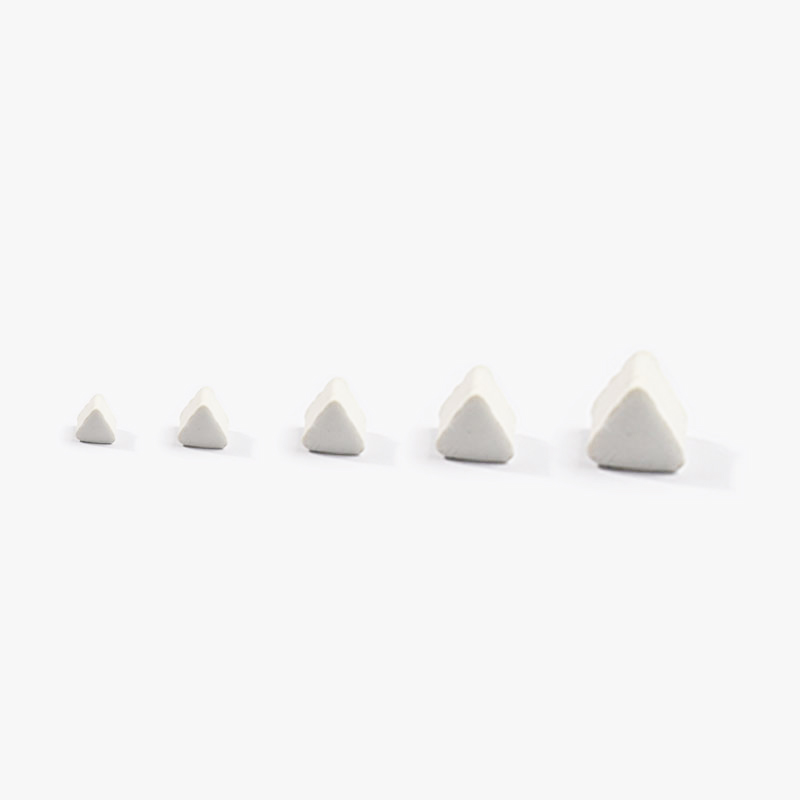
| Media | Best fit | Watch out for |
|---|---|---|
| Dry media, walnut shell and corn cob | Dry polishing and support for post-wet drying, particularly where a hollow section must not stay wet or carry residue inside. | Low cutting power, and dust generation and media separation need managing in the surrounding area. |
| Plastic media, cylindrical | Light surface refinement on thin rectangular sections where holding the shape matters more than cutting power. | Little cut power, and the size class changes quickly as the media wears, which shifts the texture pitch over a run. |
| Grinding media, alumina-based | Higher material removal where a mill seam, a joint weld or a deep transit scratch has to be cut back before refining. | Aggressive on thin wall, can over-round edges and change cross-section geometry, and needs tight depth control. |
| Ceramic media, cylinders and other elongated shapes | Linear, directional refinement of the visible faces of round and rectangular profiles after the seam has been cut back. | Flat sides and ends mark differently, and the length-to-diameter ratio limits how far the media reaches into a shallow cove. |
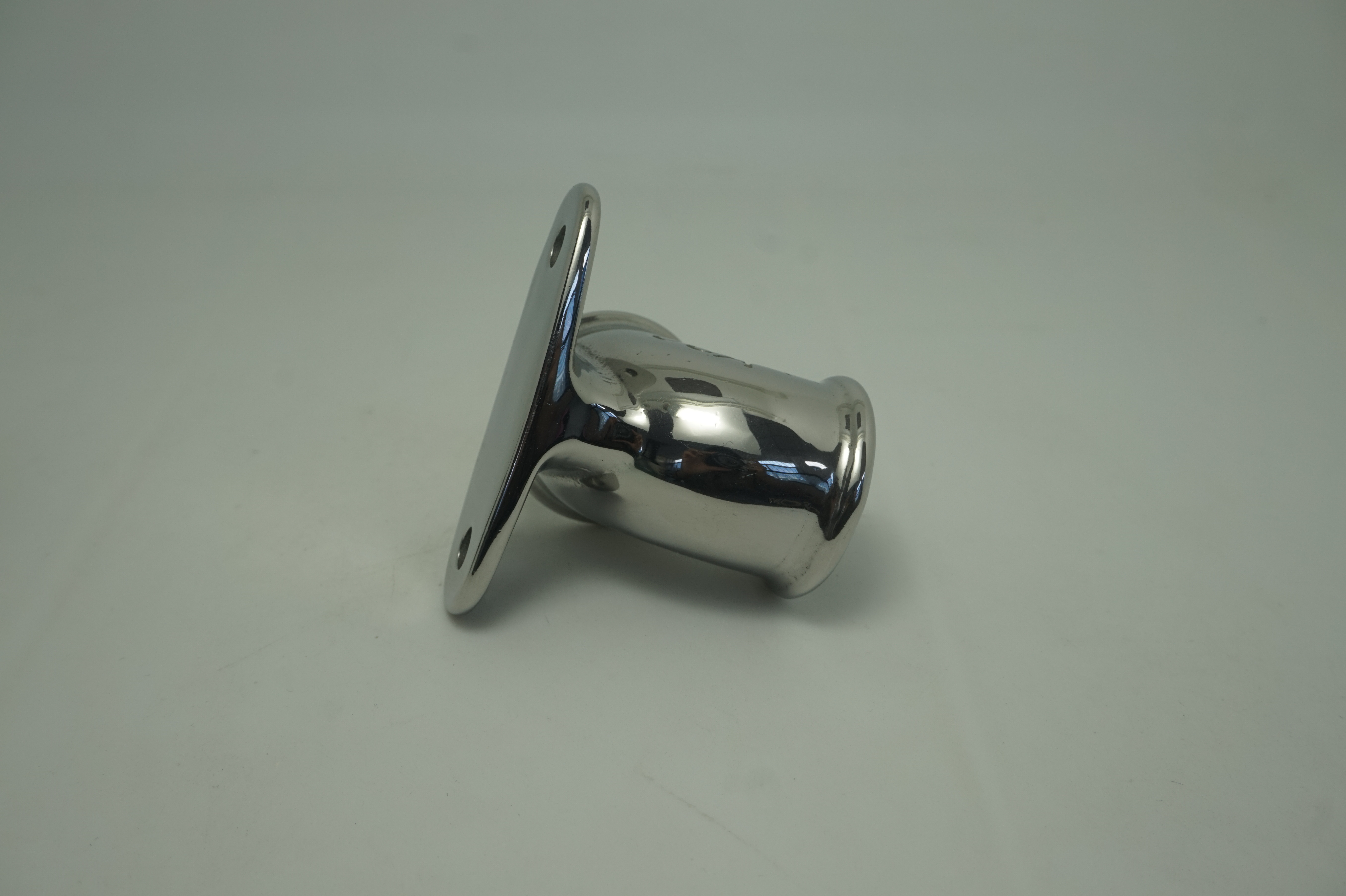
A balustrade or handrail job is never only long runs. It also contains cut-to-length spindles, elbows, brackets, base plates, ball finials and short connector sleeves, often in the same alloy and finish. Those parts are a poor fit for a longitudinal arrangement and a good fit for batch equipment, where a large number of small identical parts can be processed together with controlled part-on-part contact. Treating the two populations as one route is a common planning error: the runs are under-processed because the settings were chosen for the fittings, or the fittings are over-worked and lose their edges. Screen the order into long runs and small fittings, then specify the media class separately for each, even where the final appearance has to read the same.
| Machine route | Where it fits | What it will not do |
|---|---|---|
| Barrel finishing machine, rotary barrel tumbling | Gentle, precise batch processing of small parts, finials, sleeves and short connector pieces. | Part length and part-on-part contact restrict it to short fittings rather than long architectural runs. |
| Tub vibrator | Long and large parts such as architectural tube and profiles, where the process length has to extend along the part. | Bed depth and fixture design decide whether thin sections survive, and fluid flow has to be checked at the far end of the chamber. |
| Dry polishing machine and dryer | Post-wet drying and dry luster work, particularly where a hollow section must come out clean and dry inside. | Dry routes cut less than wet media, and dust control and media separation need planning. |
| Centrifugal barrel finishing machine | High-speed finishing of small precise parts, including where a bright appearance is required on a compact geometry. | Chamber geometry and high contact forces rule it out for long, thin-wall or easily marked sections. |
Thin-wall and rectangular profiles change shape during finishing more often than they change appearance. A length can bow along its axis, twist, lose its ovality, or take a local dent where it rested on a hard support or struck another part. Rectangular sections are the more vulnerable because the flat faces have no hoop stiffness to resist a load applied across the width. Check geometry the same way on every sample: place the length on a surface plate or a straight reference and measure the gap with a feeler gauge, measure the width across the flat at several stations, and compare the ends with a square. Record the incoming straightness first, otherwise a pre-existing bow is attributed to the finishing line and the argument cannot be settled.
| Failure mode | Likely cause | How to catch it |
|---|---|---|
| Orange peel mottling on the visible face | Over-working with a coarse medium, or excessive pressure on a soft or thin section, which deforms the surface rather than cutting it. | Reflect a straight edge or a linear light source in the surface, and take a roughness reading at the same spot to show the divergence between number and appearance. |
| Dents and part-on-part nibbling | Parts running loose together in the load, or a finished part contacting a bare support or another length. | Inspect the contact line between parts with side lighting, and run a straightedge over the damaged area to judge depth. |
| Bow along the length | Unsupported part in the bed, resting on hard supports, or lengths stacked while still wet. | Place on a surface plate or straight reference and measure the gap with a feeler gauge at several stations, against the incoming straightness record. |
| Media or swarf trapped in a bore or channel | Open ends left unplugged, a media class smaller than the opening, or no defined retrieval step at the end of the cycle. | Endoscope or internally swab every sample length, and count media into and out of the batch as a routine check. |
Rotterdam is the Dutch mainport and the centre of Europe's largest maritime, port and industrial complex, with refining, chemicals, bulk and container handling concentrated in the port and industrial area. Deltalinqs represents over 95% of the logistics, port and industrial enterprises in the mainport, with more than 700 member companies drawn from fourteen sectors; the mainport accounts for 2.9% of Dutch GDP and roughly 192,000 jobs in Rotterdam-Rijnmond, while the port as a whole supports over 500,000 jobs and more than EUR 60 billion of added value nationally. Municipal and provincial policy documents describe the cluster as the largest industry and energy cluster in Europe.
The nearest part of that base to this brief is marine: Rotterdam Partners, the city's trade and investment organisation, states that the port is the centre of Europe's biggest maritime cluster.
Refining, chemical, bulk and maritime maintenance in the port generates a steady flow of valves, pump and heat-exchanger components, flanges and machined spares, where burrs, sharp edges and surface condition affect sealing, flow and coating adhesion. This is mostly repair and overhaul work rather than high-volume series production, so batch flexibility and cross-contamination control between carbon steel, stainless and higher-alloy parts matter more than cycle time.
A Rotterdam-area buyer should first settle which material families one finishing line must handle — carbon steel, stainless, duplex or nickel alloy — and whether the parts are pre-coating (needing a defined Ra and cleanliness) or in-service spares (needing edge and burr control only), because that fixes the media and compound choice.
Freight context: Port of Rotterdam (Europoort and Botlek industrial areas, Waalhaven). The port combines deep-sea, short-sea, inland barge and rail freight, and 192,000 jobs in Rotterdam-Rijnmond are linked to the harbour. Machines and sample parts arriving from outside the EU are declared to Dutch Customs at the point of entry; the Deltalinqs membership base is dominated by logistics, port and industrial enterprises.
Business is conducted in Dutch, but engineering and procurement communication in these sectors is routinely handled in English. Buyers are KVK-registered legal entities and expect a clear commercial entity to contract with, an EORI number for customs, correct HS/TARIC classification, and a full CE technical file including the EC Declaration of Conformity and a manual in the correct language; a technical construction file held by the manufacturer is normally part of the qualification pack. For EU-internal supply the invoice carries 0% VAT with the customer's VAT identification number and the customer accounts for 21% Dutch VAT in its own return, so a Chinese seller shipping directly from outside the EU must be clear about who is importer of record and who carries the duty and import VAT. Trade and investment support is organised through bodies such as KVK, RVO, the regional development agencies and the Trade and Innovate NL network, and the Dutch technology industry is represented by FME.
The Netherlands applies the EU's common commercial policy, so imports of Chinese industrial machinery enter under EU customs rules and WTO tariff treatment rather than under a bilateral EU-China free-trade agreement; the European Commission also maintains trade-defence measures on selected Chinese product categories, and China is a WTO member. EU-China trade in goods reached EUR 732 billion in 2024, and in 2025 manufactured goods were 97.3% of EU imports from China, with machinery and vehicles alone accounting for 54.4% — the single largest category. Chinese finishing machines, media and compounds therefore arrive in a very large, well-established EU import stream, and the buyer should expect MFN duty plus trade-defence measures where a specific product is covered.
SurfacePolish supplies from Xiamen, China. The buyer's own destination rules, conformity marking, tariff classification and documentation responsibilities stay with the buyer; confirm them against the authorities named above before ordering.
Brushed stainless is not a specification, and a finish described only in words cannot be accepted or rejected consistently. The callout on the drawing or the purchase order should say what the texture direction is, which faces carry it, the roughness limit and the measurement conditions if a number is used, the reference panel and the viewing distance, and which faces are exempt. It should also say what is protected: threads, fixing holes, cut ends, machined lands. Where the buyer cannot express the finish numerically, a physical reference sample with a written description of its texture direction and appearance is still far better than an adjective. Sorting this out before a trial is what allows the trial result to be compared against a real requirement.
Send cut sections from the actual production material, roughly 300 to 500 mm long, taken from at least three places along the delivery rather than from one offcut, and cover every wall thickness and profile in the order. Add one full-length piece where bend, twist or end effects could matter, because a short coupon does not reproduce how a long, unsupported length behaves in a bed. Include one length in the condition that most often arrives: a mill seam, a fabricator's weld, a transit scratch. If the buyer has an existing part whose appearance is acceptable, send that as a reference too, with a note on where it was viewed from. Label every piece with profile, alloy, wall, provenance and what should be observed on it.
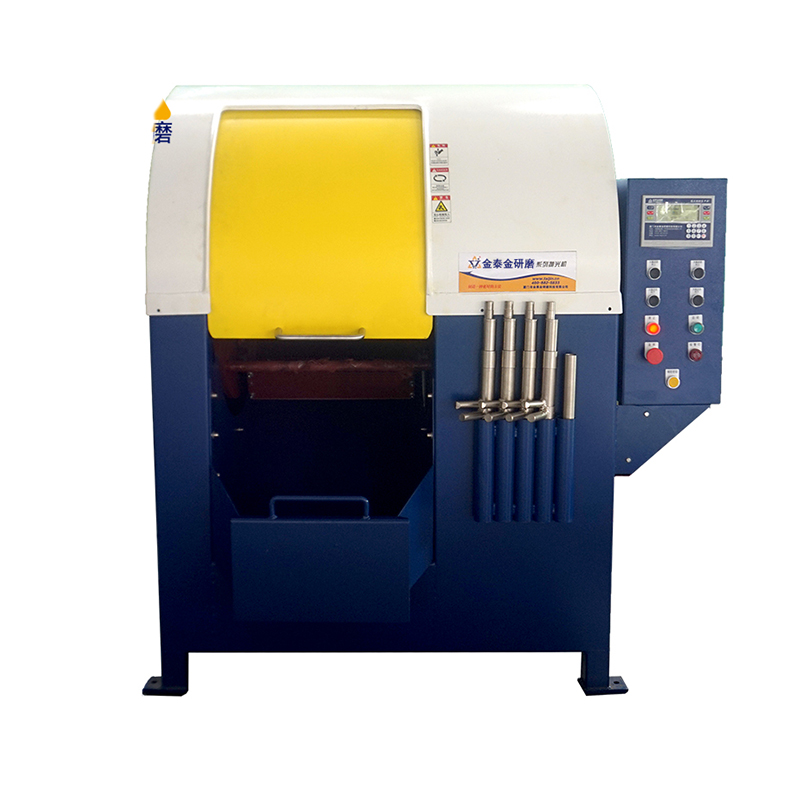
It depends on the order book rather than on the profile alone. A tub suits mixed work and shorter runs, because the set-up changes with the part and the chamber can take several profiles. A dedicated arrangement that carries the length past fixed heads, or moves heads along a stationary length, sets the texture direction by machine axis and holds it better over repeated runs, at the cost of floor space and changeover when the profile or length changes. Bring the profile mix, the typical and maximum lengths and the annual volume into the line-concept discussion; we can scope it, though the choice is yours.
No. SurfacePolish does not supply or carry out electropolishing. Where electrochemical treatment is part of the buyer's requirement, we treat it as a comparison point and as a reason to look at what a mechanical route can achieve on the same part, and we can discuss media, compound and machine options for that mechanical route. A mechanical finish should not be presented as equivalent to an electropolished surface, and the choice between the two, together with any specification that depends on it, belongs to the buyer's own engineering decision.
Length is a handling question before it is a finishing question. Long architectural sections are run in a tub or on a dedicated longitudinal arrangement rather than a round bowl, and the practical limit depends on the chamber length, the supports available and how the length is packed for shipping. For a trial, send cut sections from the production material and one full-length piece where bend or end effects could matter, so the arrangement is chosen against the real part rather than an average. Parts travel to our factory in Xiamen, and we do not process anything in Netherlands or Rotterdam.
Use Rotterdam, Netherlands as the destination on the enquiry and state whether the deliverable is equipment, media and compound, a representative sample review or a line concept. A destination does not imply local stock, a local service point or a local delivery time.
Buyers here work to the CE machinery regime (Machinery Regulation replacing the Machinery Directive, compliance by 20 January 2027) and to the Dutch/EN-ISO surface-finishing standards published by NEN, such as NEN-EN-ISO 2080 for metal-finishing terminology. In the port and process industries, client specifications for coating preparation, cleanliness and material conformity usually sit on top of those base standards.
Sources were retrieved on 2026-09-29 and describe the local industrial and trade context only. They do not evidence any SurfacePolish project, shipment, installation or service in Rotterdam.
An inspector is rejecting the delivered appearance under raking light even though roughness readings sit inside the stated band.
Send the material, dimensions, approximate weight, batch quantity, the incoming condition and photographs of the difficult features. Mark which features must not be contacted by media and state how the result will be inspected. This form carries source reference PSEO-0617; quote it if you prefer an additional manual reference.
Open the SurfacePolish enquiry form Email a prepared enquiry
No price, lead time, certification or result is promised here. Confirm whether a sample trial is available for the specific part and what the trial can and cannot show.
Page PSEO-0617 · revised 2026-09-29 · cross-border equipment, media and scoped sample review. City context is sourced and cited above.
Use this local checker to identify missing part and inspection information. It prepares a technical-review brief; it does not approve a machine, process recipe or production result.
Complete the part details to prepare a review brief.
Email : info@surface-polish.com


 IPv6 network supported


 +86-592-2381506