A buyer in Detroit, United States working on semiconductor equipment has a thin perforated electrode plate where every hole exit carries a burr and the plate cannot tolerate distortion. SurfacePolish supplies vibratory and related finishing equipment, media and compounds across borders, and runs a free sample trial: parts go to Xiamen and come back with observed results and a proposed processing direction for the buyer's engineering team. This brief is written for a buyer in Detroit working on semiconductor equipment; it describes equipment, media and a scoped sample review, not a local polishing service.
Which cleanliness method and limit does the buyer own, and is it applied before or after the buyer's own cleaning step?
Is edge rounding tolerable on a knife edge or bore lip, and what maximum radius belongs on the drawing?
Which surfaces on this part are functional, such as seal lands, gas passage walls and locating bores, and which are only cosmetic?
Before discussing media, establish what the burr actually is and where it sits. Milling leaves a rolled edge on a machined flange, turning leaves a feather on a bore lip, and EDM leaves a recast layer that behaves differently under impact media. Note the edge condition on seal lands and knife edges specifically, because those are the features where rounding is least tolerated and where a specification usually names a maximum radius or a required chamfer. Ask which burrs are functional rather than cosmetic: a burr inside a gas passage affects flow and can shed particles, while one on an external bracket face may not matter at all. Equally, record the cleanliness baseline the part arrives with, since oil, coolant and earlier blasting residue will load the compound and influence the outcome of a first cycle.
Plastic media is chosen for aluminium and other soft materials where a ceramic charge would peen, smear or mark the surface. It is lighter, so contact pressure is lower and edges survive longer, at the cost of a slower cut and a longer cycle for the same burr. Shapes range from triangles and cones to cylinders, and the harder, denser grades remove more material than the softer ones. Because plastic media wear and deform, a charge that has run for many hours behaves differently from a fresh one, and part-to-part consistency can drift within a batch if the charge is not monitored. For a chamber component with a sealing face, plastic is often the safer starting point, and the trade-off to be tested is whether the achievable surface and the cycle time are acceptable once the burr is genuinely gone.
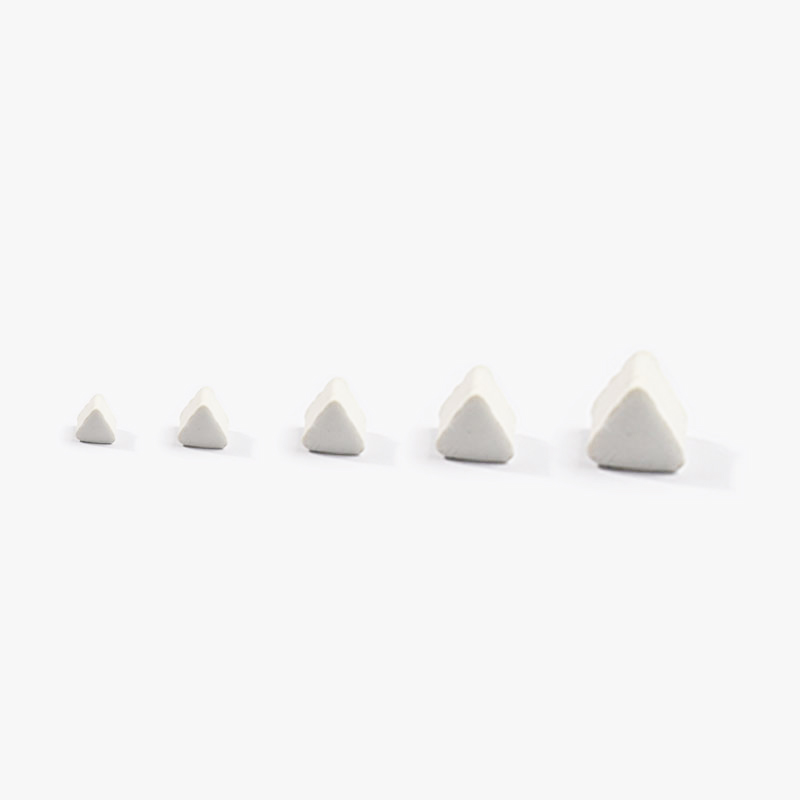
| Media | Best fit | Watch out for |
|---|---|---|
| Plastic cylinders and cones in a harder, denser grade | Longer cycles on mixed batches of small fittings where a repeatable light edge break is wanted without ceramic impact | Can float or segregate by shape in a bowl, and cylindrical forms can wedge in slots and cross-drillings |
| Heavy-cut ceramic, angle-cut triangles in a coarse size class | Removing a substantial machining burr from open external edges and pockets on aluminium and stainless housings before a refinement stage | Cuts edges and corners aggressively, leaves a coarse surface, and lodges in slots whose width approaches the media section |
| Aluminium oxide grinding media in a dense ceramic bond | Where a heavier stock removal or a more consistent cut is needed on robust stainless parts with thick edges | High removal energy rounds functional edges quickly and is a poor match for thin aluminium plates or knife-edge seal lands |
| Steel media, including balls and shaped pins | Bright finishing and edge blending on stainless components where appearance and a burnished surface matter | Transfers iron to aluminium and carbon steel, needs a corrosion-inhibiting compound, and must be separated magnetically or by screen at unload |
Magnetic finishing uses a small charge of pin-shaped or fine media driven by a moving magnetic field, which lets it reach narrow gaps, small bores and fine internal radii that tumbling media cannot enter. For semiconductor equipment parts it is most relevant on small precise items: gas nozzles, orifice plates, small machined inserts and fine slot arrays where the requirement is deburring and light refinement rather than bulk stock removal. The working envelope is small, so chamber bodies and long gas lines are out of scope. The media pins themselves are a lodging risk in the same features they are chosen to reach, and they are difficult to see inside a closed passage. Magnetic finishing also leaves a different surface signature from tumbling, so a roughness figure obtained on one route cannot be assumed to transfer to another.
| Machine route | Where it fits | What it will not do |
|---|---|---|
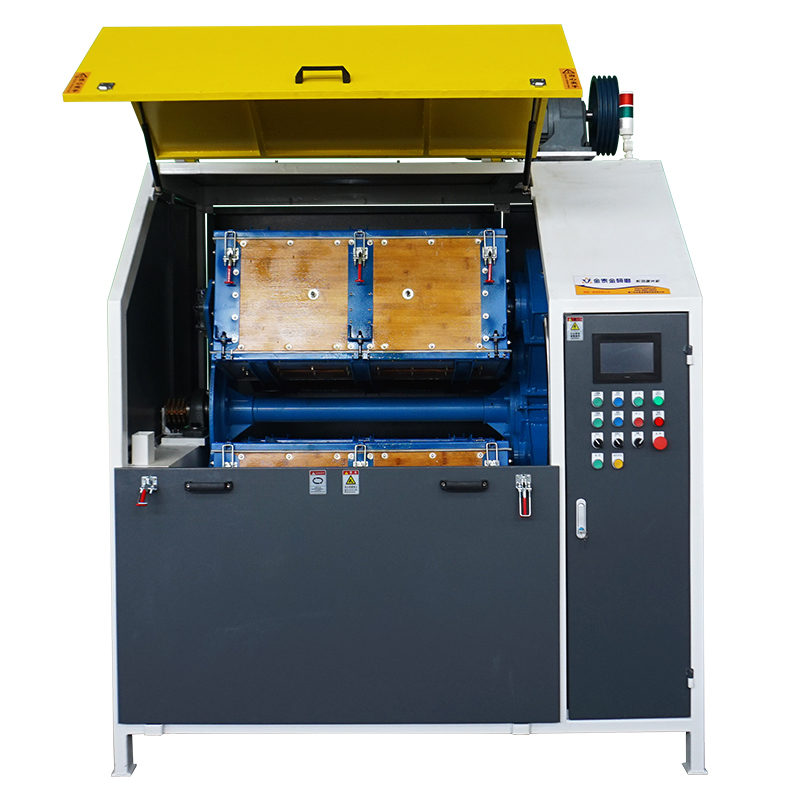
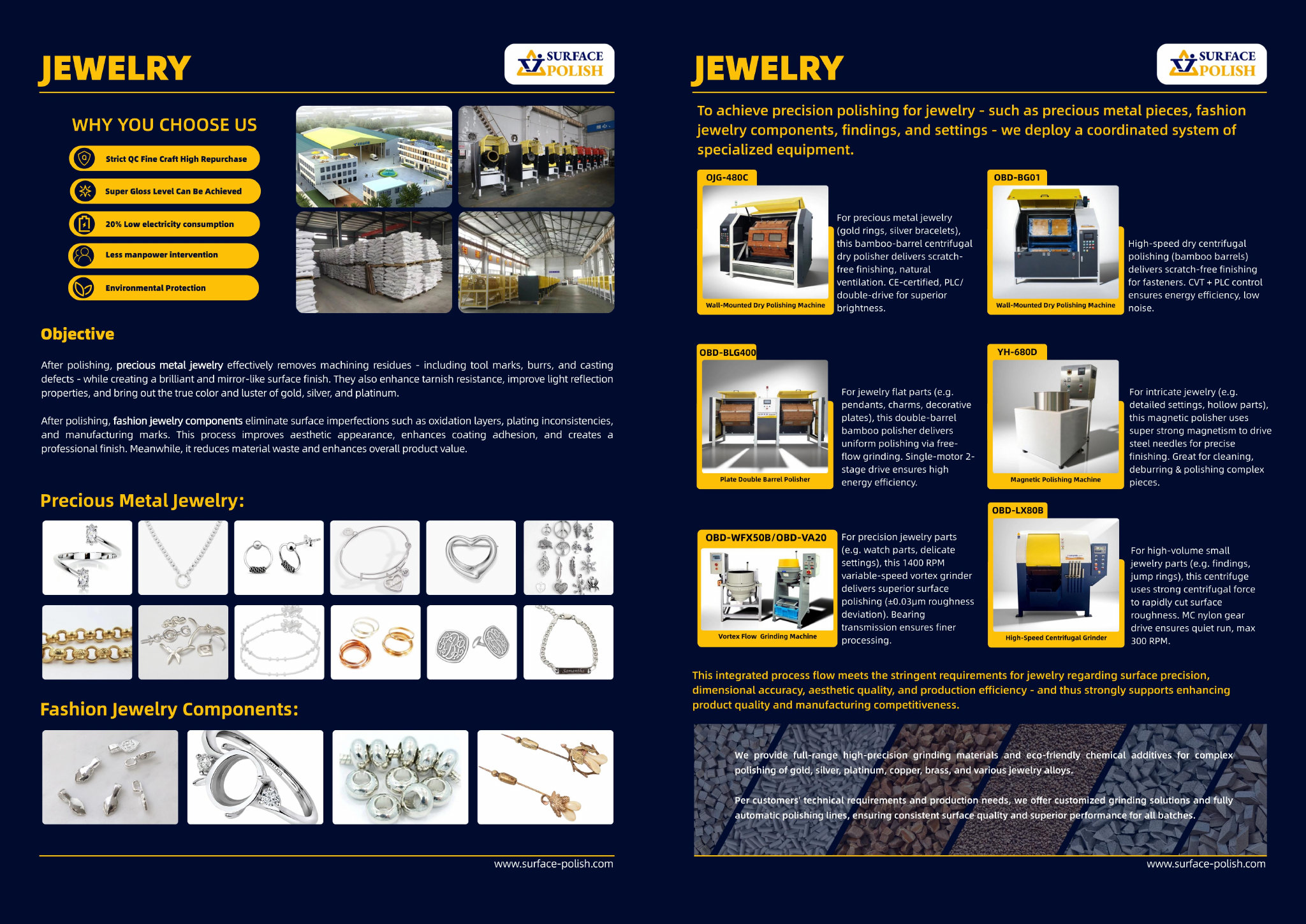
| Rotary barrel finishing machine | Gentle deburring of small fragile components and mixed fitting batches with a generous compound flow | Long cycles, no visibility while running, and internal passages can collect media and compound that must be retrieved at unload |
| Dry polishing machine and dryer | Removing residual moisture after a wet cycle and reducing water spotting on aluminium and stainless surfaces | A finishing step only; a dry part can still carry compound film, fines and media dust, so it is not a cleanliness release |
| Magnetic finishing machine | Fine deburring and light refinement of small precise features such as nozzles, orifice plates and narrow slots | Small working envelope that excludes chamber bodies and long gas lines, with pin media that can lodge in fine passages |
| Disc finishing machine | Fast, high-energy edge breaking and surface refinement on small robust parts and uniform batches of fittings | High impingement and edge-loss risk on thin or soft parts, and geometry must suit the disc working gap |
A medium lodged in a blind hole, slot or gas passage is the classic semiconductor finishing failure, and it often escapes the finishing shop and is found at the buyer's leak or particle check. It happens when the media size class is too close to the feature opening, when the charge has worn into smaller pieces, or when a passage was never mapped as a retention risk. Slots with a width close to the media section are the worst case, followed by cross-drilled intersections and deep tapped holes. Checking relies on controlled unloading and an agreed inspection: count the media charge in and out where practical, borescope the smallest passages at a defined angle, use a pin gauge on holes, and rinse into a filter for a visual residue check. Any medium found is a reportable non-conformance, not a wipe-and-release.
| Failure mode | Likely cause | How to catch it |
|---|---|---|
| Uneven finish with unrefined pockets, corners or the shielded side of a flange | Media cannot reach the feature at the chosen size or orientation, charge flow is blocked, or the part was not repositioned during the cycle | Inspect at defined locations rather than judging the whole part, photograph the same feature before and after, and measure roughness only at the surfaces the drawing controls |
| Knife-edge seal face or bore lip rounded past the drawing limit | High-energy route, over-long cycle, dense or coarse media, or a soft aluminium edge run without masking or shielding | Measure a defined edge feature before and after with an optical comparator, radius gauge or moulded replica, and compare with the maximum radius on the drawing |
| Rust spotting on stainless parts appearing hours or days after finishing | Ferrous transfer from steel media, a machine or tooling that has held carbon steel, or insufficient corrosion inhibition and drying | Inspect after a defined dwell time rather than immediately, look for pinpoint spots on and near edges, and trace media and machine history for the lot |
| Tapped threads rounded, galled or opened out by edge finishing | Media working the thread crest during a long or high-energy cycle, with no plugging or masking on the hole | Run a go and no-go thread gauge on every sampled hole, inspect crest condition at magnification, and confirm that plugs or masks were used and removed |
Detroit's current industrial policy is explicitly a reindustrialisation programme built on automotive manufacturing: the city received two U.S. Economic Development Administration grants totalling about $4.1 million, of which a $3,197,160 EDA investment supports the Georgia Street redevelopment and expansion as part of the I-94 Industrial Corridor Redevelopment Project, which the city expects to yield more than 600 new jobs and $120 million in private investment. The stated city goal is 5,000 new jobs for Detroiters over five years, with industrial and logistics business attraction and the identification and preparation of industrial sites and districts as the primary elements of the work. The state economic-development agency frames Michigan as competing for and winning projects in next-generation industries such as data analytics and manufacturing, and in September 2026 announced expansions in Oakland County, part of metro Detroit, including a new Geotab facility in Madison Heights for vehicle data and sustainable mobility. Automation Alley, based in the metro, positions itself as Michigan's digital-transformation insight centre supporting the state's technology and manufacturing businesses.
The nearest part of that base to this brief is machinery: The Michigan Economic Development Corporation announced expansions in Ingham, Kent and Oakland counties creating 127 jobs, framing the state as winning projects in next-generation industries such as manufacturing.
Automotive and supplier work is where deburring and edge control are hardest to avoid: transmission, engine and machined-housing parts, stamped brackets, and electrified-drivetrain and battery-enclosure components all carry burr, sharp-edge and Ra requirements that are checked before assembly. Because the supplier base runs both high-volume and low-volume programmes, media and compound selection turns on whether the part is aluminium, hardened steel or stainless, and on whether the burr is a machining burr or a stamping/blanking burr with a rolled edge.
The decision to settle first is which burr type dominates the part family - a machining burr on a turned or milled part, or a stamping/blanking burr with a rolled edge - and whether the print controls burr height, edge radius or Ra, because those three answers select different media shapes and compound chemistry.
Freight context: I-94 Industrial Corridor, Detroit, Oakland County International Airport (Waterford, Oakland County). Detroit's reindustrialisation programme is organised around industrial and logistics business attraction and the preparation of industrial sites and districts, with the I-94 Industrial Corridor as the named cluster. Metro Detroit is a US-Canada road, rail and Great Lakes crossing point, and Oakland County - the northern half of the metro - operates its own general-aviation airports. Imported machinery and sample parts would be entered through a US port of entry under CBP entry procedures.
Business is conducted in US English. Units matter: US drawings and purchase orders frequently use inches, microinch Ra and US gallons, and a supplier that quotes only metric can be asked to reissue documentation. Buyers are US legal entities with an EIN and expect an identifiable contracting entity, a correct HTSUS classification, a commercial invoice, packing list and bill of lading, country-of-origin marking, and an importer of record for customs. Procurement is normally evidence-driven: process selection is expected to be justified by a trial run on the buyer's own sample parts with measured results (burr height, edge radius, Ra, cleanliness) and by media and compound data sheets, rather than by a capability claim. Payment terms in general US industrial practice are open account with net-30 to net-60 terms for established buyers, with letters of credit or advance payment more common for a first order from a new overseas supplier; no US buyer assumes Incoterms, warranty terms or spare-parts lead times unless they are stated in the quotation.
The United States has no free-trade agreement with China, so Chinese industrial machinery enters under normal-trade-relations (MFN) duty rates in the Harmonized Tariff Schedule of the United States plus any Section 301 duty that applies to the specific HTSUS subheading. USTR's four-year-review modification of the Section 301 China technology-transfer investigation imposed additional Section 301 duties or increased existing rates on certain Chinese products in strategic sectors, and created a temporary exclusion process for machinery used in domestic manufacturing: chapters 84 and 85 of the HTSUS, which cover most machinery used in manufacturing processes, are the chapters that were made eligible for exclusion requests. CBP still administers Section 301 China duties, the four-year-review increases and product exclusions. The IEEPA-based additional ad valorem duties of 2025 - including the reciprocal-tariff actions and the China synthetic-opioid supply-chain duties imposed under Executive Orders 14195 and 14257 - were ordered terminated by Executive Order 14389 of 20 February 2026 and, as soon as practicable, are no longer collected. A buyer should therefore price the MFN rate plus any applicable Section 301 rate and check whether the machine's exact subheading is covered by a current exclusion, rather than assuming either the 2025 IEEPA tariffs or a blanket China rate still applies.
SurfacePolish supplies from Xiamen, China. The buyer's own destination rules, conformity marking, tariff classification and documentation responsibilities stay with the buyer; confirm them against the authorities named above before ordering.
Ask for a batch record that identifies what was actually done. A useful record lists the part numbers and quantities in the lot, the machine used, the media type and size class, the media charge mass and its age since the last screen or top-up, the compound product and dose, the water source used for rinse, the cycle time and any in-process interruptions, plus inspection results and disposition. For material traceability, request the media and compound data sheets offered by the supplier, including safety data, and keep them with the lot. Segregation evidence matters where aluminium and stainless run on the same site: a note of the purge or changeover between material families supports the buyer's own contamination control. This is process documentation from a finishing operation, not a certificate of compliance with any regulated standard.
A sample trial answers a narrow question: what happened to these parts under these settings on this equipment. It does not prove that a production lot will be uniform, because bowl size, load ratio, media age and operator practice all shift the outcome. It does not establish a particle count, a cleanliness level or fitness for a cleanroom or any regulated process environment, and it does not transfer a roughness value from a coupon to a complex geometry. It cannot guarantee a cycle time, a cost per part, a capacity or a delivery schedule, and it does not qualify a machine, medium or compound for a semiconductor application. Treat the returned parts and the settings record as evidence for the buyer's own engineering decision, and plan the production route with its own first-article and sampling discipline.
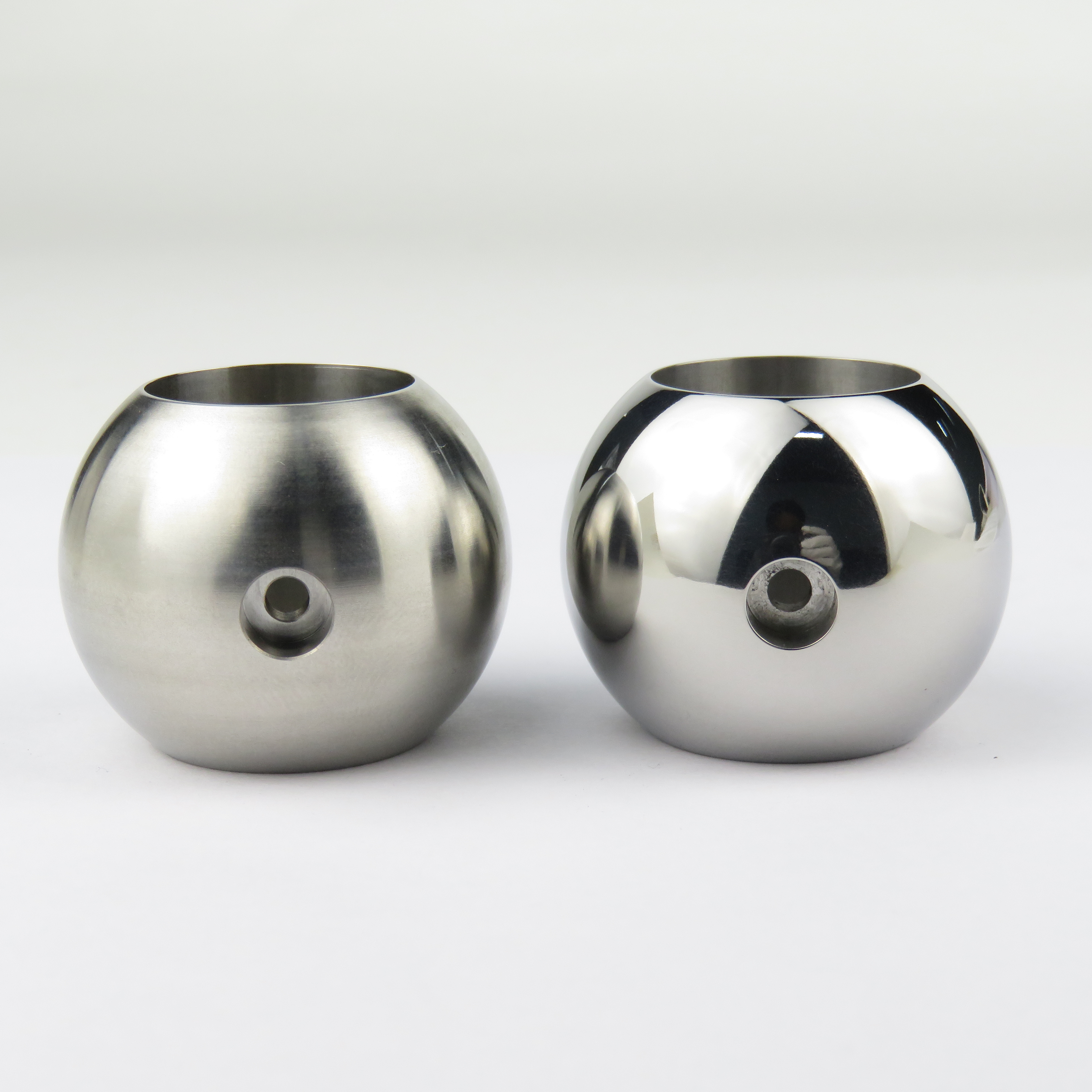
Change one variable at a time. Hold the machine, load, compound, cycle time and part mix constant, and change only the medium; if the question is cycle time, hold the charge constant and stop at two or three defined intervals. Evaluate the returned parts at the same marked measurement points, and if several people judge appearance, use coded labels so the assessment is blind. Where a cut stage is followed by a refinement stage, score the stages separately, because a good final figure can hide a coarse first stage. A clear comparison needs the returned parts, the record and your own inspectors.
Mechanical mass finishing and electropolishing are different processes with different effects, and SurfacePolish does not supply or perform electropolishing. A mechanical route can deburr and refine a surface, and it may reduce the reason to consider an electrochemical step, but it does not reproduce what electropolishing does to a surface. The honest comparison is to define what the gas line actually requires, then test whether a mechanical route can observe those requirements on representative parts. Where an electrochemical finish is mandatory in your specification, that requirement stays with your own supply chain. This page treats electropolishing only as a comparison point and as a reason to evaluate a mechanical alternative.
Send a set that covers the real range rather than one convenient piece. Include the part with the tightest passage or smallest hole, the thinnest unsupported section, the surface that must not be touched, and one part in its normal as-received condition with its usual burr and soil. Add a coupon of the same material with a known starting roughness, and a marked-up drawing naming the controlled surfaces, edge limits and any cleanliness requirement. Several pieces let more than one cycle time be examined. Parts are shipped to Xiamen and returned with a settings record.
Use Detroit, United States as the destination on the enquiry and state whether the deliverable is equipment, media and compound, a representative sample review or a line concept. A destination does not imply local stock, a local service point or a local delivery time.
A Detroit buyer works in the US voluntary-consensus system coordinated by ANSI, and in automotive work the binding requirements are normally the vehicle manufacturer's own supplier and part-approval requirements rather than a single national finishing standard. Burr height, edge radius and Ra are set on the drawing or in the customer specification, so the finishing process has to be documented against the customer's acceptance criteria.
Sources were retrieved on 2026-09-29 and describe the local industrial and trade context only. They do not evidence any SurfacePolish project, shipment, installation or service in Detroit.
The buyer must deburr hundreds of hole exits on a thin plate without warping it or driving media fragments into the holes.
Send the material, dimensions, approximate weight, batch quantity, the incoming condition and photographs of the difficult features. Mark which features must not be contacted by media and state how the result will be inspected. This form carries source reference PSEO-0015; quote it if you prefer an additional manual reference.
Open the SurfacePolish enquiry form Email a prepared enquiry
No price, lead time, certification or result is promised here. Confirm whether a sample trial is available for the specific part and what the trial can and cannot show.
Page PSEO-0015 · revised 2026-09-29 · cross-border equipment, media and scoped sample review. City context is sourced and cited above.
Use this local checker to identify missing part and inspection information. It prepares a technical-review brief; it does not approve a machine, process recipe or production result.
Complete the part details to prepare a review brief.
Email : info@surface-polish.com


 IPv6 network supported


 +86-592-2381506