A buyer in Paris, France working on semiconductor equipment has an aluminium chamber lid whose seal land and 24 blind tapped holes must survive deburring without rounding or lodging. SurfacePolish supplies vibratory finishing machines, media and compounds across borders and runs a free sample trial: the part travels to Xiamen, and the returned part comes with a proposed media, compound and cycle direction for the buyer's own review. This brief is written for a buyer in Paris working on semiconductor equipment; it describes equipment, media and a scoped sample review, not a local polishing service.
Can the required finish be reached in one mechanical route, or does the part need a cut stage followed by a refinement stage?
Which cleanliness method and limit does the buyer own, and is it applied before or after the buyer's own cleaning step?
What is the smallest internal passage, slot or hole the charge must not plug, and how will a lodged medium be detected and removed?
Start every assessment with a marked-up drawing, not a part family name. On a vacuum-chamber component the surfaces that matter are usually small: an O-ring groove floor, a knife-edge seal land, a gas inlet bore, a tapped hole pattern and a locating dowel bore. Each needs a decision before any medium is chosen, whether it is masked, plugged, finished to a roughness band or deliberately left untouched. A chamber lid and a roughing-line elbow can come off the same machining cell and still need different screening because one carries a knife edge and the other carries a welded flange. Ask which surface an elastomer or metal seal actually seats on, and treat that as a datum for acceptance. The feature list also drives handling rules: where parts may be stacked, which faces may touch, and how they are separated between operations.
Plastic media is chosen for aluminium and other soft materials where a ceramic charge would peen, smear or mark the surface. It is lighter, so contact pressure is lower and edges survive longer, at the cost of a slower cut and a longer cycle for the same burr. Shapes range from triangles and cones to cylinders, and the harder, denser grades remove more material than the softer ones. Because plastic media wear and deform, a charge that has run for many hours behaves differently from a fresh one, and part-to-part consistency can drift within a batch if the charge is not monitored. For a chamber component with a sealing face, plastic is often the safer starting point, and the trade-off to be tested is whether the achievable surface and the cycle time are acceptable once the burr is genuinely gone.
| Media | Best fit | Watch out for |
|---|---|---|
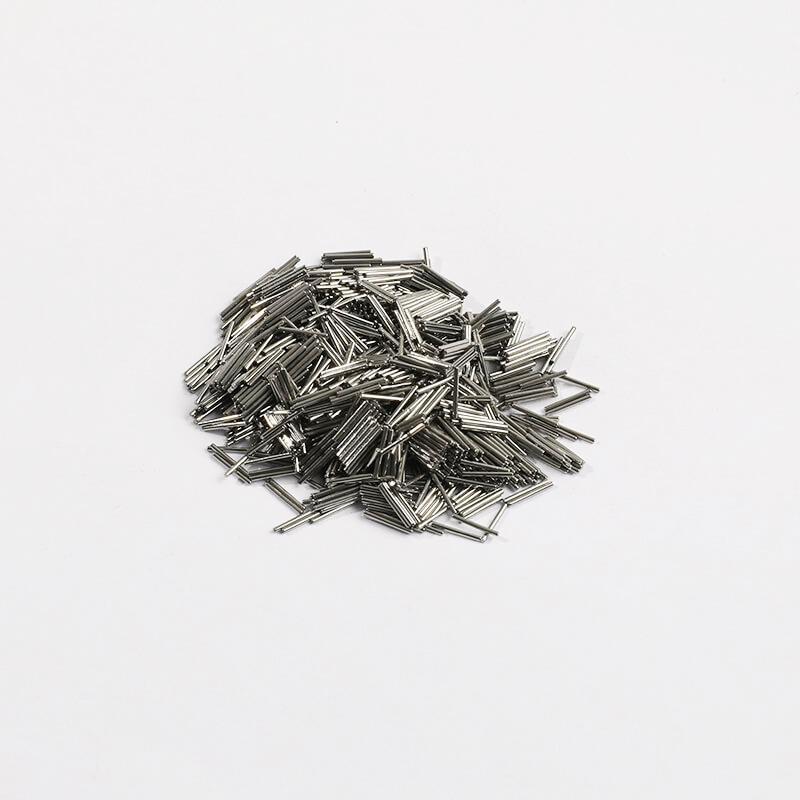
| Heavy-cut ceramic, angle-cut triangles in a coarse size class | Removing a substantial machining burr from open external edges and pockets on aluminium and stainless housings before a refinement stage | Cuts edges and corners aggressively, leaves a coarse surface, and lodges in slots whose width approaches the media section |
| Fine ceramic or porcelain spheres in a small size class | Refinement and light edge blending after a cutting stage, and reaching tighter external geometry on chamber bodies and plates | Small sizes enter and retain in gas passages and fine slots; media wear shrinks the charge and changes the finish over its life |
| Plastic cylinders and cones in a harder, denser grade | Longer cycles on mixed batches of small fittings where a repeatable light edge break is wanted without ceramic impact | Can float or segregate by shape in a bowl, and cylindrical forms can wedge in slots and cross-drillings |
| Steel media, including balls and shaped pins | Bright finishing and edge blending on stainless components where appearance and a burnished surface matter | Transfers iron to aluminium and carbon steel, needs a corrosion-inhibiting compound, and must be separated magnetically or by screen at unload |
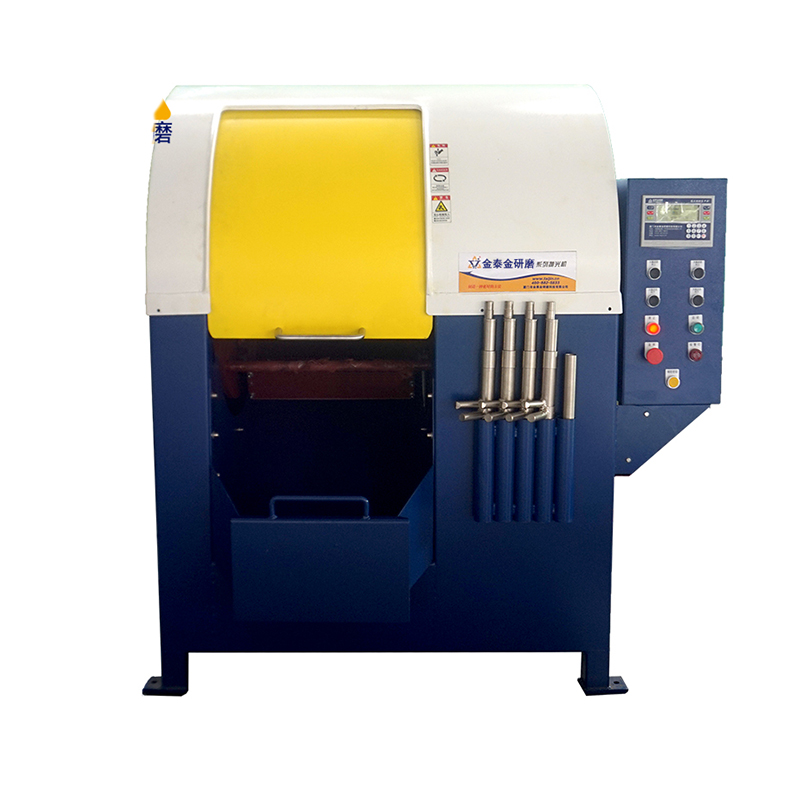
A vibratory bowl is the general-purpose starting point for chamber bodies, plates and housings that fit comfortably and can tumble without racking. Media circulates in a toroidal path and reaches external faces, edges and open pockets at moderate energy, and the open bowl allows an operator to pull a part mid-cycle for a look, which matters when a feature is sensitive. Part-on-part contact is continuous, so thin plates and finished mating faces need separation or protection within the charge. Where a heavy machining burr has to come off before refinement, a grinding finishing machine with higher removal energy can take the bulk of it, but it cuts edges faster as well and needs a tighter geometry assessment. A bowl will not reach deep internal passages on its own; those depend on media size, compound flow and how the part sits in the charge.
| Machine route | Where it fits | What it will not do |
|---|---|---|
| Disc finishing machine | Fast, high-energy edge breaking and surface refinement on small robust parts and uniform batches of fittings | High impingement and edge-loss risk on thin or soft parts, and geometry must suit the disc working gap |
| Vibratory finishing machine (bowl) | General deburring and refinement of chamber bodies, plates and housings that fit and can tumble without racking, with easy mid-cycle inspection | Continuous part-on-part contact and no access to deep internal passages; thin plates and finished mating faces need separation |
| Rotary barrel finishing machine | Gentle deburring of small fragile components and mixed fitting batches with a generous compound flow | Long cycles, no visibility while running, and internal passages can collect media and compound that must be retrieved at unload |
| Tub vibrator | Long gas rails, tubular manifolds, weldments and linear electrode assemblies that cannot rotate in a bowl | Lower energy per unit area so heavy burrs take longer, and large tubs need floor space and a suitable part support method |
Edge rounding beyond limit shows up first on knife-edge seal faces, sharp bore lips and fine slot edges, where a fractionally generous radius can change how a gasket seats or how a flow path behaves. High-energy routes, long cycles, dense media and coarse ceramic all accelerate it, and aluminium rounds faster than stainless under the same conditions. The damage is easy to miss on a finished part because the edge looks uniform and polished. Checking means measuring a defined edge feature before and after, using an optical comparator, a radius gauge or a moulded replica of the corner, and comparing against the limit the buyer placed on the drawing. Where a knife edge cannot be protected, masking, a fixture that shields the face, or a gentler medium and shorter cycle are the usual mitigations to test.
| Failure mode | Likely cause | How to catch it |
|---|---|---|
| Fine media fragments or aluminium smear embedded in a soft surface | Impingement from too much energy or charge mass, media that has fractured, or cross-contamination from a previous material family | Inspect at magnification under angled light, use a wipe or tape lift on the suspect area, and check the charge for broken media and fines |
| Water spotting or mineral residue left after wet processing and drying | Hard or high-chloride rinse water, slow or uneven drying, or parts stacked wet so moisture is trapped in pockets and grooves | Inspect dried parts under angled light for rings and haze, check the rinse water source and drying method, and verify that pockets and grooves drain before the part is packed |
| Compound film or tenacious residue left on a sealing face | A film-forming or silicate-bearing compound, insufficient rinse volume, or drying the part before it is genuinely clean | Magnify the sealing land and wipe a defined area with solvent, comparing the wipe against a clean reference; confirm with the buyer's own cleanliness method |
| Knife-edge seal face or bore lip rounded past the drawing limit | High-energy route, over-long cycle, dense or coarse media, or a soft aluminium edge run without masking or shielding | Measure a defined edge feature before and after with an optical comparator, radius gauge or moulded replica, and compare with the maximum radius on the drawing |
Paris itself is employment-dense rather than plant-dense: INSEE counted 188 002 establishments in the commune at the end of 2024, of which 2,6 % were in industry, and 1 811 255 jobs at the place of work in 2023. The industrial base that matters to a finishing buyer sits in the Ile-de-France region around the city, where Choose Paris Region reports 1 800 companies in aeronautics, space and defence and 192 800 jobs in aeronautics and space (INSEE data), plus a heavy-maintenance concentration on and around the airport platforms. Those firms are supplied by a dense subcontracting tier of machining, sheet-metal, surface-treatment and assembly shops across the Paris basin, and the region also carries electronics and health/life-science manufacturing. Aerospace and defence is the flagship cluster: ASTech Paris Region is the dedicated competitiveness cluster, and the region hosts Safran, Thales, Dassault Aviation (including a fuselage plant at Argenteuil) and MBDA.
The nearest part of that base to this brief is aerospace: Choose Paris Region describes Paris Region as the number one aeronautics region in France, with 1 800 companies in aeronautics, space and defence, 192 800 jobs in aeronautics and space, 41 % of French R&D spending in the sector, and ASTech Paris Region as the dedicated competitiveness cluster.
The aerospace and defence work done in the Paris basin turns on edge quality and surface integrity on structural and engine parts, on burr-free hydraulic and fuel-system components, and on controlled surface texture at mating and sealing faces. The same region's dense machining and sheet-metal subcontracting tier supplies those primes, so deburring and edge radius control is a recurring production cost rather than a niche operation. Because much of the work is audit-heavy, surface and cleanliness results normally have to be documented per part number rather than demonstrated on a sample.
Before selecting a finishing machine or media, a Paris-region buyer should settle whether the company will qualify the process in-house under its own EN 9100/ISO 9001 surveillance or will subcontract the operation, because that decision fixes the documentation, traceability and acceptance-test burden that the equipment must be able to support.
Freight context: Paris-Charles de Gaulle (CDG), Paris-Orly, Le Bourget, HAROPA Port (Gennevilliers / Limay / Seine axis). Choose Paris Region reports that Paris Region is the leading continental European airport hub, with two international airports (Paris Charles de Gaulle and Paris Orly), Le Bourget as Europe's top business airport, one military air base and 26 other airfields. HAROPA Port publishes 84,70 Mt of maritime traffic, 18,20 Mt of river traffic and 12 M m2 of logistics warehousing on the Seine axis, so machines can be flown into CDG or landed via Le Havre/Rouen and barged to the Paris area, while small sample parts normally move by express air.
For imports from outside the EU the declarant must file a customs declaration whose form and content are fixed by the Union Customs Code and its implementing provisions; French Customs identifies classification, origin and value as the three fundamental notions and makes the common/national tariff consultable via RITA. The customs authority is the Direction generale des douanes et droits indirects (DGDDI), which also runs the Info Douane Service for formalities questions. Buyers should expect to need an EORI number and an EU VAT treatment, because customs and tax authorisations are handled together (SOPRANO). For machinery, the CE marking and the applicable EU product-safety directives are the compliance gate items to settle before shipment, and the French market surveillance authority is the DGCCRF; the tariff rate itself must be confirmed per HS code in RITA or the EU Access2Markets tariff tool, since it varies by machine type.
France applies the EU common commercial policy, so industrial machinery arriving from China enters under the Union Customs Code and the Common Customs Tariff rather than under any bilateral French regime; the EU has no free-trade agreement with China, so no preferential duty rate applies and normal third-country duties are due on the customs value. Importers classify the machine in the tariff nomenclature and lodge a customs declaration; French Customs publishes the common and national tariff through its RITA online service and states that three notions are fundamental: the tariff classification of the product, its origin or destination, and the value of the goods.
SurfacePolish supplies from Xiamen, China. The buyer's own destination rules, conformity marking, tariff classification and documentation responsibilities stay with the buyer; confirm them against the authorities named above before ordering.
Ask for a batch record that identifies what was actually done. A useful record lists the part numbers and quantities in the lot, the machine used, the media type and size class, the media charge mass and its age since the last screen or top-up, the compound product and dose, the water source used for rinse, the cycle time and any in-process interruptions, plus inspection results and disposition. For material traceability, request the media and compound data sheets offered by the supplier, including safety data, and keep them with the lot. Segregation evidence matters where aluminium and stainless run on the same site: a note of the purge or changeover between material families supports the buyer's own contamination control. This is process documentation from a finishing operation, not a certificate of compliance with any regulated standard.
Record the starting condition before the parts leave, because a trial can only be read against a baseline. Photograph each burr and each controlled surface at a fixed scale, measure roughness at the same marked locations with the same instrument and cut-off, note edge condition with a comparator or radius gauge, and record mass and critical dimensions. Then ask for the same measurements on the returned parts at the same marked points. Without that pairing, a result is an opinion. Ask also for the settings used: machine, media type and size class, charge mass, compound and dose, cycle time, and the number of parts in the batch. Note any behaviour observed during the run, such as part-on-part impact, media lodging or compound foaming. That record is what allows two routes to be compared rather than merely described.
No cleanliness level or cleanroom readiness is certified or guaranteed here. The offer is cross-border supply of finishing machines, media and compounds, plus a sample trial that reports what was observed on the parts tested under the settings used. Cleanroom and process-environment requirements are defined by the buyer and verified by the buyer's own methods, which may include wipes, rinse collection, magnification, leak testing and functional checks. SurfacePolish can keep tested parts separated, documented and returned with a settings record, and that record can support your verification work in Paris, but the acceptance decision and any compliance statement remain with your quality function.
Any mechanical finishing operation can leave compound film, media dust and fine debris, particularly in blind features and soft aluminium surfaces. The practical controls are compound choice, rinse volume and quality, separation at unload, and a defined cleanliness check at a named surface. What that check should be is the buyer's specification, because only the buyer knows the downstream use. SurfacePolish cannot promise a particle count or certify a cleanliness level, and no process should be presented as cleanroom-ready on the strength of a sample trial. What a trial can show is how the parts looked and measured after the settings used, which supports the buyer's own verification in France.
Cycle time depends on the starting burr, the material, the media size class, the compound and how much edge refinement is wanted, so no figure can be quoted in advance. A part that only needs a light edge break may run very differently from one that must shed a machining burr before refinement, and a two-stage route needs both stages counted. The useful approach is to test a defined stop point or two on representative parts and record what changed. SurfacePolish does not promise cycle times or capacity; treat the timing on returned parts as an observation from that run, not a production commitment.
Use Paris, France as the destination on the enquiry and state whether the deliverable is equipment, media and compound, a representative sample review or a line concept. A destination does not imply local stock, a local service point or a local delivery time.
A Paris-region buyer would write surface-finish and deburring requirements into drawings and inspection plans against ISO/NF EN surface-texture standards, and would qualify the supply chain against ISO 9001 plus the aerospace scheme EN 9100 and the defence-space quality regimes used by primes such as Safran, Thales and Dassault. Cleanliness and residue limits for fluid-wetted parts are usually specified per programme rather than from a single national norm.
Sources were retrieved on 2026-09-29 and describe the local industrial and trade context only. They do not evidence any SurfacePolish project, shipment, installation or service in Paris.
The buyer needs the machined burrs removed and the groove cleaned without rounding the seal land or leaving media in the blind holes.
Send the material, dimensions, approximate weight, batch quantity, the incoming condition and photographs of the difficult features. Mark which features must not be contacted by media and state how the result will be inspected. This form carries source reference PSEO-0505; quote it if you prefer an additional manual reference.
Open the SurfacePolish enquiry form Email a prepared enquiry
No price, lead time, certification or result is promised here. Confirm whether a sample trial is available for the specific part and what the trial can and cannot show.
Page PSEO-0505 · revised 2026-09-29 · cross-border equipment, media and scoped sample review. City context is sourced and cited above.
Use this local checker to identify missing part and inspection information. It prepares a technical-review brief; it does not approve a machine, process recipe or production result.
Complete the part details to prepare a review brief.
Email : info@surface-polish.com


 IPv6 network supported


 +86-592-2381506