A buyer in Sheffield, United Kingdom in semiconductor equipment has a cast aluminium pump housing that must be deburred without exposing porosity or marking the machined flange. SurfacePolish supplies vibratory finishing machines, media and compounds across borders and runs a free sample trial: representative housings travel to Xiamen and return with observed results and a proposed media, compound and cycle direction for the buyer's own evaluation. This brief is written for a buyer in Sheffield working on semiconductor equipment; it describes equipment, media and a scoped sample review, not a local polishing service.
What is the smallest internal passage, slot or hole the charge must not plug, and how will a lodged medium be detected and removed?
Which surfaces on this part are functional, such as seal lands, gas passage walls and locating bores, and which are only cosmetic?
Which cleanliness method and limit does the buyer own, and is it applied before or after the buyer's own cleaning step?
Material state decides more about the route than the drawing tolerance does. A 6061-T6 machined plate, a 5083 weldment and a 316L casting behave differently under the same media load: aluminium work-hardens and smears, cast material can open porosity, and stainless can pick up iron from tooling or from steel media. Establish whether the part has been heat treated, whether weld zones will be finished in the same pass as the parent metal, and whether an anodise, passivation or coating step follows, because that downstream step can be the real reason a surface must be smut-free and free of embedded debris. Record the starting condition honestly: machining marks, EDM recast layer, heat tint, glass-bead residue from an earlier operation and any oil or handling soil all change what one mass-finishing cycle can achieve.
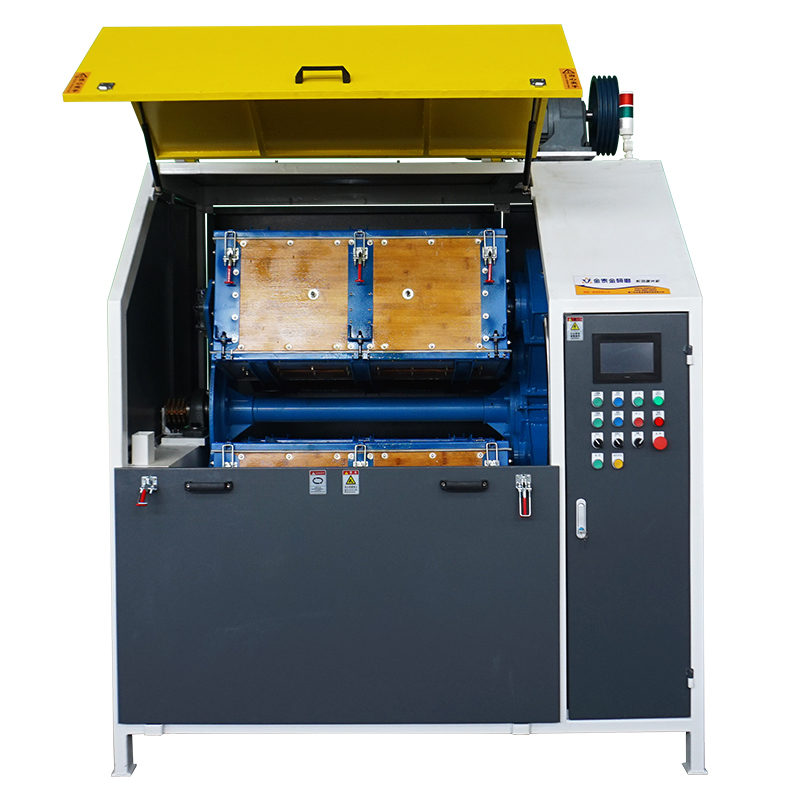
A vibratory bowl is the general-purpose starting point for chamber bodies, plates and housings that fit comfortably and can tumble without racking. Media circulates in a toroidal path and reaches external faces, edges and open pockets at moderate energy, and the open bowl allows an operator to pull a part mid-cycle for a look, which matters when a feature is sensitive. Part-on-part contact is continuous, so thin plates and finished mating faces need separation or protection within the charge. Where a heavy machining burr has to come off before refinement, a grinding finishing machine with higher removal energy can take the bulk of it, but it cuts edges faster as well and needs a tighter geometry assessment. A bowl will not reach deep internal passages on its own; those depend on media size, compound flow and how the part sits in the charge.
| Machine route | Where it fits | What it will not do |
|---|---|---|
| Vibratory finishing machine (bowl) | General deburring and refinement of chamber bodies, plates and housings that fit and can tumble without racking, with easy mid-cycle inspection | Continuous part-on-part contact and no access to deep internal passages; thin plates and finished mating faces need separation |
| Grinding finishing machine | Taking off a heavy machining burr or a defined stock layer before a refinement pass on robust stainless work | High removal energy cuts functional edges fast and demands a tighter geometry assessment and shorter cycles |
| Dry polishing machine and dryer | Removing residual moisture after a wet cycle and reducing water spotting on aluminium and stainless surfaces | A finishing step only; a dry part can still carry compound film, fines and media dust, so it is not a cleanliness release |
| Tub vibrator | Long gas rails, tubular manifolds, weldments and linear electrode assemblies that cannot rotate in a bowl | Lower energy per unit area so heavy burrs take longer, and large tubs need floor space and a suitable part support method |
Media wears, and worn media changes the process. Ceramic shrinks, plastic deforms and floats differently, steel can fracture into slivers, and all of them eventually reach a size or shape that lodges where a fresh charge would not. A working charge therefore needs a defined maintenance cycle: screen for undersize and debris, top up to a target mass, remove broken pieces, and record the change. Separation at unload deserves the same attention. Screens over the discharge, magnetic recovery for steel, tilting and draining stations, pin gauges and borescope checks on agreed features all reduce the chance that a medium travels with the part into the next operation. Where aluminium and stainless batches share a machine, purging media and compound between material families avoids cross-contamination that is difficult to see and easy to attribute to the wrong cause later.
| Media | Best fit | Watch out for |
|---|---|---|
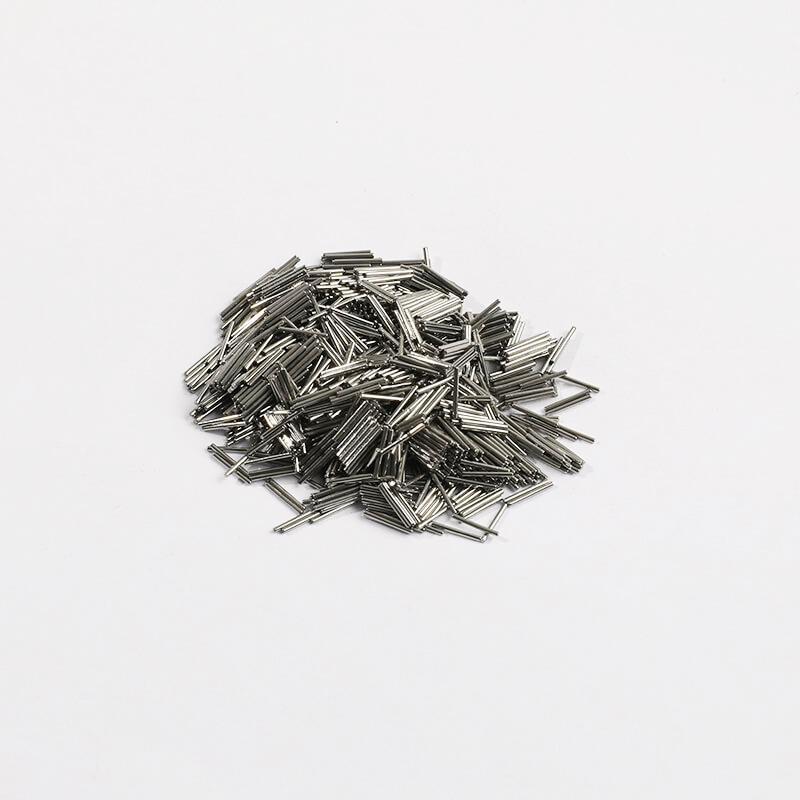
| Plastic cylinders and cones in a harder, denser grade | Longer cycles on mixed batches of small fittings where a repeatable light edge break is wanted without ceramic impact | Can float or segregate by shape in a bowl, and cylindrical forms can wedge in slots and cross-drillings |
| Steel media, including balls and shaped pins | Bright finishing and edge blending on stainless components where appearance and a burnished surface matter | Transfers iron to aluminium and carbon steel, needs a corrosion-inhibiting compound, and must be separated magnetically or by screen at unload |
| Plastic triangles and pyramids in a soft to medium grade | Deburring aluminium and other soft alloys where surface marking and edge rounding must be kept to a minimum | Slow cut rate, media deforms and wears, and a worn charge behaves noticeably differently from a fresh one |
| Fine ceramic or porcelain spheres in a small size class | Refinement and light edge blending after a cutting stage, and reaching tighter external geometry on chamber bodies and plates | Small sizes enter and retain in gas passages and fine slots; media wear shrinks the charge and changes the finish over its life |
Cross-contamination and staining are quiet failures. Aluminium worked in a charge previously used on stainless can leave a grey smear; stainless run with steel media, or in a machine that has held carbon steel, can show rust spots that appear days later; hard water and slow drying leave mineral spotting; and a compound that is too aggressive darkens aluminium. Dimensional drift is the other quiet failure, where thin plates, long tubes and unsupported walls relax or distort under tumbling loads, so a part that passed the edge check fails a flatness or position check afterwards. Both categories are caught by discipline rather than by looking harder at the finish: segregate material families and dedicate or purge media, control rinse water and drying, measure defined dimensions and flatness at the same points before and after, and keep that data with the batch record.
| Failure mode | Likely cause | How to catch it |
|---|---|---|
| Grey aluminium smear transferred onto stainless parts in a shared batch | Aluminium fines retained in media, compound or the machine after an aluminium lot, with no purge before the stainless lot | Check stainless surfaces under angled light for a dull grey film, review the changeover record, and inspect the charge and machine sump for retained fines |
| Compound film or tenacious residue left on a sealing face | A film-forming or silicate-bearing compound, insufficient rinse volume, or drying the part before it is genuinely clean | Magnify the sealing land and wipe a defined area with solvent, comparing the wipe against a clean reference; confirm with the buyer's own cleanliness method |
| Tapped threads rounded, galled or opened out by edge finishing | Media working the thread crest during a long or high-energy cycle, with no plugging or masking on the hole | Run a go and no-go thread gauge on every sampled hole, inspect crest condition at magnification, and confirm that plugs or masks were used and removed |
| Bright impact marks, dents or flattened corners from part-on-part contact | Dense charge, high load ratio, thin or light parts left loose among heavy neighbours, or a cycle run longer than the edge condition required | Look for repeating mark patterns on exposed faces and edges, compare an unsupported part with a racked or compartmentalised one, and review the batch mix and load recorded for the lot |
Sheffield is the lead city of the South Yorkshire Mayoral Combined Authority, which describes its vision as building on the region's strengths in innovation and advanced manufacturing and brings together Barnsley, Doncaster, Rotherham and Sheffield. Invest South Yorkshire presents the region as the UK's first Investment Zone, notes that stainless steel was founded there over 90 years ago, and lists aerospace, automotive, energy, logistics, nuclear and rail among its distinctive capabilities alongside the Advanced Manufacturing Research Centre and the iPort Doncaster intermodal site. The University of Sheffield AMRC works across aerospace, defence and nuclear and clean energy, with capabilities that include subtractive manufacturing, castings, fabrication and automation.
The nearest part of that base to this brief is aerospace: The AMRC lists Aerospace as one of its headline sectors, and Invest South Yorkshire lists aerospace among the region's distinctive capabilities.
South Yorkshire's advanced manufacturing base combines hard-metal machining, castings and fabricated assemblies, all of which produce burrs and edge conditions that are controlled before assembly, inspection or coating. Because AMRC's aerospace, defence and nuclear programmes are located in the region, edge and surface requirements on that work stream are usually written as measurable acceptance criteria rather than left to visual judgement.
A Sheffield buyer should fix the edge-quality acceptance criterion - for example a defined edge-break size or a surface-texture parameter - before choosing between vibratory, barrel or disc finishing, because the region's aerospace and nuclear workflows will not accept an undefined 'deburred' requirement.
Freight context: iPort Doncaster (intermodal rail freight site listed by Invest South Yorkshire as a strategic asset), Doncaster Sheffield Airport (held within the South Yorkshire MCA's business portfolio). Invest South Yorkshire lists logistics and rail among the region's distinctive capabilities and publishes an investment portfolio of strategic assets including the iPort Doncaster intermodal site; transport in the region is coordinated by the MCA's Travel South Yorkshire arm, and the MCA holds the Doncaster Sheffield Airport portfolio.
Importers need a GB-prefixed Economic Operators Registration and Identification (EORI) number, an import declaration carrying the correct commodity code, and retained commercial invoices plus the Import VAT Certificate (C79) so import VAT can be reclaimed. Machinery placed on the Great Britain market must be marked UKCA or CE: the manufacturer must draw up and retain technical documentation including a Declaration of Conformity, apply the correct marking with identification details, and cooperate with market surveillance; an authorised representative must be established in the UK. Under the Product Safety and Metrology (Amendment) Regulations 2024 the UK continues to recognise CE marking alongside or in place of UKCA for the Great Britain market, so either route can be used for most product types. Duty and import VAT are calculated from the customs value declared, and the commodity code also determines whether an import licence is needed.
English is the working language of contracts, drawings and conformity paperwork, so quotations, technical files and Declarations of Conformity should be supplied in English. UK manufacturers have now recovered above 2019 output levels in every English region and devolved nation except Northern Ireland, and the sector is concentrated in food and drink and transport equipment, with the North West the largest manufacturing region by total output. Buyers typically expect the UKCA/CE route, a Declaration of Conformity and a UK-established economic operator to be identified before order, and they need commercial invoices, customs declarations and the C79 retained in a form their finance team can use for import VAT recovery. No source verified in this research establishes a mandated payment instrument, so payment structure should be treated as commercial negotiation rather than a regulatory requirement.
SurfacePolish supplies from Xiamen, China. The buyer's own destination rules, conformity marking, tariff classification and documentation responsibilities stay with the buyer; confirm them against the authorities named above before ordering.
Ask for a batch record that identifies what was actually done. A useful record lists the part numbers and quantities in the lot, the machine used, the media type and size class, the media charge mass and its age since the last screen or top-up, the compound product and dose, the water source used for rinse, the cycle time and any in-process interruptions, plus inspection results and disposition. For material traceability, request the media and compound data sheets offered by the supplier, including safety data, and keep them with the lot. Segregation evidence matters where aluminium and stainless run on the same site: a note of the purge or changeover between material families supports the buyer's own contamination control. This is process documentation from a finishing operation, not a certificate of compliance with any regulated standard.
Send parts that represent the real range, not a single convenient sample. The set should include the part with the tightest internal passage, the thinnest unsupported section, the surface that must not be touched, and at least one part in the true as-received condition with its normal burr and soil. Add a coupon of the same material, ideally with a known starting roughness, so a measurement can be compared before and after. Supply a marked-up drawing identifying critical surfaces, edge limits and any cleanliness requirement, plus a short statement of what the part does in service. Quantity matters: several pieces allow a stop-and-look at more than one cycle time. Pack them so they arrive undamaged, label each one, and state the material and heat treatment, since an unlabelled mixed lot cannot be assessed.

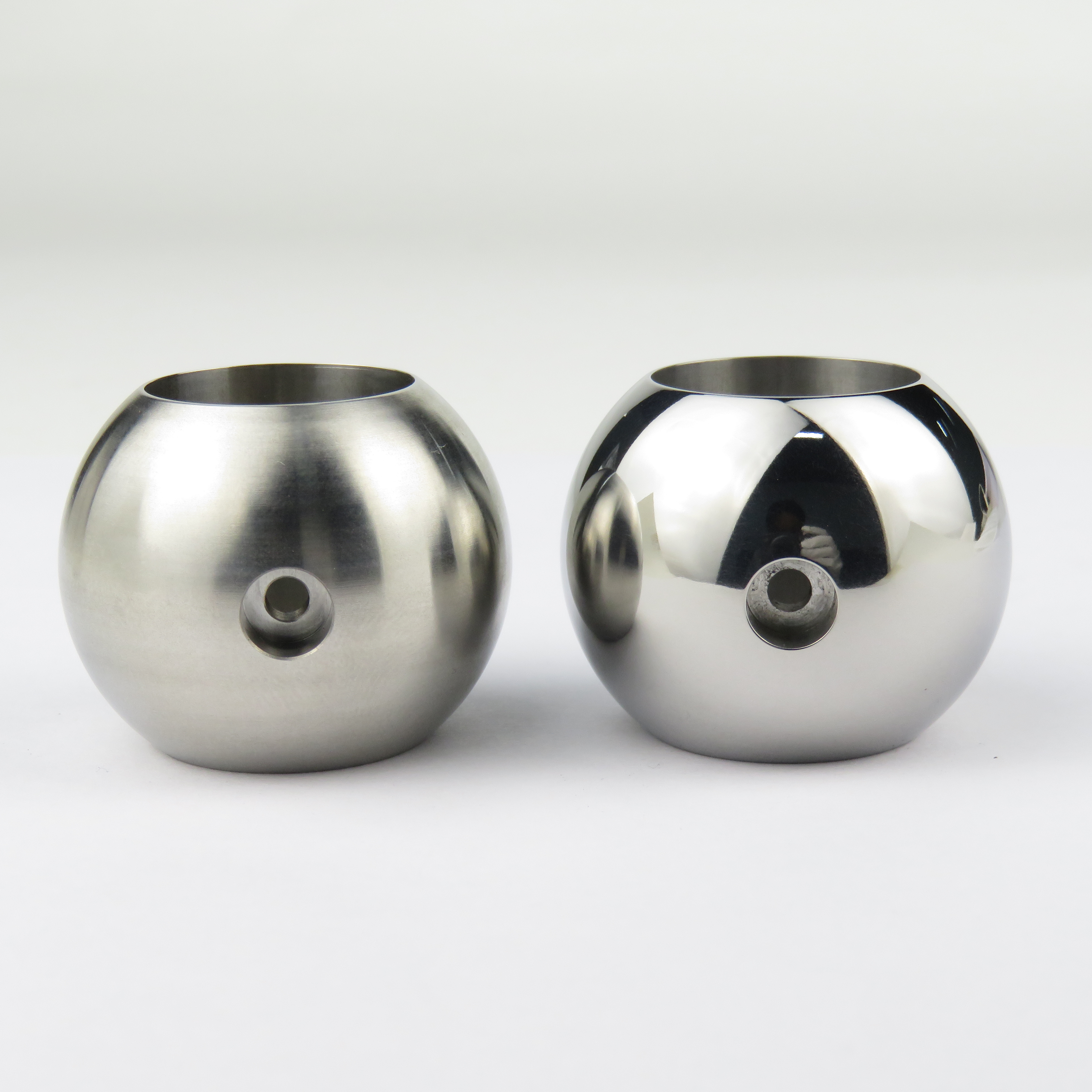
Send a set that covers the real range rather than one convenient piece. Include the part with the tightest passage or smallest hole, the thinnest unsupported section, the surface that must not be touched, and one part in its normal as-received condition with its usual burr and soil. Add a coupon of the same material with a known starting roughness, and a marked-up drawing naming the controlled surfaces, edge limits and any cleanliness requirement. Several pieces let more than one cycle time be examined. Parts are shipped to Xiamen and returned with a settings record.
Cycle time depends on the starting burr, the material, the media size class, the compound and how much edge refinement is wanted, so no figure can be quoted in advance. A part that only needs a light edge break may run very differently from one that must shed a machining burr before refinement, and a two-stage route needs both stages counted. The useful approach is to test a defined stop point or two on representative parts and record what changed. SurfacePolish does not promise cycle times or capacity; treat the timing on returned parts as an observation from that run, not a production commitment.
It can change a surface, but whether it lands inside a specified band is something to measure rather than assume. The parameter, the cut-off length, the measurement direction and the reading locations all have to be fixed first, because a seal land, a bore and an outer wall respond differently to the same charge. A trial result applies to the geometry and settings tested, not to every part in the family. SurfacePolish does not guarantee a roughness value. Send parts with a marked measurement plan, ask for readings at those points, and set your own acceptance band from data you can verify in Sheffield.
Use Sheffield, United Kingdom as the destination on the enquiry and state whether the deliverable is equipment, media and compound, a representative sample review or a line concept. A destination does not imply local stock, a local service point or a local delivery time.
Equipment placed on the Great Britain market needs UKCA or CE marking with a Declaration of Conformity, and HSE's work equipment and machinery and COSHH regimes apply on site. For aerospace and nuclear work in the region, buyers generally flow down the prime contractor's quality and assurance requirements rather than relying on general machining tolerances alone.
Sources were retrieved on 2026-09-29 and describe the local industrial and trade context only. They do not evidence any SurfacePolish project, shipment, installation or service in Sheffield.
The buyer needs the machined faces and hole edges deburred without opening casting porosity or peening the soft alloy.
Send the material, dimensions, approximate weight, batch quantity, the incoming condition and photographs of the difficult features. Mark which features must not be contacted by media and state how the result will be inspected. This form carries source reference PSEO-0235; quote it if you prefer an additional manual reference.
Open the SurfacePolish enquiry form Email a prepared enquiry
No price, lead time, certification or result is promised here. Confirm whether a sample trial is available for the specific part and what the trial can and cannot show.
Page PSEO-0235 · revised 2026-09-29 · cross-border equipment, media and scoped sample review. City context is sourced and cited above.
Use this local checker to identify missing part and inspection information. It prepares a technical-review brief; it does not approve a machine, process recipe or production result.
Complete the part details to prepare a review brief.
Email : info@surface-polish.com


 IPv6 network supported


 +86-592-2381506