
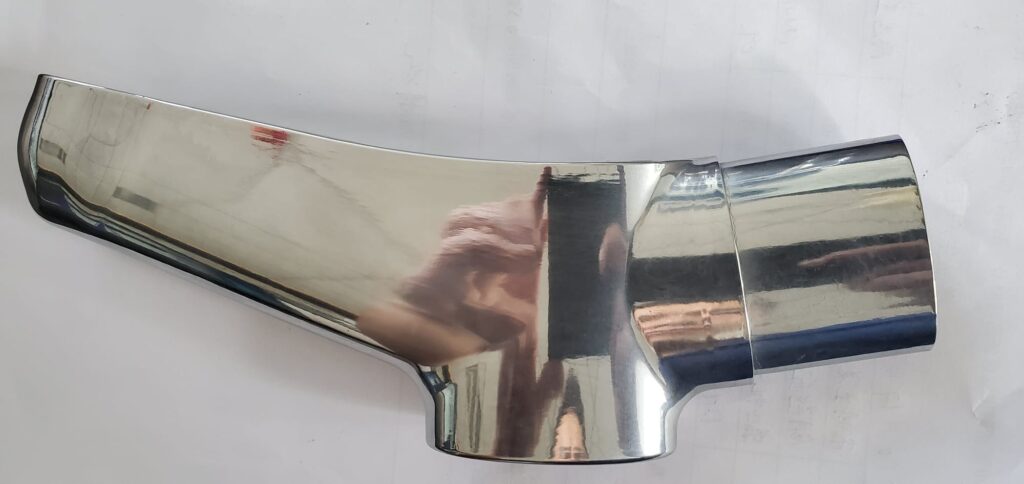
Stainless Steel Buffing Compound: The Bar and the Fluid Are Not the Same Product
Most people who search for a stainless steel buffing compound have a picture in their head of a solid bar of wax or paste, rubbed onto a rotating cloth wheel, bringing a stainless part up to a mirror. That picture is accurate for one route — and it is the wrong product for the route most industrial buyers are actually running.
Because the term is used for two different things:
- A buffing compound is, in the strict trade sense, a solid: a bar, stick or cake of abrasive suspended in a grease or wax binder, charged onto a rotating buffing wheel. It is a hand or semi-automatic operation, one contact point at a time.
- A polishing compound or polishing fluid is a liquid or powder, dosed into a wet mass finishing process — a vibratory bowl, a barrel, a centrifugal machine — where a charge of media does the cutting and the liquid carries the heat and swarf away.
They are not two grades of one product. They are two products for two processes, and buying the wrong one does not produce a worse result — it produces no result, because the product has no way to reach the part. This page draws the line, tells you which side your job is on, and is explicit about what we do and do not supply.
The difference is the vehicle, not the abrasive
Both product types contain abrasive. The difference that matters is how the abrasive is delivered to the surface:
| Buffing compound (solid) | Polishing fluid (liquid/powder) | |
|---|---|---|
| Form | Bar, stick, cake, paste | Liquid in a barrel, or powder in a drum |
| Applied to | A rotating cloth or sisal buffing wheel | The water bath of a mass finishing machine |
| Abrasive arrives by | Direct contact of a charged wheel | A charge of loose media, wetted by the fluid |
| Process type | Contact, one part at a time | Batch, the whole load at once |
| What it mainly does | Brightening and colour — raises reflectivity with little stock removal | Cutting, burnishing or cleaning, depending on the fluid's function |
| Coverage | The area the wheel touches | Every face the media flow reaches |
| Operator skill | High — pressure, wheel speed, compound charge, all by hand | Lower — the recipe is set and repeated |
| Where it fails | Cannot remove a scratch left by an earlier stage; cannot reach internal geometry | Cannot produce a directional mirror on a large flat face; needs a machine and a drying step |
The one-line version: the bar is a tool you hold against the work, and the fluid is an ingredient of a process that the work sits inside. That is why a quotation for one cannot be substituted for the other, and why a shop that owns a bowl and no buffing lathe cannot use a bar at all.
Which side of the line is your job on
Work through these four questions in order. The first two decide it for almost every enquiry.
1. Is there a rotating wheel in the process, or a chamber? If the part is presented to a wheel by hand or by a fixture, you need a solid compound. If the parts go into a chamber with media, you need a fluid. There is no third option and no adapter between them.
2. Is the job to remove something, or to brighten something? Removal — a burr, a scratch pattern, a weld discolouration — is a cutting job, and in a machine it is done by the media with a cutting fluid. Brightening only, on a face that is already geometrically correct, is a buffing job. This is where most stainless enquiries turn out to be mis-labelled: the buyer says "buffing compound" because that is the word in their trade, but what they need is to remove the previous stage's marks first.
3. How many parts, and what shape? Hundreds of small stainless parts are a batch process — a bowl or a barrel with media and fluid. One large fabricated frame, or a single part that has to be brought up on a defined face, is contact work and belongs to a wheel.
4. What happens after? A buffed surface and a machine-finished surface are different bases for plating and passivation. If two batches have to plate to the same appearance, the finishing step is held to a consistent base — and a batch process is more reproducible than a hand-held wheel, for the same reason a recipe beats an operator's judgement when the requirement is repeatability.
The liquids we actually supply, by function
This is the part of the page where being specific is worth more than being broad. Our compound range is liquid and powder, packed in 20 kg barrels and 50 kg drums — there is no solid buffing bar in the range, and we will say so plainly in the next section.
Working fluids, 20 kg per barrel — dosed into the bath of a wet process:
- Polishing fluid for stainless, 20 kg/barrel
- Polishing fluid for stainless steel, 20 kg/barrel — the stainless range carries two entries; confirm which suits your alloy and stage rather than assuming they are interchangeable
- Polishing fluid for metal, 20 kg/barrel
- Polishing fluid for metal, essential-oil type, 20 kg/barrel
- Polishing fluid for acetate, 20 kg/barrel and acetate fine-rolling oil, 20 kg/barrel — plastic work, where a wet bath has to be kept cool and short
Aluminium grinding oils:
- Metal green liquid polishing compound, aluminium grinding oil
- Metal grinding compound, aluminium green liquid, paste/oil form
Powders and drums, 50 kg:
- Abrasive polishing brightener, 50 kg/drum — the brightening class, and the closest thing in the range to what a buffing bar does, in a form a machine can use
- Abrasive solution, 50 kg/drum
- Polishing, degreasing and anti-rust powder, 50 kg/barrel — cleaning plus corrosion protection in one line
- Stainless steel polishing cleaning fluid, 50 kg/drum
- Stainless steel electrolytic polishing chemical agent, 50 kg/drum — a different process family from mechanical tumbling, and it is not an additive to one
The full range sits on the finishing compounds page. The functional division of labour between these classes — cutting, burnishing, cleaning, protection — is set out in metal polishing compound, and this page does not repeat it.
What we do not supply, and why we say so
We do not stock a solid stainless steel buffing compound — no bar, no stick, no rouge cake. There is no model number, no grade list and no grit range for us to quote, because the product is not in our range.
That statement costs us a search term and buys the buyer something more useful: a straight answer about which route their part is on. If your process involves a rotating buffing wheel and a hand or fixture presentation, the product you need is a solid compound from a supplier who makes them, and we are not that supplier. If your process involves a chamber, media and a bath — which is the majority of industrial stainless finishing — then the product is a fluid, and that is a range we do supply with SKU-level detail.
Where a customer's process sits between the two — an automated buffing head, a custom nozzle arrangement, a compound delivery system built around a specific machine — we will discuss it against a sample or a drawing, on the same OEM/ODM basis as the equipment: the part, the target finish and the presentation are reviewed first, and the configuration is proposed against those rather than from a catalogue. That is a custom-engineering conversation, not a stock order, and it is honest to describe it that way.
One clarification that saves a round of emails: the two product classes differ in what the abrasive is carried on, not in how fine they are. The bar is charged onto a cloth wheel by hand; the fluid is dosed into a bath and carried by a charge of media. Whether the bar or the fluid is the right purchase is a question about the operation, and that is set out in polishing against buffing — it is not a question about coarseness. Where the operation is a machine stage and the surface is stainless, why stainless parts are not bright after tumbling is the diagnostic that comes before any liquid is chosen.
Where a fluid will not do what a bar does
Being clear about the limits of the range makes the recommendation usable:
- A directional mirror on a large flat face. A batch process cannot produce a single-direction lay, because the media approaches from every direction. If the specification is a mirror with a directional grain, that is contact work.
- A face that must be brought up selectively. A fluid treats every face the media reaches. Masking is not a process; a wheel reaches only what it touches.
- A part too large or too few for a batch. One-off work on a large stainless fabrication is a wheel or hand job.
- A geometry where the media cannot follow. Media must not exceed about one third of the smallest feature; below that, no fluid fixes the reach problem — magnetic finishing is the answer for a thread root or cross-hole.
- A surface that must be dry and spot-free off the machine. A fluid is a wet process. It needs a rinse and a drying step; without one, a film in blind features shows up as spotting weeks later, and that is not a compound fault.
- A part whose base colour must be identical batch to batch for plating. The fluid does not set colour alone; the media, the stage sequence and the rinse do. Consistency comes from a written, repeated process.
What to send, and what you get back
A compound recommendation that holds up is a trial result, not a data sheet. A published cycle assumes a material and a removal that may not be yours, and the same is true of a published dose.
Send: representative parts including the worst one, the material and its condition, the incoming surface (what the previous step left), the finish you need and the finish you will accept, and whether there is a corrosion window before the next operation. You get back the finish, the cycle and the media consumption measured on your parts.
Two context numbers that decide whether the trial is worth the queue time. A light deburr runs 10 to 20 minutes; a brightening stage runs 2 to 8 hours — a fluid is chosen for one of those bands, not for "finishing" in general. And a charge's life runs 20 to 200 operating hours, so consumption is measured per job rather than assumed: ask for it in kilograms per 100 hours, because a supplier who cannot state that is not quoting a usable figure.
FAQ
Is a stainless steel buffing compound a liquid or a solid? In the strict trade sense it is a solid — a bar, stick or cake of abrasive in a wax or grease binder, charged onto a rotating cloth wheel. The word "compound" is used loosely for liquids too, which is where the confusion starts. If your process has a chamber and media, the product you want is a fluid; if it has a buffing wheel, it is a bar.
Can I use a liquid polishing fluid on a buffing wheel? No. A fluid is formulated to be dosed into a bath and carried by a media charge; it has no way to stay on a rotating cloth wheel in the quantity the contact needs. The reverse is also true: a solid bar cannot be dosed into a machine. The two products are not interchangeable in either direction.
I searched for buffing compound but I run a vibratory machine. What do I actually need? A polishing fluid. The give-away is the chamber: if the parts go into a bowl or barrel with media, the cutting is done by the media and the liquid's job is to carry heat and swarf away and to set whether the surface is cut, burnished or cleaned. The brightening class in the liquid range is the closest equivalent to what a buffing bar does, in a form a machine can use.
Do you sell a stainless steel buffing compound? No. Our compound range is liquid and powder, packed in 20 kg barrels and 50 kg drums, and we publish no solid buffing bar, no grade list and no grit range. Where a process needs something built around a specific machine or presentation, we will discuss it against a sample or a drawing as a custom configuration.
Will a liquid give me the same mirror as a buffing wheel? Not the same. A liquid in a batch process produces an isotropic finish, because the media approaches from every direction; a buffing wheel produces a directional lay, because the contact runs one way. If your specification calls for a directional mirror, that is contact work and a solid compound goes with it.
Which fluid suits stainless? The range carries stainless entries in 20 kg barrels, and there are two of them, so confirm which suits your alloy and your process stage rather than assuming they are interchangeable. Above that: the fluid is one line of a four-line specification — media grade, media size, and cycle are the others — and a supplier who quotes one without the other three is quoting a guess.
Max Xu, Sales — Xiamen Jin Tai Jin Grinding Technology Co.,Ltd.
No. 31, Xinchang Road, Xinyang Industrial Zone, Haicang District, Xiamen
info@surface-polish.com
This article describes the difference between a solid buffing compound and a liquid polishing fluid; it is not a claim about any specific part's achievable result. We do not publish a solid buffing compound specification because that product is not in our range; custom configurations are discussed against a sample or drawing. A finishing process is set by the material, the stock to be removed and the finish required, so the configuration for a specific part is confirmed against a trial on that part. We manufacture finishing equipment and the media and compounds that run in it; we do not offer a job-shop finishing service.
 +86-592-2381506


 IPv6 network supported
