
Buffing Compounds for Metal: The Colour on the Bar Is the Specification
A buffing bar for metal is sold by colour — black, brown, green, white, red, blue — and the colour is not decoration. Each one is a grade: a combination of abrasive type, abrasive size and binder that decides how much it cuts, what it leaves, and which metals it suits.
That is why "buffing compounds for metal" is not one product. The buyer is choosing a step in a sequence, and the colour tells you which step.
(The wider question of whether the process is a bar or a liquid, and which operation polishing and buffing actually are, is covered on the buffing compound and fluid page and the polishing and buffing page.)
What a bar actually is
A buffing compound is an abrasive suspended in a binder — a wax or grease base that melts at the wheel's surface temperature and releases the abrasive at the contact point.
Three variables, and the colour is a shorthand for the combination:
| Variable | What it controls |
|---|---|
| Abrasive type (alumina, silicon carbide, lime, tripoli) | What it cuts and how aggressively |
| Abrasive size | The cut rate, and the scratch depth it leaves behind |
| Binder hardness | How much pressure it takes to make the bar work, and how the swarf clears |
The consequence: a harder binder on a soft part does not cut — it skates. A softer binder on a hard part burns through before the work is done. That mismatch is the most common reason a bar "does not work", and it is a product-choice problem rather than a technique problem.
The colour sequence, and what each step is for
The colour naming is not standardised across manufacturers, so the sequence matters more than the specific name. The conventional progression is:
| Step | Typical colour family | What it does | Where it sits |
|---|---|---|---|
| 1. Cut / cut-down | Black, dark brown | Removes stock, cuts over a previous finish, removes a scratch | First — the heaviest stage |
| 2. Mid / cut-and-colour | Brown, dark green | Refines what the first stage left, starts bringing colour | Second |
| 3. Colour / finish | Green, white | Produces the brightness, removes the previous stage's marks | Third |
| 4. Final / high gloss | White, red, blue | Final clarity and colour on soft metals and precious metals | Last |
The rule that matters more than the colours: each stage must completely remove the previous stage's marks, or the sequence has failed. A white bar on a surface that still carries a black bar's scratch produces a bright scratch — and the usual response, more pressure or more time, makes it worse rather than better.
What decides which bar, in order
1. The metal, first
| Metal | What the binder and abrasive have to suit |
|---|---|
| Steel and stainless | Harder binder, more aggressive abrasive — the bar has to cut a work-hardening surface |
| Aluminium | Softer binder and a finer abrasive; a hard bar loads and smears |
| Brass and copper | Softer again; the bar's colour has to protect the alloy's own colour |
| Zinc die-cast | Soft and heat-sensitive; gentle cut and controlled pressure |
| Precious metals | Finest abrasive and the softest binder, because metal loss is money |
The crossover that causes problems: a bar specified for steel used on aluminium. It is not "too aggressive" in the abstract — it loads, smears and leaves a grey cast, and that reads as a bad bar rather than a mismatched one.
2. The starting condition, second
The same metal can need a different first stage depending on what the part looks like:
- A machined surface with a visible tool pattern needs a cut stage that removes the pattern, not one that polishes over it.
- A surface with a deep scratch needs the cut stage to be deep enough to reach the bottom of the scratch — otherwise the scratch is brightened rather than removed.
- A casting with scale or parting lines is not a buffing job at the first stage at all; that is a coarser process before the bar.
The question to answer in writing: what has to be removed before the bar is used. A bar cannot do the work of an abrasive stage that was skipped.
3. The finish requirement, third
And be specific about what "bright" means for this part:
- Colour and clarity judged by eye — a boundary sample is the specification, and the bar's colour stage is chosen against it.
- A roughness figure — measurable, but it does not capture colour, and on a cosmetic part colour is what is judged.
- A requirement not to lose material — on a thin or precious-metal part, the finest bar that produces the appearance is the right one, and the sequence is designed around it.
4. The wheel and the speed, which are part of the same decision
A bar is specified against a wheel as much as against a metal:
- A hard wheel with a hard bar cuts fast and marks; a soft wheel with a soft bar polishes and rounds.
- A bar needs the wheel to reach its working temperature — too slow and it does not release, too fast and it burns.
- The bar and the wheel are bought as a pair, and a shop that changes one without the other is guessing.
What goes wrong, and what the symptom means
Six symptoms a buyer can read, and what each one is telling:
| Symptom | What it usually is |
|---|---|
| The bar does not cut, it skates | Binder too hard for the metal, or the wheel is too soft |
| The bar burns and smokes | Speed too high, or pressure too high for the binder |
| A bright scratch under the finish | The previous stage's marks were not removed — go back a stage |
| A grey or hazy cast on aluminium | A bar specified for a harder metal; it is smearing rather than cutting |
| The colour varies across one part | Pressure or contact time is uneven — a technique or fixture problem, not a bar problem |
| The finish goes dull after a day | A residue left by the binder; the part was not cleaned after the buff |
The third and sixth rows are the ones that cost rework, and both are sequence or cleaning problems rather than product problems.
The liquid alternative, if the process is a machine. Where a batch is involved, a wet process replaces the bar sequence: a light deburr or edge stage runs about 10 to 20 minutes and a brightening stage 2 to 8 hours, with media life at 20 to 200 operating hours and a replacement signal of roughly 20% longer for the same result. A machine runs on three-phase 380 V or 415 V at 50 Hz, sits in the 75 to 85 dB(A) at one metre band, and ships in 25 to 35 days from the deposit. That is the alternative worth comparing against a bench sequence on any job above a handful of parts.
What we do and do not supply
Being precise about this is worth more than a product list:
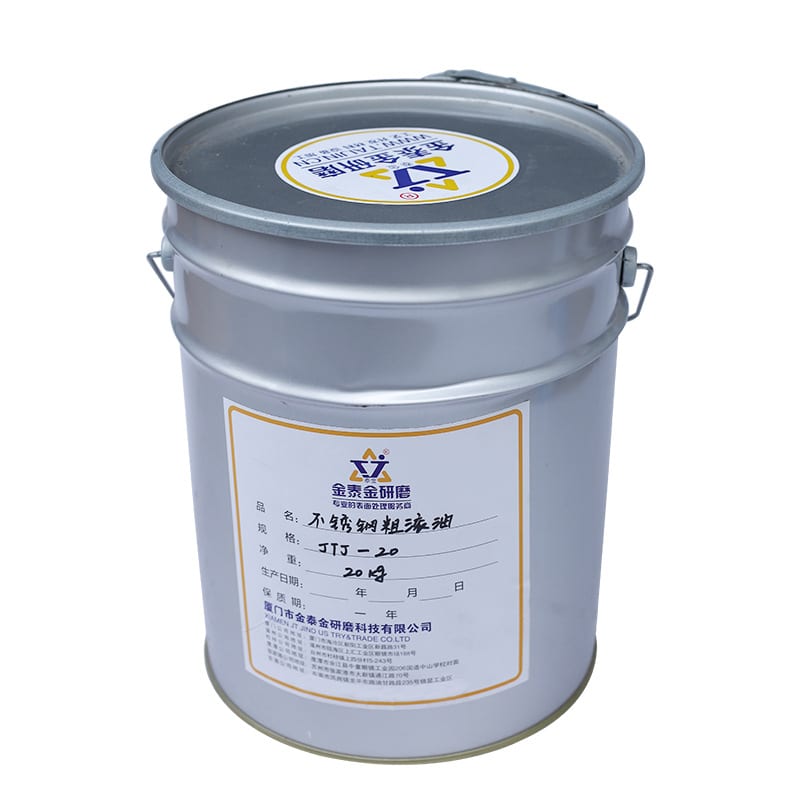
What we manufacture and supply is the liquid side: compounds and fluids metered into a wet mass-finishing process — the charge, the bowl, the barrel, the centrifugal machine. Those are specified by metal and by stage, and they ship at 20 kg barrel and 50 kg drum scale.
What we do not supply is a solid buffing bar. A bar is designed to be picked up by a cloth wheel and carried to a contact point; our products are designed to be dispersed through a charge so they reach every part in a batch. They are different forms for different processes, and a shop doing bench or wheel contact work is buying from a different supplier.
So the honest answer to this keyword: if your process is a wheel, a bar is the right product and we are not the supplier for it. If the question behind the search is "how do I get this metal bright", and the process is a machine, the liquid range is the one that applies — and the metal compound page is where that decision starts.
Where a buffing compound will not help
A surface with stock to remove. A bar refines and brightens; it does not take a milled face down. That is an abrasive stage before the buff.
A scratch deeper than the cut stage reaches. Brightening a scratch does not remove it. It goes back a stage or the part is replaced.
A part with a coating. A bar removes material, and a coating is material. If the surface is plated, anodised or painted, the specification is "do not cut" — which is a different product.
A part that must be dimensionally unchanged. Buffing removes metal, and on a thin or threaded section that removal is a tolerance risk.
A high-volume small part. A bar works one contact point at a time on one part. For hundreds of small parts, a loose charge reaches every face at once at a fraction of the per-part cost — the same economics that decide every machine family.
A dry, spot-free requirement straight off the machine. A bar leaves binder residue that has to be cleaned. If the part has to come off dry and clean, the process is a wet machine with a rinse and a dry, not a buff.
FAQ
What are buffing compounds for metal made of? An abrasive suspended in a wax or grease binder. The abrasive type and size set the cut, and the binder hardness sets how much pressure the bar needs and how the swarf clears.
Does the colour mean the same thing across brands? No. Colour naming is not standardised, so the sequence is what to compare: cut first, refine second, colour third, final gloss last. Ask a supplier which stage each bar is for rather than assuming black and white mean the same thing everywhere.
Which compound for stainless steel? A harder binder and a more aggressive abrasive than for aluminium or brass, because the bar has to cut a work-hardening surface. Using an aluminium bar on stainless polishes slowly and never removes the previous stage's marks.
Why does my aluminium go grey when I buff it? Usually a bar specified for a harder metal. It loads and smears rather than cutting, and the grey cast reads as a bad bar. The fix is a softer binder and a finer abrasive, and less pressure.
Can one bar do the whole job? No — a sequence is the normal case. A single bar either cuts too much for the final appearance or too little to remove the previous stage's marks. The number of stages is set by the starting condition and the finish required.
Do you sell buffing bars? No. We manufacture and supply the liquid side of the range — compounds and fluids metered into a wet mass-finishing process, at 20 kg barrel and 50 kg drum scale. A solid bar for wheel work is a different product from a different supplier, and a shop doing contact work should buy it as such.
Max Xu, Sales — Xiamen Jin Tai Jin Grinding Technology Co.,Ltd.
No. 31, Xinchang Road, Xinyang Industrial Zone, Haicang District, Xiamen
info@surface-polish.com
This article describes how a buffing compound is chosen for a metal; it is not a claim about any specific part's achievable result. A finishing process is set by the material, the stock to be removed and the finish required, so the sequence and the products for a specific part are confirmed against a trial on that part. We manufacture finishing equipment and the media and compounds that run in it; we do not offer a job-shop finishing service and we do not supply solid buffing bars.
 +86-592-2381506


 IPv6 network supported
