An aluminium valve body for medical devices that will be hard-anodised after finishing must arrive at the anodiser free of embedded media, residue and rounded seal lands. A buyer in Montreal, Canada can send representative bodies to SurfacePolish, a cross-border supplier of finishing machines, media and compounds, for a free sample trial and a scoped discussion. This brief is written for a buyer in Montreal working on medical devices; it describes equipment, media and a scoped sample review, not a local polishing service.
What edge radius or chamfer is allowed at each mating, sealing and press-fit feature, and how will it be measured?
What are the alloy and temper, and has machining, casting, welding or heat treatment already changed the surface hardness and porosity?
What downstream operation follows finishing, such as anodising, laser marking, bonding or assembly, and what does it require of the surface?
Begin by marking up the drawing surface by surface. An aluminium device housing may carry a visible cosmetic face, several machined mating faces that set a seal or a press fit, threaded ports, dowel holes and a thin outer wall, and each has a different finishing tolerance. Cosmetic zones can accept a uniform satin or bright finish; sealing faces and dowel bores need the edge left close to sharp or rounded to a stated radius, and a heavy media cycle destroys that. Note where the customer sees the part after assembly, because a face that meets a cosmetic grade on its own can still look wrong beside an untreated neighbour. A drawing that names, per surface, whether it is cosmetic, functional or indifferent is the cheapest document in the whole finishing project.
Magnetic finishing works on small aluminium parts with fine internal features, using a magnetic field to drive small pins or abrasive media through holes, slots and recesses that a tumbling load cannot reach. It is useful on small fittings, valve spools, connector components and parts with internal cross-holes, and it can be gentle enough for thin sections if field strength and cycle are controlled. Its limits are size and throughput: the working envelope is small and the process suits a narrow part family rather than a mixed batch, and fine media or pins lodge in blind features just as tumbling media do, so retrieval and inspection matter. Dry polishing machines and dryers handle the post-wet step, removing water from blind holes before anodising or laser marking, where a trapped droplet becomes a stain or a marking defect.
| Machine route | Where it fits | What it will not do |
|---|---|---|
| Dry polishing machine and dryer | Post-wet drying and dry polishing of aluminium parts before anodising, laser marking, bonding or packaging | Does not remove a burr or refine a surface on its own; residual media dust and incomplete drying still cause marking and coating defects |
| Grinding finishing machine | Higher material removal on aluminium parts that need a heavy burr or a pronounced chamfer removed before a gentler finishing step | Aggressive on soft aluminium, difficult to control on cosmetic faces and functional edges, and not a finishing step on its own |
| Centrifugal barrel finishing machine | Short, controlled cycles producing a fine satin finish and a defined edge on small to medium aluminium device parts | High energy bends thin walls and distorts light sections; barrel geometry limits part length and pieces per run |
| Rotary barrel finishing machine | Gentle, low-energy deburring of small precise aluminium parts in high volume, including thin and light components | Longer cycles for the same result; flat or light parts may slide rather than tumble, and an overloaded barrel stops working the load |
Media choice on aluminium is dominated by one fact: the workpiece is softer than most media used on steel. Dense ceramic and steel media that cut steel efficiently will embed, smear or gall an aluminium surface, implant iron particles that later show as staining or a galvanic couple, and round edges faster than the drawing allows. Plastic-bonded media in a light or medium abrasive grade, or a low-density ceramic, is the usual starting family for cosmetic work on 6061 and 7075, with harder ceramic reserved for a genuine heavy-cut deburr where the surface is not graded. The trade-off is real: gentle media remove less material and take longer, so a deep tool mark or heavy burr may need a coarser first stage and a gentler second. Choose media around the surface and edge the part must end with.
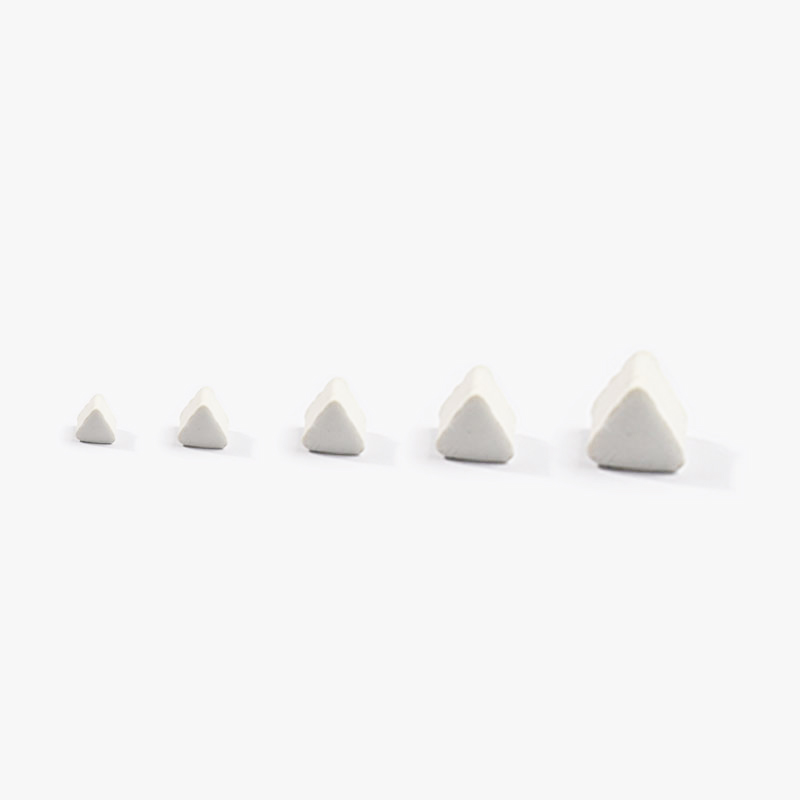
| Media | Best fit | Watch out for |
|---|---|---|
| Dry media, walnut shell, fine grade | Dry polishing, light surface cleaning and preparation before anodising or laser marking on aluminium parts | Shell dust must be extracted and the part cleaned, or the residue interferes with marking, bonding or a later coating step |
| Ceramic media, angle-cut triangles, medium size class | Heavy-cut deburring on cast or robust aluminium parts where the machined surface will be finished again or is not appearance graded | Rounds functional edges quickly and can chip or peen thin walls; not suitable where a sealing land or press fit is exposed |
| Plastic-bonded media, light to medium abrasive grade, cone and triangle shapes | General deburring and satin finishing on 6061 and 7075 where galling risk rules out dense ceramic | Wears quickly and loses edge definition; cut rate drops as the charge ages and the cosmetic result drifts unless media is screened and topped up |
| Dry media, corn cob with a polishing compound charge | Final dry polish and drying assistance on small aluminium parts where a wet rinse and dry would leave spotting | Compound loading saturates with use and the media cakes; the charge needs regular replacement, and soft aluminium can still smear |
Aluminium can leave a finishing cycle looking worse in colour than it went in. Over-alkaline compound etches and darkens the surface; hard water leaves mineral spotting that dries into rings; iron transferred from steel media or worn machine parts appears as black smut or scattered dark specks; and a slow or hot dry lets an oxide film form unevenly across a face. Castings with porosity are especially prone, because they hold liquid and release it later as a bloom. Check the part dry, under the lighting the customer will use, and compare against a retained reference part rather than memory. Control compound pH and concentration, rinse with controlled water quality, dry promptly and completely, and keep steel out of the aluminium loop. A stain found after anodising or packaging has already cost the value of the part.
| Failure mode | Likely cause | How to catch it |
|---|---|---|
| Finish bloom or speckle, or poor laser mark contrast, revealed after anodising or marking | Embedded media, a silicate or residue film, a directional texture that marks unevenly, or an oxide layer from a slow dry | Evaluate the appearance on a coated or marked sample rather than bare metal, and compare marking contrast on parts from different positions in the load |
| Bloom, bleed-out or staining appearing days after finishing on a casting | Porosity holding compound or rinse water, an as-cast skin opened by the cycle, incomplete drying before packaging or anodising | Hold finished castings for a defined period and re-inspect, and section a rejected part to confirm whether the residue originates in the pores |
| Damaged thread or media wedged in a thread root | Threads left exposed to the media field, sharp media entering the crest, insufficient plugging or masking of ports before the cycle | Run a go and no-go gauge through every sampled thread and inspect the root with a borescope or a thread impression |
| Galled, smeared or picked surface with transferred aluminium | Media too heavy or too dense for the alloy, insufficient compound lubricity, hot or overloaded charge, aluminium parts rubbing against each other | Inspect under low-angle directional light for smears and cold welds, then wipe with a white lint-free cloth to reveal transferred metal |
Montreal's industrial identity is anchored in aerospace, and the province-level cluster is organised, funded and internationally visible: when announcing defence-supply-chain funding at Aéro Montréal's 2026 International Aerospace Innovation Forum, the federal government described Aéro Montréal as the "Quebec aerospace industrial cluster" and paired it with Propulsion Québec for electric and smart transportation and with Sous-traitance industrielle Québec (STIQ) for manufacturing businesses. The same announcement shows how deliberately the region builds supplier capability, with CAD 4,495,000 of non-repayable federal funding to prepare Quebec SMEs for defence-sector requirements, and STIQ's share explicitly targeted at "manufacturing businesses in order to prepare them to meet defence sector requirements". Manufacturing is broad beyond aerospace, and the federal funding is deliberately aimed at the supplier tier: STIQ's contribution is targeted at manufacturing businesses across Quebec to prepare them to meet defence sector requirements, which is the metal-fabrication, machining and process-equipment base that Greater Montreal depends on for aerospace and transport-equipment work. The region's economic development agency also runs formal industrial clusters, including a green and smart buildings cluster whose members develop and manufacture architectural products and innovative building technologies, plus a life sciences and health technologies cluster.
The nearest part of that base to this brief is energy: Propulsion Québec, the electric and smart vehicle industrial cluster named in the same federal announcement, received a share of CAD 2.5 million to guide businesses in the electric and smart transportation sector, which is the regional electrification and energy-conversion base.
Aerospace and defence supply chains are the sharpest finishing driver in Montreal: structural and engine components, hydraulic and pneumatic fittings, and machined aluminium and titanium parts are specified with controlled edge condition, surface integrity and cleanliness because burrs and residual media create foreign-object-debris and fatigue risks. The cluster funding is explicitly aimed at moving SMEs into defence supply chains, and defence primes impose documented process control, which pushes suppliers toward repeatable, verifiable deburring and surface conditioning rather than manual operator judgement. Architectural-products and metal fabrication work in the same region adds a second, more cosmetic requirement set, where a uniform brushed or satin finish on visible stainless and aluminium is the acceptance criterion.
A Montreal aerospace or defence supplier should first settle whether the finishing step has to be a controlled, traceable process that can survive a prime-contractor audit, including media lot control, compound chemistry control and records, because adding those controls after machine selection is expensive. The second question is language and documentation: quotations, machine labelling, manuals and training material for a Quebec plant normally have to be usable in French, and that should be settled before order rather than during commissioning.
Freight context: Port of Montreal, Montréal-Trudeau International Airport, Mirabel (Mirabel airport and industrial park), CN and CPKC rail corridors. Montreal sits on the St. Lawrence corridor and combines a container and bulk seaport with a major international airport and a dedicated aerospace industrial park at Mirabel, which is what makes the region workable for both importing a machine and shipping sample parts to a supplier. For a cross-border equipment sale, the practical sequence is that machines move as sea freight into a St. Lawrence or coastal container port and are trucked or railed to the plant, while test parts and media samples can move by air through Montréal-Trudeau.
Canada is a bilingual market for selling purposes: English is the working language of procurement outside Quebec, while Quebec buyers (Montreal, Quebec City) normally expect French-language quotations, technical documentation and after-sales support, and Quebec's Charter of the French Language makes French the default for commercial documentation in the province. Procurement expectations are formal and auditable: a Canadian industrial buyer will typically ask for the tariff classification and country of origin up front, expect a commercial invoice that satisfies the CBSA invoice requirements, and expect the seller to provide proof of origin for any preferential claim. Payment norms are bank-to-bank, with wire transfer or letter of credit rather than platform payment, and Canadian buyers commonly net-30 to net-60 from invoice, so a cross-border seller should price the working-capital gap into the offer. Certificates of origin for export documentation are issued through chambers of commerce, which is why chambers such as the Hamilton Chamber of Commerce and the Winnipeg Chamber of Commerce offer document certification. The current trade environment adds policy risk to landed cost: Canadian federal programs are explicitly framed around responding to U.S. tariffs, with the FedDev Ontario Regional Tariff Response Initiative described as supporting "businesses to respond to tariff pressures" in southern Ontario, and tariff and surtax measures can change by Order in Council, so quotations should state the tariff basis and the date on which the landed-cost calculation was made.
The customs authority is the Canada Border Services Agency (CBSA), and importers of commercial goods must work through the CBSA Assessment and Revenue Management (CARM) system, which is where registration, the duties-and-taxes calculator, advance rulings and national customs rulings, and the commercial accounting declaration (CAD) are handled. Documentation expectations are explicit: "You must provide proof of country of origin when you import goods into Canada and, in some cases, your goods must also be clearly marked", the invoice or sales receipt must carry "a complete description of the goods", "the selling price" and "any conditions and terms of the sale", and the value for duty must be declared in Canadian currency only. Duties and taxes are layered rather than single: customs duty on the tariff item, the Goods and Services Tax calculated on the duty-paid value, and potentially excise duty, excise tax, surtax or safeguard measures. Importers must also clear non-tariff gates: goods must be admissible, some goods need permits, certificates or inspections from other federal departments that the CBSA applies on their behalf, controlled goods under the Defence Production Act require consultation with the CBSA and Global Affairs Canada before import, and "Goods manufactured or produced wholly or in part by forced or prison labour are prohibited from entering Canada", with due diligence resting on the importer. For electrical machinery, the practical conformity route in Canada is certification of the product to Canadian electrical safety standards by an accredited certification body rather than a self-declared CE-style mark; buyers should confirm the specific certification body and mark required before shipment. For a first shipment of a finishing machine or a media/compound sample lot, the fastest way to remove classification and valuation uncertainty is to use the CARM portal to request an advance ruling for tariff classification and origin.
SurfacePolish supplies from Xiamen, China. The buyer's own destination rules, conformity marking, tariff classification and documentation responsibilities stay with the buyer; confirm them against the authorities named above before ordering.
Residue requirements on a device component come from the buyer's own specification, not from a finishing route, and they should be stated as a measurable limit before parts are accepted. Practical checks include visual inspection of internal features under magnification or with a borescope, a wipe test with a defined solvent and a white substrate, a gravimetric non-volatile residue determination on a rinse sample, and a rinse-water conductivity or particulate count where the assembly is sensitive. Blind holes, threads and press fits are the features that retain residue, so sample them specifically rather than only a flat exterior face. If a validated cleaning process, biocompatibility data or a sterility claim is needed, that work belongs to the buyer's own quality system.
The first good batch is not the hard part; holding the finish over weeks is. Media wear, the charge volume falls, fines accumulate in the compound, screens clog and the rinse water changes, so the same timer produces a different result as the charge ages. Drift shows first as a slightly duller surface, a burr that reappears at a bore exit, or a finish that no longer matches the retained reference. Control it with a media top-up and replacement rule based on screening rather than the calendar, a compound concentration and pH check each shift, a rinse-water quality check, and a first-article comparison against the retained reference at the start of every batch. Any change of media supplier, compound, water supply or machine setting invalidates the previous baseline and should be treated as a new first-article event.
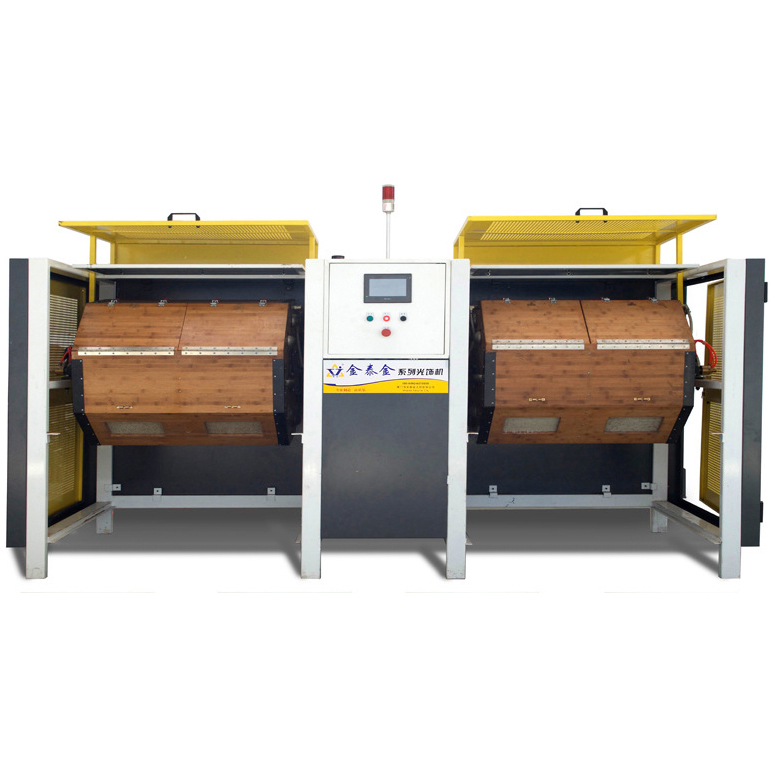
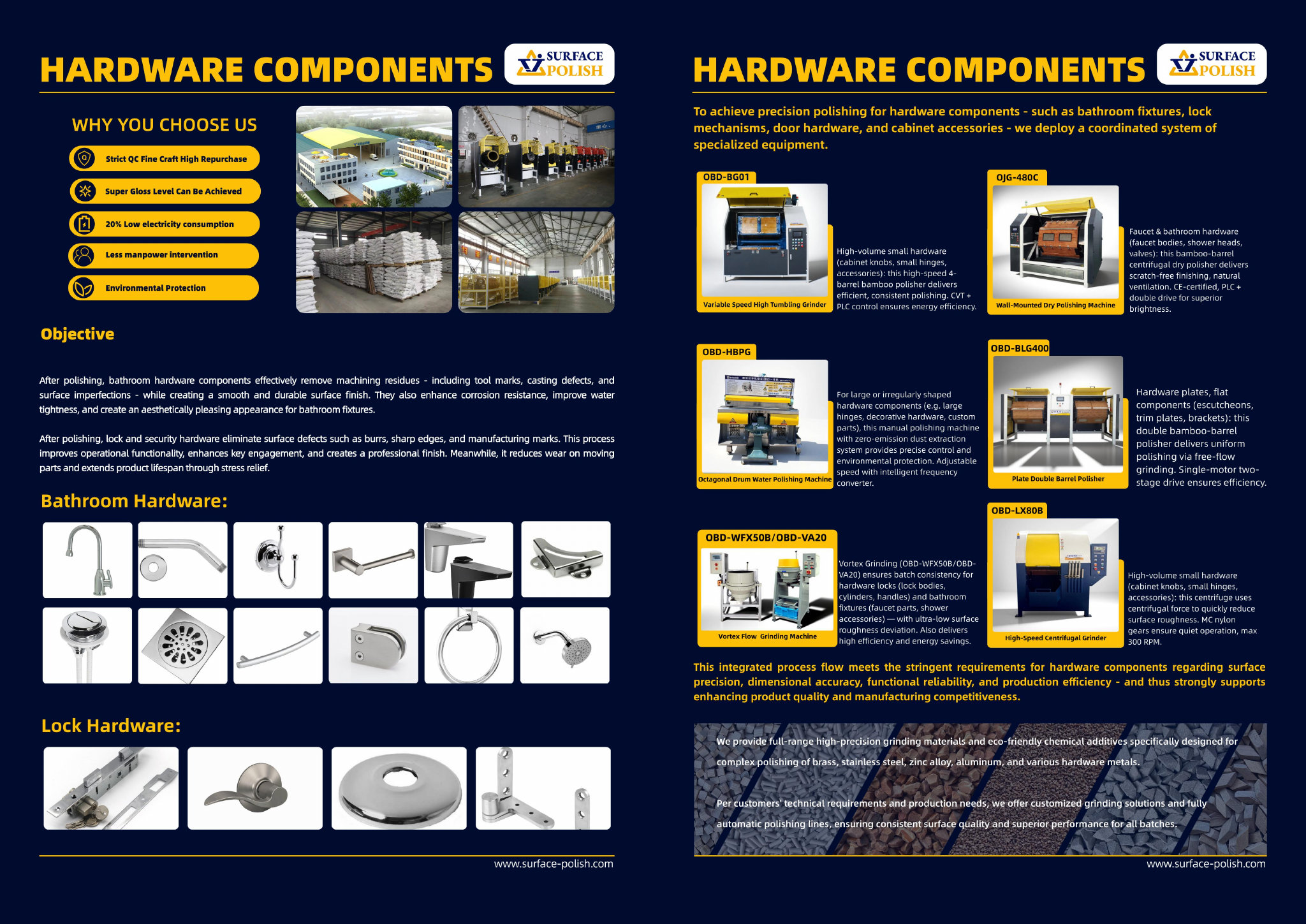
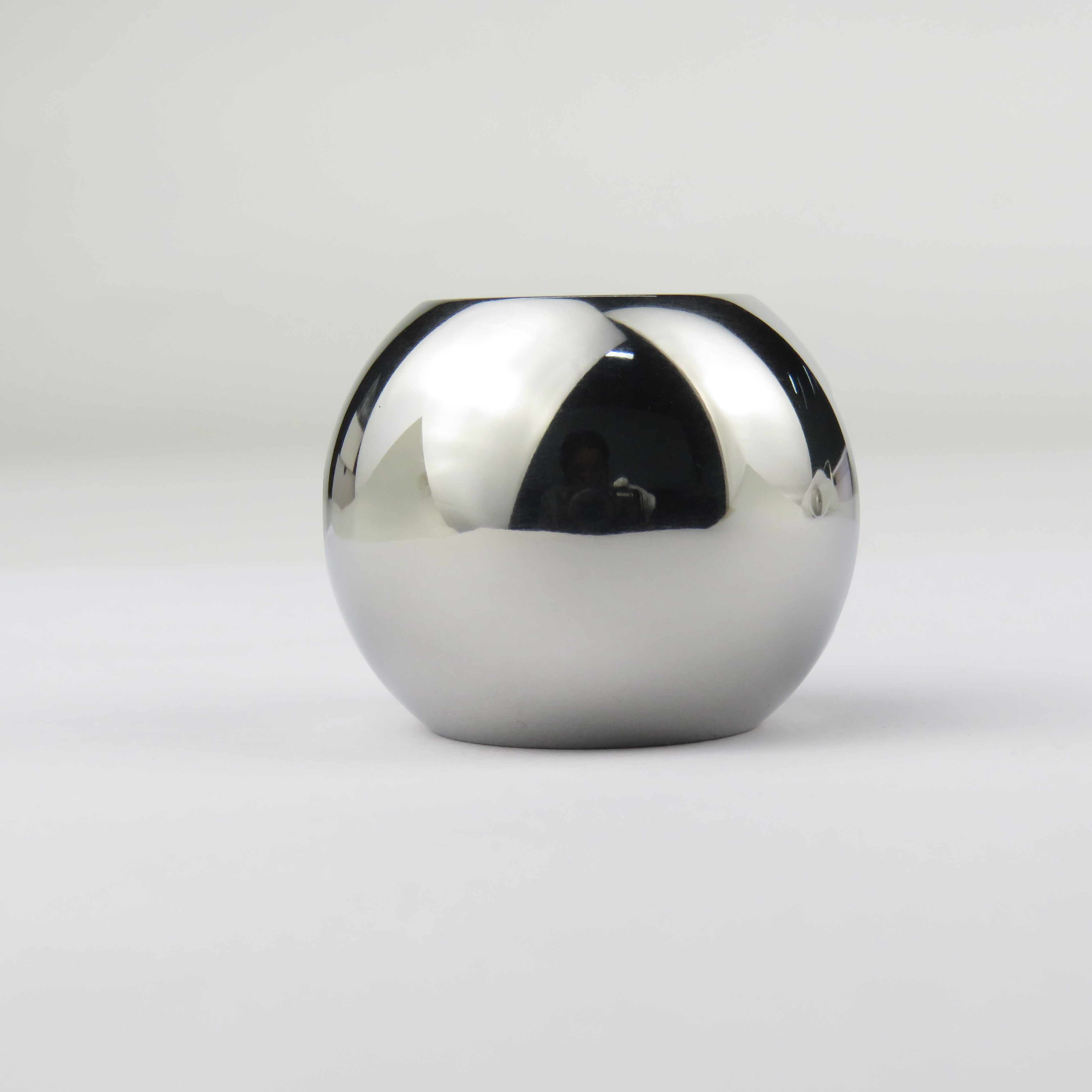
A bowl vibrator circulates a load through a media field at moderate energy, with good uniformity on small parts that tumble freely and easy discharge. A centrifugal barrel presses media and parts together at high force in a much shorter cycle, producing a fine finish and controlled edge quickly, but bending thin walls, distorting light sections and rounding edges faster. Bowl routes suit mixed small parts and gentle work; centrifugal routes suit a narrow part family that fits the barrel and accepts the energy. Parts made in Canada should be trialled in the specific geometry before a machine size is fixed, because barrel dimensions limit part length and load size.
Send representative parts, including the worst case: the thinnest wall, the tightest sealing edge, the deepest tool mark, a casting with visible porosity, the smallest hole and the feature most likely to trap media. Include two or three pieces of each condition, an untreated reference part, and a note of the alloy and temper, the part number, which surfaces are cosmetic and which are functional, and the edge radius or chamfer allowed at each critical feature. State the current process, the defect that prompted the enquiry and the downstream operation, whether anodising, laser marking, bonding or assembly. The clearer the part definition, the more useful the observations returned.
Laser marking interacts with surface texture, so contrast depends on whether the surface is directional, random satin or bright. A strong directional finish from a tub or a linishing step can produce a marking that reads differently when the part is turned, while a uniform random texture marks more consistently. Residue and embedded media also interfere, because the marking energy meets a contaminated surface. For a marked cover plate in Canada, the practical sequence is to fix the finish first, then qualify the marking programme on finished parts, and to check the mark under the lighting the end user will use rather than a bench lamp.
Use Montreal, Canada as the destination on the enquiry and state whether the deliverable is equipment, media and compound, a representative sample review or a line concept. A destination does not imply local stock, a local service point or a local delivery time.
A Montreal buyer works in French for documentation and in the Quebec occupational health and safety regime, which is administered separately from the other provinces, alongside Canadian electrical safety certification of the machine. Where the buyer is in the aerospace or defence supply chain, the governing requirement set is the prime contractor's process specification and its audit of the finishing operation, including traceability of media and compounds, rather than a single national finishing standard.
Sources were retrieved on 2026-09-29 and describe the local industrial and trade context only. They do not evidence any SurfacePolish project, shipment, installation or service in Montreal.
The buyer needs the deburring cycle to leave the sealing land flat and the thread clean, and to leave a surface that anodises without a visible bloom.
Send the material, dimensions, approximate weight, batch quantity, the incoming condition and photographs of the difficult features. Mark which features must not be contacted by media and state how the result will be inspected. This form carries source reference PSEO-0113; quote it if you prefer an additional manual reference.
Open the SurfacePolish enquiry form Email a prepared enquiry
No price, lead time, certification or result is promised here. Confirm whether a sample trial is available for the specific part and what the trial can and cannot show.
Page PSEO-0113 · revised 2026-09-29 · cross-border equipment, media and scoped sample review. City context is sourced and cited above.
Use this local checker to identify missing part and inspection information. It prepares a technical-review brief; it does not approve a machine, process recipe or production result.
Complete the part details to prepare a review brief.
Email : info@surface-polish.com


 IPv6 network supported


 +86-592-2381506