A pump manufacturer in Cologne, Germany serving food processing equipment is comparing routes for cast 316L volutes. Internal passages and a machined bore sit on the same part, and the buyer wants to know what a mechanical route can reach before committing to a finishing line. SurfacePolish supplies machines, media and compounds across borders and runs a free process sample trial on representative parts shipped to the factory in Xiamen. This brief is written for a buyer in Cologne working on food processing equipment; it describes equipment, media and a scoped sample review, not a local polishing service.
Which internal surfaces can a mechanical route physically reach, and what happens to the zones it cannot?
Where will roughness be measured, with which cut-off and in which direction, and does that location represent the surface the product actually sees?
Does the route have to remove heat tint and restore a passive condition, or refine a surface that is already clean, and who verifies that difference?
Grade and history determine what the surface can tolerate. Confirm whether the part is 304, 304L, 316 or 316L, whether it is annealed or cold worked, and whether a free-machining grade with added sulphur has been used in a product-contact position. Record every operation that has already touched the surface: forming, shot blasting, wire brushing with carbon steel, grinding with iron-bearing tooling, acid pickling, electrochemical polishing or an earlier mechanical polish. Each leaves a different starting condition and a different contamination risk. Note heat treatment and any sensitisation concern from welding or high-temperature service, because material condition affects how the surface behaves later and cannot be changed by finishing. Certificates for the delivered material and a written sequence of operations are the minimum evidence to request.
The compound does the cleaning, descaling, foam control and fine abrasive work that media alone cannot, and its chemistry family has to match the alloy. On stainless the critical questions are pH through the cycle and the chloride content of both the compound and the water used to mix and rinse it, because a chloride-bearing fluid on a sensitised or stressed surface is a pitting risk, and a residue left in a crevice is worse. Concentration and flow rate set how fast the work proceeds and how well the load is kept clean; too little compound leaves swarf and sludge on the part, while too much can foam, cushion the media and slow the cut. Water hardness affects how the compound behaves and how the rinsed surface dries. Ask for composition data and set limits.
| Media | Best fit | Watch out for |
|---|---|---|
| Liquid compound, abrasive cleaning slurry family | Cleaning, descaling and fine abrasive work through the cycle, with dosing and flow matched to the load and the alloy. | Chloride content and pH matter on stainless, foam can cushion the cut, and residue left in a crevice becomes a later defect. |
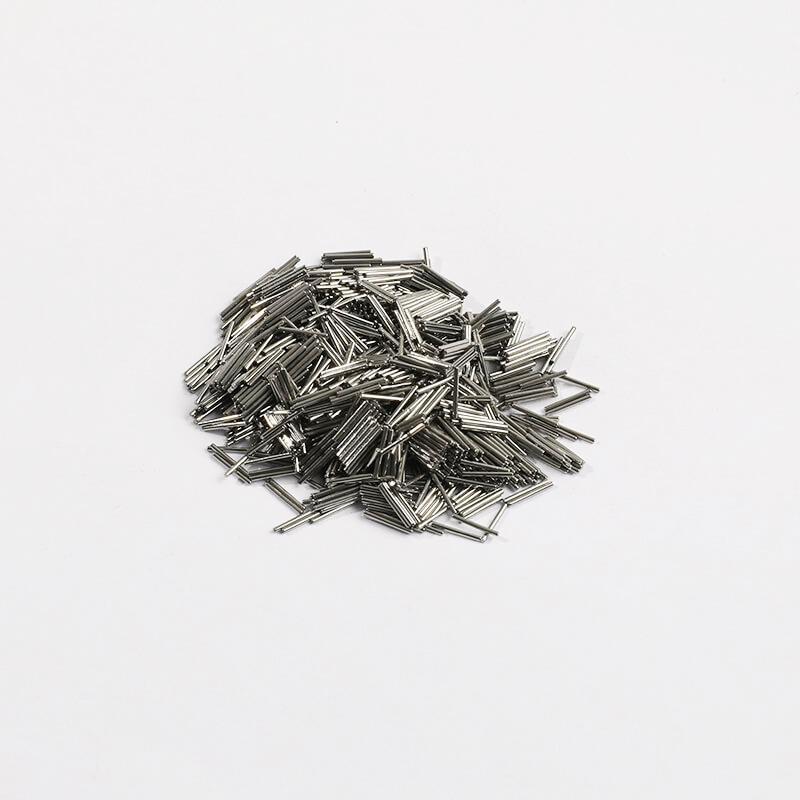
| Steel pins and fine media for magnetic finishing | Small precise components, short bores, slots and blind features that shaped tumbling media cannot enter. | Limited to small parts, will not remove a proud weld cap, and pins must be counted and recovered from every opening. |
| Dry media, walnut shell and corn cob | Light dry burnishing and cosmetic refinement where retained water in a crevice or assembly is a problem. | Generates dust requiring extraction, removes no oxide, and leaves a surface character different from a wet abrasive cycle. |
| Ceramic media, small cylinders and spheres | General deburring and light radius work on hygienic fittings, with less edge cutting than an angle-cut shape. | Small sizes lodge in gasket grooves and drilled openings, and a sphere refines slowly where oxide is thick. |
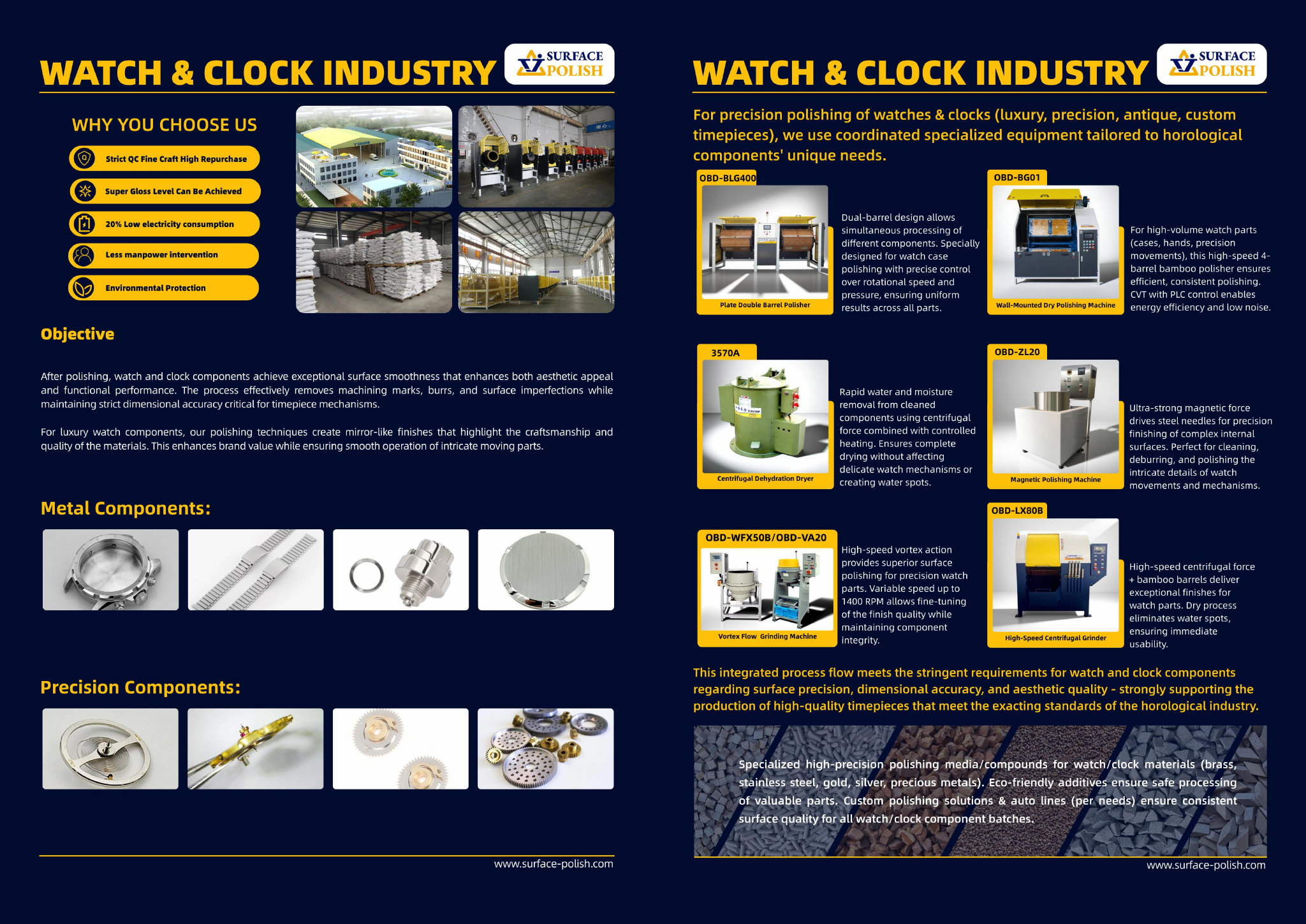
Magnetic finishing uses small steel pins or fine media driven by a rotating magnetic field, which lets it work inside small bores, slots and blind features that tumbling media cannot enter, and the pin-like medium is less likely to lodge than a shaped ceramic piece. It suits small precise components rather than large panels or long tubes, and it will not remove a proud weld cap. A dry route, using dry media on a dry polishing machine, is chosen when retained water in a crevice or an assembly is a problem, or when a light cosmetic refinement is wanted on a part that must not be wet. Dry processing generates dust and cannot remove heat tint or oxide, so it complements rather than replaces a wet abrasive stage. The dryer after a wet cycle is a process step, not an afterthought.
| Machine route | Where it fits | What it will not do |
|---|---|---|
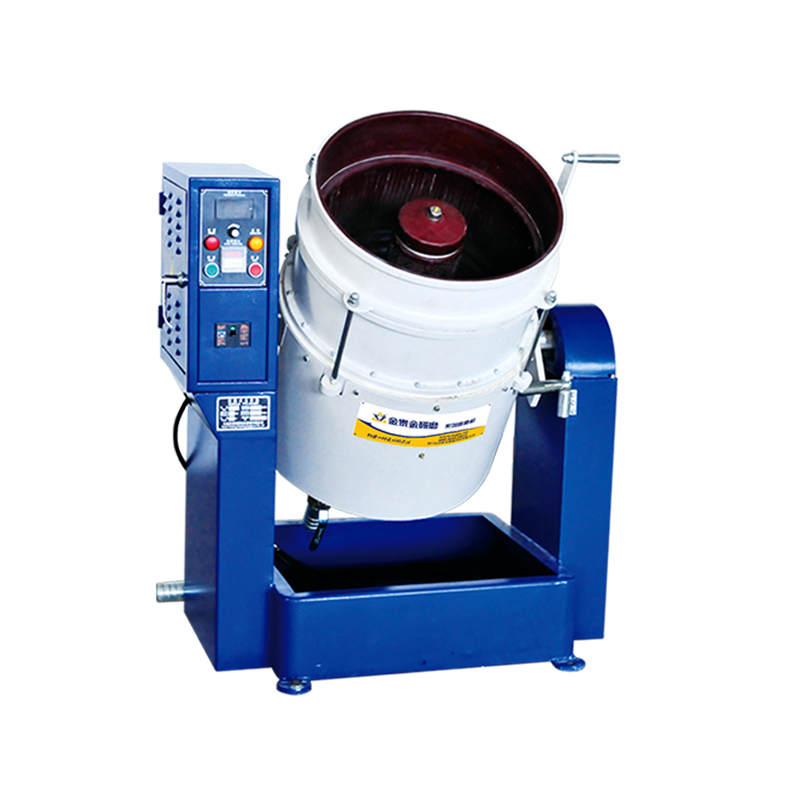
| Barrel finishing machine, rotary barrel tumbler | Large batches of small robust fittings, fasteners and valve trim that can tumble freely without damage. | Part-on-part contact is unavoidable, and fine threads, sealing lips and thin diaphragms are poor candidates. |
| Centrifugal barrel finishing machine | Higher-energy cycles that shorten the time to blend an edge or refine a small part in quantity. | The added energy increases over-rounding and imprinting risk, and delicate or mixed-size loads need careful planning. |
| Disc finishing machine | High-energy work on flat faces, flanges and convex zones where material removal or fast refinement is wanted. | Poor reach into recesses and around complex geometry, and it can dish a flat face if the cycle is not controlled. |
| Magnetic finishing machine | Small precise parts and short internal features such as slots, small bores and blind recesses. | Part size and surface area are limited, large panels and long tubes are out of scope, and it will not dress a weld cap. |
Free iron on stainless usually comes from tooling and consumables rather than from the part: carbon steel brushes, wire wheels, blasting grit or shot, iron-bearing media, shared racks, gloves that have handled mild steel and water from a contaminated line. It appears days or weeks later as a bloom of rust, often localised near a weld or a crevice. Detection uses a ferroxyl-type test or an equivalent method chosen by the buyer's own quality function, applied at the agreed locations including crevices and internal surfaces after finishing and rinsing. Control is separation: dedicated stainless tooling, media and racks; documented grade of every consumable that touches the surface; and a cleaning step after mechanical work. An upstream acid pickle or electrochemical polish brings its own concerns, including hydrogen, and sits outside what finishing equipment does.
| Failure mode | Likely cause | How to catch it |
|---|---|---|
| Media lodged in gasket grooves, threads, blind holes or tube ends | Medium size class too close to the opening size, no masking or plugging, and no counted retrieval step at the end of the cycle. | Count media into and out of the load, use a borescope at an agreed angle plus a pin gauge on critical openings, and weigh or shake parts over a tray to reveal retained pieces. |
| Uneven finish, banding or untouched shadow zones across one part | Part position in the chamber, a fixture holding a surface out of the media mass, or a load that is too full or too empty for even contact. | Take roughness readings at several marked locations instead of one, photograph at fixed angles around the part, and compare parts from the top and bottom of the same load. |
| Ceramic or steel media fragments embedded in the surface | Chipped or worn media, excessive cycle energy on a soft or thin feature, or a broken piece recirculating in the load. | Inspect under magnification at low angle, screen the media for broken pieces, and check the surface before and after a refinement stage to see whether fragments were present earlier. |
| Edge or weld toe rounded beyond the specified limit | Dense or large media running too long at high energy, or a part left free to tumble when it should have been fixtured. | Measure edges with an optical comparator or radius gauge and compare with the drawing limit, and measure a weld toe before and after the cycle on the same part. |
Cologne is primarily a services city, but the city's own statistical office records 79,173 jobs in the secondary (production) sector in 2023 out of 586,747 socially insured jobs, and counts 'Verarbeitendes Gewerbe' (manufacturing) among the five core branches that together hold about half of all Cologne jobs. The largest manufacturing cluster sits in the northern districts: Ford-Werke has its headquarters and vehicle plant in Niehl, an area the city statistics office describes as having around 25,400 mainly industrial jobs, and in the south-east DEUTZ AG has its registered office in Köln-Porz. The economic development agency of the city (KölnBusiness) organises its sector work around logistics and wholesale, health and life sciences, ICT, insurance and research, and the Rheinland around Cologne is a specialised aerospace location. Cologne/Bonn Airport alone employs around 15,000 people in 130 companies and public bodies.
The nearest part of that base to this brief is automotive: Ford-Werke's headquarters and plant are in Cologne-Niehl, a district of about 25,400 mainly industrial jobs, per the city's own statistical report on Cologne's branch structure.
Cologne's production jobs are concentrated in vehicle assembly and engine manufacture (Ford in Niehl, DEUTZ in Porz) and in the machine-building supplier tier that serves them, where castings, gears, shafts, housings and machined edges must be deburred and given a defined surface finish before assembly or coating. Automotive and engine customers in this region normally specify cleanliness and edge conditions in the drawing or in a factory standard rather than leaving them open, so a Cologne buyer's process decision is usually about meeting an existing surface and cleanliness callout, not about choosing a finish freely.
Settle first which cleanliness and surface specification governs the part (VDA 19.1/ISO 16232 cleanliness class and the drawing's roughness/edge callout) and whether the process must be qualified and traceable as a safety-relevant automotive or engine component before comparing finishing equipment or media.
Freight context: Köln Bonn Airport (CGN), Köln/Bonn, RheinCargo Rhine ports and rail terminals in the Cologne area (Niehl/Deutz/Wesseling), Combined road/rail terminals operated by RheinCargo. RheinCargo moves more than 50 million tonnes a year by rail and port across its network, and Cologne/Bonn Airport handles both passenger and air freight traffic with around 15,000 people working in 130 companies and authorities on a roughly 1,000-hectare site. Incoming finishing machines and sample parts can therefore arrive by air freight at CGN or by inland vessel/rail through the Rhine port system.
German is the working language of drawings, contracts, test reports and conformity documentation, and German buyers normally expect English-language technical documentation to be supplied alongside it. Procurement is documentation-driven: the EU declaration of conformity, the technical file, and the identity of the EU-based importer or authorised representative are settled before the order, and the EORI registration and customs declaration are the importer's responsibility rather than the exporter's (c3, c4, c5). Germany is the world's leading machinery and equipment manufacturer, so quotations compete against established domestic builders on technical documentation and measurable process data rather than on price alone (c9). Payment, delivery and risk terms are normally fixed by written contract with a named Incoterm, and classification (commodity code) is commonly confirmed in writing before shipment because it drives the duty and the import declaration.
Machinery placed on the German market must be CE marked, and the manufacturer is responsible for the conformity assessment, the technical file, the EU declaration of conformity and for affixing the mark; importers and distributors are separately obliged to ensure that only compliant, CE-marked products are placed on the EEA market (c3, c4). The customs authority is German customs (Zoll), part of the Generalzolldirektion, and the operator identification it issues, the EORI number, is a prerequisite for customs clearance in the European Union (c5, c6). In general EU practice a buyer's landed-cost plan therefore needs to cover the commodity-code classification that sets the duty rate, import VAT and the customs declaration, on top of the CE technical file and an identified EU-based economic operator who can act as importer or authorised representative; the technical documentation and the declaration of conformity must be available in the language required by the buyer's market surveillance authority.
SurfacePolish supplies from Xiamen, China. The buyer's own destination rules, conformity marking, tariff classification and documentation responsibilities stay with the buyer; confirm them against the authorities named above before ordering.
Visual acceptance is only repeatable when the viewing conditions are fixed. Agree the light source, distance, angle and magnification, whether raking light is used to reveal tint and scratches, and whether comparison is made against a physical reference or a photograph taken at the same settings. Define what counts as a defect: a colour band, a scratch, the scratch pattern left by coarse abrasive, a water spot, a handling mark. Internal surfaces need their own method, usually a borescope at an agreed insertion depth and view angle, with images retained so a later batch can be compared. Photographs are the practical record in a cross-border discussion, because a described appearance travels badly while a fixed-angle image travels well. Both sides should work from the same written standard.
Media is a consumable with a working life, and treating it as a fixed asset is a common reason a validated-looking process drifts. Plan for screening fines and broken pieces out, topping up to hold the size class and the load volume, and recording what was added and when. Compound concentration, dosing rate and rinse water quality need the same discipline, including a chloride check where the buyer's own requirements limit it, because concentration that creeps upward changes both the cut and the residue left behind. Sludge and spent compound have to be removed on a schedule, not when the chamber looks bad. Store media and compound so they cannot pick up contamination from a carbon steel fabrication area. Write the routine down, because a process that depends on one experienced operator is not yet a line.
No. SurfacePolish supplies mechanical finishing equipment, media and compounds across borders and runs a free sample trial on parts sent to the factory in Xiamen. Electropolishing is an electrochemical operation that is neither supplied nor performed, and no chemical pickling or passivation step is offered either. Where the two routes are compared on this page it is to help a buyer decide what they actually need, not to present a mechanical process as a substitute. If your specification requires an electrochemical finish, that work has to be sourced and verified by you.
Treat every recess as a retrieval point rather than hoping it stays clear. Choose a medium size class well below the smallest opening, mask or plug features that were never meant to see media, count media into and out of a load, and add a defined check such as a borescope at an agreed angle plus a pin gauge on critical holes. Where a groove is too narrow for any medium to enter, it will also be too narrow for oxide removal, so the two facts belong in the same conversation. Buyers in Cologne shipping parts for a trial should send the tightest feature they have.
It can, and the source is usually the tooling or the consumable rather than the stainless itself. Carbon steel brushes, wire wheels, blasting grit, iron-bearing media, shared racks and contaminated rinse water can all deposit free iron that appears later as a rust bloom. Control means dedicated stainless tooling and racks, documented grades for everything that touches the surface, and a cleaning step after mechanical work. Detection is by a ferroxyl-type test or an equivalent method chosen by your own quality function, applied at agreed locations including crevices. The acceptance decision and its critical locations remain yours.
Use Cologne, Germany as the destination on the enquiry and state whether the deliverable is equipment, media and compound, a representative sample review or a line concept. A destination does not imply local stock, a local service point or a local delivery time.
A Cologne buyer in the vehicle and engine supply chain will normally work to IATF 16949 with VDA 6.3 process audits and to the technical-cleanliness regime VDA 19.1 / ISO 16232 for residual particle limits, alongside surface-texture specifications such as ISO 21920 and material certificates to EN 10204 (3.1). For the machines themselves, placement on the EU market requires CE marking under the EU Machinery Regulation.
Sources were retrieved on 2026-09-29 and describe the local industrial and trade context only. They do not evidence any SurfacePolish project, shipment, installation or service in Cologne.
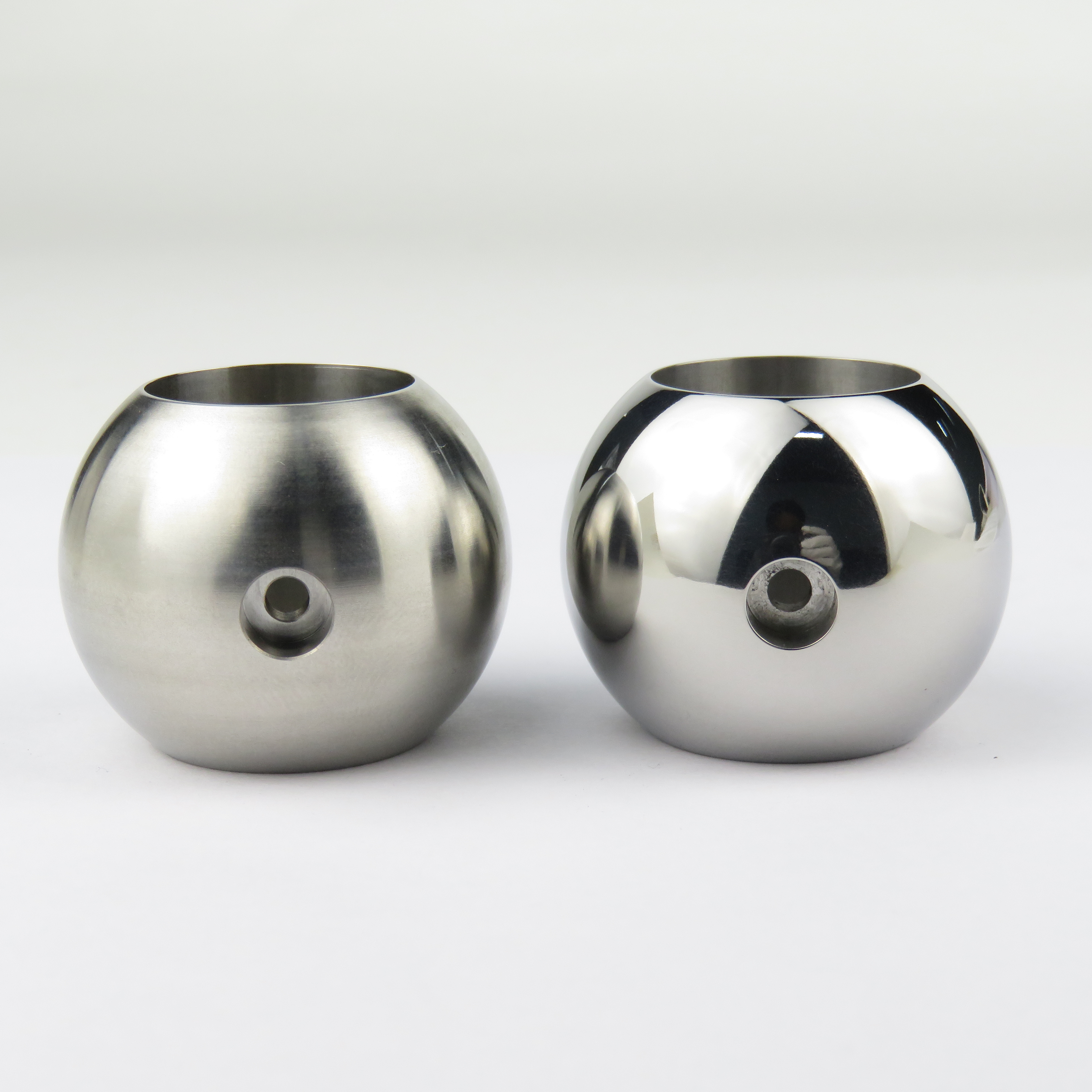
The buyer needs the internal cast surfaces and the gasket face refined without changing the shaft bore or the sealing geometry.
Send the material, dimensions, approximate weight, batch quantity, the incoming condition and photographs of the difficult features. Mark which features must not be contacted by media and state how the result will be inspected. This form carries source reference PSEO-0354; quote it if you prefer an additional manual reference.
Open the SurfacePolish enquiry form Email a prepared enquiry
No price, lead time, certification or result is promised here. Confirm whether a sample trial is available for the specific part and what the trial can and cannot show.
Page PSEO-0354 · revised 2026-09-29 · cross-border equipment, media and scoped sample review. City context is sourced and cited above.
Use this local checker to identify missing part and inspection information. It prepares a technical-review brief; it does not approve a machine, process recipe or production result.
Complete the part details to prepare a review brief.
Email : info@surface-polish.com


 IPv6 network supported


 +86-592-2381506