A filling equipment builder in Coventry, United Kingdom working in food processing equipment has a 316L manifold with two dozen small orifices and a sealing face that must stay flat. Media small enough to pass a 1.5 mm hole can also disappear inside the part, so the buyer needs a route that deburrs without creating a retrieval problem. SurfacePolish supplies finishing machines, media and compounds across borders with a free sample trial. This brief is written for a buyer in Coventry working on food processing equipment; it describes equipment, media and a scoped sample review, not a local polishing service.
What must the finished surface survive in service, including cleaning cycles, and how will that be checked without leaning on a finishing trial?
What free-iron and chloride exposure does the process itself introduce, and can the buyer's own cleanliness test detect it before the part is released?
Which surfaces on this part touch product, and what does each one have to satisfy in roughness, oxide freedom, edge condition and cleanliness?
Reachability decides the route more often than the finish target does. Measure the internal diameter of every tube, the depth and diameter of every blind hole, the width of every crevice and gasket groove and the corner radius at every internal weld. Ratios matter more than absolute size: a bore that is wide but very deep, or a groove narrower than the smallest available medium, stays untouched by any tumbling process however long the cycle runs. Ask whether a borescope can be inserted and at what angle, because a surface that cannot be seen cannot be inspected after finishing. List the zones a machine cannot reach, and decide in advance whether those zones are finished by another method, accepted as-is with a stated condition, or designed out of the part.
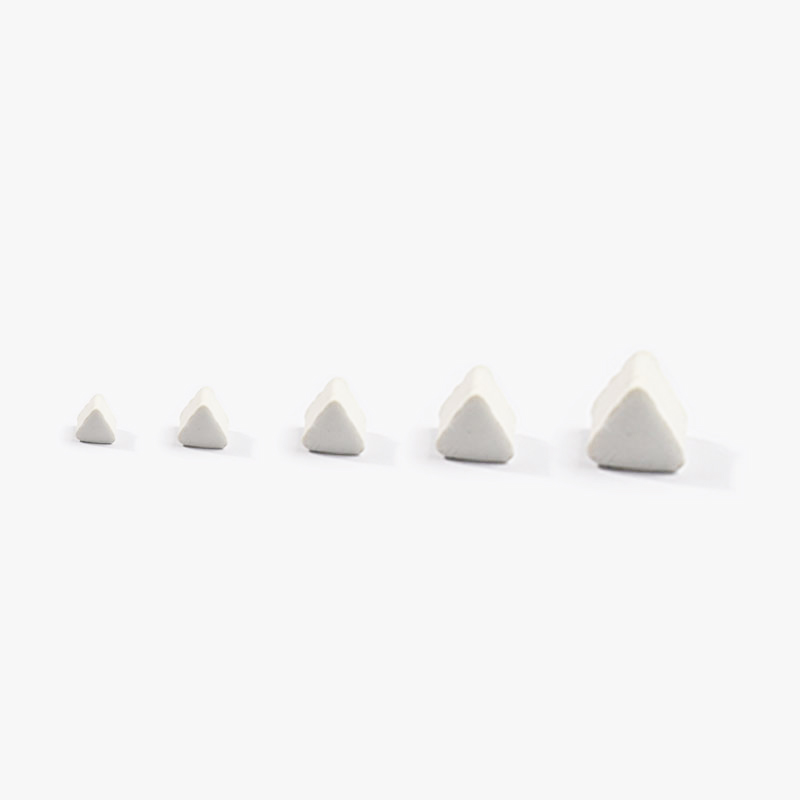
Ceramic media in angle-cut triangles, cylinders, stars and small spheres is the workhorse for stainless weld refinement and deburring. Bonding and shape class set the cut: an angle-cut triangle reaches into corners and along a weld toe, a cylinder rolls and blends, and a small sphere refines without cutting an edge hard. Size drives reach as much as aggression does, because a piece larger than the crevice simply cannot enter it. Ceramic wears down and changes its effective size class over its working life, so top-up and screening are part of holding a finish steady. Wear also produces sludge and fine debris that must be rinsed away, and a chipped piece is an embedding risk. Buying medium on price alone usually shows up later as inconsistent finish and higher consumption.
| Media | Best fit | Watch out for |
|---|---|---|
| Liquid compound, abrasive cleaning slurry family | Cleaning, descaling and fine abrasive work through the cycle, with dosing and flow matched to the load and the alloy. | Chloride content and pH matter on stainless, foam can cushion the cut, and residue left in a crevice becomes a later defect. |
| Steel media, balls and diagonals | Bright surface refinement on robust stainless parts where a dense medium is wanted to work into recesses. | Can transfer iron to stainless, imprint soft or thin features, flatten a deliberate edge radius, and needs magnetic recovery. |
| Ceramic media, angle-cut triangles | Heavier weld-zone refinement and edge blending on 304 and 316L parts where a corner or a toe line has to be reached. | Wears down and changes its effective size class, produces sludge, and can over-round a thin edge or a soft detail. |
| Plastic media, cones and triangles | Gentle edge blending and cosmetic refinement on softer non-ferrous fittings, thin sections and delicate parts. | Cannot remove heat tint, mill scale or a weld cap, so it must follow the operation that does that work. |
Magnetic finishing uses small steel pins or fine media driven by a rotating magnetic field, which lets it work inside small bores, slots and blind features that tumbling media cannot enter, and the pin-like medium is less likely to lodge than a shaped ceramic piece. It suits small precise components rather than large panels or long tubes, and it will not remove a proud weld cap. A dry route, using dry media on a dry polishing machine, is chosen when retained water in a crevice or an assembly is a problem, or when a light cosmetic refinement is wanted on a part that must not be wet. Dry processing generates dust and cannot remove heat tint or oxide, so it complements rather than replaces a wet abrasive stage. The dryer after a wet cycle is a process step, not an afterthought.
| Machine route | Where it fits | What it will not do |
|---|---|---|
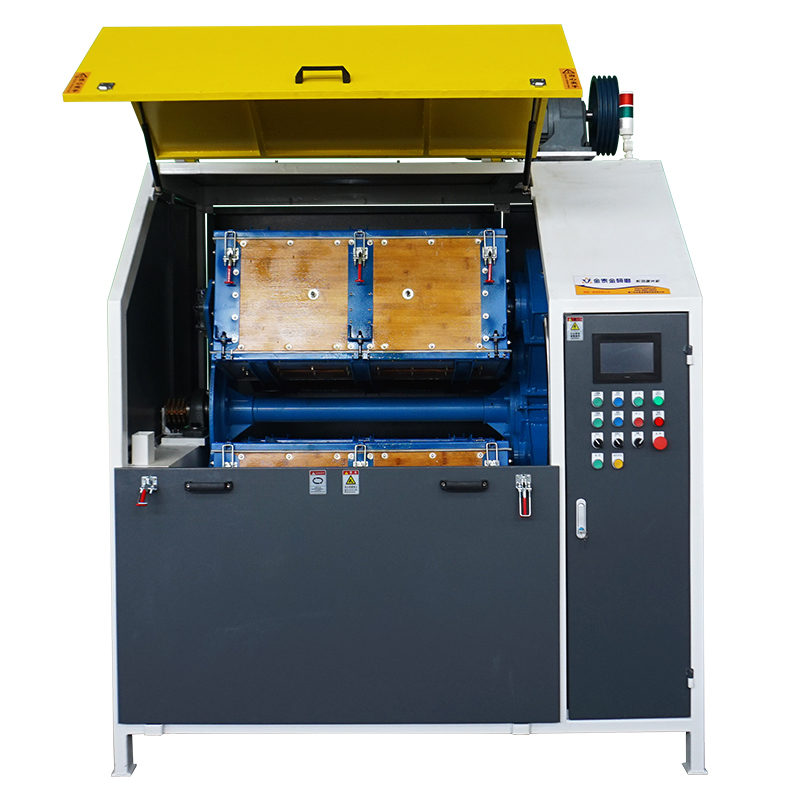
| Grinding finishing machine | Removing a proud weld cap, heavy scale and heat tint before any tumbling or refinement stage. | Leaves a scratch pattern that needs refining, can smear oxide, and iron-bearing tooling can deposit free iron on stainless. |
| Vibratory finishing machine, bowl type | Edge and weld-toe blending plus surface refinement on mid-sized parts, with a visible load and adjustable energy. | Chamber geometry caps part size, and the inside of a long tube or a narrow crevice stays out of reach. |
| Barrel finishing machine, rotary barrel tumbler | Large batches of small robust fittings, fasteners and valve trim that can tumble freely without damage. | Part-on-part contact is unavoidable, and fine threads, sealing lips and thin diaphragms are poor candidates. |
| Dry polishing machine and dryer | Dry burnishing where a wet cycle is unwanted, and drying parts after a wet cycle so crevices do not stay wet. | Removes no oxide and needs dust extraction; a dryer manages water, it does not change the finish left by the wet stage. |
Removing material always changes the part, and the change is not always wanted. A weld toe can be rounded past the radius the drawing implies, a sealing lip can lose its bite, a gasket seat can dish enough to leak, and a thin tank panel can deflect under a heavy load. Media size class and density drive this: a large dense piece on a soft detail rounds it quickly, while a small light piece barely touches it. Detection uses an optical comparator or radius gauge on edges, a flatness check on sealing faces, and dimensional measurement of any feature that carries a tolerance. Dye penetrant or a visual check finds an undercut created by over-grinding a weld cap. Thin-wall parts deserve measurement before and after, because distortion in a small load only worsens at production fill levels.
| Failure mode | Likely cause | How to catch it |
|---|---|---|
| Heat tint or oxide remaining at the weld toe and in the crevice beside it | Cycle too gentle or too short for the oxide thickness, or a medium size class too large to enter the toe line. | Inspect the toe at magnification under raking light against an agreed visual reference, photograph at a fixed angle before and after, and apply the buyer's own free-iron or passive-condition method where specified. |
| Rust bloom or free-iron staining appearing after finishing | Carbon steel brushes, iron-bearing media, shared racks or contaminated rinse water depositing free iron on a 304 or 316L surface. | Run a ferroxyl-type test or the buyer's own equivalent at agreed locations including crevices and internal surfaces, after rinsing and drying, and record the result with the batch. |
| Cross-contamination from tooling, racks or media shared with carbon steel | No dedicated stainless area, undocumented consumable grades, or media stored where mild steel fabrication dust settles. | Audit which tools, racks and media touch the part, record their grades, store media covered and segregated, and confirm cleanliness with the buyer's own test after a tooling change. |
| Thin-wall distortion or dishing on tanks, panels and chutes | Heavy media load striking unsupported thin sheet, or a chamber fill level that lets parts fall rather than tumble. | Measure wall flatness and key dimensions before and after, inspect under raking light for oil-canning, and run the test at the production fill level rather than a light one. |
Coventry is one of the local authority areas inside the West Midlands Combined Authority, whose region-wide economic and skills activity includes a skills hub opened at Coventry city centre South. The city's dedicated business support route changed on 1 April 2026, when the Coventry & Warwickshire Growth Hub transitioned to a new regional model that centralises programmes, events and funding information through Business Growth West Midlands, with local advisory support remaining available through Coventry City Council. Coventry sits inside the West Midlands production base that Make UK studied with the West Midlands Combined Authority and the West Midlands RAS Cluster, surveying over 100 manufacturers of all sizes.
The nearest part of that base to this brief is automotive: Coventry sits inside the West Midlands Combined Authority area, the production region whose robotics and autonomous systems adoption Make UK studied with survey responses from over 100 manufacturers.
Coventry sits inside the West Midlands production base that Make UK and the West Midlands Combined Authority surveyed on robotics and autonomous systems adoption - a programme aimed at lifting productivity in an industrial base where deburring and edge finishing sit between machining and assembly and are a candidate for the same automation programme. Because no Coventry-specific industrial source could be verified in this research, process specifics should be drawn from the customer's drawing and specification rather than from regional averages.
A Coventry buyer should confirm who in the supply chain owns the finishing specification - the OEM, the tier-one or the machining supplier - before selecting equipment, because the edge and cleanliness requirement is normally flowed down contractually rather than agreed locally.
Freight context: Hams Hall Rail Freight Terminal (ABP-owned, near Birmingham) as the nearest inland container terminal to Coventry, West Midlands motorway network (M6, M69, A45) for road freight. ABP's 11ha Hams Hall terminal, located eight miles outside Birmingham, handles deep-sea and short-sea traffic to and from ports such as Southampton, Tilbury and Felixstowe along with Channel Tunnel and Scottish domestic traffic, making it the practical inland container gateway for Coventry consignments.
English is the working language of contracts, drawings and conformity paperwork, so quotations, technical files and Declarations of Conformity should be supplied in English. UK manufacturers have now recovered above 2019 output levels in every English region and devolved nation except Northern Ireland, and the sector is concentrated in food and drink and transport equipment, with the North West the largest manufacturing region by total output. Buyers typically expect the UKCA/CE route, a Declaration of Conformity and a UK-established economic operator to be identified before order, and they need commercial invoices, customs declarations and the C79 retained in a form their finance team can use for import VAT recovery. No source verified in this research establishes a mandated payment instrument, so payment structure should be treated as commercial negotiation rather than a regulatory requirement.
BSI is the UK's National Standards Body, and British Standards (BS, including adopted BS EN ISO texts) are the documents a UK buyer's surface-finish, edge and cleanliness specifications are normally written against and purchased through. On the plant side, HSE maintains the work equipment and machinery topic covering the safe supply and use of machinery, and the COSHH regime, which requires employers to identify, assess and control risks from hazardous substances - the regime that applies to finishing compounds, abrasive media and the dust and effluent they generate.
SurfacePolish supplies from Xiamen, China. The buyer's own destination rules, conformity marking, tariff classification and documentation responsibilities stay with the buyer; confirm them against the authorities named above before ordering.
An Ra number without a location, cut-off and direction is close to meaningless. Fix the measurement location on the drawing, including whether it sits on base metal, a dressed weld or the heat-affected zone, since those are different surfaces. Choose the cut-off and evaluation length to suit the expected roughness and record both, because the same surface returns different values under different settings. Traverse across the lay rather than along it when the requirement concerns the surface the product sees, and take several readings at each agreed location rather than one. Use a calibrated instrument with a reference specimen and record the instrument and the operator. Remember what roughness does not describe: a crevice, an oxide film, a contaminated surface or a sharp edge can all coexist with an acceptable Ra value.
A sample trial reports what was observed on the parts tested under the settings used, and that is the whole of it. It cannot promise a roughness value, an edge dimension, a cycle time, a throughput, a cost per part or a delivery date, and it does not qualify a machine, medium, compound or process for food contact, hygienic service or any regulated application. A handful of parts does not represent production variation in material, welding or fit-up, and performance in service, including corrosion behaviour after cleaning and any passivation step, is not established by a finishing trial. What a trial does give is evidence: how a route behaved on real geometry, which zones it reached, what the surface looked like, and where a mechanical route runs out of reach. The decisions that follow belong with the buyer.

Heat tint is oxide, so it is removed by cut rather than by cleaning. Ceramic media with an aggressive shape and bonding, or a grinding stage followed by refinement, are the usual mechanical answers on accessible weld zones. The limit is reach: a tint line that runs into a toe, a crevice or a small bore may survive a cycle that polishes the cap, which is why the toe should be inspected rather than judged by the shine of the weld face. Media size, shape and cycle energy must suit the oxide thickness. A trial on your own parts shows what was removed on the geometry tested.
It can, and the source is usually the tooling or the consumable rather than the stainless itself. Carbon steel brushes, wire wheels, blasting grit, iron-bearing media, shared racks and contaminated rinse water can all deposit free iron that appears later as a rust bloom. Control means dedicated stainless tooling and racks, documented grades for everything that touches the surface, and a cleaning step after mechanical work. Detection is by a ferroxyl-type test or an equivalent method chosen by your own quality function, applied at agreed locations including crevices. The acceptance decision and its critical locations remain yours.
Treat every recess as a retrieval point rather than hoping it stays clear. Choose a medium size class well below the smallest opening, mask or plug features that were never meant to see media, count media into and out of a load, and add a defined check such as a borescope at an agreed angle plus a pin gauge on critical holes. Where a groove is too narrow for any medium to enter, it will also be too narrow for oxide removal, so the two facts belong in the same conversation. Buyers in Coventry shipping parts for a trial should send the tightest feature they have.
Use Coventry, United Kingdom as the destination on the enquiry and state whether the deliverable is equipment, media and compound, a representative sample review or a line concept. A destination does not imply local stock, a local service point or a local delivery time.
Machinery placed on the Great Britain market needs UKCA or CE marking with a Declaration of Conformity, and HSE's work equipment and machinery and COSHH regimes govern safe operation and the media, compounds and dust involved. In a multi-tier supply chain, the surface, edge and cleanliness requirement is normally flowed down from the OEM or tier-one rather than set by the finishing shop.
Sources were retrieved on 2026-09-29 and describe the local industrial and trade context only. They do not evidence any SurfacePolish project, shipment, installation or service in Coventry.
The buyer needs burrs removed from the orifice edges without lodging media in holes that are too small for most shapes.
Send the material, dimensions, approximate weight, batch quantity, the incoming condition and photographs of the difficult features. Mark which features must not be contacted by media and state how the result will be inspected. This form carries source reference PSEO-0284; quote it if you prefer an additional manual reference.
Open the SurfacePolish enquiry form Email a prepared enquiry
No price, lead time, certification or result is promised here. Confirm whether a sample trial is available for the specific part and what the trial can and cannot show.
Page PSEO-0284 · revised 2026-09-29 · cross-border equipment, media and scoped sample review. City context is sourced and cited above.
Use this local checker to identify missing part and inspection information. It prepares a technical-review brief; it does not approve a machine, process recipe or production result.
Complete the part details to prepare a review brief.
Email : info@surface-polish.com


 IPv6 network supported


 +86-592-2381506