A fabricator in Turin, Italy supplying food processing equipment has a 316L tube spool whose internal orbital weld still shows heat tint. They searched for electropolishing, and what they really need is a decision: which route reaches that bore, and what a mechanical route can achieve on the outside of the joint. SurfacePolish supplies finishing machines, media and compounds across borders and runs a free sample trial on parts sent to Xiamen. This brief is written for a buyer in Turin working on food processing equipment; it describes equipment, media and a scoped sample review, not a local polishing service.
Does the route have to remove heat tint and restore a passive condition, or refine a surface that is already clean, and who verifies that difference?
Which internal surfaces can a mechanical route physically reach, and what happens to the zones it cannot?
What free-iron and chloride exposure does the process itself introduce, and can the buyer's own cleanliness test detect it before the part is released?
Before any trial, fix the starting condition in a way that can be compared later. Take roughness readings at agreed locations, photograph the part under consistent lighting, note visible burrs, tint and scratches, and keep one untouched part as a reference. Describe the batch: how many pieces of each size, whether they are identical, and whether mixed sizes will share a chamber. Decide how parts will be separated, racked or compartmented, and which surfaces may touch each other or a fixture. Handling rules matter as much as process settings on stainless, because a bench, a rack or a glove that has touched carbon steel can leave the contamination that later appears as a rust bloom. Write the baseline down, because a trial without an incoming record produces observations nobody can interpret.
A tub vibrator gives a long, open chamber that accepts parts a bowl cannot, including tube spools, chute sections, small vessels and long fabrications. The part can be repositioned, rotated or left static depending on what has to be reached, and the open design makes it easier to watch what is happening to a weld during the cycle. The trade-off is evenness: coverage depends on how the part sits relative to the media mass, so banding and untouched shadow zones are common unless fixture and part orientation are planned. Internal surfaces of a long small-bore tube remain out of reach regardless of tub size. Tub capacity, media volume, how the part is supported and how it is lifted in and out should be settled before the route is accepted.
| Machine route | Where it fits | What it will not do |
|---|---|---|
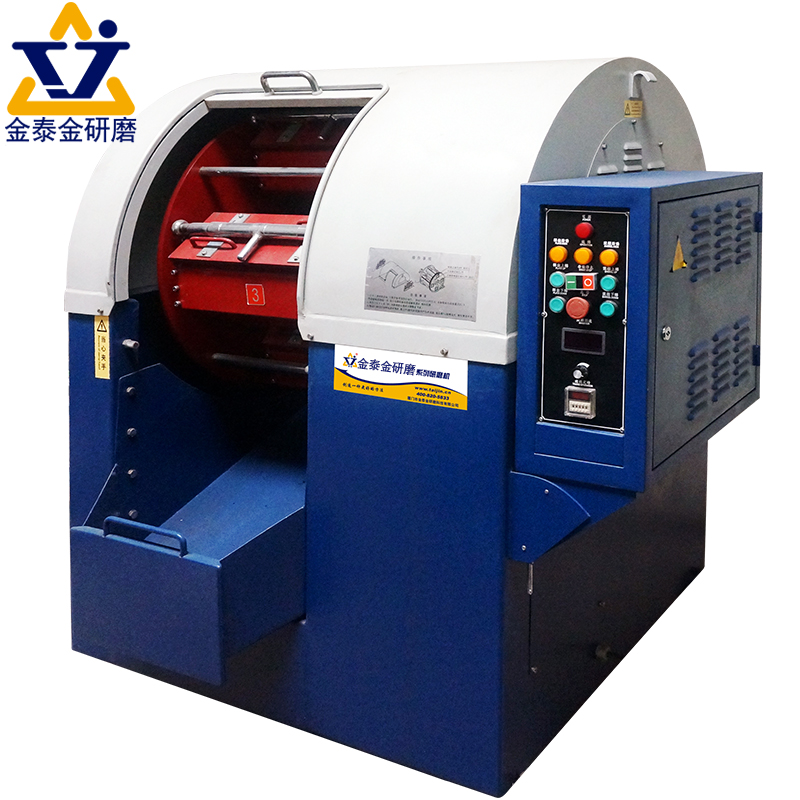
| Vibratory finishing machine, bowl type | Edge and weld-toe blending plus surface refinement on mid-sized parts, with a visible load and adjustable energy. | Chamber geometry caps part size, and the inside of a long tube or a narrow crevice stays out of reach. |
| Centrifugal barrel finishing machine | Higher-energy cycles that shorten the time to blend an edge or refine a small part in quantity. | The added energy increases over-rounding and imprinting risk, and delicate or mixed-size loads need careful planning. |
| Barrel finishing machine, rotary barrel tumbler | Large batches of small robust fittings, fasteners and valve trim that can tumble freely without damage. | Part-on-part contact is unavoidable, and fine threads, sealing lips and thin diaphragms are poor candidates. |
| Disc finishing machine | High-energy work on flat faces, flanges and convex zones where material removal or fast refinement is wanted. | Poor reach into recesses and around complex geometry, and it can dish a flat face if the cycle is not controlled. |
Steel media in balls, diagonals and pins is dense and produces a bright refined surface quickly, which makes it attractive where appearance matters. On stainless the trade-off is contamination: steel media and its wear debris can transfer iron to the surface, and that iron is exactly what later appears as a rust bloom in service. Magnetic separation makes steel media easy to recover, and its mass helps it work into recesses, but it can also imprint soft or thin features and flatten a deliberate edge radius. Whether steel is acceptable depends on the buyer's own cleanliness and free-iron requirements and on what happens downstream. If a stainless part will meet moisture or a chloride-bearing environment, settle the contamination question before steel media is written into the process.
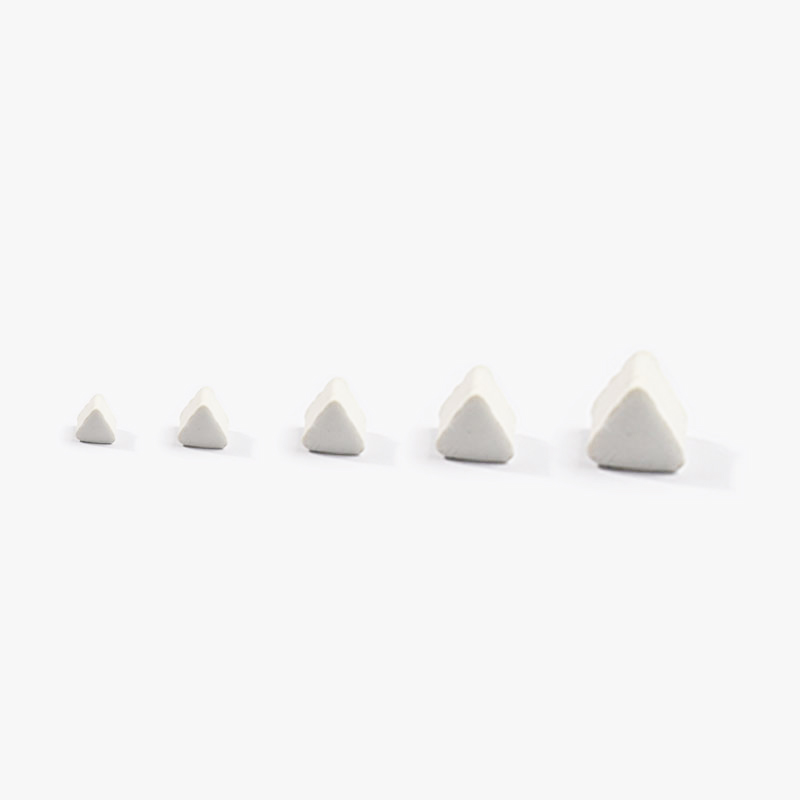
| Media | Best fit | Watch out for |
|---|---|---|
| Grinding media, coarse alumina-based | Removing a proud weld cap, heavy scale and heat tint before a refinement stage on accessible external surfaces. | Leaves a coarse scratch pattern that must be refined, removes material fast, and can gouge thin sheet or a soft alloy. |
| Ceramic media, angle-cut triangles | Heavier weld-zone refinement and edge blending on 304 and 316L parts where a corner or a toe line has to be reached. | Wears down and changes its effective size class, produces sludge, and can over-round a thin edge or a soft detail. |
| Liquid compound, abrasive cleaning slurry family | Cleaning, descaling and fine abrasive work through the cycle, with dosing and flow matched to the load and the alloy. | Chloride content and pH matter on stainless, foam can cushion the cut, and residue left in a crevice becomes a later defect. |
| Plastic media, cones and triangles | Gentle edge blending and cosmetic refinement on softer non-ferrous fittings, thin sections and delicate parts. | Cannot remove heat tint, mill scale or a weld cap, so it must follow the operation that does that work. |
Abrasive media working on a tinted weld can smear and burnish the oxide into a smooth, shiny, deceptive layer instead of cutting through it. The surface reads better visually than the starting condition while the chromium-depleted zone underneath is unchanged, and roughness readings may even improve because the profile has been flattened. This is most likely where a cycle is too gentle or too short for the oxide thickness, or where the compound is cleaning rather than cutting. Detection means looking at the transition zone rather than the cap: a dye-based or free-iron check, a cross-section of a sample part, or a controlled comparison between a mechanically worked area and a freshly ground area. Refinement should only follow a stage that genuinely removed the oxide, which is why sequence matters more than final polish.
| Failure mode | Likely cause | How to catch it |
|---|---|---|
| A shiny but burnished surface with intact oxide beneath it | Abrasive media smearing the oxide instead of cutting through it, often where a cleaning compound was relied on to do the cutting. | Examine the transition zone rather than the cap, compare a mechanically worked area with a freshly ground control area, and cross-section one sample part under magnification. |
| Discolouration, water spotting or flash rust after the cycle | Contaminated or hard rinse water, incomplete draining of a crevice, or a part left wet before drying. | Inspect after drying under consistent lighting, check the rinse water source and quality, and verify that orientation during draining lets every recess empty. |
| Gasket seat or sealing face dished so it no longer seals | Over-finishing a machined face, part-on-part contact in an unseparated load, or media hammering a face that should have been masked. | Check flatness of the sealing face with a straight edge, a feeler gauge or a surface plate before and after, and confirm against the sealing requirement the buyer's specification states. |
| Ceramic or steel media fragments embedded in the surface | Chipped or worn media, excessive cycle energy on a soft or thin feature, or a broken piece recirculating in the load. | Inspect under magnification at low angle, screen the media for broken pieces, and check the surface before and after a refinement stage to see whether fragments were present earlier. |
Turin is the centre of Piedmont's metalworking and automotive supply base. The Camera di commercio di Torino's quarterly Torino Congiuntura survey describes the metropolitan area's manufacturing output in mid-2026 as still favourable but progressively slowing: in the second quarter mechanical industries fell 3.3% year on year and transport-equipment industries recorded no change against the same quarter of the previous year, while food industries rose 6.3% and electrical and electronic industries rose 5.0%, with textile, clothing and footwear the best-performing branch at +11.1%. The same chamber compiles the national observatory on the Italian automotive-components industry, whose 2025 edition covers 2,134 companies with legal headquarters in Italy, about 168,000 employees and roughly EUR 55.5 billion of turnover directly attributable to the automotive sector in 2024.
For this brief the relevant part of that base is food: Food industries are a tracked manufacturing branch in the Turin area, up 6.3% year on year in the second quarter of 2026, and the Turin chamber runs dedicated agro-food promotion projects for Turin and its province.
In automotive-component and mechanical subcontracting work, deburring and edge break are normally drawing requirements rather than cosmetic choices, because burrs and uncontrolled radii affect fatigue behaviour, coating and paint adhesion, and assembly fit. Turin's survey shows mechanical and transport-equipment producers under margin pressure in 2026, and that is exactly the situation in which media consumption, compound use and cycle time per batch - rather than the purchase price of the machine - decide whether a finishing process change is worth making.
The buyer should settle the acceptance test first: which parameter (Ra, Rz, edge radius or a visual class), measured with which instrument, on how many parts, and whether the requirement is on the whole batch or on a sample - because in a mechanical and automotive supply base that, not the machine's headline capacity, determines the process window, the media and the cycle time.
Freight context: Aeroporto di Torino (Torino Caselle) - listed by ENAC among Italy's strategic airports of national interest, Road and rail freight (no commercial seaport in the metropolitan area). Turin is an inland industrial city with no commercial seaport; ENAC, the national civil aviation authority, lists Turin among Italy's strategic airports of national interest, and the metropolitan area's freight otherwise moves by road and rail towards the northern Italian gateways. Incoming non-EU equipment or sample parts clear customs at their EU point of entry and are then delivered to Turin by road or rail, so the point of entry - not the final destination - governs the documentation.
Business is conducted in Italian; quotations, drawings, technical dossiers and declarations of conformity are normally expected in Italian, and correspondence in English is workable but rarely sufficient for a purchase order or for a conformity file. Italian industrial buyers qualify suppliers through a documented process: a part drawing with surface-texture indications, a sample or trial batch, and written acceptance criteria are the usual gate before a machine or media is specified into production. Payment and documentation norms follow Italian/EU practice - the importing entity's VAT and EORI details, invoice data matching the customs declaration, and standard EU commercial terms - so a cross-border seller should expect the conformity documentation (declaration of conformity, technical file, material certificates) to be requested before, not after, delivery.
Italy applies the EU's common commercial policy to imports from China, so Chinese industrial machinery enters under the EU Common Customs Tariff, where the duty rate depends on the type and origin of the goods and the working tariff is TARIC. Istat's August 2026 extra-EU trade release records a 16.0% year-on-year increase in Italian purchases from China, alongside strong growth from India, OPEC and Mercosur, so China remains one of the fastest-growing sources of Italian imports. Anti-dumping and other trade-defence measures apply case by case to specific product categories rather than to finishing machinery in general, so the applicable rate must be checked against the specific commodity code before a quotation is finalised.
SurfacePolish supplies from Xiamen, China. The buyer's own destination rules, conformity marking, tariff classification and documentation responsibilities stay with the buyer; confirm them against the authorities named above before ordering.
Acceptance has to exist before finishing begins, otherwise every batch becomes a negotiation about appearance. Write the requirement per zone: which surfaces are product-contact, what roughness band applies to each, which edges keep a radius, which faces stay flat, what cleanliness and residue condition is required, and which features come back untouched. Name the inspection method and instrument for each requirement and the person who accepts or rejects. Where a requirement comes from a design code or a customer specification, the buyer's own quality function states and verifies it. A first article fully inspected and retained as the physical reference removes most later argument, particularly on welds, where a kept part says far more than a written description. Re-confirm the requirement whenever drawing, material or upstream fabrication changes.
Without an incoming record a returned part cannot be judged. Photograph and measure each part before it is sent, at the same locations that will be measured afterwards, and note tint, burrs and scratches. If two media, two compounds or two cycle settings are compared, change one variable per test and keep everything else identical, including load fill and cycle time. Keep the parts separated through the process so a result can be attributed to the right condition. Where appearance is the question, have two people assess the same parts against the same reference under the same light before discussing the result. Mark which parts are left unfinished as controls. A comparison that moves several variables at once produces a result nobody can act on.
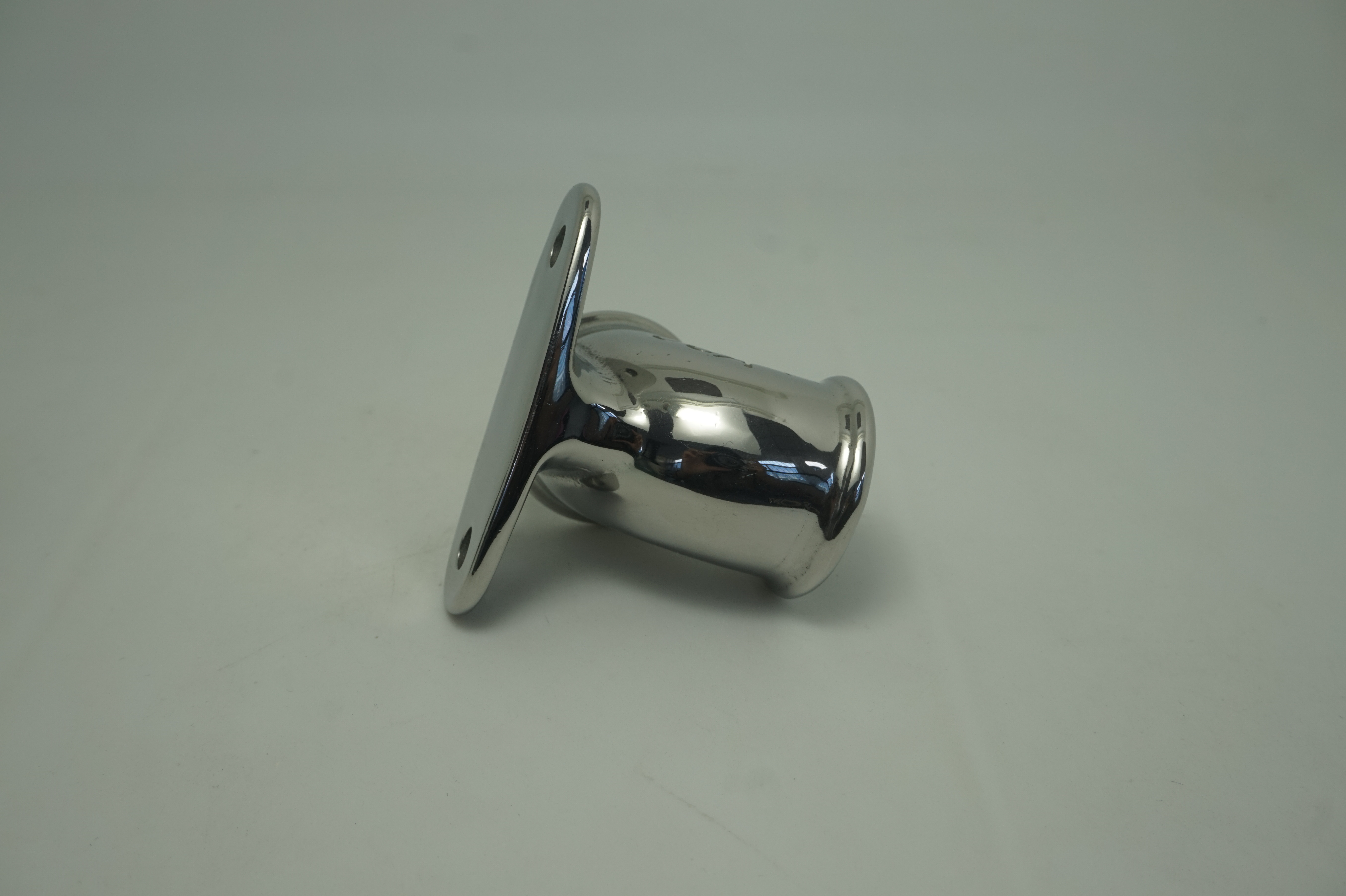
Treat every recess as a retrieval point rather than hoping it stays clear. Choose a medium size class well below the smallest opening, mask or plug features that were never meant to see media, count media into and out of a load, and add a defined check such as a borescope at an agreed angle plus a pin gauge on critical holes. Where a groove is too narrow for any medium to enter, it will also be too narrow for oxide removal, so the two facts belong in the same conversation. Buyers in Turin shipping parts for a trial should send the tightest feature they have.
No. SurfacePolish supplies finishing machines, media and compounds, and no machine, medium, compound or process is presented as approved, certified or qualified for food contact, hygienic service or any regulated application. Certification of that kind depends on the finished equipment, its design, its materials and the way it is operated, and it is defined and verified by your own quality and regulatory functions against the requirements that apply to your market. What a supplier can provide is equipment and consumables information, including composition data for media and compounds, so your own assessment has something to work from. A sample trial is not a certification.
No. Mechanical finishing removes material and can strip oxide and free iron from the surfaces it touches, but it does not restore a passive film and it does not perform a chemical passivation step. Passivation, whether by a paste, a bath or an electrochemical process, is a separate operation with its own method and verification that belongs to your own specification and supply chain. Mechanical work can leave a surface in better or worse condition for that step, which is one reason media and compound selection on 316L should consider what comes afterwards rather than only the finish you see at the end of the cycle.
Use Turin, Italy as the destination on the enquiry and state whether the deliverable is equipment, media and compound, a representative sample review or a line concept. A destination does not imply local stock, a local service point or a local delivery time.
The national reference for finish is UNI, the Italian standards body, which publishes the Italian editions of the EN/ISO surface-texture standards (UNI EN ISO 21920-1 and -2:2022); machinery supplied into Italy must additionally meet the EU machinery legislation, with Directive 2006/42/EC applying to machinery placed on the market before 20 January 2027 and Regulation (EU) 2023/1230 from that date.
Sources were retrieved on 2026-09-29 and describe the local industrial and trade context only. They do not evidence any SurfacePolish project, shipment, installation or service in Turin.
The buyer must get the internal weld zone clean and oxide-free but cannot get a mechanical tool or tumbling media into a bore that long.
Send the material, dimensions, approximate weight, batch quantity, the incoming condition and photographs of the difficult features. Mark which features must not be contacted by media and state how the result will be inspected. This form carries source reference PSEO-0414; quote it if you prefer an additional manual reference.
Open the SurfacePolish enquiry form Email a prepared enquiry
No price, lead time, certification or result is promised here. Confirm whether a sample trial is available for the specific part and what the trial can and cannot show.
Page PSEO-0414 · revised 2026-09-29 · cross-border equipment, media and scoped sample review. City context is sourced and cited above.
Use this local checker to identify missing part and inspection information. It prepares a technical-review brief; it does not approve a machine, process recipe or production result.
Complete the part details to prepare a review brief.
Email : info@surface-polish.com


 IPv6 network supported


 +86-592-2381506