A buyer in Vancouver, Canada working with nickel-alloy combustor hardware for aerospace components needs heat tint and drilling burr removed from 0.6 mm cooling holes without changing hole geometry. SurfacePolish is a cross-border equipment and media supplier rather than a local shop; its free sample trial can test finer media and lower-energy routes on the parts sent, and the findings are reported as observations to be verified by the buyer. This brief is written for a buyer in Vancouver working on aerospace components; it describes equipment, media and a scoped sample review, not a local polishing service.
What edge condition is actually specified at each critical location, and which machine and media combination can hold inside that band?
How will media be kept out of drilled passages, tapped holes and closed volumes, and what retrieval and verification step proves it?
At what batch size, load pattern and media wear state does the trial result still describe what production will produce?
Material leaves an edge far faster than it leaves an adjacent face on every mechanical finishing route, and on aerospace parts edge condition is frequently a specified requirement rather than a byproduct. Drawings may call out a defined radius, a broken edge or an edge that must remain sharp for a sealing or shearing function. Record the pre-finish edge state with an optical comparator, radius gauges or a cast impression before processing, then set the allowable band in writing. Fatigue-critical holes are the classic case: an edge that is too sharp concentrates stress, while one that is over-rounded changes the bearing area of a fastener head. Because stock removal at an edge is far faster than on a flat face, cycle intensity and media size class are the levers that control it. If edge limits are tight, plan an edge-specific operation rather than hoping a bulk cycle will land inside the band.
Steel media works by burnishing: it displaces surface metal and compresses it rather than cutting it away, which produces a bright, uniform appearance and can improve surface texture without the dimensional change that a cutting medium causes. That property makes it attractive where features must keep their geometry and only the surface appearance needs to change. The conditions are strict. Burnishing needs a clean load, correct compound chemistry and controlled water, because any debris, iron contamination or hard water deposit is pressed into the surface rather than flushed away. Steel media is heavy and concentrates energy, so thin walls and unsupported sections need lower energy or fixturing. It also carries a cross-contamination risk: stainless and aluminum parts can pick up iron from carbon steel media, so keep baths and media dedicated. Select it after the removal requirement has been met, not as a substitute for deburring.
| Media | Best fit | Watch out for |
|---|---|---|
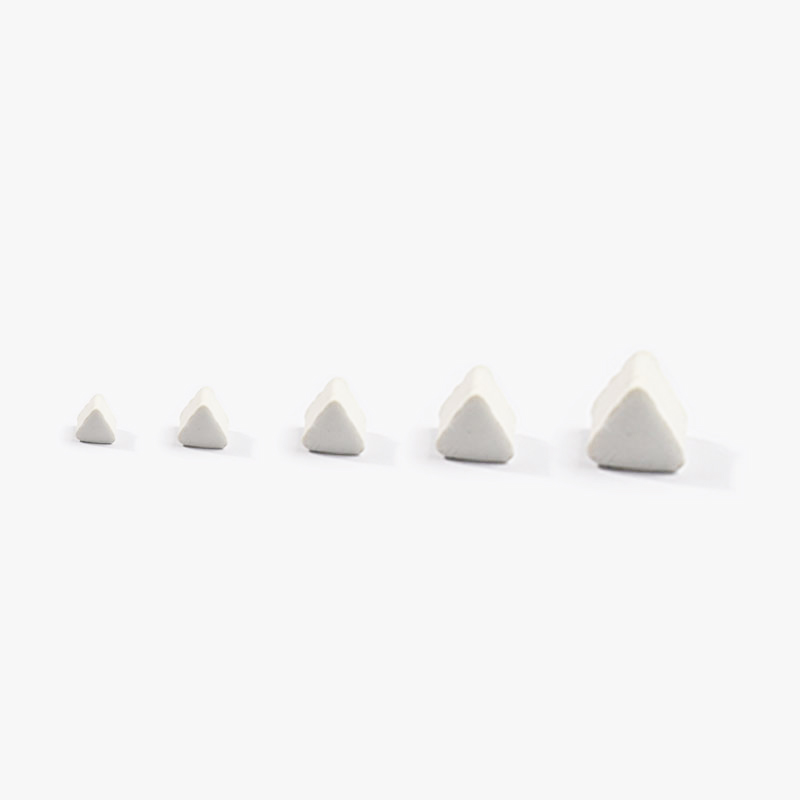
| Plastic media, cones and triangles | Gentle cutting on aluminium, thin-wall sections and surfaces that must not be scored. | Deforms and loads with metal fines so cut rate falls while the blend still looks intact; ineffective in deep recesses and tight radii. |
| Mildly acidic or chelated brightening compound | Brightening certain stainless grades where the buyer's specification permits that chemistry family. | Not appropriate where hydrogen uptake is a concern on high-strength steel, and requires close pH control and good rinse water quality. |
| Dry media: walnut shell and corn cob | Light deburring, drying support and residue removal on parts where moisture carryover is the governing concern. | Slower cutting, generates dust requiring extraction, and its condition and moisture content must be controlled to stay repeatable. |
| Steel media for burnishing | Bright, uniform appearance with minimal dimensional change on parts whose geometry must stay as machined. | Presses debris and hard-water deposits into the surface, concentrates energy on thin sections, and carries iron cross-contamination risk. |
Disc finishing machines generate fast cycles by driving media and parts between a rotating disc and the chamber wall, which raises energy at the part surface and shortens the time needed to blend an edge or refine a face. That energy is the trade: flat plates, simple brackets and robust turned parts finish quickly and evenly, while assemblies with thin sections, brazed joints, unsupported flanges or already-tight edge limits can suffer edge rolling, local distortion or part-on-part marking. Geometry limits are real, since a part that is larger than the working gap or too light to stay in the media stream will not be processed predictably. The route deserves evaluation when removal rate and cycle time dominate and the part is simple and robust. Where a part is complex or expensive, disc finishing is more often a stage for one defined face than a whole-part answer.
| Machine route | Where it fits | What it will not do |
|---|---|---|
| Dry polishing machine and dryer | Post-wet drying and light dry finishing of parts with blind holes and passages where moisture carryover matters. | Dry media cut slowly, require dust extraction and medium condition control, and forced-air drying must be matched to internal geometry. |
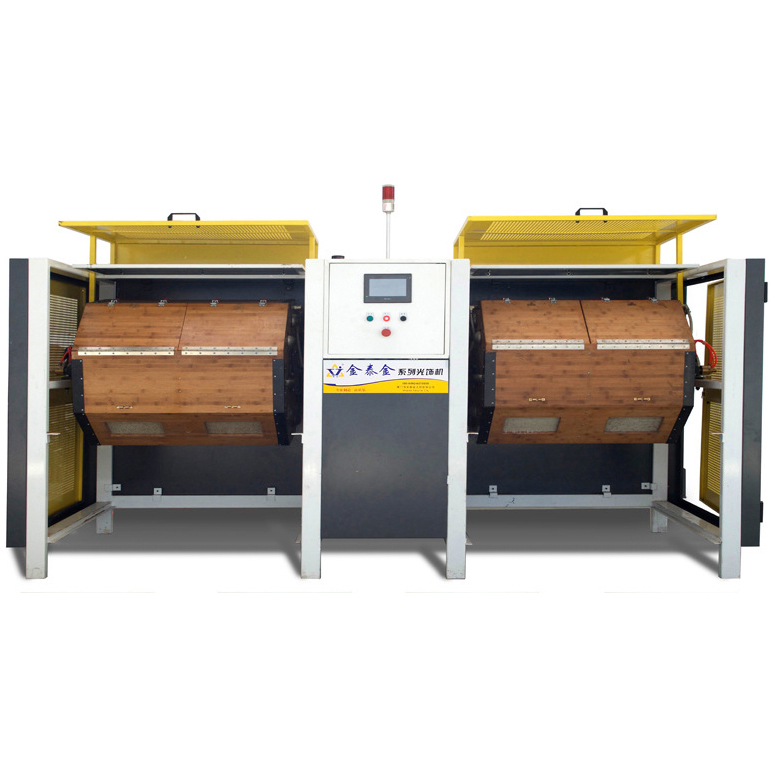
| Rotary barrel tumbling machine | Gentle, uniform processing of small robust parts in large quantities, such as bushings, spacers and fasteners. | Slow cycles, per-barrel weight limits, and limited access for inspecting or repositioning parts during the run. |
| Magnetic finishing machine | Small precise parts with internal edges and recesses that loose media cannot enter, using small pins or needles. | Bounded by part size and mass, by workpiece material attraction to the pins, and by the need to retrieve residual pins. |
| Disc finishing machine | Fast cycles on flat plates, brackets and robust turned parts with simple geometry. | High energy risks edge roll, distortion of thin sections and part-on-part marking; part size is bounded by the working gap. |
Discolouration and residue usually arrive together and point at chemistry rather than mechanics. A lean compound lets metal fines and heat build up, producing a dark or heat-tinted patch that follows the media flow pattern. Rich, hard or contaminated water leaves dried salts and films, especially in blind holes where rinse water does not circulate. Uneven finish across one part or across a batch typically has a loading cause: parts blocking each other, too large a load, unmixed sizes, inconsistent fixturing or a chamber run below its proper load volume. Check by comparing appearance against an agreed physical master under fixed lighting, by reading rinse-water conductivity or chloride level, and by measuring surface texture at multiple recorded locations instead of one convenient spot. Then separate the two problems, because chemistry fixes do not solve loading variation and loading changes will not remove a residue film.
| Failure mode | Likely cause | How to catch it |
|---|---|---|
| Uneven finish across a batch or across one part | Load volume outside the chamber's working range, parts blocking one another, mixed part sizes, or inconsistent fixturing and media distribution. | Measure surface texture at several recorded locations on multiple parts from the same load and record the load pattern alongside the results. |
| Local flatness or geometry change on a datum face | Media contact on a surface where appearance was treated as the only requirement and flatness was not protected. | Confirm the datum condition with the buyer's own method, such as a CMM or a surface plate check against the stated requirement, on parts from the first and last part of the load. |
| Edge radius grown past the drawing limit | Cycle time, energy setting or media size class allowing continued edge removal after the adjacent face has stabilised. | Compare the recorded pre-finish edge state with the finished state using radius gauges, an optical comparator or a cast impression at fixed positions. |
| Dried compound residue or water spotting in recesses | Rich compound, hard or chloride-bearing rinse water, or a drying method that does not move air through blind features. | Inspect recesses with a borescope, read rinse-water conductivity or hardness, and verify the drying method against the part's internal geometry. |
Vancouver's industrial base is small in land area and high in value, and local business organisations treat industrial land supply itself as the binding constraint on manufacturing. The Greater Vancouver Board of Trade reports that from 2019 to 2023, over 5 million square feet of industrial investment were diverted to Calgary from Metro Vancouver because of limited land supply and regulatory barriers, and estimates that expanding industrial land supply by one per cent could support 126,100 new jobs and add CAD 12.2 billion to provincial GDP. The sectors that remain are tied to the port and to food processing: the Board of Trade frames its industrial-land campaign explicitly around unlocking "B.C.'s manufacturing and agri-food sectors" and maximising trade through the ports, and it notes that the region is home to Canada's largest and most diversified port. West of the city, the west coast gateway is rail- and container-intensive: Western Canada has 16,000 track miles of rail, employs 270,000-plus people in the transportation sector, and member ports import 2.4 million container TEUs annually, which is the infrastructure that bulk and project freight into the region depends on.
The nearest part of that base to this brief is food: The Greater Vancouver Board of Trade's industrial-land report and release are framed around unlocking B.C.'s manufacturing and agri-food sectors, and identify the provincial "50-50 Rule" on food-processor input sourcing as a barrier to year-round food processing operations.
Metro Vancouver's manufacturing is squeezed onto scarce industrial land, so equipment that fits a compact footprint and reduces rework is a direct way to protect throughput on an expensive site. The food-processing and agri-food base in the Fraser Valley runs stainless process equipment and packaging machinery where weld dressing, edge break and controlled surface roughness on product-contact surfaces are recurring requirements, and the port and rail gateway supports a machinery-repair and heavy-equipment service sector where hydraulic and structural steel components are reworked and returned to service. Deburring and surface conditioning in this market is therefore more about stainless process hardware and repair-and-overhaul components than about high-volume mass finishing.
A Vancouver buyer should settle the footprint-and-utilities question first, because industrial floor space is the scarcest input in Metro Vancouver: machine size, foundation, water supply, effluent handling and ventilation should be priced against the cost of the space they consume, not treated as line items after the equipment decision. The second question is whether the finish requirement is come-from the product-contact stainless side of the business, in which case cleaning and passivation matter more than Ra targets, or from a repair-and-overhaul customer with a written surface specification.
Freight context: Port of Vancouver (Vancouver Fraser Port Authority), Vancouver International Airport (YVR), Surrey and Vancouver intermodal rail yards, Canadian Pacific Kansas City and CN mainlines. Vancouver is Canada's Pacific gateway, and the western transportation forum records member ports importing 2.4 million container TEUs annually on a base of 16,000 track miles of rail across Western Canada. That makes the region the natural first point of entry for equipment coming from Asia, with onward movement by rail or truck; sample parts and media can be airfreighted through YVR. Port authority pages were not retrievable for direct citation during this research, so the gateway figures here come from the western Canadian transportation association and the regional board of trade.
China is one of Canada's ten principal merchandise trading partners and the second-largest single-country source of Canadian imports after the United States: Statistics Canada reported CAD 5,369 million of balance-of-payments imports from China in January 2025, against a CAD 2,299 million bilateral merchandise deficit that month. Canada has no free trade agreement with China, so Chinese-origin industrial machinery enters under the Most-Favoured-Nation (MFN) tariff column of the Canadian Customs Tariff; the preferential treatments listed in the tariff (CUSMA/UST and MXT, CETA/CEUT, CPTPP/CPTPT, UKT, KRT and others) do not include China, and preferential rates require proof of origin plus the applicable shipping rules, so a China-origin machine cannot claim them. Tariff classification is mandatory work, not a formality: vibratory, barrel, centrifugal and disc finishing machines are classified in Chapter 84 ("Nuclear reactors, boilers, machinery and mechanical appliances; parts thereof") according to the function of the machine, and the ten-digit Canadian tariff item drives both the duty rate and the statistics. A further landed-cost risk sits outside the tariff schedule: under the Special Import Measures Act (SIMA), the CBSA and the Canadian International Trade Tribunal may apply anti-dumping and countervailing duties to named goods, so a buyer should check the measures-in-force list for the specific product before assuming the MFN rate is the final duty.
The customs authority is the Canada Border Services Agency (CBSA), and importers of commercial goods must work through the CBSA Assessment and Revenue Management (CARM) system, which is where registration, the duties-and-taxes calculator, advance rulings and national customs rulings, and the commercial accounting declaration (CAD) are handled. Documentation expectations are explicit: "You must provide proof of country of origin when you import goods into Canada and, in some cases, your goods must also be clearly marked", the invoice or sales receipt must carry "a complete description of the goods", "the selling price" and "any conditions and terms of the sale", and the value for duty must be declared in Canadian currency only. Duties and taxes are layered rather than single: customs duty on the tariff item, the Goods and Services Tax calculated on the duty-paid value, and potentially excise duty, excise tax, surtax or safeguard measures. Importers must also clear non-tariff gates: goods must be admissible, some goods need permits, certificates or inspections from other federal departments that the CBSA applies on their behalf, controlled goods under the Defence Production Act require consultation with the CBSA and Global Affairs Canada before import, and "Goods manufactured or produced wholly or in part by forced or prison labour are prohibited from entering Canada", with due diligence resting on the importer. For electrical machinery, the practical conformity route in Canada is certification of the product to Canadian electrical safety standards by an accredited certification body rather than a self-declared CE-style mark; buyers should confirm the specific certification body and mark required before shipment. For a first shipment of a finishing machine or a media/compound sample lot, the fastest way to remove classification and valuation uncertainty is to use the CARM portal to request an advance ruling for tariff classification and origin.
SurfacePolish supplies from Xiamen, China. The buyer's own destination rules, conformity marking, tariff classification and documentation responsibilities stay with the buyer; confirm them against the authorities named above before ordering.
A roughness number is only meaningful with its measurement setup attached. Agree the exact locations, which surfaces are excluded, the evaluation length and cutoff, the filter and whether the requirement is stated as an average, a maximum or a profile parameter. Values taken at different cutoffs on the same surface will not agree, and values taken on a curved or interrupted surface such as a fillet, thread flank or cast skin are unreliable unless the setup is designed for it. Record instrument identification, stylus condition and the calibration status in use at the time, and keep the readings with the batch. For areal or functional appearance requirements, prefer a documented procedure over an informal comparison, and state plainly that roughness readings describe the sampled locations on the parts measured. Repeatability comes from repeating the same setup, not from taking more readings in different ways.
Expect the first production batches to differ from trial parts, because a trial is run with extra attention on one or two pieces while a line runs a full load with a different operator, a partly worn blend and normal handling between operations. Reduce that gap by planning a ramp-up sequence: run a low quantity, inspect the first part fully, compare it against the retained trial part at the agreed locations, then increase load size only after the comparison holds. Re-inspect at defined intervals through the ramp and keep a reference part from each stage. Be clear about what a sample trial cannot establish. Observations apply to the parts tested and to the setup used. A trial does not establish fitness for a regulated or safety-critical application, does not replace the buyer's own qualification or structural testing, and does not transfer responsibility for acceptance, which always remains with the buyer's engineering and quality functions.
Specify the location, the evaluation length and cutoff, the filter, and whether the requirement is a maximum or an average, then keep that setup unchanged for every batch and comparison. Readings taken with different cutoffs on the same surface will not agree, and readings on interrupted or curved surfaces such as fillets or cast skins need a setup designed for them. Record the instrument and its calibration status with the results. When you compare a trial part from Xiamen with your production parts, Canada and China, use one instrument and one setup so the difference you are reading is the process, not the measurement.
SurfacePolish is not a local polishing shop and has no branch, dealer or technician presence in Vancouver or anywhere else outside its own factory. What is offered is cross-border supply of finishing machines and consumables, a scoped discussion of a finishing line concept, and a free sample trial in which representative parts are shipped to the factory, processed and returned with observations and a proposed media and cycle direction. Buyers who need on-site processing should source that locally. Buyers building an in-house finishing capability can use the trial to choose equipment and media for their own line.
Only partly. A trial is run with extra attention on a small number of pieces, while production runs a full load with a different operator, a partly worn media blend and the normal handling between operations. Treat trial output as evidence about the parts tested and the settings used, then plan a ramp-up in which the first production part is fully inspected and compared against the retained trial part at the same locations. Where results diverge, check the media blend and load pattern first, since those drift before a machine setting changes. SurfacePolish reports observations and a proposed direction; qualification and acceptance stay with the buyer.
Use Vancouver, Canada as the destination on the enquiry and state whether the deliverable is equipment, media and compound, a representative sample review or a line concept. A destination does not imply local stock, a local service point or a local delivery time.
A Vancouver buyer references Canadian electrical safety certification, WorkSafeBC requirements for machine guarding and safeguarding, and — where the plant handles food or beverages — the federal and provincial food-safety regime that governs product-contact surfaces and cleaning. Where the finishing step serves a marine or heavy-equipment customer, the acceptance criteria normally come from that customer's repair specification rather than from a national finishing standard.
Sources were retrieved on 2026-09-29 and describe the local industrial and trade context only. They do not evidence any SurfacePolish project, shipment, installation or service in Vancouver.
The buyer must remove heat tint and light burr from 0.6 mm holes without enlarging the holes or embedding media.
Send the material, dimensions, approximate weight, batch quantity, the incoming condition and photographs of the difficult features. Mark which features must not be contacted by media and state how the result will be inspected. This form carries source reference PSEO-0121; quote it if you prefer an additional manual reference.
Open the SurfacePolish enquiry form Email a prepared enquiry
No price, lead time, certification or result is promised here. Confirm whether a sample trial is available for the specific part and what the trial can and cannot show.
Page PSEO-0121 · revised 2026-09-29 · cross-border equipment, media and scoped sample review. City context is sourced and cited above.
Use this local checker to identify missing part and inspection information. It prepares a technical-review brief; it does not approve a machine, process recipe or production result.
Complete the part details to prepare a review brief.
Email : info@surface-polish.com


 IPv6 network supported


 +86-592-2381506