A buyer in Bordeaux, France in industrial machinery needs a 2.5 m stainless guard extrusion finished to a uniform bright band while a narrow slot along its face stays clear of media and keeps its edges. SurfacePolish supplies finishing machines, media and compounds across borders and offers a free sample trial, returning tested sections with observations and a proposed direction. This brief is written for a buyer in Bordeaux working on industrial machinery; it describes equipment, media and a scoped sample review, not a local polishing service.
How will the finish be measured or viewed, with which instrument, angle, cutoff and master, and who holds that master?
How much stock may the sequence remove before datums, seal faces, flatness or edge form fall outside their allowance?
Which faces must reach a mirror and which only need to be clean and uniform, and how is each one judged?
Every mirror sequence removes metal, and the removal is rarely uniform across a large face. Datum pads, dowel registers, bearing seats and seal lands carry assembly geometry, so measure them before finishing and agree a dimensional and flatness allowance. Where an allowance is tight, mask the feature, finish around it by hand, or plan a light final lapping pass that keeps the face flat. A part that looks correct but has lost flatness on a mounting face will not assemble squarely, and a curved cover panel shows a distorted reflection after only a few hundredths of a millimetre of uneven stock removal. Record incoming values with the same instruments that will accept the finished part, at the same marked locations.
Media handling is where good sequences are quietly spoiled. Parts must be separated from the charge completely, using screens or a separation deck matched to the smallest media in use, with a counted charge so losses stay visible. Screen out worn media on a schedule and top the charge up, because a blend of very small and original-size media finishes unevenly. Keep steel and ceramic media in dedicated machines or dedicated charges: a few steel pieces in a ceramic load leave bright speckle and iron pickup on stainless, while ceramic fines in a steel charge cause sleeks. Store dry media sealed against moisture, and clean the machine between material families when switching from ferrous to stainless work.
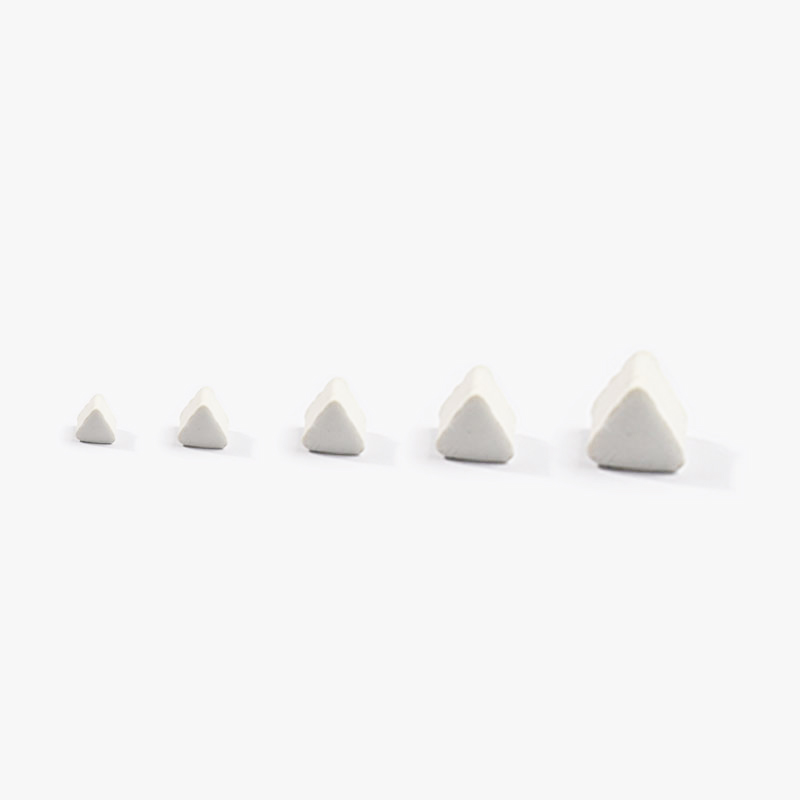
| Media | Best fit | Watch out for |
|---|---|---|
| Plastic or polyester media | Gentle processing of aluminium, brass, copper and thin panels where metal smearing, nicks and distortion must be avoided. | Low density gives little contact force, so cycles run long and heavy grinding marks may survive; plastic also wears quickly and can float above the working mass. |
| Coarse ceramic angle-cut cylinders or triangles | First cut stage on rigid parts with open faces, removing grinding or machining damage on cast iron, steel and stainless before refinement. | Leaves a deep pattern the next stage must fully erase, chips thin edges, and its wear debris carries fine abrasive into later stages if the charge is not screened. |
| Small high-density ceramic spheres or ovals | Colour and pre-lustre stages where a uniform, soft-looking finish matters more than stock removal, including curved and contoured faces. | Very slow cut, easily lost through screens sized for larger media, and ineffective in deep recesses because it cannot reach or press against the surface. |
| Magnetic finishing pins and needles | Small precise parts with internal edges, cross holes, slots and fine detail that no tumbling medium of usable size can reach. | Limited by working envelope and part mass, removes very little material, and pins can embed in soft metals or remain in cavities if retrieval is not checked. |
Magnetic finishing drives small pins or needles with a moving magnetic field, so the abrasive follows internal edges, cross holes, slots and fine detail that no tumbling medium of usable size can enter. It is the practical route for small precise parts such as valve spools, small gears, nozzle bodies and instrument components where a bright edge or a cleaned intersection matters. It removes very little material, so it is a refinement and edge-conditioning step rather than a way to erase coarse grinding marks. Working envelope and part mass are the main limits: large faces and heavy parts do not fit, and the effect falls off where the field cannot drive the pins. Check coverage on a sample with magnification and a borescope.
| Machine route | Where it fits | What it will not do |
|---|---|---|
| Disc finishing machine | Fast, high-energy cut down on small to medium parts with simple geometry where cycle time matters and edge rounding is tolerable. | Part-on-part contact and wall pressure can chip or deform parts, and the difference between sufficient and excessive removal is narrow. |
| Barrel finishing machine / rotary barrel tumbler | Dense, uniform colour on small hardware that tolerates sliding contact, especially with steel media for a burnished appearance. | Nothing longer than the barrel diagonal can be processed, and slender parts can bend or nick against neighbours in the load. |
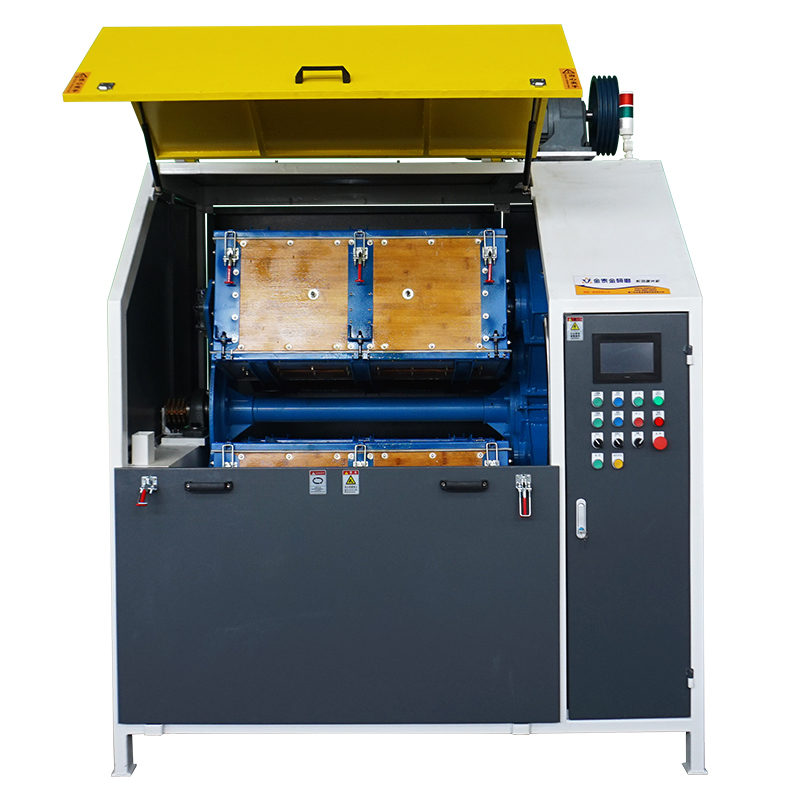
| Centrifugal barrel finishing machine | High-speed cut down and refinement on small to medium parts where a short, energetic cycle is needed before colour stages. | Aggressive on edges and thin sections, requires tight cycle control, and does not replace a finer refinement stage. |
| Tub vibrator | Long and large parts such as shafts, extrusions and frame members that cannot be folded into a barrel, including external grooves. | Poor at bores running parallel to the long axis, and slender parts still need support or balanced loading to hold straightness. |
Two of the most expensive defects are invisible in a reflected image. Media lodges in blind holes, slots, undercuts and threaded features, and it can survive rinsing, drying and even assembly, while the small pins used in magnetic finishing can embed in soft surfaces. At the same time, long cycles quietly round edges past their limit and remove material from datums, seals and bearing seats, so a part passes a visual check and fails a fit check. Control both with geometry rather than appearance: reconcile a counted charge, borescope or pin gauge every cavity, measure edge radii and critical dimensions against incoming values, and set a maximum cycle time that the edge and dimensional allowances actually support.
| Failure mode | Likely cause | How to catch it |
|---|---|---|
| Orange peel, a slow wave that distorts the reflected image | Soft or work-hardened surface deformed rather than cut, a heavy cut stage followed by too little refinement, or a dry or buffing stage at high speed with excess pressure. | Reflect a straight edge or fluorescent tube in the face at a shallow angle, compare the shape of the image against a physical master in the same lighting, and repeat at several viewing angles. |
| Media lodged in blind holes, slots, undercuts or threaded features | Media size too close to the opening, a slot or cavity that traps the charge, or no defined retrieval step before rinsing and drying. | Reconcile a counted media charge before and after the cycle, borescope each cavity at an agreed angle, and pin or thread gauge the features the charge could enter. |
| Compound residue film, water spots or a dull bloom after drying | Incomplete rinsing, hard or contaminated rinse water, a dose above target, or drying that leaves a cavity to bleed residue onto the finished face. | Wipe a defined area with a clean white cloth after drying, inspect cavities for bleed-out, and check rinse water hardness or conductivity at the point of use. |
| Dimensional drift or lost flatness on datums, seals and bearing seats | Uneven stock removal across a large or asymmetric face, over-long cycles, or unprotected functional features exposed to the full charge energy. | Measure flatness and critical dimensions with a CMM or surface plate at the same marked points used for the incoming survey, and compare the change against the allowance. |
Bordeaux combines an Atlantic port economy with an aerospace and defence industrial base: the Port de Bordeaux operates seven specialised terminals along the Gironde estuary and Garonne, receives close to a thousand vessels a year, and states that the industrial-port complex accounts for 8 620 jobs, with a stated strategic aim of building a new industrial-port model around energy transition. INSEE counted 14 432 establishments in the commune at the end of 2024, 3,2 % in industry, and 211 556 jobs at the place of work in 2023. The wider Gironde industrial base includes aeronautics and defence (Dassault Aviation, Thales and ArianeGroup sites around Merignac, Saint-Medard-en-Jalles and Le Haillan), naval and yacht refit activity in the port, and food and wine-related manufacturing.
The nearest part of that base to this brief is aerospace: Bordeaux and the Gironde fall within Aerospace Valley, the leading European aerospace competitiveness cluster covering Nouvelle-Aquitaine, which serves the aeronautics, space and drones sectors in this region.
Aerostructures, space hardware and defence equipment built in the Bordeaux area need controlled edge quality on machined and formed parts, deburring of fluid and pneumatic components, and surface preparation for bonding and coating, all with the traceability that EN 9100 work demands. The port's naval refit and yacht activity adds a second, very different requirement - large-surface preparation, weld dressing and finish on hulls and superstructures in a marine corrosion environment. Food and wine equipment in the region adds stainless fabrication where surface roughness and residue-free cleaning matter hygienically.
A Bordeaux buyer should settle whether the finishing operation supports a bonded or coated surface, because in that case surface chemistry and cleanliness, not just roughness, decide whether the process is acceptable - and those parameters must be specified before a machine or media is selected.
Freight context: Port de Bordeaux (7 terminals: Bassens, Bacalan, Le Verdon, Blaye, Pauillac, Ambares, Bordeaux), Bordeaux-Merignac Airport. The port operates 24 hours a day, 365 days a year and states that its seven specialised terminals along the Gironde and Garonne receive close to a thousand vessels a year, with the industrial-port complex supporting 8 620 jobs. For equipment imports this means the machine can be landed directly on the estuary at Bassens or Verdon and moved by road, with Bordeaux-Merignac handling urgent parts and media samples.
France applies the EU common commercial policy, so industrial machinery arriving from China enters under the Union Customs Code and the Common Customs Tariff rather than under any bilateral French regime; the EU has no free-trade agreement with China, so no preferential duty rate applies and normal third-country duties are due on the customs value. Importers classify the machine in the tariff nomenclature and lodge a customs declaration; French Customs publishes the common and national tariff through its RITA online service and states that three notions are fundamental: the tariff classification of the product, its origin or destination, and the value of the goods.
For imports from outside the EU the declarant must file a customs declaration whose form and content are fixed by the Union Customs Code and its implementing provisions; French Customs identifies classification, origin and value as the three fundamental notions and makes the common/national tariff consultable via RITA. The customs authority is the Direction generale des douanes et droits indirects (DGDDI), which also runs the Info Douane Service for formalities questions. Buyers should expect to need an EORI number and an EU VAT treatment, because customs and tax authorisations are handled together (SOPRANO). For machinery, the CE marking and the applicable EU product-safety directives are the compliance gate items to settle before shipment, and the French market surveillance authority is the DGCCRF; the tariff rate itself must be confirmed per HS code in RITA or the EU Access2Markets tariff tool, since it varies by machine type.
SurfacePolish supplies from Xiamen, China. The buyer's own destination rules, conformity marking, tariff classification and documentation responsibilities stay with the buyer; confirm them against the authorities named above before ordering.
A mirror surface changes with the observer, so viewing conditions belong in the specification. Agree the light source type, the distance and angle, the viewing direction, and whether inspection happens in a booth or in the machine environment. A physical master approved by both parties, kept clean and stored protected, is more reliable than a photograph; photographs of reflective parts mostly record the light source. Define what is acceptable, such as a limited number of fine marks, a haze limit inside a stated area, and no visible peel, and state where the standard does not apply, for instance inside a recess that will be painted or covered. Re-confirm the master whenever the sequence or media family changes.
A trial runs a small, hand-selected load on equipment that has just been set up. Production runs mixed batches on a media charge of unknown age, with transfer time between stages, variable rinse quality, operators on different shifts, and parts arriving with different incoming damage. Plan a defined pilot batch that uses the intended line configuration and a full first-article inspection, then compare it with the trial observations before committing volume. Watch the variables that scale badly: drying time in a humid season, water chemistry, load density and the handling between cut, colour and lustre stages. Treat the pilot as the real test of stability and keep its settings record with the parts so any drift can be traced.
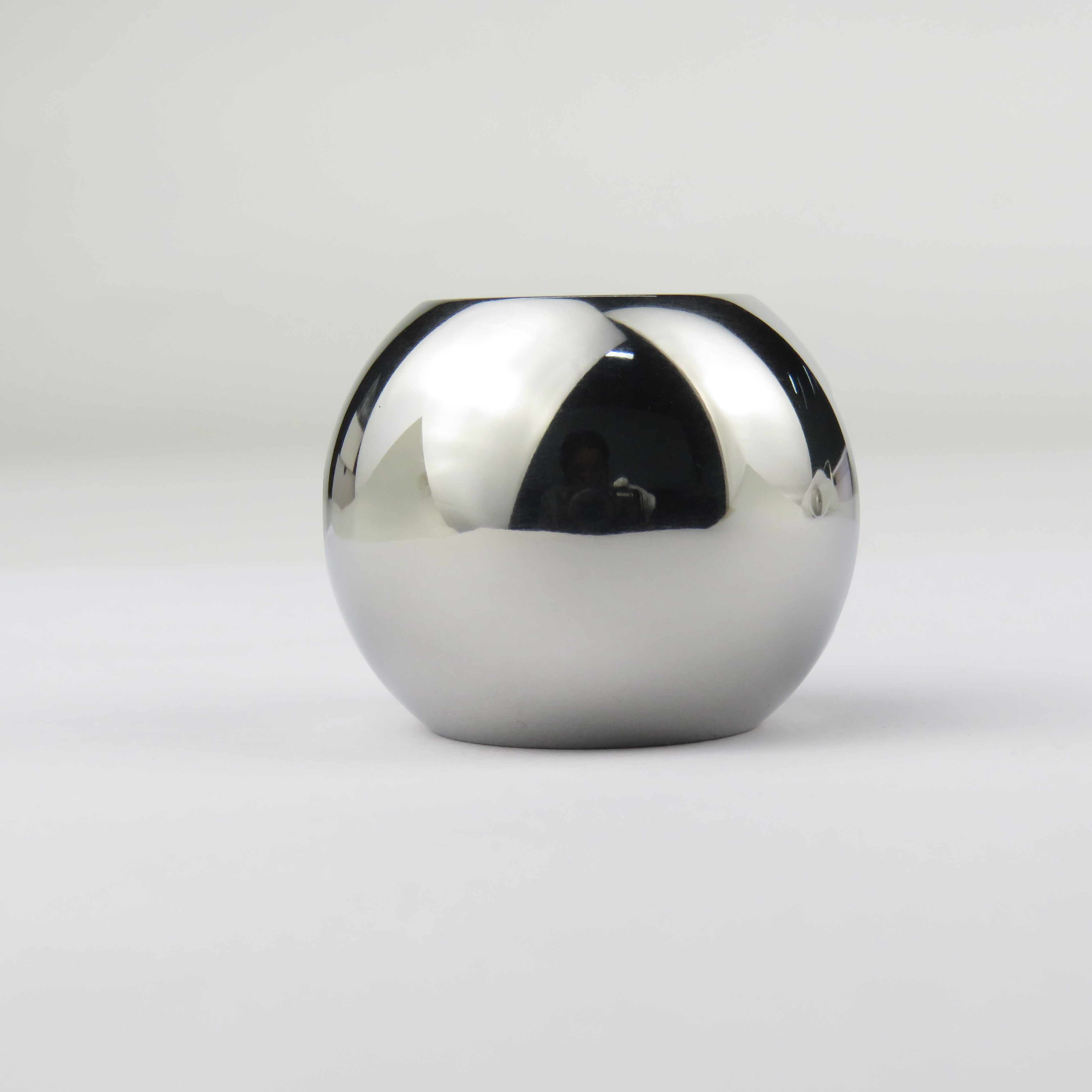
Orange peel is a wave in the surface, produced when metal is deformed rather than cut, usually on softer alloys, on work-hardened layers, or when a heavy cut stage is followed by too little refinement. It shows as a distorted reflected line when you view a straight edge in the face. Polishing with finer media does not remove it, because the wave extends below the depth a fine stage can reach; the sequence has to return to a cutting stage and then refine properly. If the wave comes from the incoming material or a forming operation, it may not be removable at all.
Design the charge around the smallest opening rather than the average part. Use media clearly smaller than the hole, or mask and plug the features before the cycle, count the media into and out of the load as a reconciliation, and add a retrieval step with a defined check such as a borescope or pin gauge. For France buyers sending parts for a trial, include the part with the tightest feature so the media class is chosen against real geometry. The small pins used in magnetic finishing embed easily in soft metal, so those features need extra inspection.
Send representative production parts including the thinnest wall, the tightest feature that must stay clear and the worst edge, plus a witness coupon of the same material and condition, a drawing extract covering the finished faces and the acceptance requirement you intend to apply. Label every piece and note its incoming condition with photographs, readings and measurements. The return is the tested parts with observations and a proposed media, compound and cycle direction for the buyer's own evaluation. A trial on parts shipped from France is a comparison, not a qualification, and it establishes no capacity or delivered surface value.
Use Bordeaux, France as the destination on the enquiry and state whether the deliverable is equipment, media and compound, a representative sample review or a line concept. A destination does not imply local stock, a local service point or a local delivery time.
A Bordeaux buyer would reference ISO/NF EN surface-texture standards for finish and EN 9100 for aerospace and defence work, plus customer specifications for bonding, sealing and cleanliness; ISO 9001 is the general baseline and marine work is governed by classification-society and owner requirements on top. Material conformity certificates and process traceability are standard expectations in the aerospace and naval supply chains here.
Sources were retrieved on 2026-09-29 and describe the local industrial and trade context only. They do not evidence any SurfacePolish project, shipment, installation or service in Bordeaux.
The buyer needs the long bright band finished uniformly while keeping the narrow slot clear of media and preserving its edges.
Send the material, dimensions, approximate weight, batch quantity, the incoming condition and photographs of the difficult features. Mark which features must not be contacted by media and state how the result will be inspected. This form carries source reference PSEO-0579; quote it if you prefer an additional manual reference.
Open the SurfacePolish enquiry form Email a prepared enquiry
No price, lead time, certification or result is promised here. Confirm whether a sample trial is available for the specific part and what the trial can and cannot show.
Page PSEO-0579 · revised 2026-09-29 · cross-border equipment, media and scoped sample review. City context is sourced and cited above.
Use this local checker to identify missing part and inspection information. It prepares a technical-review brief; it does not approve a machine, process recipe or production result.
Complete the part details to prepare a review brief.
Email : info@surface-polish.com


 IPv6 network supported


 +86-592-2381506