In Boston, United States, an industrial machinery buyer wants a cast iron handwheel rim and spokes brought to an even bright finish despite the graphite structure and small voids in the casting. SurfacePolish supplies finishing machines, media and compounds across borders and runs a free sample trial, returning the tested parts with observations and a proposed process direction for the buyer's own review. This brief is written for a buyer in Boston working on industrial machinery; it describes equipment, media and a scoped sample review, not a local polishing service.
Which faces must reach a mirror and which only need to be clean and uniform, and how is each one judged?
How much stock may the sequence remove before datums, seal faces, flatness or edge form fall outside their allowance?
What batch size, part mix and media maintenance routine will production really run, and does the trial describe that condition?
Bright finishing does not fill a defect, it magnifies it. A reflection compresses the whole surface into a narrow viewing angle, so a gas pore in a casting, a slag inclusion at a weld toe or a non-metallic stringer in free-machining bar becomes a visible comet trail once the surrounding metal is smooth. Screen the incoming substrate before any media is chosen: examine under glancing light, wipe the surface clean of oil, and where the drawing allows, run a dye penetrant check across weld toes and machined transitions. If the defect density is high, no sequence of cut, colour and lustre stages will produce a uniform image, and the honest answer is that the casting, the weld or the requirement itself has to change.
When a part must lose a measurable amount of stock before colour stages, disc finishing and centrifugal barrel machines deliver far more energy than a conventional vibrator. That energy shortens the cut stage but also rounds edges, work hardens soft alloys and can distort thin sections. Load the parts so they cannot jam against the disc wall, and bracket cycle time tightly, because the difference between enough removal and too much is small. Centrifugal barrels suit small to medium parts with simple geometry. Neither route removes the need for refinement: the surface they leave still needs finer media and a polishing compound before a reflected image becomes coherent, and the depth achieved has to be verified on a sample rather than assumed from a setting.
| Machine route | Where it fits | What it will not do |
|---|---|---|
| Barrel finishing machine / rotary barrel tumbler | Dense, uniform colour on small hardware that tolerates sliding contact, especially with steel media for a burnished appearance. | Nothing longer than the barrel diagonal can be processed, and slender parts can bend or nick against neighbours in the load. |
| Dry polishing machine and dryer | Final lustre, dry colour and post-wet drying where the last reflected image cannot be produced by a wet mass-finishing stage. | Works on accessible faces only, generates dust and heat that need control, and offers no way to correct a defect left by an earlier stage. |
| Vibratory finishing machine (bowl or tub) | Cut-to-colour sequences on rigid, mostly open parts such as housings, covers, brackets and frames, with adjustable energy and no fixturing. | Cannot present media uniformly into pockets with narrow mouths or deep internal bores, and broad flat faces finish more slowly than edges. |
| Disc finishing machine | Fast, high-energy cut down on small to medium parts with simple geometry where cycle time matters and edge rounding is tolerable. | Part-on-part contact and wall pressure can chip or deform parts, and the difference between sufficient and excessive removal is narrow. |
Media handling is where good sequences are quietly spoiled. Parts must be separated from the charge completely, using screens or a separation deck matched to the smallest media in use, with a counted charge so losses stay visible. Screen out worn media on a schedule and top the charge up, because a blend of very small and original-size media finishes unevenly. Keep steel and ceramic media in dedicated machines or dedicated charges: a few steel pieces in a ceramic load leave bright speckle and iron pickup on stainless, while ceramic fines in a steel charge cause sleeks. Store dry media sealed against moisture, and clean the machine between material families when switching from ferrous to stainless work.
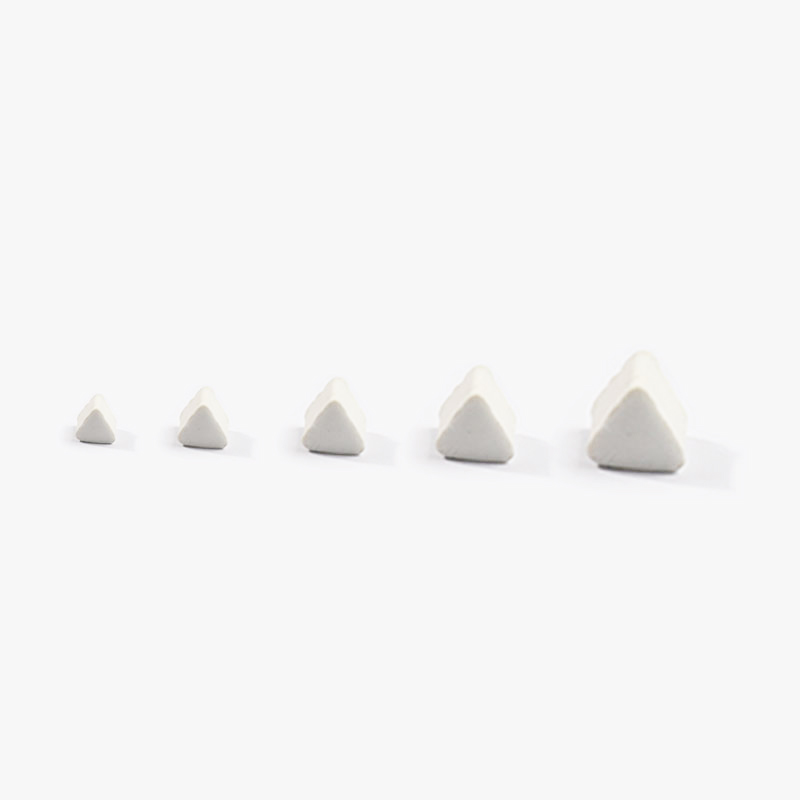
| Media | Best fit | Watch out for |
|---|---|---|
| Medium ceramic triangles or angle-cut shapes | Blending, edge conditioning and the refinement step that removes the coarse cut pattern on housings, brackets, covers and frames. | Media that cannot enter a slot or recess leaves those areas at a different finish, so those faces need a separate operation or a stated lower standard. |
| Dry media - walnut shell | Dry polishing, light deburring and lubricity on parts where a residual oil film is acceptable, and drying or lustre steps after wet processing. | Not a stock-removal medium, generates dust that needs extraction, and can leave an oily film that interferes with a later cleaning or coating requirement. |
| Small high-density ceramic spheres or ovals | Colour and pre-lustre stages where a uniform, soft-looking finish matters more than stock removal, including curved and contoured faces. | Very slow cut, easily lost through screens sized for larger media, and ineffective in deep recesses because it cannot reach or press against the surface. |
| Plastic or polyester media | Gentle processing of aluminium, brass, copper and thin panels where metal smearing, nicks and distortion must be avoided. | Low density gives little contact force, so cycles run long and heavy grinding marks may survive; plastic also wears quickly and can float above the working mass. |
A bright face can carry a ghost of every earlier stage. When a coarse grinding or cut pattern is not fully removed, the finer stages polish the crests and leave the valleys, producing visible lines or a woven crosshatch that reappears as the viewing angle changes. The causes are a stage that removed too little, a refinement step that reused a contaminated charge, or a crosshatch direction that was never rotated between steps. Each successive stage should run across the previous direction at a clear angle, so an operator can see when the earlier pattern is gone. Inspect by reflecting a light source at a shallow angle and rotating the part: a mark that vanishes at one angle and returns at another is still in the surface.
| Failure mode | Likely cause | How to catch it |
|---|---|---|
| Embedded media particles or finishing pins in a soft surface | High contact pressure on aluminium, brass or copper, worn media with sharp fractured edges, or magnetic-finishing pins driven into a surface that cannot resist them. | Examine at magnification under raking light, wipe with a clean cloth and check for pulled particles, and consider a dye penetrant or etching check on a sample part. |
| Heat tint or discolouration concentrated near edges and thin sections | Friction at a dry or high-speed stage raising local temperature, poor cooling or compound flow, or a load that packs parts against each other with no media between them. | Compare colour against a master in consistent lighting, look for a gradient from edge inward, and check whether the tint follows load contact points or the whole face. |
| Ghost pattern of an earlier coarse stage showing through the final finish | A cut or refinement stage removed too little material, a later stage reused a contaminated charge, or the crosshatch direction was not changed between steps. | Reflect a light source at a shallow angle and rotate the part; a mark that disappears at one angle and returns at another is still in the surface rather than on it. |
| Haze, a general loss of image clarity with no directional pattern | Worn media shedding an oversized fine fraction, agglomerated abrasive in the compound line, or fine grit carried into a late stage from screens, machine walls or a shared rinse. | View under raking light at low magnification against a master, then trace the pattern by machine and by rinse line to separate a charge problem from a rinse or transfer problem. |
Greater Boston's industrial base is weighted towards life sciences and advanced research and development rather than heavy manufacturing. MassBio, the Massachusetts Biotechnology Council, puts Massachusetts biopharma employment at 113,503 in 2025, a 3.1% contraction and the first annual decline in more than two decades of tracking, while biomanufacturing added 238 jobs. The Federal Reserve Bank of Boston documents scientific R&D as one of the state's fastest-growing activities up to mid-2023, with employment in scientific R&D establishments up 31% between January 2020 and July 2023, close to 50% faster than the national rate. The Federal Reserve's First District Beige Book reports manufacturing activity and revenues up slightly in recent months, with at least one manufacturer raising capital spending on automation because of labour scarcity. Boston is also a federal port of entry: CBP's Massachusetts table lists Boston (0401) and Logan Airport (0417) in the same field office district.
For this brief the relevant part of that base is machinery: The Federal Reserve's First District Beige Book (September 2026) reports manufacturing activity and revenues up slightly, with most contacts performing at or above expectations.
Biomanufacturing and medical-device production around Boston drives demand for burr-free, cleanable stainless and alloy parts: machined manifolds, pump and valve bodies, fittings, instrument housings and surgical-instrument components are usually specified with controlled edge radii and a defined surface finish before passivation or other customer-qualified final cleaning. Because much of the local base is R&D and pilot-scale rather than long-run production, the recurring need is a repeatable finish on small and medium lots, not a dedicated high-volume line, and the acceptance test is often a cleanliness or residue check rather than a visual one.
A Boston-area buyer should settle the cleanliness and residue specification first (which extraction, particle or TOC test the customer will run) together with the edge-break callouts, because those decide whether mass finishing is acceptable at all or whether the part has to stay with a controlled hand or disc process. For pilot and clinical lots the practical question is whether the supplier can reproduce the validated finish on a few hundred parts, not just demonstrate it on a sample.
Freight context: Boston, Massachusetts (CBP port of entry 0401), Logan International Airport / Logan Airport (CBP port of entry 0417; airport code BOS). FAA final CY2025 enplanement data list Boston's General Edward Lawrence Logan International with 21,021,153 boardings, and CBP's Massachusetts table lists Boston (0401) and Logan Airport (0417) under a Boston field office, so both the seaport district and the airport can process customs entries. Containerised finishing machines from China would normally arrive at a large East Coast container port and move inland by truck or rail, while air consignments such as sample parts clear at Logan (0417) or another East Coast gateway.
Business is conducted in US English. Units matter: US drawings and purchase orders frequently use inches, microinch Ra and US gallons, and a supplier that quotes only metric can be asked to reissue documentation. Buyers are US legal entities with an EIN and expect an identifiable contracting entity, a correct HTSUS classification, a commercial invoice, packing list and bill of lading, country-of-origin marking, and an importer of record for customs. Procurement is normally evidence-driven: process selection is expected to be justified by a trial run on the buyer's own sample parts with measured results (burr height, edge radius, Ra, cleanliness) and by media and compound data sheets, rather than by a capability claim. Payment terms in general US industrial practice are open account with net-30 to net-60 terms for established buyers, with letters of credit or advance payment more common for a first order from a new overseas supplier; no US buyer assumes Incoterms, warranty terms or spare-parts lead times unless they are stated in the quotation.
The customs authority is U.S. Customs and Border Protection (CBP), part of the Department of Homeland Security. The importer of record files an entry and then an entry summary (CBP Form 7501): '"Entry Summary" refers to the documentation necessary to enable U.S. Customs and Border Protection to assess duties, collect statistics, and determine whether other requirements of law have been met.' Classification is made in the Harmonized Tariff Schedule of the United States, and an importer may request a written CBP ruling on the correct HTSUS classification and rate of duty, which is the practical way to confirm the treatment of a finishing machine before shipment. Every article of foreign origin must be marked with the English name of its country of origin 'in a conspicuous place as legibly, indelibly, and permanently as the nature of the article (or container) will permit' under 19 U.S.C. 1304 and 19 CFR 134.11. The $800 de minimis (Section 321) exemption is no longer available for ordinary freight: CBP suspended it indefinitely for all modes other than the international postal network effective 24 June 2026, so even low-value sample parts and media must go through formal or informal entry and pay applicable duty. General US industry practice is that there is no single machinery conformity mark comparable to the EU's CE marking; buyers instead verify electrical components and control panels, machine guarding against workplace-safety requirements, and any customer-specific qualification.
SurfacePolish supplies from Xiamen, China. The buyer's own destination rules, conformity marking, tariff classification and documentation responsibilities stay with the buyer; confirm them against the authorities named above before ordering.
Cosmetic acceptance is only half a disposition. Measure the dimensions and flatness that assembly depends on, gauge or thread-check features that media could enter or round, and run the functional check the part actually needs, whether that is seal condition, bearing fit, sliding contact, flow or leak. Cleanliness needs its own verification rather than an assumption: flush blind holes and passage intersections, borescope them at an agreed angle, and examine what the flush carries out. Wipe a defined area with a clean white cloth and record what appears, since compound residue and iron pickup often show only after drying. Confirm cleanliness after drying, not before, and record the method so the next batch is judged on the same basis.
A useful trial changes one variable at a time. If two media classes are being compared, hold the machine, load ratio, compound dose and cycle time constant, and identify which returned parts came from which set. Measure the same marked points before and after, with the same instrument and settings, and judge appearance against the same master and lighting. Where two sequences are compared, record each stage separately so any difference can be attributed rather than read only from the final image. Blind the evaluation if two people will judge, and ask for the raw settings and photographs to come back with the parts. A comparison where several variables moved at once produces a direction that cannot be defended later.
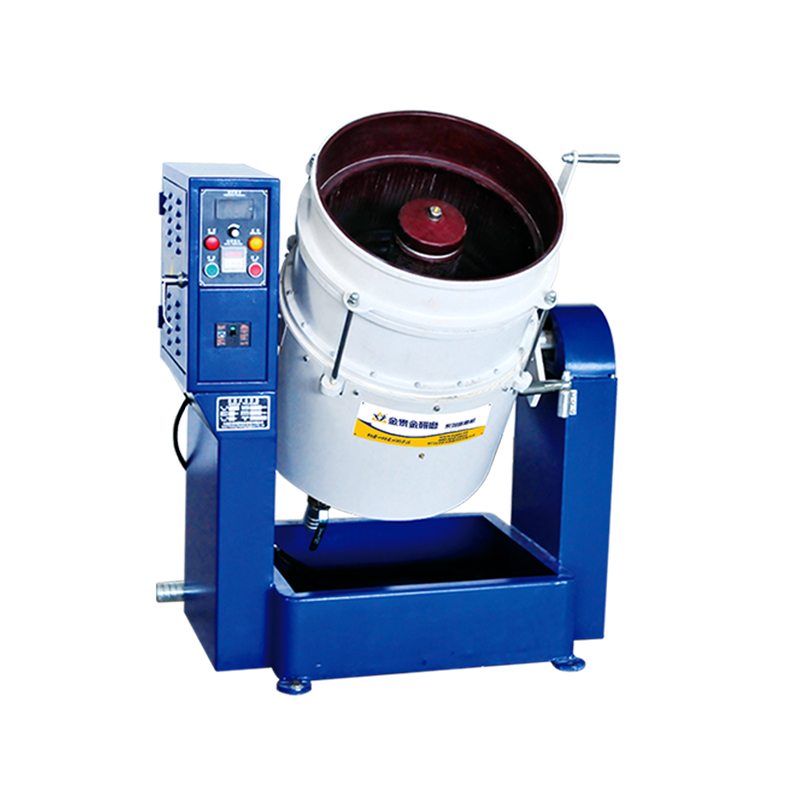
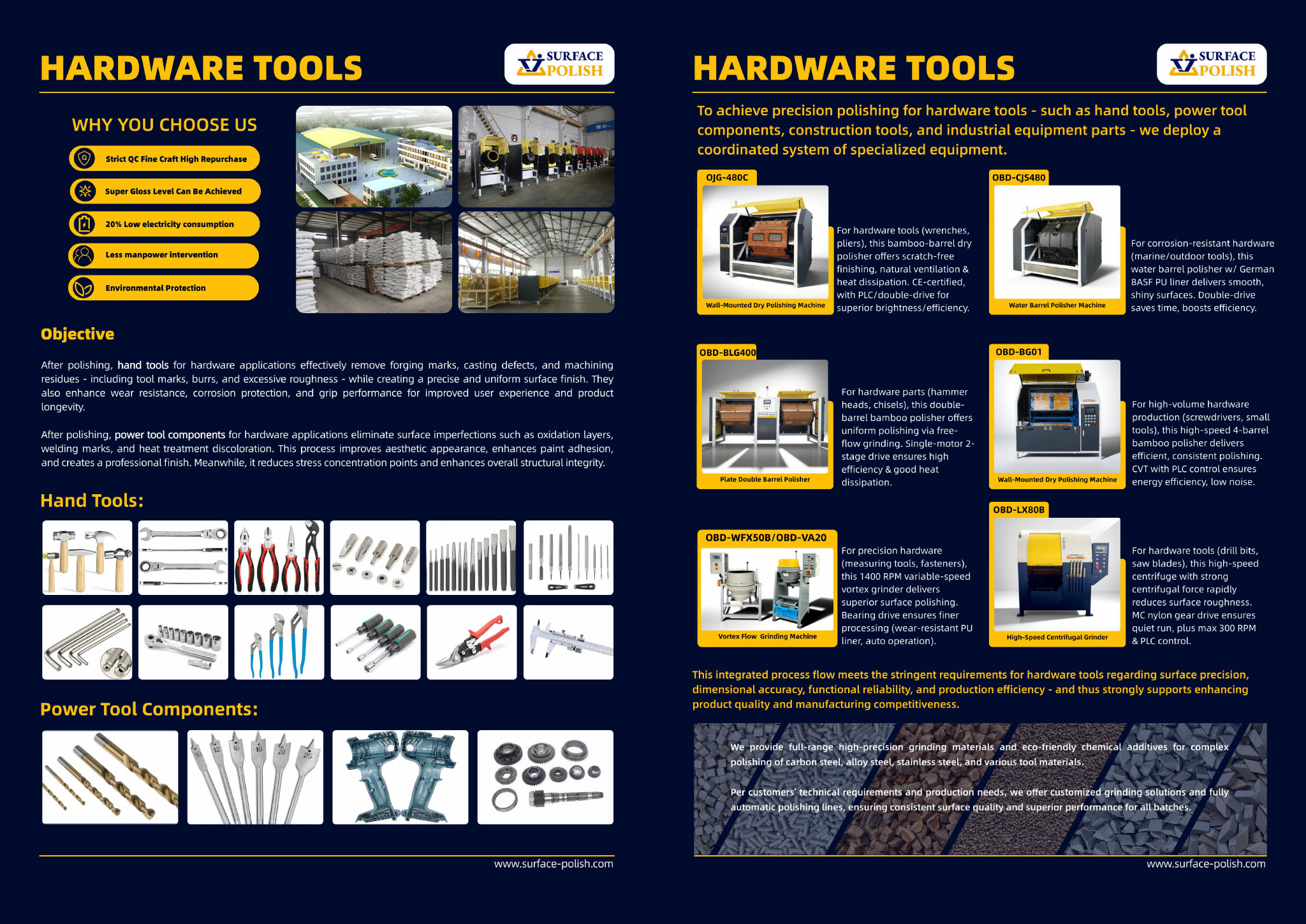
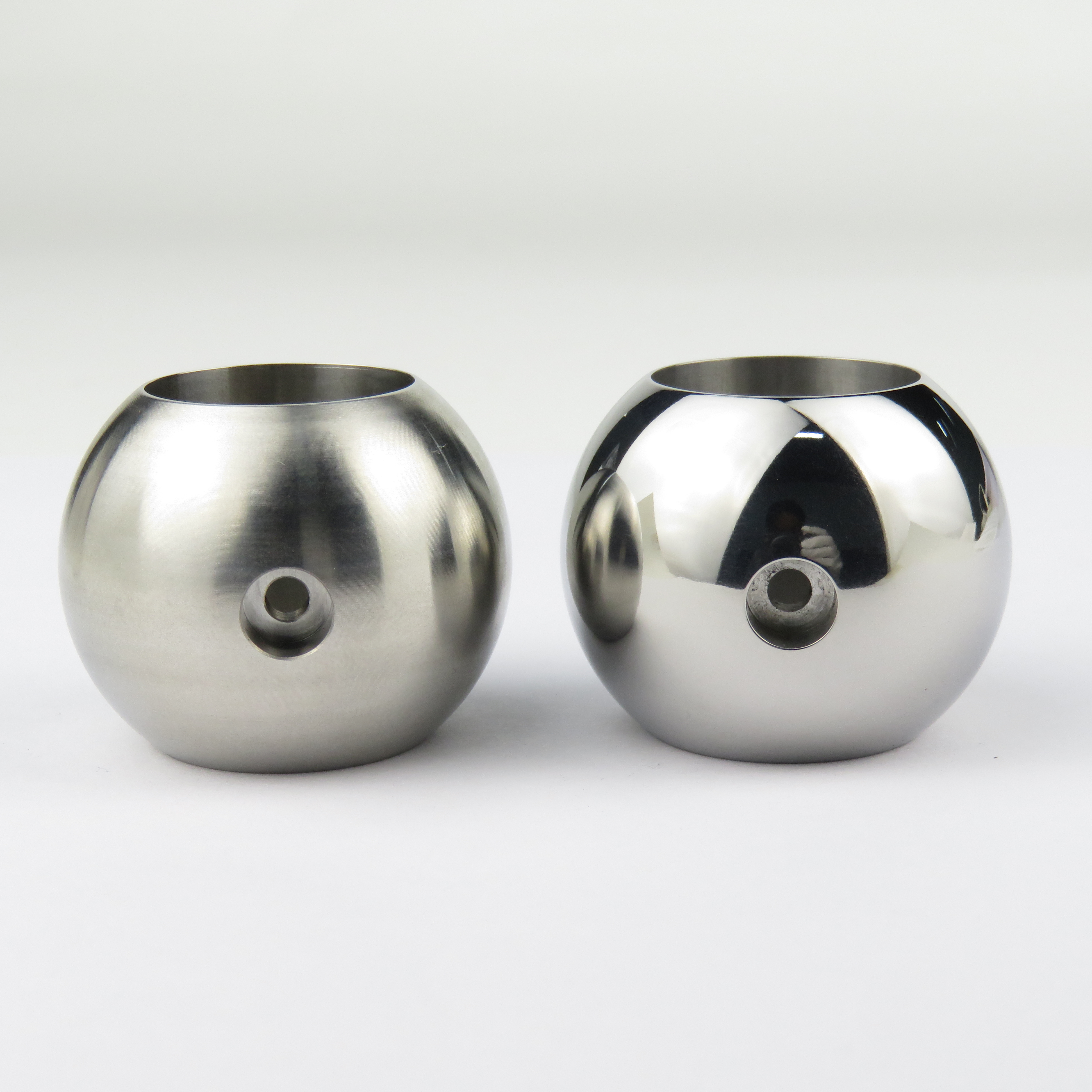
Each stage removes the pattern left by the one before it. A coarse cut removes grinding or machining damage, a refinement stage erases the cut pattern, a colour stage removes the refinement marks, and a lustre stage produces the final reflected image. Skipping or shortening a stage leaves a ghost of it in the surface that finer work only polishes around. Because the steps use different media, compounds and often different machines, a line is planned as a route with a defined finish at each stage, including the rinses and drying between them.
Haze and sleeks usually come from contamination rather than from a wrong final medium. Worn media shed an oversized fine fraction, abrasive can agglomerate in the compound line, screens and machine walls carry grit from an earlier coarse stage, and a shared or under-controlled rinse moves particles forward. Inspect under raking light against a master and trace the pattern: defects that appear in one machine point to the charge, while those spread across machines point to rinsing or handling. Clean the charge, screen the media and re-establish the rinse before changing the compound.
Sometimes, but geometry decides. Media has to sit against the surface and move along it, so recesses with narrow mouths, deep bores, broad flat faces and internal corners may finish unevenly or not at all. A mass-finishing route can still deliver an excellent result on open faces while internal detail reaches a lower, more uniform standard, and it is often sensible to define the requirement per face. Where a small internal edge is the visible feature, a magnetic finishing step or a controlled hand operation may be the only practical route; where a part is too heavy or too long for the envelope, none of it applies.
Use Boston, United States as the destination on the enquiry and state whether the deliverable is equipment, media and compound, a representative sample review or a line concept. A destination does not imply local stock, a local service point or a local delivery time.
Medical-device and biopharma buyers in Massachusetts typically reference FDA quality-system expectations (21 CFR 820) and ISO 13485, and bioprocessing hardware is commonly specified to ASME BPE surface-finish and roughness requirements; machined-part surface texture is called out to ASME B46.1 or ISO 4287, and residue or particle limits are normally defined by the customer's own cleaning-validation protocol rather than by a general finishing standard.
Sources were retrieved on 2026-09-29 and describe the local industrial and trade context only. They do not evidence any SurfacePolish project, shipment, installation or service in Boston.
The buyer wants the rim and spokes to look uniformly bright despite the graphite structure and small surface voids of the casting.
Send the material, dimensions, approximate weight, batch quantity, the incoming condition and photographs of the difficult features. Mark which features must not be contacted by media and state how the result will be inspected. This form carries source reference PSEO-0069; quote it if you prefer an additional manual reference.
Open the SurfacePolish enquiry form Email a prepared enquiry
No price, lead time, certification or result is promised here. Confirm whether a sample trial is available for the specific part and what the trial can and cannot show.
Page PSEO-0069 · revised 2026-09-29 · cross-border equipment, media and scoped sample review. City context is sourced and cited above.
Use this local checker to identify missing part and inspection information. It prepares a technical-review brief; it does not approve a machine, process recipe or production result.
Complete the part details to prepare a review brief.
Email : info@surface-polish.com


 IPv6 network supported


 +86-592-2381506
