In Calgary, Canada, an industrial machinery buyer has a brass valve body that must come up bright and even across a curved cast face without losing thread form at the ports. SurfacePolish is a cross-border supplier of finishing machines, media and compounds, and a free sample trial returns the tested parts with observations and a proposed process direction for the buyer to evaluate. This brief is written for a buyer in Calgary working on industrial machinery; it describes equipment, media and a scoped sample review, not a local polishing service.
Can available media actually reach the geometry, and what finish is realistic in the recesses and internal features it cannot reach?
What batch size, part mix and media maintenance routine will production really run, and does the trial describe that condition?
How much stock may the sequence remove before datums, seal faces, flatness or edge form fall outside their allowance?
Bright polishing rounds edges, and the more energy and time the sequence needs, the more rounding appears. Some edges are cosmetic and rounding is welcome; others define function, such as a scraper edge on a machine-tool slideway, a knife edge on a metering blade, a thread start, or the lapped lip of a valve seat. Mark those features on the drawing and state a maximum edge radius or a no-touch zone before media is selected. Inspection can use radius gauges, a cast impression or an optical comparator against the incoming edge form. Where a crisp edge and a bright face conflict, the practical order is to finish the face first and restore the edge with a controlled hand operation, or to accept a slightly duller face that preserves the edge.
Ceramic media cuts well and holds shape, which keeps the working geometry predictable, but dense ceramic can chip thin edges and its wear debris becomes fine abrasive that carries into later stages. Plastic media is light and gentle, which suits aluminium and brass, though lower density means less contact force and a longer cut stage. Steel media burnishes rather than cuts and gives the brightest wet result on stainless and hardened steel, but it can transfer iron and rust if compound and rinse do not protect the load. Dry media such as walnut shell or corn cob is used for lubricity and drying rather than stock removal. Every medium wears, so measure size loss and replace on a schedule: a worn charge finishes differently and no longer describes an earlier trial result.
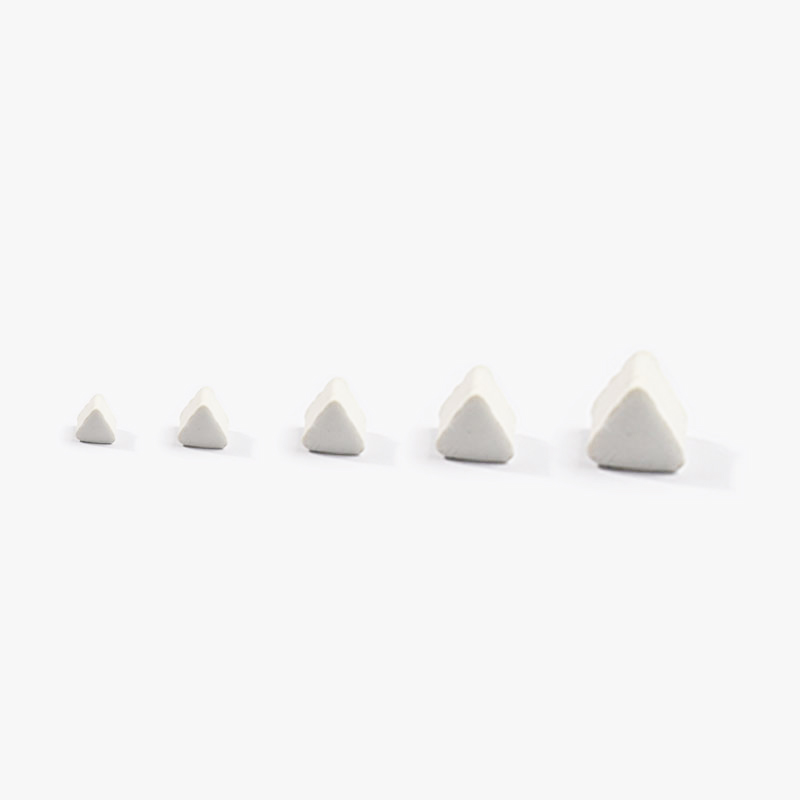
| Media | Best fit | Watch out for |
|---|---|---|
| Plastic or polyester media | Gentle processing of aluminium, brass, copper and thin panels where metal smearing, nicks and distortion must be avoided. | Low density gives little contact force, so cycles run long and heavy grinding marks may survive; plastic also wears quickly and can float above the working mass. |
| Hardened steel media, balls and shaped shot | Bright burnishing of stainless and hardened steel, and the final wet lustre stage where a dense medium can peen a surface smooth. | Can transfer iron and rust to stainless, dents soft or thin parts, and must be kept in a dedicated charge away from ceramic media. |
| Small high-density ceramic spheres or ovals | Colour and pre-lustre stages where a uniform, soft-looking finish matters more than stock removal, including curved and contoured faces. | Very slow cut, easily lost through screens sized for larger media, and ineffective in deep recesses because it cannot reach or press against the surface. |
| Dry media - walnut shell | Dry polishing, light deburring and lubricity on parts where a residual oil film is acceptable, and drying or lustre steps after wet processing. | Not a stock-removal medium, generates dust that needs extraction, and can leave an oily film that interferes with a later cleaning or coating requirement. |
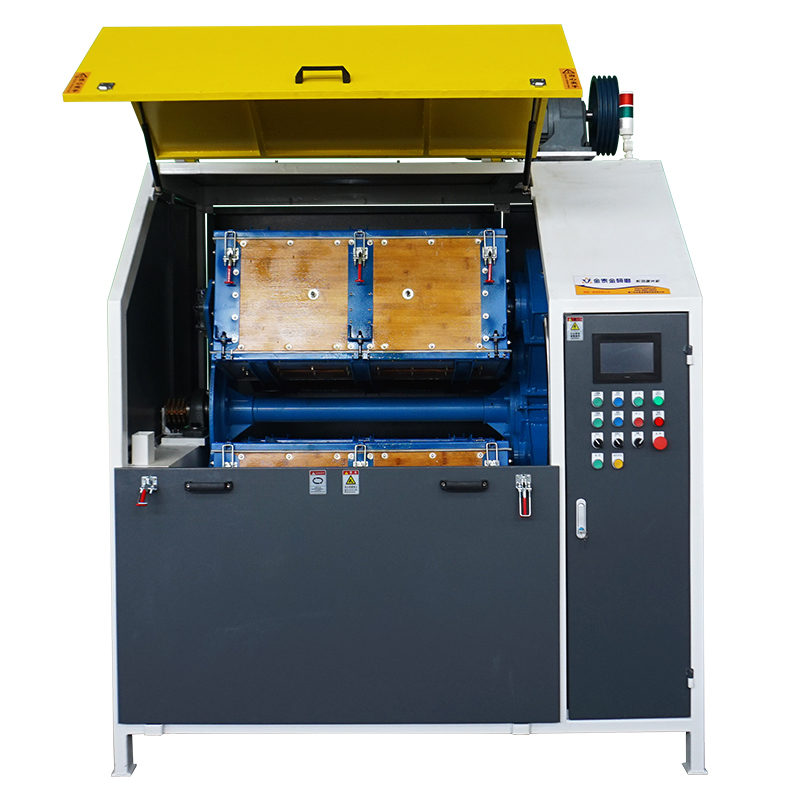
For housings, cover plates, brackets and frames that are rigid and mostly open, a vibratory bowl or tub gives the most forgiving cut-to-colour sequence. The charge moves as a mass, so there is no fixturing to design and no clamping marks, and cycle energy can be tuned through amplitude, media density and load ratio. The limit is reach: media cannot present abrasive uniformly into a pocket whose mouth is narrower than its base, and broad flat faces finish more slowly than edges because contact pressure there is lower. Part-on-part contact also leaves nicks on thin or sharply detailed features, so small, slender or intricate parts usually belong in a gentler route even when their surface requirement is identical.
| Machine route | Where it fits | What it will not do |
|---|---|---|
| Vibratory finishing machine (bowl or tub) | Cut-to-colour sequences on rigid, mostly open parts such as housings, covers, brackets and frames, with adjustable energy and no fixturing. | Cannot present media uniformly into pockets with narrow mouths or deep internal bores, and broad flat faces finish more slowly than edges. |
| Barrel finishing machine / rotary barrel tumbler | Dense, uniform colour on small hardware that tolerates sliding contact, especially with steel media for a burnished appearance. | Nothing longer than the barrel diagonal can be processed, and slender parts can bend or nick against neighbours in the load. |
| Magnetic finishing machine | Refinement and edge conditioning of small precise parts with internal edges, cross holes and fine detail that media cannot enter. | Working envelope and part mass restrict size, removal is very small, and coverage falls off wherever the field cannot drive the pins. |
| Dry polishing machine and dryer | Final lustre, dry colour and post-wet drying where the last reflected image cannot be produced by a wet mass-finishing stage. | Works on accessible faces only, generates dust and heat that need control, and offers no way to correct a defect left by an earlier stage. |
Haze is a general loss of image clarity without a clear directional pattern, and sleeks are the fine unidirectional lines that often accompany it. Both usually come from contamination: worn media shedding an oversized fine fraction, abrasive agglomerating in a compound line, machine walls and screens carrying grit from a previous coarse stage, or parts that were never rinsed between stages. The pattern is diagnostic, because haze appearing in one machine points at the charge while haze on parts from a shared rinse points at the water or the transfer. Check under raking light and low magnification against a master, and verify charge and rinse first: replacing compound before cleaning the machine usually repeats the defect.
| Failure mode | Likely cause | How to catch it |
|---|---|---|
| Heat tint or discolouration concentrated near edges and thin sections | Friction at a dry or high-speed stage raising local temperature, poor cooling or compound flow, or a load that packs parts against each other with no media between them. | Compare colour against a master in consistent lighting, look for a gradient from edge inward, and check whether the tint follows load contact points or the whole face. |
| Dimensional drift or lost flatness on datums, seals and bearing seats | Uneven stock removal across a large or asymmetric face, over-long cycles, or unprotected functional features exposed to the full charge energy. | Measure flatness and critical dimensions with a CMM or surface plate at the same marked points used for the incoming survey, and compare the change against the allowance. |
| Ghost pattern of an earlier coarse stage showing through the final finish | A cut or refinement stage removed too little material, a later stage reused a contaminated charge, or the crosshatch direction was not changed between steps. | Reflect a light source at a shallow angle and rotate the part; a mark that disappears at one angle and returns at another is still in the surface rather than on it. |
| Orange peel, a slow wave that distorts the reflected image | Soft or work-hardened surface deformed rather than cut, a heavy cut stage followed by too little refinement, or a dry or buffing stage at high speed with excess pressure. | Reflect a straight edge or fluorescent tube in the face at a shallow angle, compare the shape of the image against a physical master in the same lighting, and repeat at several viewing angles. |
Calgary is Canada's energy head-office city and has been building aerospace, life sciences and logistics depth on top of that base. Calgary Economic Development reports that more than 70 major energy companies have head offices in the city and that 462 of Alberta's 940 cleantech companies are headquartered there. The aerospace sector is real but narrower than Montreal's: the region's aerospace ecosystem is anchored by applied research and development, aerospace components and parts manufacturing, maintenance, repair and overhaul (MRO), and unmanned systems, with CAD 3 billion contributed to Alberta's GDP in 2024 and over 100 direct global routes from Calgary International Airport. Life sciences has grown to more than 140 companies in human and animal health, with medical device manufacturing and diagnostics among the growth subsectors. Logistics is a genuine industrial cluster in its own right, with both CPKC and CN headquartered in Calgary and the proposed Prairie Economic Gateway inland port positioned to add manufacturing, processing and distribution capacity.
For this brief the relevant part of that base is machinery: Calgary Economic Development identifies value-added processing and rail freight and intermodal transportation among the growth subsectors, and notes that both CPKC and CN are headquartered in the city.
Calgary's energy and oilfield service base generates a continuous flow of valve bodies, fittings, pump components, tubular connections and machined parts where burrs at sealing faces and threads are a leak-path and galling risk, and where surface finish on sealing surfaces is a functional specification. Aerospace components and MRO work in the same city adds edge-condition and cleanliness requirements on machined aluminium and steel parts, and the emerging medical device and diagnostics manufacturing base adds small, high-value parts where hand deburring variability is the main quality problem. Because both the energy and aerospace customers operate under formal quality systems, the finishing step usually has to be documented and repeatable rather than operator-dependent.
A Calgary buyer should settle which surface is actually functional before choosing a process: on valve, pump and tubular components the acceptance criterion is usually a specific sealing-face finish and a burr-free thread or edge, and that determines whether vibratory, centrifugal or spindle finishing is even applicable, and whether edge radius rather than surface roughness is the real specification. The second question is repeatability across shifts, because energy and aerospace customers increasingly require documented, repeatable surface condition rather than a finish that depends on which operator ran the part.
Freight context: YYC Calgary International Airport and YYC Global Logistics Park, CPKC headquarters and intermodal terminals, CN intermodal terminals, Prairie Economic Gateway inland port (proposed). Calgary handles 75 per cent of Alberta's air cargo shipments through YYC and has over 100 direct routes into Europe and the Americas, and both Class 1 railways are headquartered in the city, giving access to West Coast ports and to centres in Canada, the United States and Mexico. The proposed Prairie Economic Gateway inland port, a City of Calgary and Rocky View County partnership, is projected to generate over CAD 7 billion in economic activity and more than 30,000 jobs over 10 to 12 years, and is explicitly targeted at manufacturing, logistics, processing and distribution.
The customs authority is the Canada Border Services Agency (CBSA), and importers of commercial goods must work through the CBSA Assessment and Revenue Management (CARM) system, which is where registration, the duties-and-taxes calculator, advance rulings and national customs rulings, and the commercial accounting declaration (CAD) are handled. Documentation expectations are explicit: "You must provide proof of country of origin when you import goods into Canada and, in some cases, your goods must also be clearly marked", the invoice or sales receipt must carry "a complete description of the goods", "the selling price" and "any conditions and terms of the sale", and the value for duty must be declared in Canadian currency only. Duties and taxes are layered rather than single: customs duty on the tariff item, the Goods and Services Tax calculated on the duty-paid value, and potentially excise duty, excise tax, surtax or safeguard measures. Importers must also clear non-tariff gates: goods must be admissible, some goods need permits, certificates or inspections from other federal departments that the CBSA applies on their behalf, controlled goods under the Defence Production Act require consultation with the CBSA and Global Affairs Canada before import, and "Goods manufactured or produced wholly or in part by forced or prison labour are prohibited from entering Canada", with due diligence resting on the importer. For electrical machinery, the practical conformity route in Canada is certification of the product to Canadian electrical safety standards by an accredited certification body rather than a self-declared CE-style mark; buyers should confirm the specific certification body and mark required before shipment. For a first shipment of a finishing machine or a media/compound sample lot, the fastest way to remove classification and valuation uncertainty is to use the CARM portal to request an advance ruling for tariff classification and origin.
China is one of Canada's ten principal merchandise trading partners and the second-largest single-country source of Canadian imports after the United States: Statistics Canada reported CAD 5,369 million of balance-of-payments imports from China in January 2025, against a CAD 2,299 million bilateral merchandise deficit that month. Canada has no free trade agreement with China, so Chinese-origin industrial machinery enters under the Most-Favoured-Nation (MFN) tariff column of the Canadian Customs Tariff; the preferential treatments listed in the tariff (CUSMA/UST and MXT, CETA/CEUT, CPTPP/CPTPT, UKT, KRT and others) do not include China, and preferential rates require proof of origin plus the applicable shipping rules, so a China-origin machine cannot claim them. Tariff classification is mandatory work, not a formality: vibratory, barrel, centrifugal and disc finishing machines are classified in Chapter 84 ("Nuclear reactors, boilers, machinery and mechanical appliances; parts thereof") according to the function of the machine, and the ten-digit Canadian tariff item drives both the duty rate and the statistics. A further landed-cost risk sits outside the tariff schedule: under the Special Import Measures Act (SIMA), the CBSA and the Canadian International Trade Tribunal may apply anti-dumping and countervailing duties to named goods, so a buyer should check the measures-in-force list for the specific product before assuming the MFN rate is the final duty.
SurfacePolish supplies from Xiamen, China. The buyer's own destination rules, conformity marking, tariff classification and documentation responsibilities stay with the buyer; confirm them against the authorities named above before ordering.
Ra and gloss are not interchangeable and should not be traded for one another. Ra is a two-dimensional profile average over a defined cutoff, so a face can hold a low Ra while still showing waviness, orange peel or directional marks that dominate the reflected image; conversely, a surface with a slightly higher Ra can look brighter because its texture scatters light uniformly. If the requirement is appearance, specify appearance: a reflectance or gloss reading at a stated angle and instrument geometry, plus a physical master and viewing conditions. If the requirement is texture or function, specify the profile parameter, the cutoff and the evaluation length. Ask for both where both matter, and record which one governs acceptance at each location.
Scaling up changes the charge faster than it changes the machine. Media wears, so the working size distribution drifts and a charge that cut well in a trial may burnish instead after a few hundred hours; screen and top up on a schedule, and record charge age with each batch. Compound dose should be metered against flow and checked, not assumed. Keep the load ratio inside the range the trial established, weigh or count parts rather than eyeballing the load, and separate material families so stainless does not pick up iron from carbon steel. Verify the rinse and dry stages as carefully as the finishing stage, because residue tolerated in small trial batches often becomes a visible film at production volume.

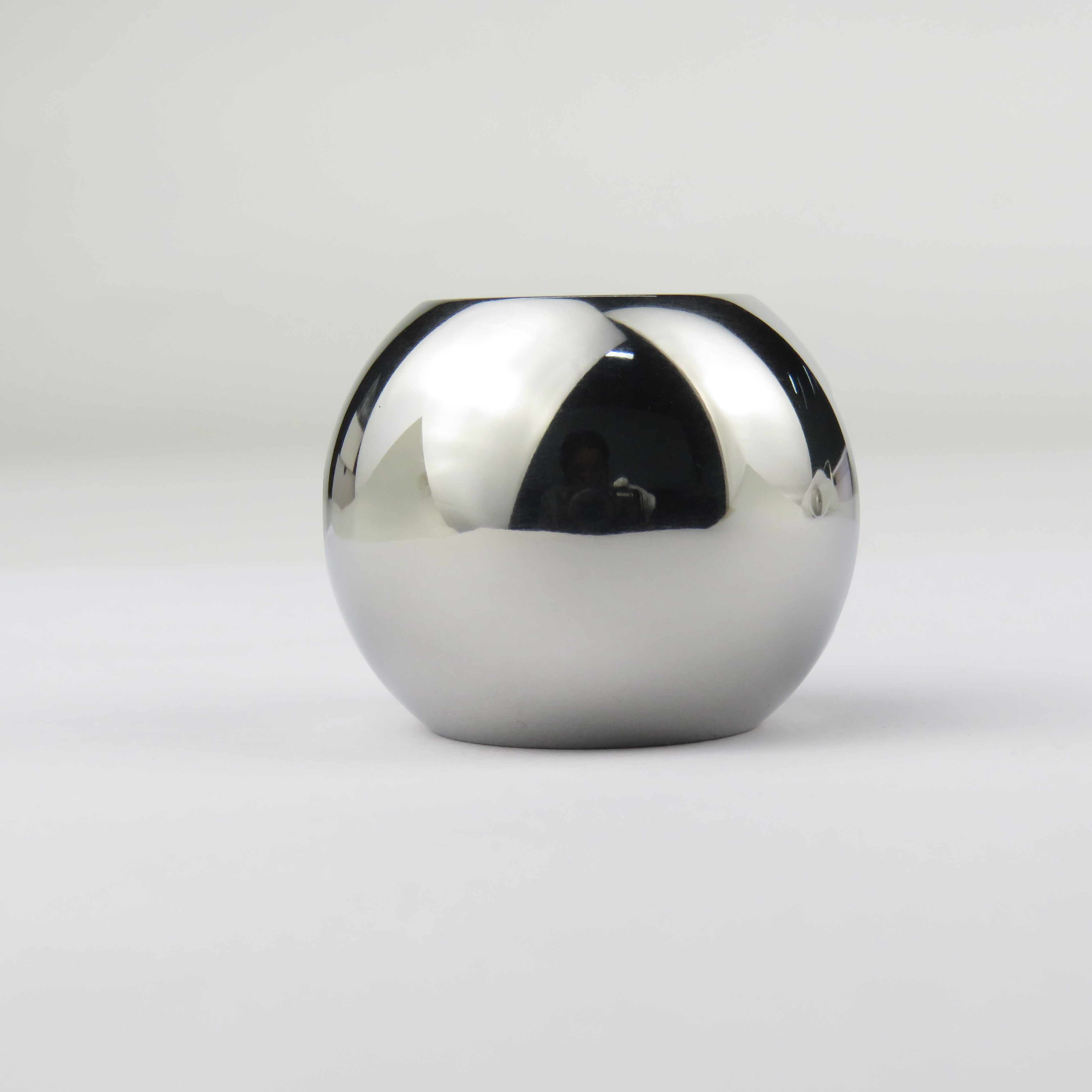
Ra alone is not enough. It is an average over a defined cutoff length, so a surface with a low Ra can still show waviness, orange peel or directional marks that dominate what a viewer sees, while a slightly rougher surface can look brighter if it scatters light evenly. Specify the measurement setup as well as the value, and where appearance is what matters, add a reflectance or gloss reading at a stated angle together with a physical master and viewing conditions. For Calgary buyers working to a functional surface requirement, specify the profile and the appearance requirement separately.
Haze and sleeks usually come from contamination rather than from a wrong final medium. Worn media shed an oversized fine fraction, abrasive can agglomerate in the compound line, screens and machine walls carry grit from an earlier coarse stage, and a shared or under-controlled rinse moves particles forward. Inspect under raking light against a master and trace the pattern: defects that appear in one machine point to the charge, while those spread across machines point to rinsing or handling. Clean the charge, screen the media and re-establish the rinse before changing the compound.
Design the charge around the smallest opening rather than the average part. Use media clearly smaller than the hole, or mask and plug the features before the cycle, count the media into and out of the load as a reconciliation, and add a retrieval step with a defined check such as a borescope or pin gauge. For Canada buyers sending parts for a trial, include the part with the tightest feature so the media class is chosen against real geometry. The small pins used in magnetic finishing embed easily in soft metal, so those features need extra inspection.
Use Calgary, Canada as the destination on the enquiry and state whether the deliverable is equipment, media and compound, a representative sample review or a line concept. A destination does not imply local stock, a local service point or a local delivery time.
A Calgary buyer in the energy supply chain normally works to the end-user's material and inspection specification for sealing faces, threads and surface finish, plus the requirements of the applicable pressure-equipment or pipeline standard their customer names. On the plant side, Alberta occupational health and safety rules for guarding and lockout apply, along with Canadian electrical safety certification for the equipment.
Sources were retrieved on 2026-09-29 and describe the local industrial and trade context only. They do not evidence any SurfacePolish project, shipment, installation or service in Calgary.
The buyer wants consistent colour and brightness across the curved face without rounding the port threads or losing the cast form.
Send the material, dimensions, approximate weight, batch quantity, the incoming condition and photographs of the difficult features. Mark which features must not be contacted by media and state how the result will be inspected. This form carries source reference PSEO-0139; quote it if you prefer an additional manual reference.
Open the SurfacePolish enquiry form Email a prepared enquiry
No price, lead time, certification or result is promised here. Confirm whether a sample trial is available for the specific part and what the trial can and cannot show.
Page PSEO-0139 · revised 2026-09-29 · cross-border equipment, media and scoped sample review. City context is sourced and cited above.
Use this local checker to identify missing part and inspection information. It prepares a technical-review brief; it does not approve a machine, process recipe or production result.
Complete the part details to prepare a review brief.
Email : info@surface-polish.com


 IPv6 network supported


 +86-592-2381506