In Leeds, United Kingdom, an industrial machinery buyer wants a cast iron handwheel rim and spokes brought to an even bright finish despite the graphite structure and small voids in the casting. SurfacePolish supplies finishing machines, media and compounds across borders and runs a free sample trial, returning the tested parts with observations and a proposed process direction for the buyer's own review. This brief is written for a buyer in Leeds working on industrial machinery; it describes equipment, media and a scoped sample review, not a local polishing service.
Which faces must reach a mirror and which only need to be clean and uniform, and how is each one judged?
How much stock may the sequence remove before datums, seal faces, flatness or edge form fall outside their allowance?
What is the substrate condition - cast, welded, forged or machined - and which defects already in it will become visible once the metal is smooth?
Every mirror sequence removes metal, and the removal is rarely uniform across a large face. Datum pads, dowel registers, bearing seats and seal lands carry assembly geometry, so measure them before finishing and agree a dimensional and flatness allowance. Where an allowance is tight, mask the feature, finish around it by hand, or plan a light final lapping pass that keeps the face flat. A part that looks correct but has lost flatness on a mounting face will not assemble squarely, and a curved cover panel shows a distorted reflection after only a few hundredths of a millimetre of uneven stock removal. Record incoming values with the same instruments that will accept the finished part, at the same marked locations.
A mirror finish is a sequence of progressively finer steps, each removing the pattern left by the one before it, and no single machine substitutes for the whole sequence. A typical line separates cut down, refinement, colour and final lustre, with rinse, inspection and drying between stages so coarse particles and dried residue do not travel forward. Running one vibrator longer at one media specification tends to plateau: the surface reaches the limit of that media and stops improving while edges keep rounding and dimensions keep shrinking. Plan the line as a route with a defined finish at each stage, decide which stages share a machine and which need their own equipment, and treat transfer, rinsing and drying as process steps with their own controls.
| Machine route | Where it fits | What it will not do |
|---|---|---|
| Tub vibrator | Long and large parts such as shafts, extrusions and frame members that cannot be folded into a barrel, including external grooves. | Poor at bores running parallel to the long axis, and slender parts still need support or balanced loading to hold straightness. |
| Vibratory finishing machine (bowl or tub) | Cut-to-colour sequences on rigid, mostly open parts such as housings, covers, brackets and frames, with adjustable energy and no fixturing. | Cannot present media uniformly into pockets with narrow mouths or deep internal bores, and broad flat faces finish more slowly than edges. |
| Centrifugal barrel finishing machine | High-speed cut down and refinement on small to medium parts where a short, energetic cycle is needed before colour stages. | Aggressive on edges and thin sections, requires tight cycle control, and does not replace a finer refinement stage. |
| Magnetic finishing machine | Refinement and edge conditioning of small precise parts with internal edges, cross holes and fine detail that media cannot enter. | Working envelope and part mass restrict size, removal is very small, and coverage falls off wherever the field cannot drive the pins. |
Ceramic media cuts well and holds shape, which keeps the working geometry predictable, but dense ceramic can chip thin edges and its wear debris becomes fine abrasive that carries into later stages. Plastic media is light and gentle, which suits aluminium and brass, though lower density means less contact force and a longer cut stage. Steel media burnishes rather than cuts and gives the brightest wet result on stainless and hardened steel, but it can transfer iron and rust if compound and rinse do not protect the load. Dry media such as walnut shell or corn cob is used for lubricity and drying rather than stock removal. Every medium wears, so measure size loss and replace on a schedule: a worn charge finishes differently and no longer describes an earlier trial result.
| Media | Best fit | Watch out for |
|---|---|---|
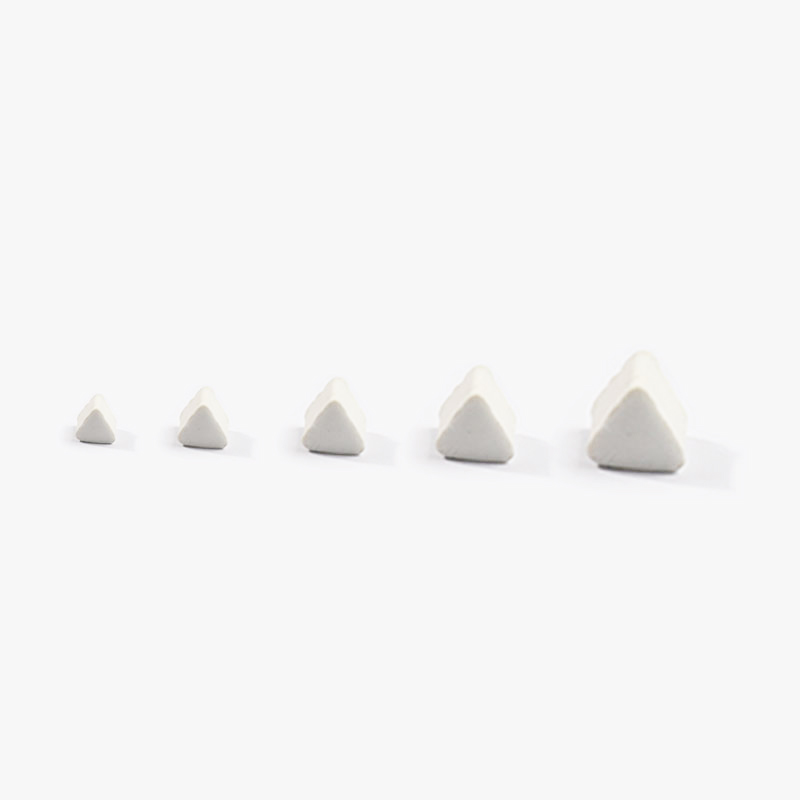
| Small high-density ceramic spheres or ovals | Colour and pre-lustre stages where a uniform, soft-looking finish matters more than stock removal, including curved and contoured faces. | Very slow cut, easily lost through screens sized for larger media, and ineffective in deep recesses because it cannot reach or press against the surface. |
| Dry media - walnut shell | Dry polishing, light deburring and lubricity on parts where a residual oil film is acceptable, and drying or lustre steps after wet processing. | Not a stock-removal medium, generates dust that needs extraction, and can leave an oily film that interferes with a later cleaning or coating requirement. |
| Plastic or polyester media | Gentle processing of aluminium, brass, copper and thin panels where metal smearing, nicks and distortion must be avoided. | Low density gives little contact force, so cycles run long and heavy grinding marks may survive; plastic also wears quickly and can float above the working mass. |
| Medium ceramic triangles or angle-cut shapes | Blending, edge conditioning and the refinement step that removes the coarse cut pattern on housings, brackets, covers and frames. | Media that cannot enter a slot or recess leaves those areas at a different finish, so those faces need a separate operation or a stated lower standard. |
Orange peel is a slow wave in the surface, visible as a distorted reflected line, and it usually comes from the finishing process rather than the substrate. It develops when a soft or work-hardened layer is deformed rather than cut, when a heavy cut stage is followed by too little refinement, or when a buffing or dry stage runs at high speed with excess pressure and little cooling. Aluminium, copper and annealed stainless are the most prone. Detection belongs in the acceptance routine: reflect a straight edge or a fluorescent tube in the face, look at the shape of the image, and compare against a physical master in the same lighting. Extra fine polishing will not remove peel that sits below the surface; the sequence has to return to a cutting stage.
| Failure mode | Likely cause | How to catch it |
|---|---|---|
| Sleeks, fine unidirectional lines across a bright face | Contaminated charge or rinse, a metal particle trapped between media and part, or a polishing direction that was never rotated between successive stages. | Orient the light along and then across the lines, note where each family appears on the part, and inspect the charge and rinse screens for embedded foreign particles. |
| Embedded media particles or finishing pins in a soft surface | High contact pressure on aluminium, brass or copper, worn media with sharp fractured edges, or magnetic-finishing pins driven into a surface that cannot resist them. | Examine at magnification under raking light, wipe with a clean cloth and check for pulled particles, and consider a dye penetrant or etching check on a sample part. |
| Iron pickup or rust bloom on a stainless surface | Carbon steel particles or steel media sharing a machine or charge, contaminated rinse water, or a damp surface left in contact with packaging after drying. | Wipe or swab the surface and look for a brown trace, check the charge and machine for ferrous pieces, and inspect parts after a short dwell in the packaging they will ship in. |
| Ghost pattern of an earlier coarse stage showing through the final finish | A cut or refinement stage removed too little material, a later stage reused a contaminated charge, or the crosshatch direction was not changed between steps. | Reflect a light source at a shallow angle and rotate the part; a mark that disappears at one angle and returns at another is still in the surface rather than on it. |
Leeds is in West Yorkshire and forms part of the Yorkshire and The Humber region, whose manufacturing output Make UK now records as having exceeded 2019 levels along with every other English region, with aerospace and defence investment fuelling growth in the strongest-performing areas. The West & North Yorkshire Chamber of Commerce represents the city through its Leeds Chamber and publishes Local Skills Improvement Plans for West Yorkshire. Leeds Bradford Airport is the city's airport, marketing flights to over 80 destinations from Yorkshire, while Yorkshire's sea freight moves through the Humber ports, where ABP operates Immingham, the UK's largest port by tonnage at around 46 million tonnes a year, and Hull.
For this brief the relevant part of that base is machinery: Make UK records that all English regions have now exceeded 2019 manufacturing output levels, and West Yorkshire sits inside the Yorkshire and The Humber manufacturing base covered by that measure.
Leeds finishing demand is best treated as regional rather than city-specific: Yorkshire and The Humber has an active goods-producing base whose output feeds national assembly and construction supply chains, and machined or formed parts entering those chains still need burrs and edges controlled. The acceptance criterion - surface texture, edge condition or cleanliness - is what determines the process, and it is normally set by the customer's drawing rather than by local convention.
A Leeds buyer should establish first whether the part's acceptance criterion is a surface-texture value, an edge condition or a cleanliness level, then confirm media and compound compatibility with the workpiece material before committing to a machine type.
Freight context: Leeds Bradford Airport, Port of Immingham (ABP) - the UK's largest port by tonnage, on the Humber, Port of Hull (ABP) - container terminal and Humber offshore wind base. Leeds Bradford Airport presents itself as the airport for the heart of Yorkshire, and ABP's Humber ports are the region's deep-sea and short-sea gateways: ABP states that Immingham handles around 46 million tonnes of cargo a year and that Hull is the UK's leading softwood timber port and the focus of the offshore wind sector on the Humber.
Importers need a GB-prefixed Economic Operators Registration and Identification (EORI) number, an import declaration carrying the correct commodity code, and retained commercial invoices plus the Import VAT Certificate (C79) so import VAT can be reclaimed. Machinery placed on the Great Britain market must be marked UKCA or CE: the manufacturer must draw up and retain technical documentation including a Declaration of Conformity, apply the correct marking with identification details, and cooperate with market surveillance; an authorised representative must be established in the UK. Under the Product Safety and Metrology (Amendment) Regulations 2024 the UK continues to recognise CE marking alongside or in place of UKCA for the Great Britain market, so either route can be used for most product types. Duty and import VAT are calculated from the customs value declared, and the commodity code also determines whether an import licence is needed.
English is the working language of contracts, drawings and conformity paperwork, so quotations, technical files and Declarations of Conformity should be supplied in English. UK manufacturers have now recovered above 2019 output levels in every English region and devolved nation except Northern Ireland, and the sector is concentrated in food and drink and transport equipment, with the North West the largest manufacturing region by total output. Buyers typically expect the UKCA/CE route, a Declaration of Conformity and a UK-established economic operator to be identified before order, and they need commercial invoices, customs declarations and the C79 retained in a form their finance team can use for import VAT recovery. No source verified in this research establishes a mandated payment instrument, so payment structure should be treated as commercial negotiation rather than a regulatory requirement.
SurfacePolish supplies from Xiamen, China. The buyer's own destination rules, conformity marking, tariff classification and documentation responsibilities stay with the buyer; confirm them against the authorities named above before ordering.
Ask for a settings record with every batch: machine and stage, media type and size class, charge mass and age, compound product and measured dose, load ratio, cycle time and rinse conditions. Retain a fully inspected first article as the physical reference, together with its measurement data and photographs at fixed scale and lighting. Write the disposition rule in advance, covering what passes, what is reworked and what is scrapped, and name who decides. The record should state plainly that the reported condition applies to the parts tested, at the locations measured, with the settings used; it is a description, not a guarantee of future output or of fitness for any regulated application. Certificate and approval requests belong with the buyer's own quality function.
A trial runs a small, hand-selected load on equipment that has just been set up. Production runs mixed batches on a media charge of unknown age, with transfer time between stages, variable rinse quality, operators on different shifts, and parts arriving with different incoming damage. Plan a defined pilot batch that uses the intended line configuration and a full first-article inspection, then compare it with the trial observations before committing volume. Watch the variables that scale badly: drying time in a humid season, water chemistry, load density and the handling between cut, colour and lustre stages. Treat the pilot as the real test of stability and keep its settings record with the parts so any drift can be traced.

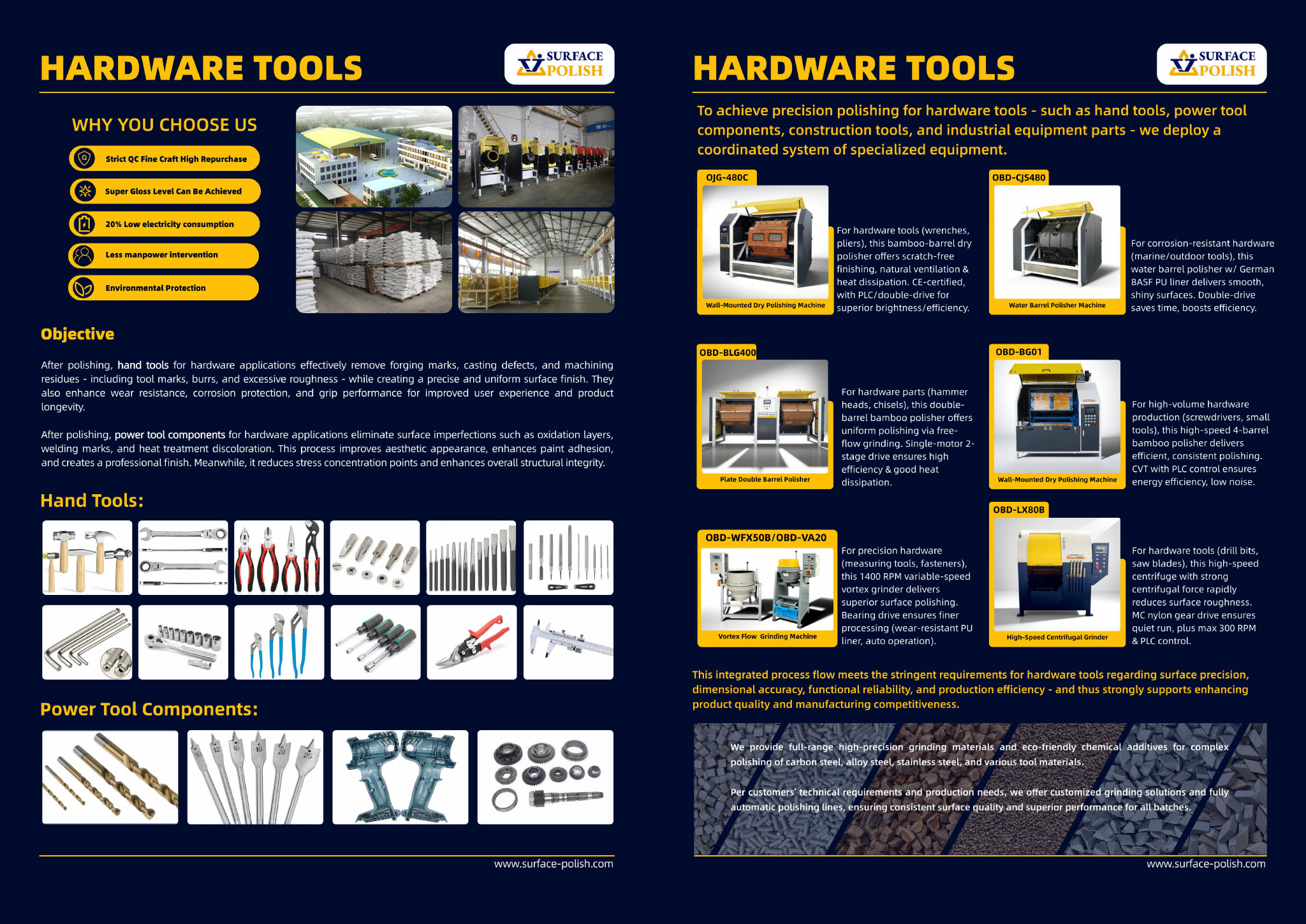
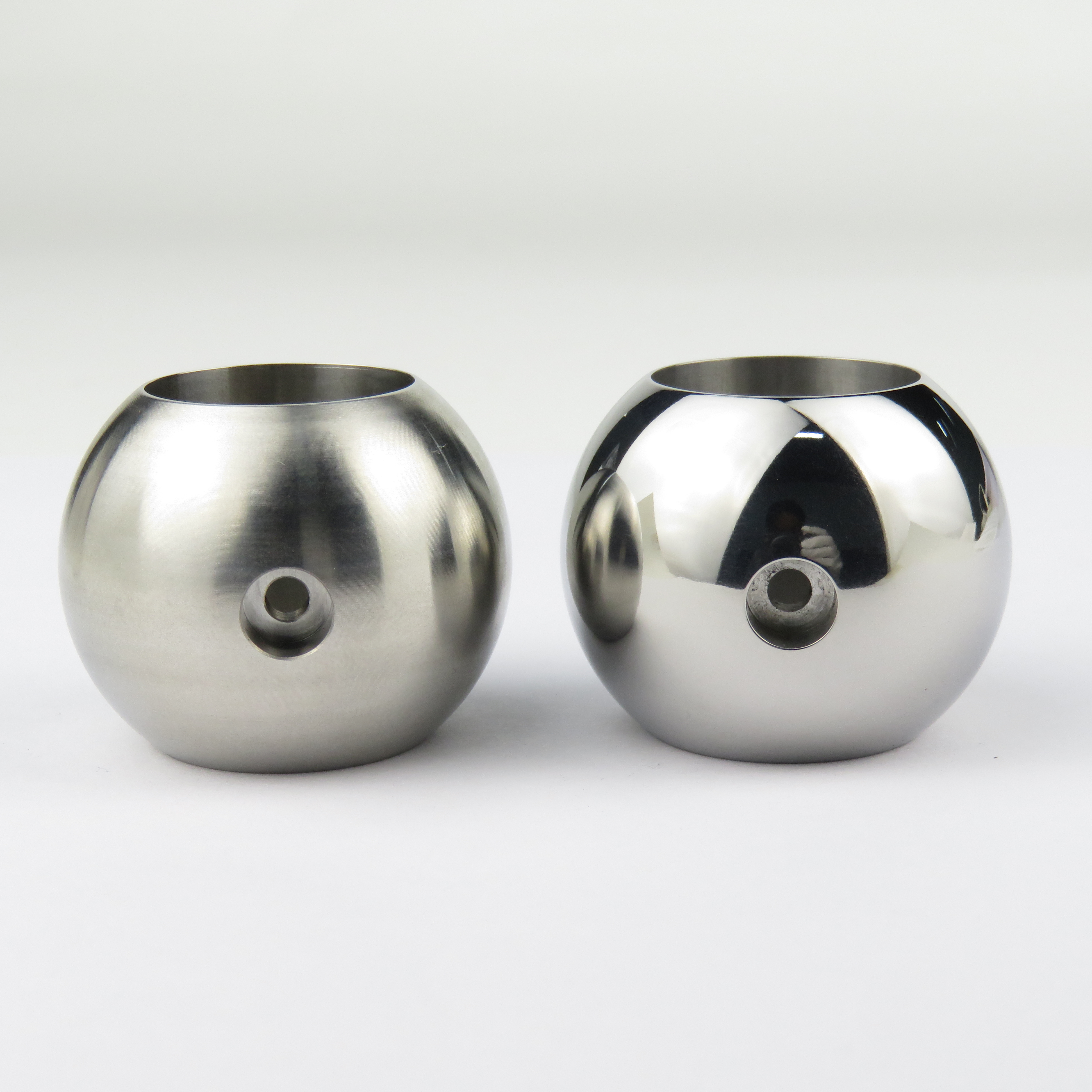
Send representative production parts including the thinnest wall, the tightest feature that must stay clear and the worst edge, plus a witness coupon of the same material and condition, a drawing extract covering the finished faces and the acceptance requirement you intend to apply. Label every piece and note its incoming condition with photographs, readings and measurements. The return is the tested parts with observations and a proposed media, compound and cycle direction for the buyer's own evaluation. A trial on parts shipped from United Kingdom is a comparison, not a qualification, and it establishes no capacity or delivered surface value.
No to both. SurfacePolish is a cross-border supplier of finishing machines, media and compounds, and it does not supply or perform electropolishing or operate a plant, branch, dealer or technician service in United Kingdom or any other market. What is offered is equipment and consumables, a scoped discussion of a finishing line concept, and a free sample trial in which representative parts are shipped to Xiamen and returned with observations and a proposed process direction. Where an electrochemical finish is under consideration, the discussion stays a comparison with a mechanical route.
Orange peel is a wave in the surface, produced when metal is deformed rather than cut, usually on softer alloys, on work-hardened layers, or when a heavy cut stage is followed by too little refinement. It shows as a distorted reflected line when you view a straight edge in the face. Polishing with finer media does not remove it, because the wave extends below the depth a fine stage can reach; the sequence has to return to a cutting stage and then refine properly. If the wave comes from the incoming material or a forming operation, it may not be removable at all.
Use Leeds, United Kingdom as the destination on the enquiry and state whether the deliverable is equipment, media and compound, a representative sample review or a line concept. A destination does not imply local stock, a local service point or a local delivery time.
UKCA or CE marking with a Declaration of Conformity is required for machinery placed on the Great Britain market, HSE's work equipment and machinery topic and COSHH cover safe operation and hazardous substances, and buyers in aerospace-linked West Yorkshire supply chains normally receive these requirements already flowed down from the prime contractor's specification.
Sources were retrieved on 2026-09-29 and describe the local industrial and trade context only. They do not evidence any SurfacePolish project, shipment, installation or service in Leeds.
The buyer wants the rim and spokes to look uniformly bright despite the graphite structure and small surface voids of the casting.
Send the material, dimensions, approximate weight, batch quantity, the incoming condition and photographs of the difficult features. Mark which features must not be contacted by media and state how the result will be inspected. This form carries source reference PSEO-0249; quote it if you prefer an additional manual reference.
Open the SurfacePolish enquiry form Email a prepared enquiry
No price, lead time, certification or result is promised here. Confirm whether a sample trial is available for the specific part and what the trial can and cannot show.
Page PSEO-0249 · revised 2026-09-29 · cross-border equipment, media and scoped sample review. City context is sourced and cited above.
Use this local checker to identify missing part and inspection information. It prepares a technical-review brief; it does not approve a machine, process recipe or production result.
Complete the part details to prepare a review brief.
Email : info@surface-polish.com


 IPv6 network supported


 +86-592-2381506
