A buyer producing industrial machinery in Mississauga, Canada has a long stainless pump shaft that must be brightened without bowing, losing roundness at the bearing seat or rounding the keyway edges. SurfacePolish supplies finishing machines, media and compounds internationally and runs a free sample trial on parts shipped to Xiamen, returning observations and a proposed direction rather than a promised result. This brief is written for a buyer in Mississauga working on industrial machinery; it describes equipment, media and a scoped sample review, not a local polishing service.
What is the substrate condition - cast, welded, forged or machined - and which defects already in it will become visible once the metal is smooth?
How much stock may the sequence remove before datums, seal faces, flatness or edge form fall outside their allowance?
What batch size, part mix and media maintenance routine will production really run, and does the trial describe that condition?
Two parts with the same alloy name can behave differently under the same media. Hardened tool steel resists cutting and holds a polish longer, while annealed low-carbon steel cuts quickly and can smear under high contact pressure. Austenitic stainless work hardens, so a heavy first pass can leave a skin harder than the bulk, after which fine media stop removing material and only burnish it. Aluminium and brass are soft enough that media pressure rolls metal instead of cutting it, producing a wave rather than a cut. Ask for the actual condition - hardness range, heat treatment, cold work, and whether the part was cast, forged or machined from bar - then confirm it on a sample rather than trusting a datasheet to describe the surface the media will meet.
Compound concentration is a process variable that drifts. Dosing on a timer is convenient but ignores carry-out, evaporation and the fines load, so a batch that starts at target can finish well above or below it. Meter dose against water flow, check pH and, where available, conductivity at the start and end of a cycle, and record those values with the batch. Water quality shapes the final image: hard water leaves mineral spots that read as haze, and high chloride or iron content can stain stainless during rinsing. The rinse after each stage deserves the same control as the finishing stage, with enough volume and flow to remove compound and loose fines before the part dries, because dried residue is far harder to remove without disturbing the finish.
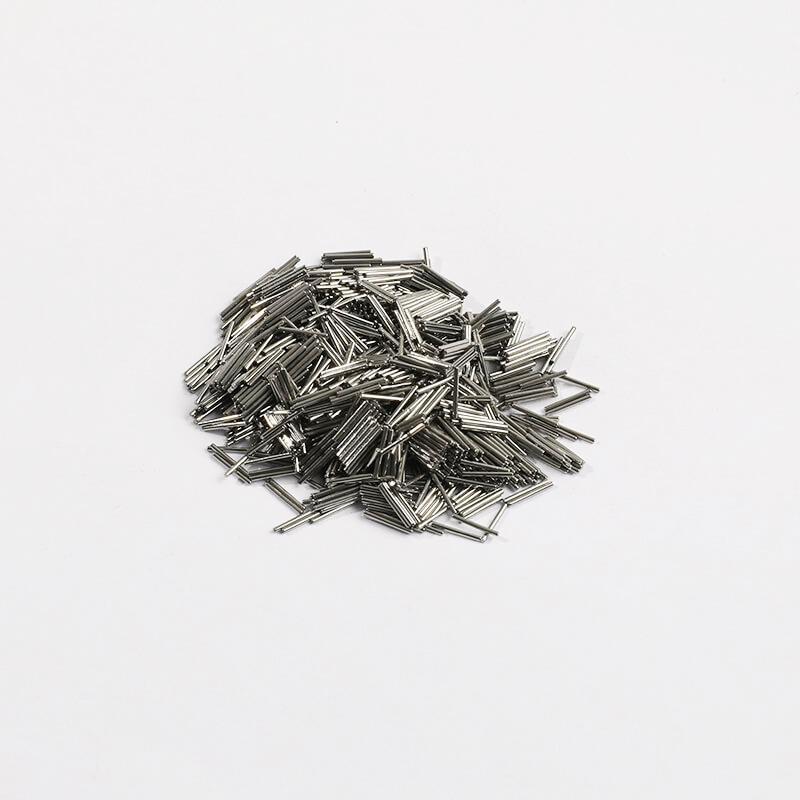
| Media | Best fit | Watch out for |
|---|---|---|
| Hardened steel media, balls and shaped shot | Bright burnishing of stainless and hardened steel, and the final wet lustre stage where a dense medium can peen a surface smooth. | Can transfer iron and rust to stainless, dents soft or thin parts, and must be kept in a dedicated charge away from ceramic media. |
| Plastic or polyester media | Gentle processing of aluminium, brass, copper and thin panels where metal smearing, nicks and distortion must be avoided. | Low density gives little contact force, so cycles run long and heavy grinding marks may survive; plastic also wears quickly and can float above the working mass. |
| Magnetic finishing pins and needles | Small precise parts with internal edges, cross holes, slots and fine detail that no tumbling medium of usable size can reach. | Limited by working envelope and part mass, removes very little material, and pins can embed in soft metals or remain in cavities if retrieval is not checked. |
| Small high-density ceramic spheres or ovals | Colour and pre-lustre stages where a uniform, soft-looking finish matters more than stock removal, including curved and contoured faces. | Very slow cut, easily lost through screens sized for larger media, and ineffective in deep recesses because it cannot reach or press against the surface. |
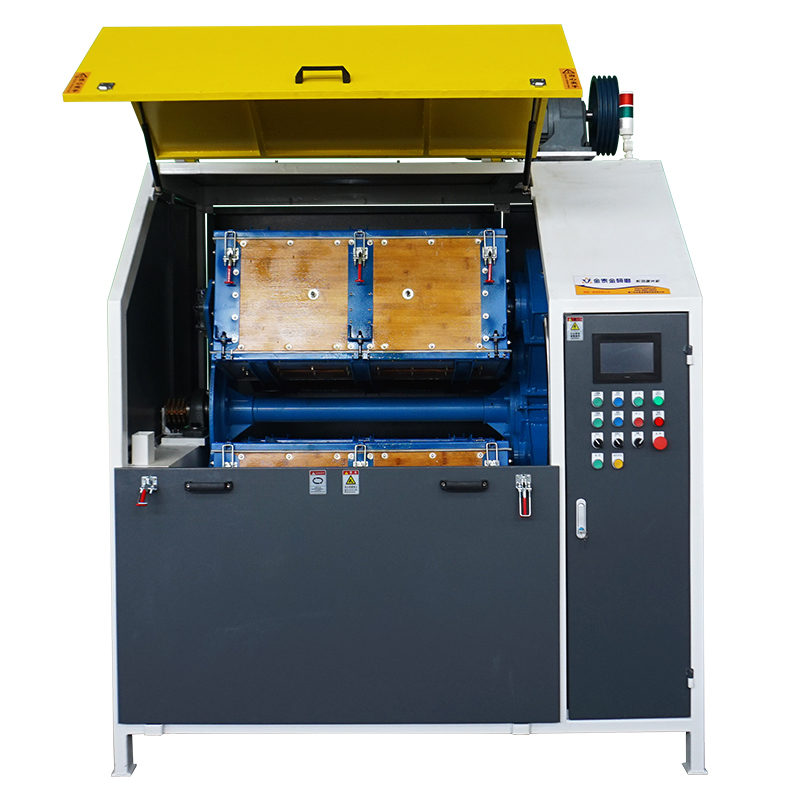
For housings, cover plates, brackets and frames that are rigid and mostly open, a vibratory bowl or tub gives the most forgiving cut-to-colour sequence. The charge moves as a mass, so there is no fixturing to design and no clamping marks, and cycle energy can be tuned through amplitude, media density and load ratio. The limit is reach: media cannot present abrasive uniformly into a pocket whose mouth is narrower than its base, and broad flat faces finish more slowly than edges because contact pressure there is lower. Part-on-part contact also leaves nicks on thin or sharply detailed features, so small, slender or intricate parts usually belong in a gentler route even when their surface requirement is identical.
| Machine route | Where it fits | What it will not do |
|---|---|---|
| Disc finishing machine | Fast, high-energy cut down on small to medium parts with simple geometry where cycle time matters and edge rounding is tolerable. | Part-on-part contact and wall pressure can chip or deform parts, and the difference between sufficient and excessive removal is narrow. |
| Barrel finishing machine / rotary barrel tumbler | Dense, uniform colour on small hardware that tolerates sliding contact, especially with steel media for a burnished appearance. | Nothing longer than the barrel diagonal can be processed, and slender parts can bend or nick against neighbours in the load. |
| Vibratory finishing machine (bowl or tub) | Cut-to-colour sequences on rigid, mostly open parts such as housings, covers, brackets and frames, with adjustable energy and no fixturing. | Cannot present media uniformly into pockets with narrow mouths or deep internal bores, and broad flat faces finish more slowly than edges. |
| Grinding finishing machine | The heavier stock-removal stage before a mirror sequence, cutting back grinding damage, scale and recast layers on robust parts. | High removal also rounds edges and can work harden or distort thin sections, so it needs a defined depth target and a sample check. |
A bright face can carry a ghost of every earlier stage. When a coarse grinding or cut pattern is not fully removed, the finer stages polish the crests and leave the valleys, producing visible lines or a woven crosshatch that reappears as the viewing angle changes. The causes are a stage that removed too little, a refinement step that reused a contaminated charge, or a crosshatch direction that was never rotated between steps. Each successive stage should run across the previous direction at a clear angle, so an operator can see when the earlier pattern is gone. Inspect by reflecting a light source at a shallow angle and rotating the part: a mark that vanishes at one angle and returns at another is still in the surface.
| Failure mode | Likely cause | How to catch it |
|---|---|---|
| Sleeks, fine unidirectional lines across a bright face | Contaminated charge or rinse, a metal particle trapped between media and part, or a polishing direction that was never rotated between successive stages. | Orient the light along and then across the lines, note where each family appears on the part, and inspect the charge and rinse screens for embedded foreign particles. |
| Embedded media particles or finishing pins in a soft surface | High contact pressure on aluminium, brass or copper, worn media with sharp fractured edges, or magnetic-finishing pins driven into a surface that cannot resist them. | Examine at magnification under raking light, wipe with a clean cloth and check for pulled particles, and consider a dye penetrant or etching check on a sample part. |
| Heat tint or discolouration concentrated near edges and thin sections | Friction at a dry or high-speed stage raising local temperature, poor cooling or compound flow, or a load that packs parts against each other with no media between them. | Compare colour against a master in consistent lighting, look for a gradient from edge inward, and check whether the tint follows load contact points or the whole face. |
| Ghost pattern of an earlier coarse stage showing through the final finish | A cut or refinement stage removed too little material, a later stage reused a contaminated charge, or the crosshatch direction was not changed between steps. | Reflect a light source at a shallow angle and rotate the part; a mark that disappears at one angle and returns at another is still in the surface rather than on it. |
Mississauga is one of the largest manufacturing and distribution municipalities in the Greater Toronto Area, and its economic development agency positions the city specifically around industrial supply chains: Invest Mississauga's leading-industries page invites businesses to "Join a growing community of globally connected businesses and robust supply chains in Mississauga", and it maintains a public economic development data centre for the city. The city's manufacturing base sits inside the Toronto region's food and beverage cluster, which the City of Toronto measures at more than 64,000 workers across the region with more than half of those jobs located inside the city of Toronto itself, leaving a substantial remainder in the surrounding 905 municipalities including Mississauga and Brampton. Mississauga also sits inside the automotive and advanced-manufacturing belt of southern Ontario, whose supply chains the federal government is actively supporting: FedDev Ontario announced a combined repayable investment of over CAD 12.5 million for Hamilton-area businesses alone as they "respond to tariff-related pressures, strengthen domestic supply chains, and position themselves for long-term growth".
For this brief the relevant part of that base is machinery: The same federal backgrounder documents Hamilton-area manufacturers of pressure equipment, hot-rolled steel bar, custom robotic welding systems, CNC machining and prefabricated steel buildings receiving investment to modernise plants and adopt advanced manufacturing technologies, which is the supply chain Mississauga's machinery and fabrication base sits in.
Mississauga's manufacturing mix of food and beverage processing, metal fabrication and automotive-tier parts creates three distinct finishing problems in one city: stainless process and packaging equipment where weld dressing and cleanable surfaces are required, sheet-metal and fabricated enclosures where a uniform finish on visible surfaces is part of the delivered product, and machined or stamped metal components where burrs interfere with assembly, sealing or coating adhesion. Because much of this work is high-mix and short-run, the practical constraint is changeover time and the cost of dedicating a finishing step to a small batch, which is what drives interest in flexible batch machines rather than large dedicated lines.
A Mississauga buyer should settle the batch-size and changeover question before choosing equipment, because a high-mix fabricator or food-equipment builder will lose more money to media changeover and cleaning between jobs than to slow cycle times within a job. The second question is whether the finishing step is there to protect a downstream process — coating adhesion, sealing, or a customer's burr limit on an automotive drawing — in which case the acceptance criterion and the inspection method need to be agreed in writing before the machine is specified.
Freight context: Toronto Pearson International Airport (immediately adjacent to Mississauga), CN and CPKC intermodal terminals in the Greater Toronto Area, Port of Toronto (inland marine gateway), Greater Toronto Area 400-series highway freight network. Mississauga's principal logistics advantage is its position directly beside Toronto Pearson International Airport, which makes air freight of sample parts, media and urgent spares practical, combined with dense rail intermodal and highway freight capacity across the GTA. Machines arriving from Asia would normally land at a coastal container port and be railed or trucked into the GTA, with the Port of Toronto providing an inland marine option for bulk and project cargo.
Canada is a bilingual market for selling purposes: English is the working language of procurement outside Quebec, while Quebec buyers (Montreal, Quebec City) normally expect French-language quotations, technical documentation and after-sales support, and Quebec's Charter of the French Language makes French the default for commercial documentation in the province. Procurement expectations are formal and auditable: a Canadian industrial buyer will typically ask for the tariff classification and country of origin up front, expect a commercial invoice that satisfies the CBSA invoice requirements, and expect the seller to provide proof of origin for any preferential claim. Payment norms are bank-to-bank, with wire transfer or letter of credit rather than platform payment, and Canadian buyers commonly net-30 to net-60 from invoice, so a cross-border seller should price the working-capital gap into the offer. Certificates of origin for export documentation are issued through chambers of commerce, which is why chambers such as the Hamilton Chamber of Commerce and the Winnipeg Chamber of Commerce offer document certification. The current trade environment adds policy risk to landed cost: Canadian federal programs are explicitly framed around responding to U.S. tariffs, with the FedDev Ontario Regional Tariff Response Initiative described as supporting "businesses to respond to tariff pressures" in southern Ontario, and tariff and surtax measures can change by Order in Council, so quotations should state the tariff basis and the date on which the landed-cost calculation was made.
Canada's national standards system is coordinated by the Standards Council of Canada (SCC), which accredits standards-development organizations, certification bodies and testing laboratories; the SCC and CSA Group websites could not be retrieved for citation during this research, so this entry rests on the accessible Government of Canada and CCOHS material below. The Canadian Centre for Occupational Health and Safety describes standards as documents that "establish specifications and procedures to ensure the reliability of the products, methods, and services people use every day on the job", and Innovation, Science and Economic Development Canada (ISED) maintains the federal entry point for "[t]he different types of standards and certifying bodies that can be used by your business". In practice a Canadian buyer of finishing equipment references (a) the Canadian electrical safety certification of the machine and its control panel, (b) provincial occupational health and safety regulation for machine guarding, lockout and dust/ventilation control, which in Canada is enforced by the provinces rather than by a single federal inspectorate, and (c) the buyer's own customer-specific surface finish, edge-condition and cleanliness specifications, which are contractual rather than national standards. Finishing-process standards in the ISO 25.080 machine-tool and ISO 8500-series surface-preparation families are the usual technical reference points, but product-level standards sold by CSA Group were not retrievable for verification here.
SurfacePolish supplies from Xiamen, China. The buyer's own destination rules, conformity marking, tariff classification and documentation responsibilities stay with the buyer; confirm them against the authorities named above before ordering.
Cosmetic acceptance is only half a disposition. Measure the dimensions and flatness that assembly depends on, gauge or thread-check features that media could enter or round, and run the functional check the part actually needs, whether that is seal condition, bearing fit, sliding contact, flow or leak. Cleanliness needs its own verification rather than an assumption: flush blind holes and passage intersections, borescope them at an agreed angle, and examine what the flush carries out. Wipe a defined area with a clean white cloth and record what appears, since compound residue and iron pickup often show only after drying. Confirm cleanliness after drying, not before, and record the method so the next batch is judged on the same basis.
Scaling up changes the charge faster than it changes the machine. Media wears, so the working size distribution drifts and a charge that cut well in a trial may burnish instead after a few hundred hours; screen and top up on a schedule, and record charge age with each batch. Compound dose should be metered against flow and checked, not assumed. Keep the load ratio inside the range the trial established, weigh or count parts rather than eyeballing the load, and separate material families so stainless does not pick up iron from carbon steel. Verify the rinse and dry stages as carefully as the finishing stage, because residue tolerated in small trial batches often becomes a visible film at production volume.
Sometimes, but geometry decides. Media has to sit against the surface and move along it, so recesses with narrow mouths, deep bores, broad flat faces and internal corners may finish unevenly or not at all. A mass-finishing route can still deliver an excellent result on open faces while internal detail reaches a lower, more uniform standard, and it is often sensible to define the requirement per face. Where a small internal edge is the visible feature, a magnetic finishing step or a controlled hand operation may be the only practical route; where a part is too heavy or too long for the envelope, none of it applies.
The pits were in the casting before polishing. Bright finishing compresses the surface into a narrow reflected image, so gas porosity, shrinkage voids and non-metallic inclusions become far more visible once the surrounding metal is smooth, and additional fine polishing only makes them clearer. The options are to move the requirement to a satin or blasted finish that tolerates the surface, change the casting route or the location of the visible face, or accept a written level of visible pits. A trial can show how current castings respond; it cannot remove a defect below the surface.
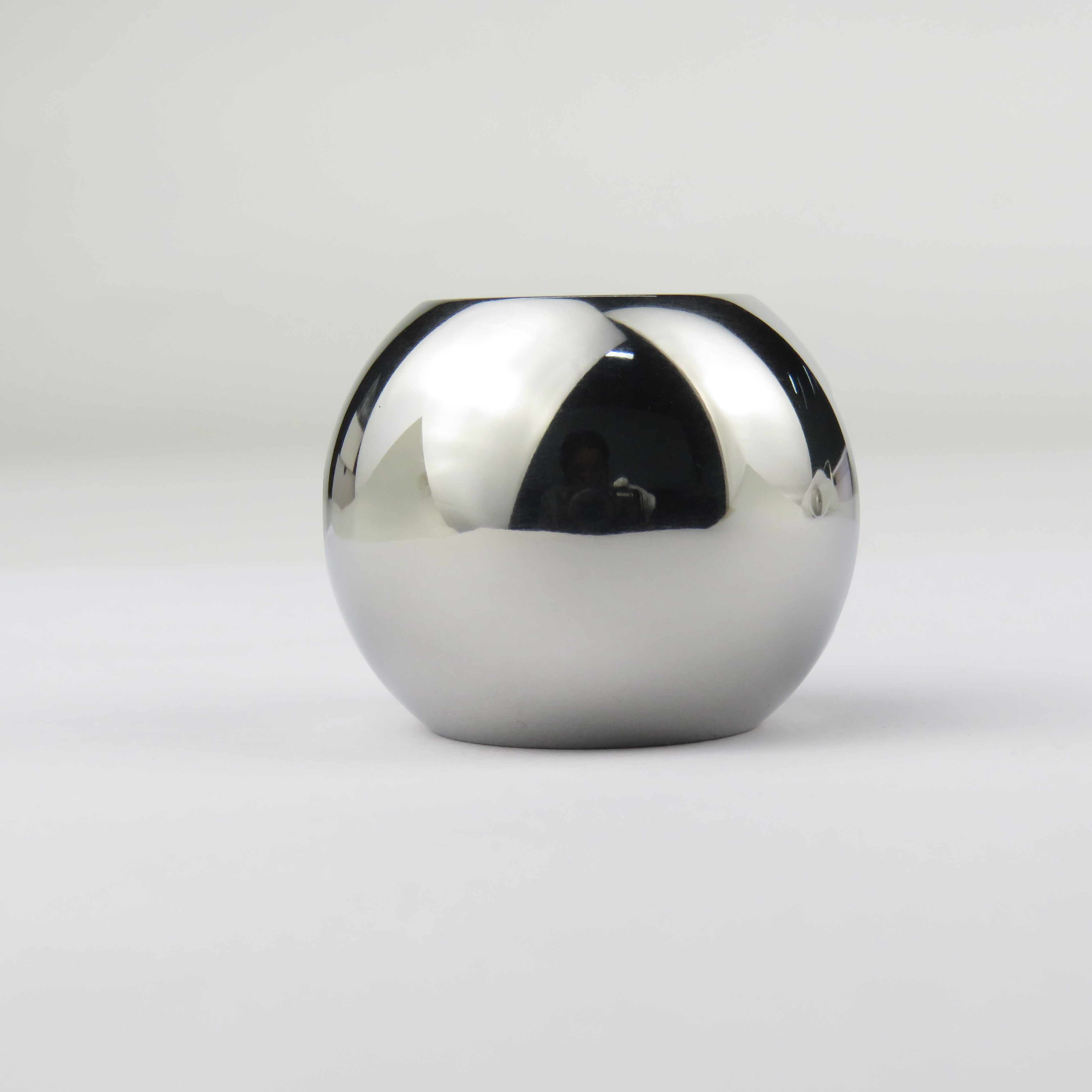
Orange peel is a wave in the surface, produced when metal is deformed rather than cut, usually on softer alloys, on work-hardened layers, or when a heavy cut stage is followed by too little refinement. It shows as a distorted reflected line when you view a straight edge in the face. Polishing with finer media does not remove it, because the wave extends below the depth a fine stage can reach; the sequence has to return to a cutting stage and then refine properly. If the wave comes from the incoming material or a forming operation, it may not be removable at all.
Use Mississauga, Canada as the destination on the enquiry and state whether the deliverable is equipment, media and compound, a representative sample review or a line concept. A destination does not imply local stock, a local service point or a local delivery time.
A Mississauga buyer references Canadian electrical safety certification of the equipment, Ontario occupational health and safety requirements for guarding and lockout, and — for food and beverage customers — the food-safety expectations that apply to product-contact surfaces and cleaning procedures. Automotive-tier customers add their own drawing-level specifications for burr limits, edge condition and surface roughness.
Sources were retrieved on 2026-09-29 and describe the local industrial and trade context only. They do not evidence any SurfacePolish project, shipment, installation or service in Mississauga.
The buyer needs a bright shaft without bowing it in the charge and without losing roundness or the bearing seat fit.
Send the material, dimensions, approximate weight, batch quantity, the incoming condition and photographs of the difficult features. Mark which features must not be contacted by media and state how the result will be inspected. This form carries source reference PSEO-0159; quote it if you prefer an additional manual reference.
Open the SurfacePolish enquiry form Email a prepared enquiry
No price, lead time, certification or result is promised here. Confirm whether a sample trial is available for the specific part and what the trial can and cannot show.
Page PSEO-0159 · revised 2026-09-29 · cross-border equipment, media and scoped sample review. City context is sourced and cited above.
Use this local checker to identify missing part and inspection information. It prepares a technical-review brief; it does not approve a machine, process recipe or production result.
Complete the part details to prepare a review brief.
Email : info@surface-polish.com


 IPv6 network supported


 +86-592-2381506