In Vancouver, Canada, an industrial machinery buyer needs a hardened die insert brought to a bright cavity finish without rounding the parting-line edges or disturbing the shut-off face. SurfacePolish is a cross-border supplier of finishing machines, media and compounds, and its free sample trial returns the tested parts with observations and a proposed media, compound and cycle direction for the buyer's own evaluation. This brief is written for a buyer in Vancouver working on industrial machinery; it describes equipment, media and a scoped sample review, not a local polishing service.
Can available media actually reach the geometry, and what finish is realistic in the recesses and internal features it cannot reach?
Which faces must reach a mirror and which only need to be clean and uniform, and how is each one judged?
How much stock may the sequence remove before datums, seal faces, flatness or edge form fall outside their allowance?
The as-received surface records what earlier operations did, and its deepest damage sets the stock-removal budget. A face ground with a coarse wheel carries scratches far deeper than the visible line, an EDM surface carries a recast layer that must be cut back, and a part previously plated, painted or repaired by welding hides interfaces that respond differently to the same media. Assess scratch depth on a witness coupon or a sacrificial area, then compare it with the total removal the sequence can afford before dimensions or edge form are lost. A part that was brightened once and then re-machined can also carry a ghost pattern of the earlier finish. Reading this before quoting avoids a disappointing trial result that is really a substrate problem.
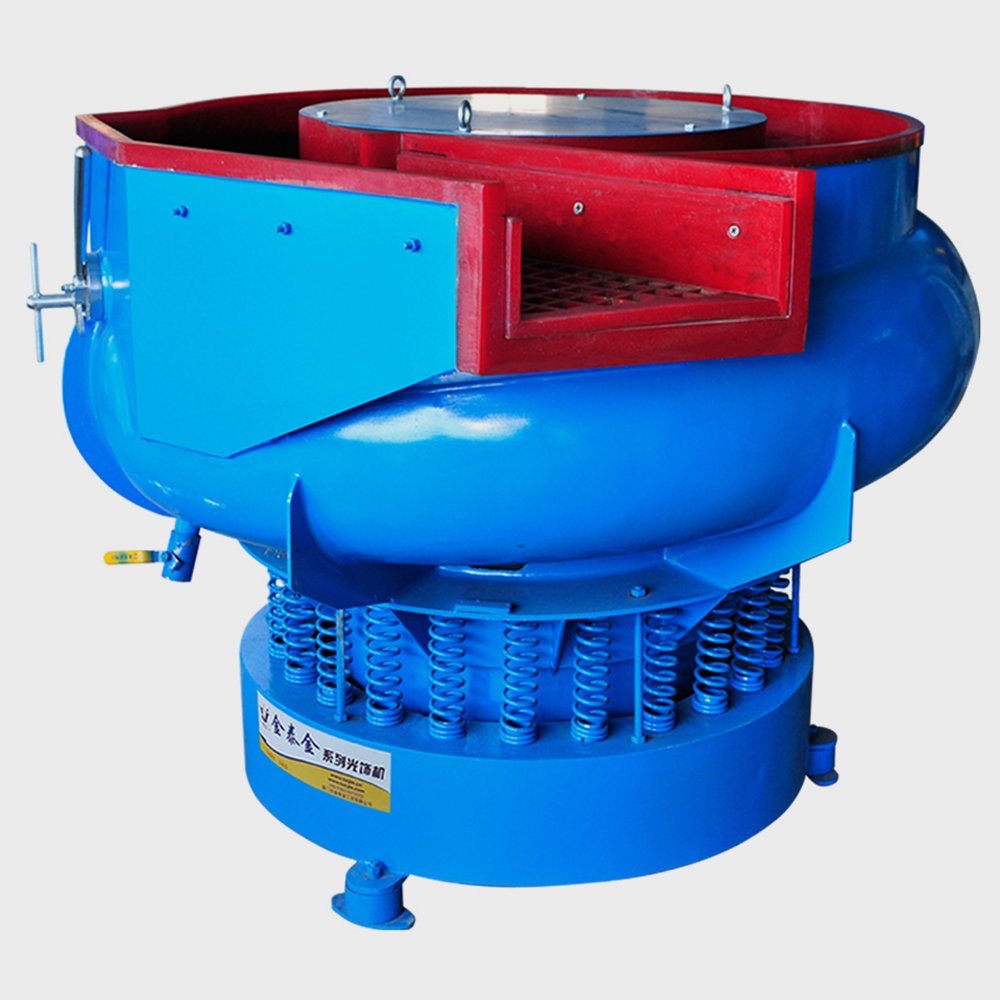
When a part must lose a measurable amount of stock before colour stages, disc finishing and centrifugal barrel machines deliver far more energy than a conventional vibrator. That energy shortens the cut stage but also rounds edges, work hardens soft alloys and can distort thin sections. Load the parts so they cannot jam against the disc wall, and bracket cycle time tightly, because the difference between enough removal and too much is small. Centrifugal barrels suit small to medium parts with simple geometry. Neither route removes the need for refinement: the surface they leave still needs finer media and a polishing compound before a reflected image becomes coherent, and the depth achieved has to be verified on a sample rather than assumed from a setting.
| Machine route | Where it fits | What it will not do |
|---|---|---|
| Tub vibrator | Long and large parts such as shafts, extrusions and frame members that cannot be folded into a barrel, including external grooves. | Poor at bores running parallel to the long axis, and slender parts still need support or balanced loading to hold straightness. |
| Magnetic finishing machine | Refinement and edge conditioning of small precise parts with internal edges, cross holes and fine detail that media cannot enter. | Working envelope and part mass restrict size, removal is very small, and coverage falls off wherever the field cannot drive the pins. |
| Disc finishing machine | Fast, high-energy cut down on small to medium parts with simple geometry where cycle time matters and edge rounding is tolerable. | Part-on-part contact and wall pressure can chip or deform parts, and the difference between sufficient and excessive removal is narrow. |
| Barrel finishing machine / rotary barrel tumbler | Dense, uniform colour on small hardware that tolerates sliding contact, especially with steel media for a burnished appearance. | Nothing longer than the barrel diagonal can be processed, and slender parts can bend or nick against neighbours in the load. |
Compound does more than lubricate: it carries abrasive, controls pH, keeps fines in suspension, prevents rust and determines how cleanly a part leaves the machine. Cutting stages usually run a more aggressive abrasive-bearing compound, while colour and lustre stages run a cleaner, higher-lubricity product with little or no abrasive so the surface is refined rather than scratched. pH matters by material family, since strongly alkaline compounds attack aluminium and acidic conditions can stain some steels, so match the family to the alloy and rinse promptly. Foam control matters too, because a foaming charge cushions contact and slows cutting unpredictably. Treat the compound specification and dose as part of the process recipe rather than as a consumable line item.
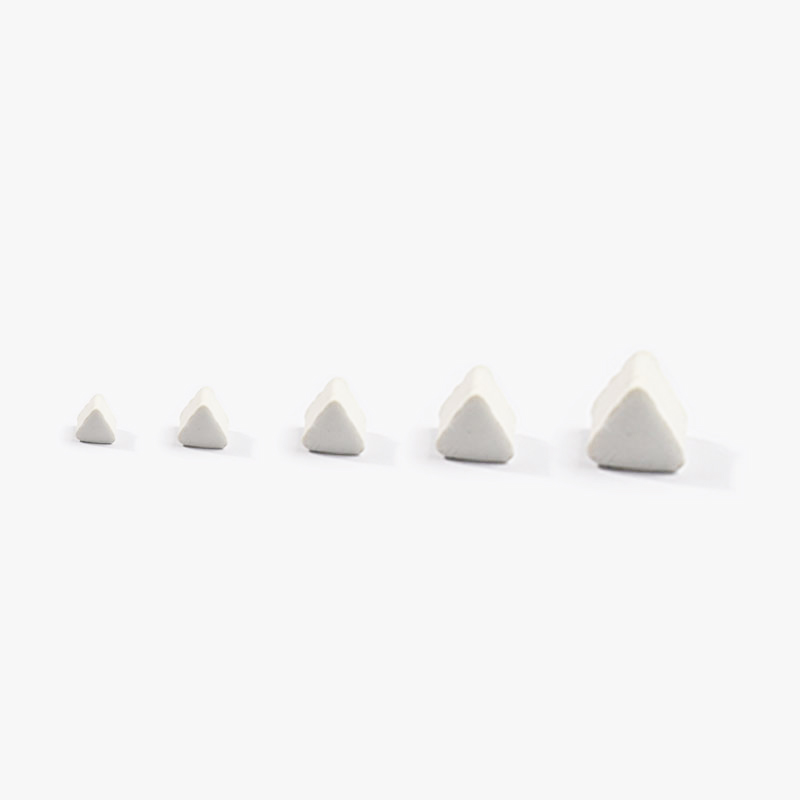
| Media | Best fit | Watch out for |
|---|---|---|
| Coarse ceramic angle-cut cylinders or triangles | First cut stage on rigid parts with open faces, removing grinding or machining damage on cast iron, steel and stainless before refinement. | Leaves a deep pattern the next stage must fully erase, chips thin edges, and its wear debris carries fine abrasive into later stages if the charge is not screened. |
| Medium ceramic triangles or angle-cut shapes | Blending, edge conditioning and the refinement step that removes the coarse cut pattern on housings, brackets, covers and frames. | Media that cannot enter a slot or recess leaves those areas at a different finish, so those faces need a separate operation or a stated lower standard. |
| Plastic or polyester media | Gentle processing of aluminium, brass, copper and thin panels where metal smearing, nicks and distortion must be avoided. | Low density gives little contact force, so cycles run long and heavy grinding marks may survive; plastic also wears quickly and can float above the working mass. |
| Dry media - walnut shell | Dry polishing, light deburring and lubricity on parts where a residual oil film is acceptable, and drying or lustre steps after wet processing. | Not a stock-removal medium, generates dust that needs extraction, and can leave an oily film that interferes with a later cleaning or coating requirement. |
Two of the most expensive defects are invisible in a reflected image. Media lodges in blind holes, slots, undercuts and threaded features, and it can survive rinsing, drying and even assembly, while the small pins used in magnetic finishing can embed in soft surfaces. At the same time, long cycles quietly round edges past their limit and remove material from datums, seals and bearing seats, so a part passes a visual check and fails a fit check. Control both with geometry rather than appearance: reconcile a counted charge, borescope or pin gauge every cavity, measure edge radii and critical dimensions against incoming values, and set a maximum cycle time that the edge and dimensional allowances actually support.
| Failure mode | Likely cause | How to catch it |
|---|---|---|
| Orange peel, a slow wave that distorts the reflected image | Soft or work-hardened surface deformed rather than cut, a heavy cut stage followed by too little refinement, or a dry or buffing stage at high speed with excess pressure. | Reflect a straight edge or fluorescent tube in the face at a shallow angle, compare the shape of the image against a physical master in the same lighting, and repeat at several viewing angles. |
| Compound residue film, water spots or a dull bloom after drying | Incomplete rinsing, hard or contaminated rinse water, a dose above target, or drying that leaves a cavity to bleed residue onto the finished face. | Wipe a defined area with a clean white cloth after drying, inspect cavities for bleed-out, and check rinse water hardness or conductivity at the point of use. |
| Heat tint or discolouration concentrated near edges and thin sections | Friction at a dry or high-speed stage raising local temperature, poor cooling or compound flow, or a load that packs parts against each other with no media between them. | Compare colour against a master in consistent lighting, look for a gradient from edge inward, and check whether the tint follows load contact points or the whole face. |
| Embedded media particles or finishing pins in a soft surface | High contact pressure on aluminium, brass or copper, worn media with sharp fractured edges, or magnetic-finishing pins driven into a surface that cannot resist them. | Examine at magnification under raking light, wipe with a clean cloth and check for pulled particles, and consider a dye penetrant or etching check on a sample part. |
Vancouver's industrial base is small in land area and high in value, and local business organisations treat industrial land supply itself as the binding constraint on manufacturing. The Greater Vancouver Board of Trade reports that from 2019 to 2023, over 5 million square feet of industrial investment were diverted to Calgary from Metro Vancouver because of limited land supply and regulatory barriers, and estimates that expanding industrial land supply by one per cent could support 126,100 new jobs and add CAD 12.2 billion to provincial GDP. The sectors that remain are tied to the port and to food processing: the Board of Trade frames its industrial-land campaign explicitly around unlocking "B.C.'s manufacturing and agri-food sectors" and maximising trade through the ports, and it notes that the region is home to Canada's largest and most diversified port. West of the city, the west coast gateway is rail- and container-intensive: Western Canada has 16,000 track miles of rail, employs 270,000-plus people in the transportation sector, and member ports import 2.4 million container TEUs annually, which is the infrastructure that bulk and project freight into the region depends on.
The nearest part of that base to this brief is energy: The western Canadian transportation and supply chain association documents the scale of the gateway that serves the region, with CAD 247 billion of goods exported from Western Canada and 270,000-plus Canadians employed in the transportation sector, which is the freight and resource-export base the port complex serves.
Metro Vancouver's manufacturing is squeezed onto scarce industrial land, so equipment that fits a compact footprint and reduces rework is a direct way to protect throughput on an expensive site. The food-processing and agri-food base in the Fraser Valley runs stainless process equipment and packaging machinery where weld dressing, edge break and controlled surface roughness on product-contact surfaces are recurring requirements, and the port and rail gateway supports a machinery-repair and heavy-equipment service sector where hydraulic and structural steel components are reworked and returned to service. Deburring and surface conditioning in this market is therefore more about stainless process hardware and repair-and-overhaul components than about high-volume mass finishing.
A Vancouver buyer should settle the footprint-and-utilities question first, because industrial floor space is the scarcest input in Metro Vancouver: machine size, foundation, water supply, effluent handling and ventilation should be priced against the cost of the space they consume, not treated as line items after the equipment decision. The second question is whether the finish requirement is come-from the product-contact stainless side of the business, in which case cleaning and passivation matter more than Ra targets, or from a repair-and-overhaul customer with a written surface specification.
Freight context: Port of Vancouver (Vancouver Fraser Port Authority), Vancouver International Airport (YVR), Surrey and Vancouver intermodal rail yards, Canadian Pacific Kansas City and CN mainlines. Vancouver is Canada's Pacific gateway, and the western transportation forum records member ports importing 2.4 million container TEUs annually on a base of 16,000 track miles of rail across Western Canada. That makes the region the natural first point of entry for equipment coming from Asia, with onward movement by rail or truck; sample parts and media can be airfreighted through YVR. Port authority pages were not retrievable for direct citation during this research, so the gateway figures here come from the western Canadian transportation association and the regional board of trade.
Canada's national standards system is coordinated by the Standards Council of Canada (SCC), which accredits standards-development organizations, certification bodies and testing laboratories; the SCC and CSA Group websites could not be retrieved for citation during this research, so this entry rests on the accessible Government of Canada and CCOHS material below. The Canadian Centre for Occupational Health and Safety describes standards as documents that "establish specifications and procedures to ensure the reliability of the products, methods, and services people use every day on the job", and Innovation, Science and Economic Development Canada (ISED) maintains the federal entry point for "[t]he different types of standards and certifying bodies that can be used by your business". In practice a Canadian buyer of finishing equipment references (a) the Canadian electrical safety certification of the machine and its control panel, (b) provincial occupational health and safety regulation for machine guarding, lockout and dust/ventilation control, which in Canada is enforced by the provinces rather than by a single federal inspectorate, and (c) the buyer's own customer-specific surface finish, edge-condition and cleanliness specifications, which are contractual rather than national standards. Finishing-process standards in the ISO 25.080 machine-tool and ISO 8500-series surface-preparation families are the usual technical reference points, but product-level standards sold by CSA Group were not retrievable for verification here.
China is one of Canada's ten principal merchandise trading partners and the second-largest single-country source of Canadian imports after the United States: Statistics Canada reported CAD 5,369 million of balance-of-payments imports from China in January 2025, against a CAD 2,299 million bilateral merchandise deficit that month. Canada has no free trade agreement with China, so Chinese-origin industrial machinery enters under the Most-Favoured-Nation (MFN) tariff column of the Canadian Customs Tariff; the preferential treatments listed in the tariff (CUSMA/UST and MXT, CETA/CEUT, CPTPP/CPTPT, UKT, KRT and others) do not include China, and preferential rates require proof of origin plus the applicable shipping rules, so a China-origin machine cannot claim them. Tariff classification is mandatory work, not a formality: vibratory, barrel, centrifugal and disc finishing machines are classified in Chapter 84 ("Nuclear reactors, boilers, machinery and mechanical appliances; parts thereof") according to the function of the machine, and the ten-digit Canadian tariff item drives both the duty rate and the statistics. A further landed-cost risk sits outside the tariff schedule: under the Special Import Measures Act (SIMA), the CBSA and the Canadian International Trade Tribunal may apply anti-dumping and countervailing duties to named goods, so a buyer should check the measures-in-force list for the specific product before assuming the MFN rate is the final duty.
SurfacePolish supplies from Xiamen, China. The buyer's own destination rules, conformity marking, tariff classification and documentation responsibilities stay with the buyer; confirm them against the authorities named above before ordering.
A roughness number without its setup is not a specification. Decide the cutoff length, filter, evaluation length, number of traces and their direction relative to the preceding polish direction, then keep every one of those settings unchanged between the incoming survey and the final inspection. Curved and narrow faces need a fixture or a witness coupon processed in the same charge, because a stylus cannot follow a small radius reliably and a hand-held trace on a curved surface is not comparable. Where a face is critical, mark the exact measurement positions on the drawing or with a permanent label and record them. Optical instruments avoid stylus damage on soft polished surfaces but see a different frequency band than a contact profilometer, so do not mix instrument types within one comparison.
Scaling up changes the charge faster than it changes the machine. Media wears, so the working size distribution drifts and a charge that cut well in a trial may burnish instead after a few hundred hours; screen and top up on a schedule, and record charge age with each batch. Compound dose should be metered against flow and checked, not assumed. Keep the load ratio inside the range the trial established, weigh or count parts rather than eyeballing the load, and separate material families so stainless does not pick up iron from carbon steel. Verify the rinse and dry stages as carefully as the finishing stage, because residue tolerated in small trial batches often becomes a visible film at production volume.
No to both. SurfacePolish is a cross-border supplier of finishing machines, media and compounds, and it does not supply or perform electropolishing or operate a plant, branch, dealer or technician service in Canada or any other market. What is offered is equipment and consumables, a scoped discussion of a finishing line concept, and a free sample trial in which representative parts are shipped to Xiamen and returned with observations and a proposed process direction. Where an electrochemical finish is under consideration, the discussion stays a comparison with a mechanical route.
Design the charge around the smallest opening rather than the average part. Use media clearly smaller than the hole, or mask and plug the features before the cycle, count the media into and out of the load as a reconciliation, and add a retrieval step with a defined check such as a borescope or pin gauge. For Canada buyers sending parts for a trial, include the part with the tightest feature so the media class is chosen against real geometry. The small pins used in magnetic finishing embed easily in soft metal, so those features need extra inspection.
Rounding depends on the energy and duration of the sequence and on how exposed the edge is. A light refinement pass may barely touch it, while a long cut stage on a soft alloy can visibly round it. Mark the edges that must stay crisp, state a maximum radius or a no-touch zone before media is selected, and measure with a radius gauge, an optical comparator or a cast impression against the incoming form. Where a bright face and a crisp edge conflict, the practical order is to finish the face and then restore or protect the edge rather than to keep polishing.
Use Vancouver, Canada as the destination on the enquiry and state whether the deliverable is equipment, media and compound, a representative sample review or a line concept. A destination does not imply local stock, a local service point or a local delivery time.
A Vancouver buyer references Canadian electrical safety certification, WorkSafeBC requirements for machine guarding and safeguarding, and — where the plant handles food or beverages — the federal and provincial food-safety regime that governs product-contact surfaces and cleaning. Where the finishing step serves a marine or heavy-equipment customer, the acceptance criteria normally come from that customer's repair specification rather than from a national finishing standard.
Sources were retrieved on 2026-09-29 and describe the local industrial and trade context only. They do not evidence any SurfacePolish project, shipment, installation or service in Vancouver.
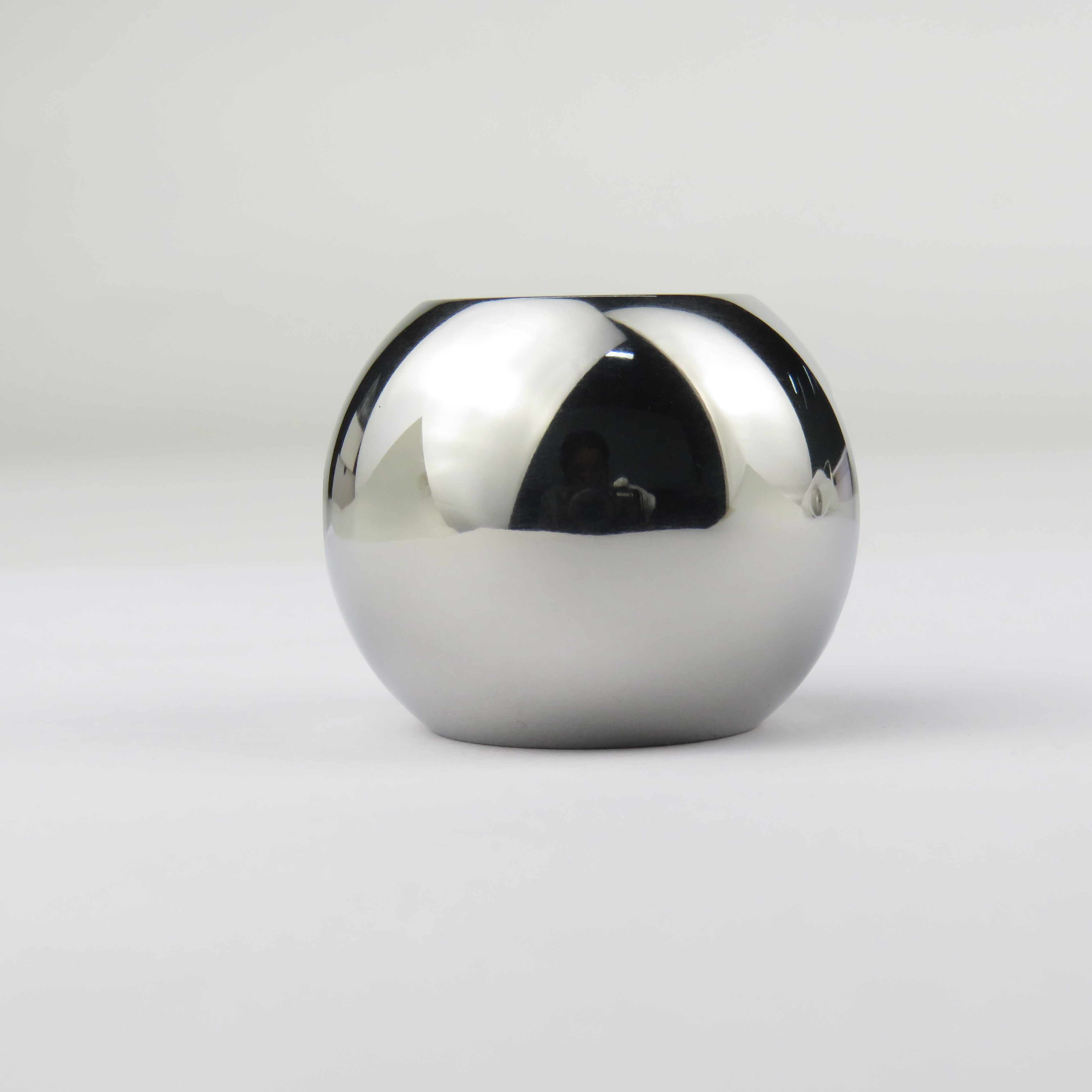
The buyer wants a mirror-like cavity wall for release behaviour but cannot lose the sharp parting-line edges or the shut-off face height.
Send the material, dimensions, approximate weight, batch quantity, the incoming condition and photographs of the difficult features. Mark which features must not be contacted by media and state how the result will be inspected. This form carries source reference PSEO-0129; quote it if you prefer an additional manual reference.
Open the SurfacePolish enquiry form Email a prepared enquiry
No price, lead time, certification or result is promised here. Confirm whether a sample trial is available for the specific part and what the trial can and cannot show.
Page PSEO-0129 · revised 2026-09-29 · cross-border equipment, media and scoped sample review. City context is sourced and cited above.
Use this local checker to identify missing part and inspection information. It prepares a technical-review brief; it does not approve a machine, process recipe or production result.
Complete the part details to prepare a review brief.
Email : info@surface-polish.com


 IPv6 network supported


 +86-592-2381506