A buyer in Arnhem, Netherlands in energy equipment has a grey cast iron compressor casing where the machined bore edges and drilled oil gallery entries need deburring despite graphite smearing and cast-iron dust. SurfacePolish supplies finishing machines, media and compounds across borders, and a free sample trial returns representative parts from Xiamen with an observation record and a proposed media, compound and cycle direction. This brief is written for a buyer in Arnhem working on energy equipment; it describes equipment, media and a scoped sample review, not a local polishing service.
Which material families and heat-treatment states share the equipment, and what separation is needed to avoid ferrous or graphite carry-over onto stainless parts?
Does the drawing state an edge break or an edge round at each controlled edge, and what maximum radius applies where over-rounding is the risk?
What must the part be clean of, and what method and limit does the buyer use to verify cleanliness before assembly, welding, coating or a leak test?
Deburring specifications fail more often on the incoming condition than on the finishing parameters. Two machining suppliers can deliver the same part number with visibly different burr height, edge sharpness, tool marks and trapped chips, because feed, tool wear and coolant strategy differ. A cycle that clears one supplier's burr may leave the other's root attached. Before writing any requirement, record what arrives: where the burrs sit, how tall they are, how sharp the edges are, the roughness at named points and the mass of the part. Keep one as-received reject in the sample set so the route is tested against the worst credible input rather than an average one. When the requirement is written, state the starting condition it assumes.
Match media hardness and density to the workpiece, not to the finish someone wants to see. A heavy-cut ceramic cuts carbon and stainless steel edges and also cuts them quickly, which is useful for a thick Poisson burr on a flange and risky on a soft aluminium housing where the same charge peens and smears the surface. Plastic media gives up cut rate to stay gentle on soft alloys and thin sections, and steel media changes the mechanism: instead of cutting, it burnishes and can work-harden a surface. Alumina-bearing or grinding media sit at the aggressive end and suit robust, hard parts with generous edge limits. The decision is a three-way match between part hardness, burr root thickness and the tightest edge allowance. Where a hard body carries a delicate machined land, two stages beat one harder charge.
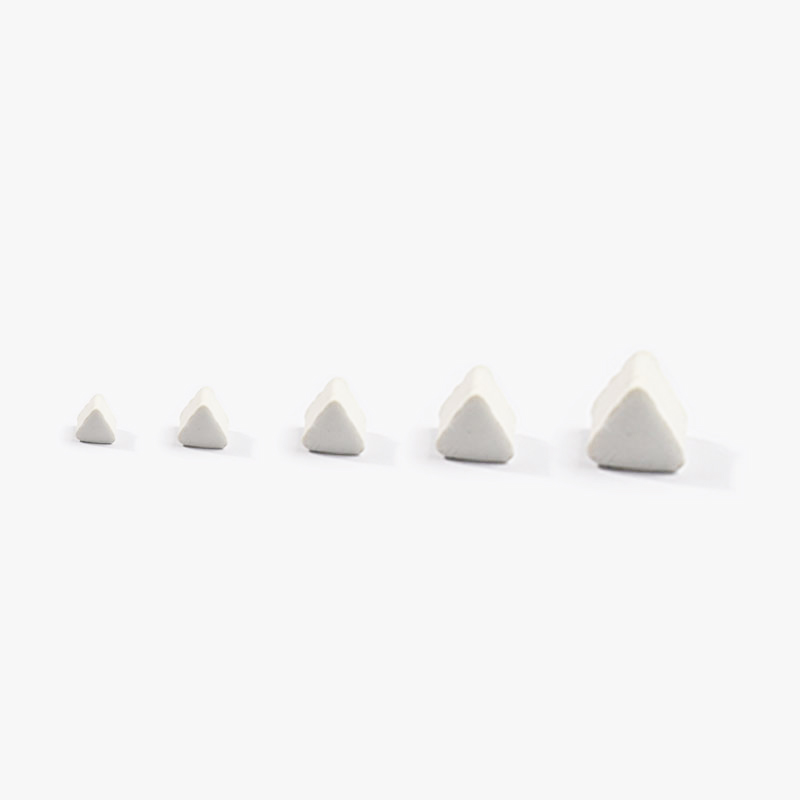
| Media | Best fit | Watch out for |
|---|---|---|
| Alumina-bearing grinding media in a dense ceramic bond | Heavy stock removal and consistent cutting on hard or work-hardened parts with generous edge limits, such as robust flanges and heavy fittings | High removal energy rounds functional edges quickly and is a poor match for thin plates, thin-wall castings and lapped sealing faces |
| Hardened steel media, balls and pins | Burnishing and bright finishing of stainless and hardened parts, and light edge consolidation where a cutting action is not wanted | Changes the surface by deformation rather than cutting, can work-harden or smear a soft surface, and needs corrosion protection and separation from acidic compounds |
| Fine ceramic spheres or small porcelain shapes in a light size class | Refinement and edge blending after a cutting stage, and light deburring of small fittings, thread entries and tighter external geometry | Small sizes enter and retain in fine passages and cross-drillings, and the charge changes size and cut rate as it wears |
| Heavy-cut ceramic, angle-cut triangles in a coarse size class | Removing a substantial or thick burr root from open external edges, flange corners, cast bosses and large tapped entries on steel and stainless parts | Cuts controlled edges and gasket lands as readily as burrs, leaves a coarse surface, and lodges in slots whose width approaches the media section |
Every mass-finishing route is also a contact problem. Parts touch each other, the machine wall and any fixture, and each contact is a chance to mark, peen or bend a finished face. Compartmenting a charge, racking parts individually or running a smaller load with more media between parts changes the contact pattern, and it changes throughput in the same move. Where a machined gasket land, a ground spigot or a lapped sealing face must arrive unmarked, decide which faces are allowed to bear contact and design the load around that. A fixture can hold a part out of the mass, but it also shields the area behind it, so the shielded zone has to be finished another way or left as-machined. Record the contact plan with the load.
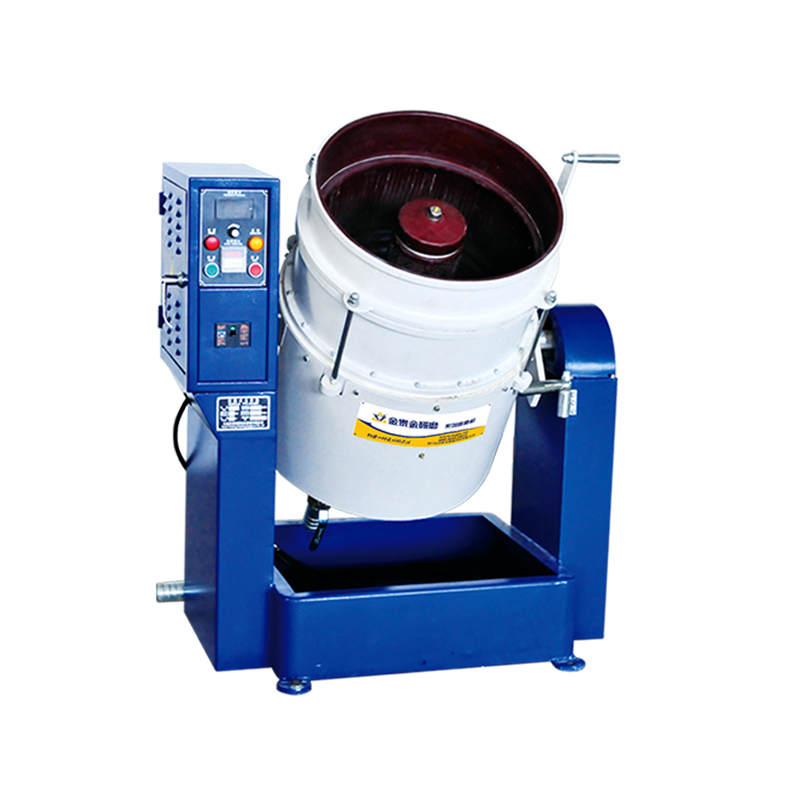
| Machine route | Where it fits | What it will not do |
|---|---|---|
| Disc finishing machine | Fast, high-energy cycles on small to medium robust parts, including batches of fittings and small housings that need a quick cut | High contact pressure rounds edges quickly and can mark or deform thin and soft parts, with results sensitive to load and disc condition |
| Grinding finishing machine | Heavier stock removal and thick burr roots on robust parts where clearing material in a shorter cycle matters more than the surface result | Aggressive edge rounding and a coarser surface, so it fits lapped seats, thin sections and tight edge bands poorly |
| Tub vibrator | Long parts such as manifold rails, shafts, long housings and stacked plate sets that cannot tumble in a bowl, with support or rotation along their length | Lower energy per unit area so heavy burrs take longer, and the tub needs floor space plus a defined part support method |
| Centrifugal barrel finishing machine | Short high-pressure cycles on small precision parts such as spools, sleeves, small valve bodies and drilled fittings | Rounds edges and can distort thin unsupported sections quickly, and needs balanced barrel loading, controlled stop time and careful fixturing |
Media lodging is a geometry and media-condition problem, and it concentrates at intersections. A cross-drilling breaking into a bore, a blind tapped hole, a keyway, a snap-ring groove and a slot whose width approaches the medium section are all traps. The usual causes are a size class chosen against an average feature rather than the smallest one, a charge that has fractured into smaller pieces, and a secondary burr or fold that closes part of the opening while the part is running. Retrieval often costs more than the deburring itself, especially where the trap is inside a body that cannot be opened. Plan detection before the run: which passages are borescoped at an agreed angle, which holes are pin gauged, how a flush through a filter is collected, and how the part mass is compared.
| Failure mode | Likely cause | How to catch it |
|---|---|---|
| Controlled edge rounded past the drawing limit, or an edge left sharper than the specified break | Cycle too long or energy too high for the edge allowance, dense or coarse media, an unmasked functional edge, or a drawing requirement that never stated a maximum radius | Measure a defined edge feature before and after with a radius gauge, optical comparator or moulded replica, compare against the maximum on the drawing, and check the same feature on parts from different positions in the load |
| Loss of flatness or a dimensional shift on thin plates, thin walls and long unsupported sections | Part-on-part impacts and fixture pressure in a high-energy route, too high a load ratio, or insufficient support along a slender part | Check flatness on a surface plate or a coordinate measuring machine at marked points before and after finishing, and check the same points across parts from different load positions |
| Tenacious compound film or reaction residue left in a gasket groove, thread or blind hole | A film-forming or silicate-bearing compound, insufficient rinse volume or temperature, or drying the part before it is genuinely clean | Wipe a defined area with solvent against a clean reference, check for a continuous water film on a rinsed sample, and inspect recessed features at magnification before packing |
| Burr still present on an internal cross-drilling intersection after finishing | No credible access route for the charge, a medium too large to enter the passage, or a cycle too short for the intersection to see enough contact | Borescope the intersection at the agreed angle on sample parts, section one representative part to expose the wall, and compare against the recorded as-received condition |
Arnhem's industrial identity is cleantech and energy. Cleantech Park Arnhem, formerly Industriepark Kleefse Waard (IPKW), is a 90-hectare business park for companies working on clean technology across four themes: energy, materials, mobility and human capital. The park generates 6.6 million kWh of electricity a year from 24,000 solar panels and 8.5 million kWh from wind power, runs a bioheat installation, provides 96 electric-vehicle charging points, and is a co-founder of Connectr, a collaboration between education, government and industry; the hydrogen cluster involves partners including HyGear, HAN Automotive and the municipality of Arnhem. Oost NL is the regional development agency for Gelderland and Overijssel, the two provinces in which Arnhem sits.
For this brief the relevant part of that base is energy: Cleantech Park Arnhem states that companies on the park work on generating, storing, distributing and efficiently using energy, including smart energy grids and storing energy in batteries or hydrogen, and that it is a co-founder of the Connectr energy-transition collaboration.
Cleantech and hydrogen technology work at Kleefse Waard involves stainless and aluminium components for electrolysers, pressure systems, valves, heat exchangers and battery modules, where cleanliness, edge quality and surface condition affect sealing, welding and corrosion performance. Mobility and battery work adds machined parts where burrs must be removed without altering critical dimensions.
A buyer should settle whether parts are pre-weld and pre-coating (where a defined Ra plus freedom from burrs and contamination is essential) or finished parts needing a functional or cosmetic edge radius, and whether hydrogen or pressure service imposes additional cleanliness limits on the process.
Freight context: Cleantech Park Arnhem (former Industriepark Kleefse Waard), 90 hectares. Arnhem has no seaport; it is an inland industrial location served by road and rail, with the port of Rotterdam as the nearest deep-sea gateway for machinery arriving from outside the EU. Imported machines must still be declared to Dutch Customs at the point of entry and the importer needs an EORI number.
Goods entering the Netherlands from outside the EU must be declared to Dutch Customs (Douane, part of the Belastingdienst); the importer needs an EORI number, import duty is calculated on the customs value (goods value plus transport and insurance to the EU external border), and import VAT is paid at the border unless an article 23 permit or a fiscal representative is used. CE marking is mandatory for most machinery placed on the EEA market: the Machinery Regulation replaced the Machinery Directive and manufacturers must comply with the new requirements by 20 January 2027. The importer must verify that the conformity assessment was carried out correctly, that CE marking is applied properly, that the technical file is present and complete, and that the user manual is supplied in the correct language; the manufacturer's EC Declaration of Conformity must be kept. Dutch companies imported over EUR 140 billion of machinery and appliances in 2024, 24% of total Dutch goods imports.
The Dutch standards body is NEN (Nederlands Normalisatie-instituut), which publishes and maintains the NEN and NEN-EN-ISO standards; the content of a standard is set by a NEN standards committee made up of the organisations concerned, not by NEN itself. For surface finishing NEN publishes NEN-EN-ISO 2080, which defines the terms for the general types of surface-finishing processes with emphasis on practical use in metal finishing, under the standards committee for metallic coatings and corrosion of metals and alloys. Machinery safety, EMC, low-voltage, ATEX, RoHS and ecodesign requirements reach Dutch buyers through the CE directives and regulations referenced by KVK, with the Machinery Regulation applying from 20 January 2027.
SurfacePolish supplies from Xiamen, China. The buyer's own destination rules, conformity marking, tariff classification and documentation responsibilities stay with the buyer; confirm them against the authorities named above before ordering.
Dimensional and visual checks do not prove a part functions, so acceptance should include the functional checks that matter to the assembly. Depending on the part, that may be a fit check of a mating component, a passage-clearance check, a seal or leak test, a torque check on a tapped feature, or a check that a coating or weld will take on the finished surface. Cleanliness is a separate acceptance axis with its own method: a borescope or mirror check of internal passages, a flush through a filter with the residue inspected against a limit, or a wipe test on a defined area. Define those limits on the buyer's side, because they depend on the service environment. Establish whether the process leaves a condition that traps penetrant.
A comparison between two media or two settings is only readable if one variable changes. Changing media size class and cycle length together produces a result that cannot be attributed to either, and the next trial starts from an unknown position. Fix the machine, the load ratio, the compound and the cycle, change one thing, and repeat with at least two or three parts per setting so a single outlier does not decide the direction. Measure at the same named positions with the same instrument and cut-off as the baseline, and keep the inspection sequence identical. Record not only what improved but what got worse or stayed unchanged; the rejected direction is often the most useful part of the record.
Sometimes, and only through a defined access route. A burr on the inside wall of a cross-drilling can be reached by a small media size class that enters the passage, by a magnetic pin charge on parts small enough for that machine, or by a targeted mechanical method rather than bulk mass finishing. What decides it is the smallest opening, whether the passage has an exit, and how the result will be inspected. For a Netherlands buyer, send the part with its tightest intersection and agree how the internal edge will be borescoped or gauged. SurfacePolish reports observations on the parts tested; the requirement stays the buyer's to define.
An edge break means the sharp corner is removed, usually to a small defined size, and the intent is that no sharp edge or wire edge remains. An edge round means the edge is held inside a controlled radius band, often with both a minimum and a maximum, because the function depends on the contour, for example where a seal seats or a coating must cover the edge uniformly. Specifying only the word deburr leaves the size open, and mass finishing rounds every edge in proportion to the energy used. For each controlled edge, state which of the two applies, the size or band, and how it will be measured.
The finishing step is part of the route, and what it leaves behind matters to the next operation. Compound residue in a gasket groove or thread can interfere with welding, passivation or a coating bond, and a surface finished with an acid-bearing compound may need a defined rinse and neutralisation first. Mechanical work also changes the edge geometry a coating must cover, so an edge deliberately broken or rounded takes a coating differently from a sharp one. Tell the finishing route what comes next and agree the rinse, dry and handling between them. Where a hardened, high-strength steel is later plated, raise the embrittlement question with whoever owns that specification.
Use Arnhem, Netherlands as the destination on the enquiry and state whether the deliverable is equipment, media and compound, a representative sample review or a line concept. A destination does not imply local stock, a local service point or a local delivery time.
Buyers here would reference the CE machinery regime (Machinery Regulation from 20 January 2027) and the Dutch/EN-ISO surface-finishing standards published by NEN, such as NEN-EN-ISO 2080. Hydrogen and pressure-equipment projects typically add their own material, cleanliness and traceability requirements on top of those base standards.
Sources were retrieved on 2026-09-29 and describe the local industrial and trade context only. They do not evidence any SurfacePolish project, shipment, installation or service in Arnhem.
The buyer must remove machining burrs at the bore edges and gallery entries while dealing with graphite smearing and fine cast-iron dust in the charge.
Send the material, dimensions, approximate weight, batch quantity, the incoming condition and photographs of the difficult features. Mark which features must not be contacted by media and state how the result will be inspected. This form carries source reference PSEO-0668; quote it if you prefer an additional manual reference.
Open the SurfacePolish enquiry form Email a prepared enquiry
No price, lead time, certification or result is promised here. Confirm whether a sample trial is available for the specific part and what the trial can and cannot show.
Page PSEO-0668 · revised 2026-09-29 · cross-border equipment, media and scoped sample review. City context is sourced and cited above.
Use this local checker to identify missing part and inspection information. It prepares a technical-review brief; it does not approve a machine, process recipe or production result.
Complete the part details to prepare a review brief.
Email : info@surface-polish.com


 IPv6 network supported


 +86-592-2381506