A buyer in Atlanta, United States in energy equipment has a forged F316 weld-neck flange whose bore and bolt-hole entry burrs must be removed without disturbing the serrated raised face. SurfacePolish supplies finishing machines, media and compounds across borders and runs a free sample trial, returning representative parts from Xiamen with an observation record and a proposed media, compound and cycle direction. This brief is written for a buyer in Atlanta working on energy equipment; it describes equipment, media and a scoped sample review, not a local polishing service.
What is the smallest internal passage, cross-drilling or tapped hole the charge must never plug, and how would a lodged medium be found and removed?
Does the drawing state an edge break or an edge round at each controlled edge, and what maximum radius applies where over-rounding is the risk?
Is deburring done before or after heat treatment, and in what metallurgical and surface condition does the part arrive at the finishing step?
Name the burr before choosing a cut energy. A Poisson burr pushed sideways by tool pressure sits along a machined edge; a rollover caps the edge where the tool exits; a tear leaves a ragged fragment on a ductile material; and a secondary burr forms on the far side of a drilled or tapped feature. They do not respond to the same charge. A thin rollover on stainless can be blended away by a light refinement pass, while a thick tear on a casting may need a heavier cutting stage before any edge blending begins. What matters is the burr root, the material still attached below the visible lip. An edge that looks clean can still carry a root that later releases a particle into a hydraulic or gas circuit. Record how that judgement was made.
Shape and size class decide where the charge can go and how it cuts when it gets there. An angle-cut triangle presents a point and a sharp edge, so it works into a corner or a thread entry and cuts hard; a sphere rolls and makes softer, more uniform contact; a cylinder or oval lies along a face and blends rather than digs. Size then sets the access limit: the medium must be comfortably smaller than the smallest opening it is expected to clear, and comfortably larger than any opening it must never enter. Those two constraints are often only a size class apart, which is why thread entries, cross-drillings and slot widths need listing before a charge is ordered. Media that fractures in service defeats the original sizing, so screen the working charge.
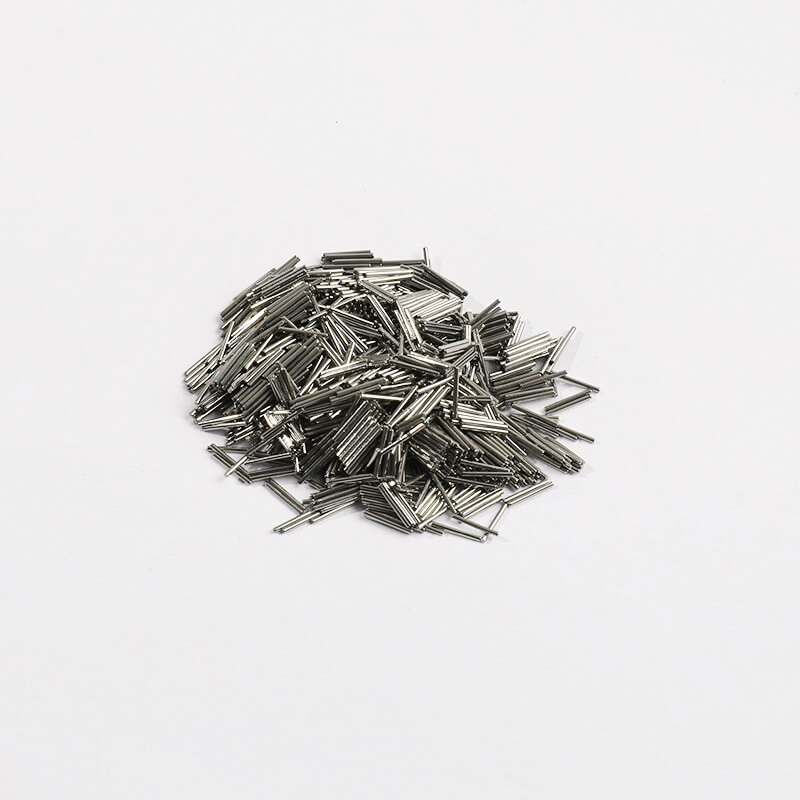
| Media | Best fit | Watch out for |
|---|---|---|
| Dry media, walnut shell with an abrasive or polishing compound | Light dry deburring, deflashing, drying and low-residue finishing of small parts and of features where a wet bath is difficult to remove | Low cutting energy so it cannot remove a substantial burr root, produces dust needing extraction, and consumption is high |
| Dry media, corn cob granules with a polishing compound | Final dry polish, light edge blending and drying after a wet stage on small parts and fittings | Almost no cutting action, absorbs compound and contaminates quickly, and must be kept separate per material family to avoid carry-over |
| Hardened steel media, balls and pins | Burnishing and bright finishing of stainless and hardened parts, and light edge consolidation where a cutting action is not wanted | Changes the surface by deformation rather than cutting, can work-harden or smear a soft surface, and needs corrosion protection and separation from acidic compounds |
| Magnetic pin or needle charge | Reaching small internal intersections, radial holes and thread entries on small precision parts such as spools, sleeves and drilled fittings | Limited by part size and shape, pins must be retrieved and inspected for breakage, and the result depends heavily on fixture and field design |
Internal intersections are a different problem from external surface refinement, and no amount of extra energy in a bowl fixes them. A cross-drilling meeting a main bore creates a burr on the inside wall that external media rarely reaches. Access routes include a small media size class that can enter the passage, magnetic finishing where a pin or needle charge is driven into the feature on small parts, or a targeted mechanical method outside mass finishing. Each has a boundary: a size class small enough to enter a passage is also small enough to lodge in it, magnetic pins are limited by part size and by retrieval, and blind features with no exit cannot be flushed clean. Decide per feature which access route is credible, and how the result will be seen.
| Machine route | Where it fits | What it will not do |
|---|---|---|
| Magnetic finishing machine | Small precision parts with internal intersections, radial holes and thread entries that a bulk charge cannot reach | Limited by part size and material, pins must be retrieved and checked, and it does not level or refine large flat surfaces |
| Grinding finishing machine | Heavier stock removal and thick burr roots on robust parts where clearing material in a shorter cycle matters more than the surface result | Aggressive edge rounding and a coarser surface, so it fits lapped seats, thin sections and tight edge bands poorly |
| Centrifugal barrel finishing machine | Short high-pressure cycles on small precision parts such as spools, sleeves, small valve bodies and drilled fittings | Rounds edges and can distort thin unsupported sections quickly, and needs balanced barrel loading, controlled stop time and careful fixturing |
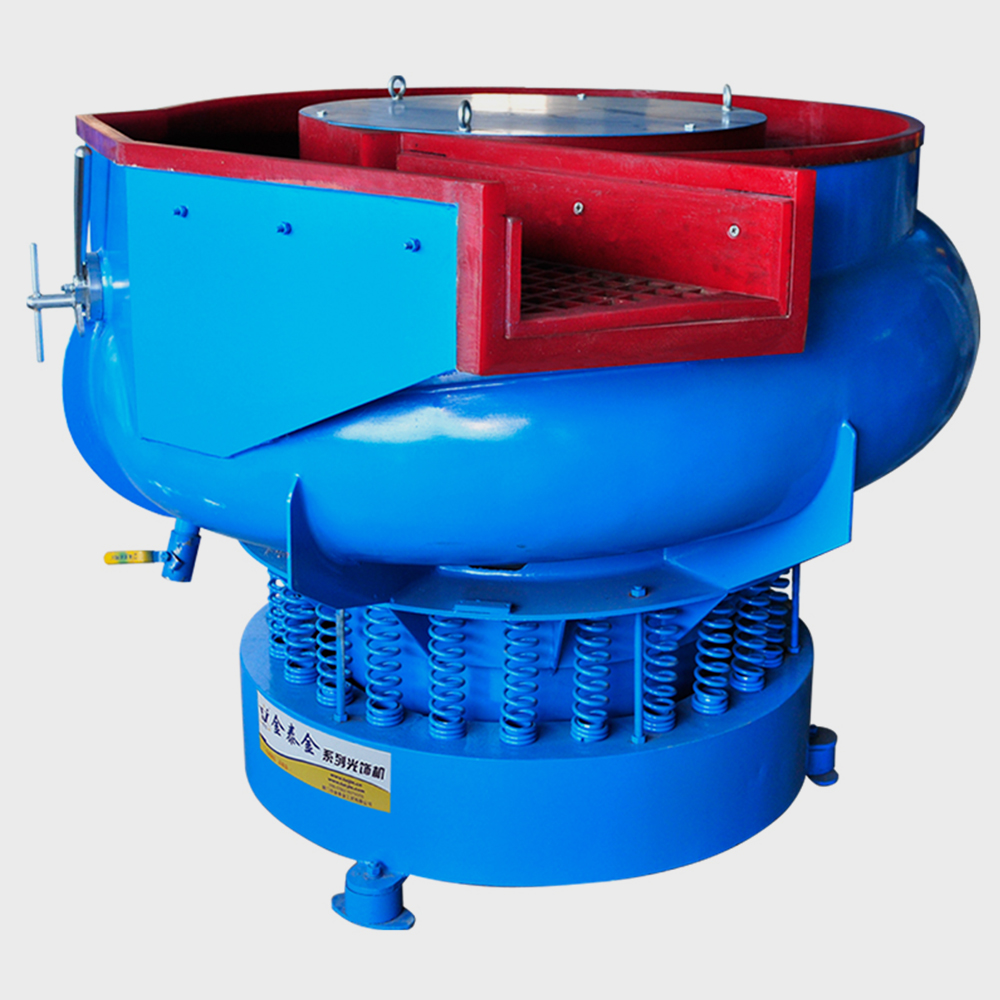
| Vibratory finishing machine (bowl) | General deburring and refinement of valve bodies, flange plates, pump components and fittings that fit the bowl and can move freely in the charge | No access to deep internal passages, constant part-on-part contact, and finished faces need separation or fixture protection |
Mass finishing acts on the whole section, not only on the edge, so flatness and wall thickness deserve their own screening on thin and slender parts. Heat-exchanger plates, thin diaphragms, long unsupported shafts and thin-wall pump components can bend, dish or lose flatness under part-on-part impacts and fixture pressure even when the surface result looks correct. The distortion is often small and shows up later as an assembly problem, a gasket that will not seat, or a plate stack with uneven contact. Fixtures and masking solve some of it but introduce their own marks: a masked face keeps its as-machined condition and may show a boundary where the media reached, and a rack can leave contact witness marks. Screen those outcomes on the drawing.
| Failure mode | Likely cause | How to catch it |
|---|---|---|
| Media fragments or abrasive fines embedded in a soft surface or machined groove | Impingement from excessive energy or charge mass, fractured media left in the working charge, or cross-contamination from a previous material family | Inspect at magnification under angled light, use a tape lift or solvent wipe on the suspect area, and screen the charge for broken media and accumulated fines |
| Tenacious compound film or reaction residue left in a gasket groove, thread or blind hole | A film-forming or silicate-bearing compound, insufficient rinse volume or temperature, or drying the part before it is genuinely clean | Wipe a defined area with solvent against a clean reference, check for a continuous water film on a rinsed sample, and inspect recessed features at magnification before packing |
| Burr lip folded flat over the edge with the root still attached | Too light a cut for the burr thickness, a refinement-only pass used as the only stage, or a soft ductile material that rolls instead of fracturing | Draw a probe or lint-free wipe along the edge, examine at magnification under angled light, and take a sectioned or moulded replica sample where the feature is critical |
| Media lodged in a cross-drilling, blind tapped hole, keyway, groove or internal passage | Size class chosen against an average feature rather than the smallest one, media fractured into smaller pieces during the cycle, or a secondary burr that closed part of the opening | Borescope agreed passages at a fixed angle, pin gauge every tapped hole, count the charge in and out where practical, flush through a filter and inspect the residue, and compare part mass before and after |
Atlanta's industrial base combines transportation and logistics head offices with aerospace, defence and specialty metal fabrication, plus food and beverage production and a large academic medical centre. The Federal Reserve's Sixth District Beige Book, which covers Georgia, reports manufacturing activity growing at a moderate pace, with a fabricator of specialty metal products seeing particularly strong demand for aerospace and defence-related goods and a military shipbuilder expecting a decade of defence-driven demand. Hartsfield/Jackson Atlanta International tops the FAA's final CY2025 enplanement table, and CBP lists Atlanta, Georgia (port 1704) as a port of entry with its field office in the city. The Coca-Cola Company's own history page records the drink's first serving in downtown Atlanta in 1886, Norfolk Southern's corporate address is 650 W. Peachtree Street NW in Atlanta, and Emory University, based in the city, presents health and medical research as central to its mission.
The nearest part of that base to this brief is marine: The Beige Book also reports a military shipbuilder in the district expecting ongoing demand for the next decade given strength in defence spending.
Aerospace, defence and general machinery fabrication in the Atlanta region produces machined and formed metal parts whose burrs and edge condition affect fatigue life, coating adhesion and assembly fit, so edge blending and surface preparation before priming, anodising or plating are routine process steps. Fabricated sheet-metal and tube assemblies typically need weld dressing and edge radiusing, while food and beverage equipment adds a hygiene requirement: stainless product-contact parts are usually finished to a cleanable, pit-free surface with controlled roughness rather than to a decorative polish.
The first decision is whether the part is governed by an aerospace or defence special-process requirement (for example NADCAP-approved passivation, anodising or painting) or by a general industrial finish, because that sets the acceptable media, compound chemistry and documentation package. Confirming the inspection method for edge radius, Ra and burr limits before any media trial avoids qualifying a finish against the wrong criterion.
Freight context: Hartsfield/Jackson Atlanta International Airport (ATL), Atlanta, Georgia (CBP port of entry 1704 with the Atlanta field office), Norfolk Southern rail network, corporate headquarters at 650 W. Peachtree Street NW, Atlanta. FAA final CY2025 enplanement data rank Hartsfield/Jackson Atlanta International first in the country with 51,459,786 boardings, and CBP's Georgia table lists Atlanta, Georgia (1704) with the field office in the city; Norfolk Southern's published corporate address is 650 W. Peachtree Street NW, Atlanta, Georgia 30308. Metro Atlanta has no seaport, so containerised machines from China normally land at a US East or Gulf coast port and reach Atlanta by rail or truck, with air consignments and sample parts clearing at the Atlanta port of entry.
Business is conducted in US English. Units matter: US drawings and purchase orders frequently use inches, microinch Ra and US gallons, and a supplier that quotes only metric can be asked to reissue documentation. Buyers are US legal entities with an EIN and expect an identifiable contracting entity, a correct HTSUS classification, a commercial invoice, packing list and bill of lading, country-of-origin marking, and an importer of record for customs. Procurement is normally evidence-driven: process selection is expected to be justified by a trial run on the buyer's own sample parts with measured results (burr height, edge radius, Ra, cleanliness) and by media and compound data sheets, rather than by a capability claim. Payment terms in general US industrial practice are open account with net-30 to net-60 terms for established buyers, with letters of credit or advance payment more common for a first order from a new overseas supplier; no US buyer assumes Incoterms, warranty terms or spare-parts lead times unless they are stated in the quotation.
The customs authority is U.S. Customs and Border Protection (CBP), part of the Department of Homeland Security. The importer of record files an entry and then an entry summary (CBP Form 7501): '"Entry Summary" refers to the documentation necessary to enable U.S. Customs and Border Protection to assess duties, collect statistics, and determine whether other requirements of law have been met.' Classification is made in the Harmonized Tariff Schedule of the United States, and an importer may request a written CBP ruling on the correct HTSUS classification and rate of duty, which is the practical way to confirm the treatment of a finishing machine before shipment. Every article of foreign origin must be marked with the English name of its country of origin 'in a conspicuous place as legibly, indelibly, and permanently as the nature of the article (or container) will permit' under 19 U.S.C. 1304 and 19 CFR 134.11. The $800 de minimis (Section 321) exemption is no longer available for ordinary freight: CBP suspended it indefinitely for all modes other than the international postal network effective 24 June 2026, so even low-value sample parts and media must go through formal or informal entry and pay applicable duty. General US industry practice is that there is no single machinery conformity mark comparable to the EU's CE marking; buyers instead verify electrical components and control panels, machine guarding against workplace-safety requirements, and any customer-specific qualification.
SurfacePolish supplies from Xiamen, China. The buyer's own destination rules, conformity marking, tariff classification and documentation responsibilities stay with the buyer; confirm them against the authorities named above before ordering.
An acceptance record is only as strong as the chain behind it. A measured roughness or edge radius means little unless the record links the part to the batch, the batch to the charge, and the charge to the media type, size class, charge age, compound and settings used on that day. Request the settings record with the returned parts, plus the media and compound identification, the cycle count on the charge and the maintenance history. On the measuring side, know the calibration status of the instrument and the uncertainty attached to the value, because a reading quoted to two decimal places on an uncalibrated gauge is not evidence. Decide which records the buyer owns and which are requested from the supplier.
The value of a sample trial comes from the range of parts sent, not from the quantity. A box of identical nominal parts tests one geometry and one burr condition; it cannot show how the proposed route behaves on the tightest passage, the thinnest wall or the hardest material in the family. Send a small set chosen to cover the extremes: the part with the smallest internal opening, the part with the longest unsupported section, the part with the most protected edge, one part in the hardest heat-treatment state the family sees, and one as-received reject that already fails. Label every part so its identity survives the trip, and send enough pieces that some can be sectioned or measured destructively.


Size the charge well below the smallest opening it could enter, and treat every passage as a retrieval point rather than assuming it stays clear. List the tightest hole, slot, thread and cross-drilling first, then choose a size class against that geometry instead of the average part. Screen the working charge, because fractured media produces smaller pieces that defeat the original sizing. Plan detection: a borescope at an agreed angle, a pin gauge in every tapped hole, a count of the charge in and out where practical, a flush collected through a filter, and a part mass check. For Atlanta buyers preparing a trial, include the smallest passage.
No. A trial reports what was observed on the parts that were sent, under the settings that were used on the machine that ran them. It does not establish what will happen across other heats, casting lots, machining sources or a full production charge, and it does not demonstrate how the process behaves once the media has worn. Treat the returned parts and the observation record as a direction to test at production scale. The next step is a production-representative batch on the machine the buyer will use, with the buyer's own first-article discipline, agreed sampling and the features that matter measured against the recorded baseline.
Sometimes, and only through a defined access route. A burr on the inside wall of a cross-drilling can be reached by a small media size class that enters the passage, by a magnetic pin charge on parts small enough for that machine, or by a targeted mechanical method rather than bulk mass finishing. What decides it is the smallest opening, whether the passage has an exit, and how the result will be inspected. For a United States buyer, send the part with its tightest intersection and agree how the internal edge will be borescoped or gauged. SurfacePolish reports observations on the parts tested; the requirement stays the buyer's to define.
Use Atlanta, United States as the destination on the enquiry and state whether the deliverable is equipment, media and compound, a representative sample review or a line concept. A destination does not imply local stock, a local service point or a local delivery time.
Buyers in this supply chain commonly reference AS9100 and NADCAP-approved special processes for aerospace work, with SAE AMS process specifications such as AMS 2700 for passivation named on the certificate, while general industrial and food-equipment parts are specified to ASME B46.1 or ISO 4287 for texture with the customer's chosen salt-spray, adhesion or cleanliness test for coatings and hygiene.
Sources were retrieved on 2026-09-29 and describe the local industrial and trade context only. They do not evidence any SurfacePolish project, shipment, installation or service in Atlanta.
The buyer must remove the machining burr at the bore and bolt-hole entries while leaving the serrated raised face untouched.
Send the material, dimensions, approximate weight, batch quantity, the incoming condition and photographs of the difficult features. Mark which features must not be contacted by media and state how the result will be inspected. This form carries source reference PSEO-0078; quote it if you prefer an additional manual reference.
Open the SurfacePolish enquiry form Email a prepared enquiry
No price, lead time, certification or result is promised here. Confirm whether a sample trial is available for the specific part and what the trial can and cannot show.
Page PSEO-0078 · revised 2026-09-29 · cross-border equipment, media and scoped sample review. City context is sourced and cited above.
Use this local checker to identify missing part and inspection information. It prepares a technical-review brief; it does not approve a machine, process recipe or production result.
Complete the part details to prepare a review brief.
Email : info@surface-polish.com


 IPv6 network supported


 +86-592-2381506
