A buyer in Chennai, India in energy equipment has a forged F316 weld-neck flange whose bore and bolt-hole entry burrs must be removed without disturbing the serrated raised face. SurfacePolish supplies finishing machines, media and compounds across borders and runs a free sample trial, returning representative parts from Xiamen with an observation record and a proposed media, compound and cycle direction. This brief is written for a buyer in Chennai working on energy equipment; it describes equipment, media and a scoped sample review, not a local polishing service.
Which edges on this part are functional, such as gasket lands, seat bands, stem guides, metering lands and thread entries, and which only need to be free of a sharp edge?
What is the smallest internal passage, cross-drilling or tapped hole the charge must never plug, and how would a lodged medium be found and removed?
What must the part be clean of, and what method and limit does the buyer use to verify cleanliness before assembly, welding, coating or a leak test?
Read the drawing surface by surface before any medium is discussed. On an energy-equipment part the surfaces that decide acceptance are rarely the largest: a raised-face gasket land, a valve seat bore, a stem guide diameter, a cross-drilling intersection, a thread entry and a locating spigot each behave differently under an abrasive charge. Separate them into surfaces that seal or locate, surfaces that only carry flow, and surfaces that are cosmetic. A pump housing and a manifold block may share a material grade and still need opposite treatment because one carries a machined gasket land and the other only drilled passages. Mark the protected list on the buyer's own drawing revision, then decide for each item whether it is masked, fixtured out of the mass, finished to a band, or left as-machined. That list also governs handling between operations.
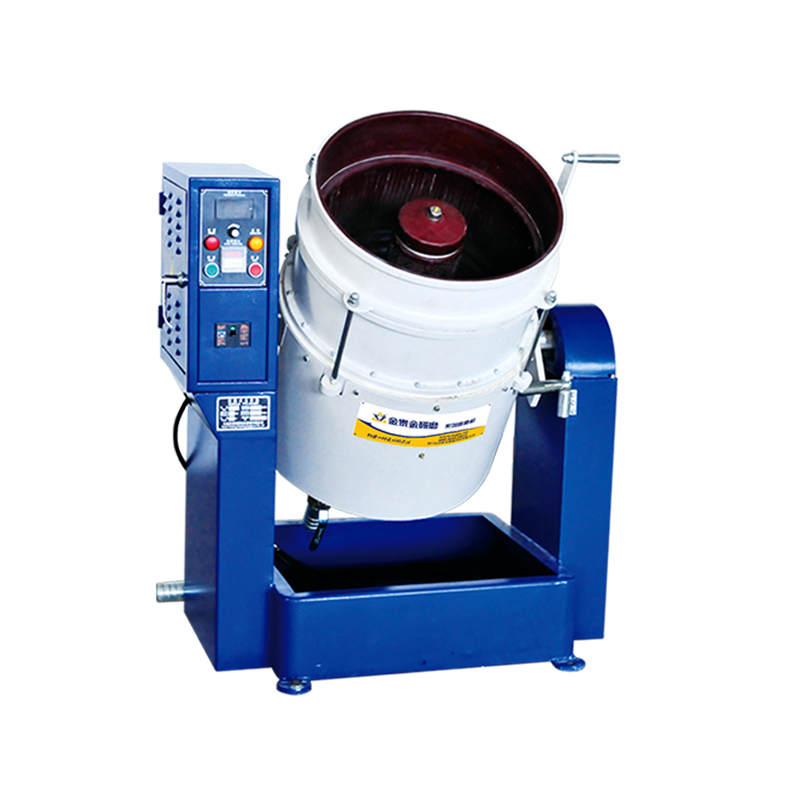
Geometry decides the machine frame before any setting does. A bowl vibrator needs the part to move freely in the charge; a long manifold body, a shaft or a stacked plate set cannot tumble that way and belongs in a tub where it can be carried, rotated or supported along its length. Mass matters as much as length: a heavy valve body sinks in a small charge and stalls the part-on-media motion, so either the charge grows or the machine size grows. Thin plates need the opposite treatment, a low load ratio and separation so they are not driven into each other. Before comparing machines, list the largest and smallest envelope in the batch, the heaviest single part, the longest unsupported span and any feature that cannot bear load. Those four numbers eliminate most of the catalogue.
| Machine route | Where it fits | What it will not do |
|---|---|---|
| Dry polishing machine and dryer | Drying after a wet cycle and dry light polishing or deburring of small parts, including features where residual moisture is a problem | Removes little or no material, needs dust extraction when dry media is used, and does not replace a cutting stage for a substantial burr |
| Tub vibrator | Long parts such as manifold rails, shafts, long housings and stacked plate sets that cannot tumble in a bowl, with support or rotation along their length | Lower energy per unit area so heavy burrs take longer, and the tub needs floor space plus a defined part support method |
| Magnetic finishing machine | Small precision parts with internal intersections, radial holes and thread entries that a bulk charge cannot reach | Limited by part size and material, pins must be retrieved and checked, and it does not level or refine large flat surfaces |
| Barrel finishing machine and rotary barrel tumbler | Gentle, low-impingement deburring of small, fragile or precision parts and mixed fitting batches where edge protection matters more than speed | Long cycles, no visibility while the barrel runs, and internal features can collect media and compound that must be retrieved at unload |
Shape and size class decide where the charge can go and how it cuts when it gets there. An angle-cut triangle presents a point and a sharp edge, so it works into a corner or a thread entry and cuts hard; a sphere rolls and makes softer, more uniform contact; a cylinder or oval lies along a face and blends rather than digs. Size then sets the access limit: the medium must be comfortably smaller than the smallest opening it is expected to clear, and comfortably larger than any opening it must never enter. Those two constraints are often only a size class apart, which is why thread entries, cross-drillings and slot widths need listing before a charge is ordered. Media that fractures in service defeats the original sizing, so screen the working charge.
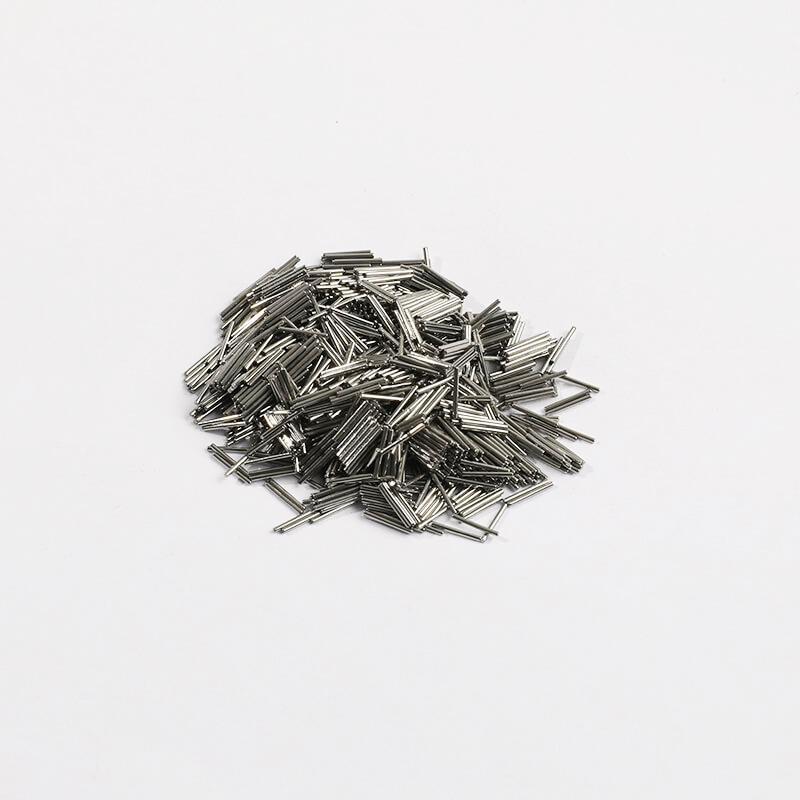
| Media | Best fit | Watch out for |
|---|---|---|
| Heavy-cut ceramic, angle-cut triangles in a coarse size class | Removing a substantial or thick burr root from open external edges, flange corners, cast bosses and large tapped entries on steel and stainless parts | Cuts controlled edges and gasket lands as readily as burrs, leaves a coarse surface, and lodges in slots whose width approaches the media section |
| Fine ceramic spheres or small porcelain shapes in a light size class | Refinement and edge blending after a cutting stage, and light deburring of small fittings, thread entries and tighter external geometry | Small sizes enter and retain in fine passages and cross-drillings, and the charge changes size and cut rate as it wears |
| Alumina-bearing grinding media in a dense ceramic bond | Heavy stock removal and consistent cutting on hard or work-hardened parts with generous edge limits, such as robust flanges and heavy fittings | High removal energy rounds functional edges quickly and is a poor match for thin plates, thin-wall castings and lapped sealing faces |
| Magnetic pin or needle charge | Reaching small internal intersections, radial holes and thread entries on small precision parts such as spools, sleeves and drilled fittings | Limited by part size and shape, pins must be retrieved and inspected for breakage, and the result depends heavily on fixture and field design |
Contamination in this process is mostly invisible at the machine and is discovered downstream. Three forms matter on energy-equipment parts. Media fragments and abrasive fines can embed in soft surfaces or in a machined groove and later appear as particles in a fluid system. Material carryover happens when carbon steel fines or cast-iron graphite from an earlier batch stay in the charge, the machine, the rinse tank or the drying cloth and transfer to stainless parts. Compound residue and its reaction products can sit in a gasket groove, a thread or a blind hole and interfere with welding, passivation or a coating step. Control is separation and cleaning discipline, verified with a wipe or tape lift, magnification, and a flush residue check.
| Failure mode | Likely cause | How to catch it |
|---|---|---|
| Tenacious compound film or reaction residue left in a gasket groove, thread or blind hole | A film-forming or silicate-bearing compound, insufficient rinse volume or temperature, or drying the part before it is genuinely clean | Wipe a defined area with solvent against a clean reference, check for a continuous water film on a rinsed sample, and inspect recessed features at magnification before packing |
| Thread entry deformation, a damaged lead thread or a burr folded into the first threads | Aggressive media at an unprotected thread entry, media lodging in the thread and working against it, or handling damage at load and unload | Run a go and no-go thread gauge on every tapped feature in the sample, inspect the first threads under magnification, and check the entry chamfer against the drawing |
| Burr lip folded flat over the edge with the root still attached | Too light a cut for the burr thickness, a refinement-only pass used as the only stage, or a soft ductile material that rolls instead of fracturing | Draw a probe or lint-free wipe along the edge, examine at magnification under angled light, and take a sectioned or moulded replica sample where the feature is critical |
| Burr still present on an internal cross-drilling intersection after finishing | No credible access route for the charge, a medium too large to enter the passage, or a cycle too short for the intersection to see enough contact | Borescope the intersection at the agreed angle on sample parts, section one representative part to expose the wall, and compare against the recorded as-received condition |
Chennai is the industrial core of Tamil Nadu, a state that houses 110 industrial parks and estates, 45 Domestic Tariff Zones and over 42 operational Special Economic Zones, and is served by 4 international airports and 2 domestic airports (s1). The metropolitan belt is an automotive cluster: Tamil Nadu accounts for 35% of India's auto component production with more than 1,500 auto component factories, and Chennai appears as a named auto cluster alongside Thoothukudi, Madurai and Coimbatore (s2). Chennai is also a shipbuilding and marine hub, with Chennai, Thoothukudi and Cuddalore fostering shipyard clusters, dry docks and marine fabrication facilities anchored by Chennai Port and Kamarajar Port (s3). Heavy engineering value chains spanning pumps, valves, motors, fasteners and industrial machinery are concentrated in the Chennai-Tiruvallur cluster (s4), and life sciences manufacturing is anchored in a Chennai cluster including TICEL Biotech Park and Bioville park (s5).
The nearest part of that base to this brief is medical: Tamil Nadu's life sciences industry is anchored by four major industrial clusters - Chennai, Cuddalore, Krishnagiri and Coimbatore - with TICEL Biotech Park at Chennai and Bioville park in Chennai and Chengalpattu (s5).
Chennai's automotive and auto-component base runs high-volume machined and cast parts whose burrs, edge condition and surface roughness are inspected by OEM and tier-one customers, which makes deburring and consistent finish a throughput and quality problem rather than a craft operation. The shipbuilding, pumps/valves and biotech equipment segments add stainless and marine-alloy work where passivation, contamination control and cleanliness of product-contact surfaces matter as much as the cosmetic finish.
A Chennai buyer should settle the process window against the customer's drawing - required roughness and burr tolerance, alloy and heat-treatment condition, and whether the part is safety- or appearance-critical - because in an automotive or medical supply chain the finishing step has to hold a documented, repeatable result rather than merely look acceptable.
Freight context: Chennai Port, Kamarajar Port (Ennore), Chennai International Airport, Sriperumbudur / Oragadam industrial corridor. Chennai Port and Kamarajar Port at Ennore are the two port gateways inside the Chennai shipbuilding and industrial cluster, and the state's network includes 4 international airports and 2 domestic airports (s1, s3). Machines and sample parts therefore move by sea through Chennai/Ennore or by air through Chennai International Airport, with the automotive corridor at Sriperumbudur and Oragadam as the inland destination.
India's foreign-trade, customs and standards machinery works in English: the Foreign Trade Policy, DGFT's IEC and scheme material, the BIS standards catalogue and Invest India's investor guide are all published in English, and the mandatory import documents are the internationally conventional bill of lading, commercial invoice cum packing list and bill of entry (c1, c3, c6, c10). Payment in the import channel is bank-intermediated; the Foreign Trade Policy treats the irrevocable commercial letter of credit as the instrument that fixes an importer's commitment when import policy changes (c4), so a supplier should expect LC or advance terms rather than open-account credit on a first order. Indian industry associations are explicit about import substitution: the Bombay Chamber of Commerce and Industry states that one of its major focuses today is how to expand manufacturing setups and substitute imported products (c13), so a cross-border equipment seller should expect questions about local support, spares, training and total cost of ownership rather than price alone, and should hold the IEC, GST registration, bill of entry documentation and any BIS obligation as part of the commercial discussion.
India classifies every imported item in the ITC(HS) schedule, a compilation of codes for all merchandise for export and import whose Schedule I lays down the import policy regime for each item, maintained at 8-digit level under the First Schedule of the Customs Tariff Act, 1975 and aligned at 6 digits with the WCO Harmonized System (c1, c3). Importability is judged by the policy in force on the date of import, and when a policy moves from free to restricted, goods already committed through an irrevocable commercial letter of credit opened before the change can still be imported up to the balance quantity, value and period in that ICLC (c4). Preferential customs treatment is available only through the preferential trade agreements, free trade agreements, CECAs and CEPAs that India notifies and that are in operation (c5), so Chinese-origin industrial machinery is assessed at the applicable rate of the customs tariff rather than under any India-China preferential rate; India's commerce leadership has separately pointed to exports under free trade pacts growing faster than imports (c12). For capital goods specifically, DGFT operates the Export Promotion Capital Goods (EPCG) scheme, whose stated objective is to facilitate import of capital goods for producing quality goods and services (c7), which Indian firms use when they want duty relief on imported plant against an export obligation.
SurfacePolish supplies from Xiamen, China. The buyer's own destination rules, conformity marking, tariff classification and documentation responsibilities stay with the buyer; confirm them against the authorities named above before ordering.
Dimensional and visual checks do not prove a part functions, so acceptance should include the functional checks that matter to the assembly. Depending on the part, that may be a fit check of a mating component, a passage-clearance check, a seal or leak test, a torque check on a tapped feature, or a check that a coating or weld will take on the finished surface. Cleanliness is a separate acceptance axis with its own method: a borescope or mirror check of internal passages, a flush through a filter with the residue inspected against a limit, or a wipe test on a defined area. Define those limits on the buyer's side, because they depend on the service environment. Establish whether the process leaves a condition that traps penetrant.
The value of a sample trial comes from the range of parts sent, not from the quantity. A box of identical nominal parts tests one geometry and one burr condition; it cannot show how the proposed route behaves on the tightest passage, the thinnest wall or the hardest material in the family. Send a small set chosen to cover the extremes: the part with the smallest internal opening, the part with the longest unsupported section, the part with the most protected edge, one part in the hardest heat-treatment state the family sees, and one as-received reject that already fails. Label every part so its identity survives the trip, and send enough pieces that some can be sectioned or measured destructively.
Sometimes, and only through a defined access route. A burr on the inside wall of a cross-drilling can be reached by a small media size class that enters the passage, by a magnetic pin charge on parts small enough for that machine, or by a targeted mechanical method rather than bulk mass finishing. What decides it is the smallest opening, whether the passage has an exit, and how the result will be inspected. For a India buyer, send the part with its tightest intersection and agree how the internal edge will be borescoped or gauged. SurfacePolish reports observations on the parts tested; the requirement stays the buyer's to define.
Use more than one method, because each misses something. Visual inspection under angled light at magnification catches obvious sharp edges, wire edges and remaining burr fragments. A tactile check with a probe, a fine needle or a lint-free wipe drawn along the edge catches lips that have been folded flat. A radius gauge, optical comparator or moulded replica gives an edge size, and a profilometer or surface roughness tester with a suitable cut-off and traversing direction gives a profile across the edge when the geometry allows it. Microscopy helps on small features and when documenting a dispute. Compare against a master agreed before the batch.
No. A trial reports what was observed on the parts that were sent, under the settings that were used on the machine that ran them. It does not establish what will happen across other heats, casting lots, machining sources or a full production charge, and it does not demonstrate how the process behaves once the media has worn. Treat the returned parts and the observation record as a direction to test at production scale. The next step is a production-representative batch on the machine the buyer will use, with the buyer's own first-article discipline, agreed sampling and the features that matter measured against the recorded baseline.
Use Chennai, India as the destination on the enquiry and state whether the deliverable is equipment, media and compound, a representative sample review or a line concept. A destination does not imply local stock, a local service point or a local delivery time.
A Chennai buyer's surface, edge and cleanliness specifications are written against Indian Standards (IS) published by the Bureau of Indian Standards, and automotive and life-sciences customers normally layer their own drawing tolerances and cleanliness requirements on top of the IS reference (s1). Where a product falls under a BIS quality-control order, the licence or registration requirement attaches to the item placed on the Indian market.
Sources were retrieved on 2026-09-29 and describe the local industrial and trade context only. They do not evidence any SurfacePolish project, shipment, installation or service in Chennai.
The buyer must remove the machining burr at the bore and bolt-hole entries while leaving the serrated raised face untouched.
Send the material, dimensions, approximate weight, batch quantity, the incoming condition and photographs of the difficult features. Mark which features must not be contacted by media and state how the result will be inspected. This form carries source reference PSEO-0938; quote it if you prefer an additional manual reference.
Open the SurfacePolish enquiry form Email a prepared enquiry
No price, lead time, certification or result is promised here. Confirm whether a sample trial is available for the specific part and what the trial can and cannot show.
Page PSEO-0938 · revised 2026-09-29 · cross-border equipment, media and scoped sample review. City context is sourced and cited above.
Use this local checker to identify missing part and inspection information. It prepares a technical-review brief; it does not approve a machine, process recipe or production result.
Complete the part details to prepare a review brief.
Email : info@surface-polish.com


 IPv6 network supported


 +86-592-2381506