A buyer in Dusseldorf, Germany in energy equipment has an aluminium actuator housing whose thin fin edges and thread entries need deburring without peening the alloy, rounding the O-ring bore lip or bending the fins. SurfacePolish supplies finishing machines, media and compounds across borders and runs a free sample trial, returning the parts from Xiamen with an observation record and a proposed media, compound and cycle direction. This brief is written for a buyer in Dusseldorf working on energy equipment; it describes equipment, media and a scoped sample review, not a local polishing service.
What must the part be clean of, and what method and limit does the buyer use to verify cleanliness before assembly, welding, coating or a leak test?
Which material families and heat-treatment states share the equipment, and what separation is needed to avoid ferrous or graphite carry-over onto stainless parts?
Is deburring done before or after heat treatment, and in what metallurgical and surface condition does the part arrive at the finishing step?
Read the drawing surface by surface before any medium is discussed. On an energy-equipment part the surfaces that decide acceptance are rarely the largest: a raised-face gasket land, a valve seat bore, a stem guide diameter, a cross-drilling intersection, a thread entry and a locating spigot each behave differently under an abrasive charge. Separate them into surfaces that seal or locate, surfaces that only carry flow, and surfaces that are cosmetic. A pump housing and a manifold block may share a material grade and still need opposite treatment because one carries a machined gasket land and the other only drilled passages. Mark the protected list on the buyer's own drawing revision, then decide for each item whether it is masked, fixtured out of the mass, finished to a band, or left as-machined. That list also governs handling between operations.
Compound delivered at the wrong concentration or flow makes the same media behave like a different charge. Too little and the abrasive cut becomes dry and marking increases; too much and cutting slows while foam and carry-over rise. Flow rate matters as much as dose, because it is the flow that carries fines away from the part and keeps the working zone consistent across a long cycle. Water quality belongs in the same discussion: hardness, pH and dissolved solids in the make-up water shift the compound's behaviour, and a plant that changes its water source can change its results without touching a machine setting. Where the fluid is recirculated, filtration and turnover decide how much swarf and broken media stay in suspension and how often the bath is dumped.
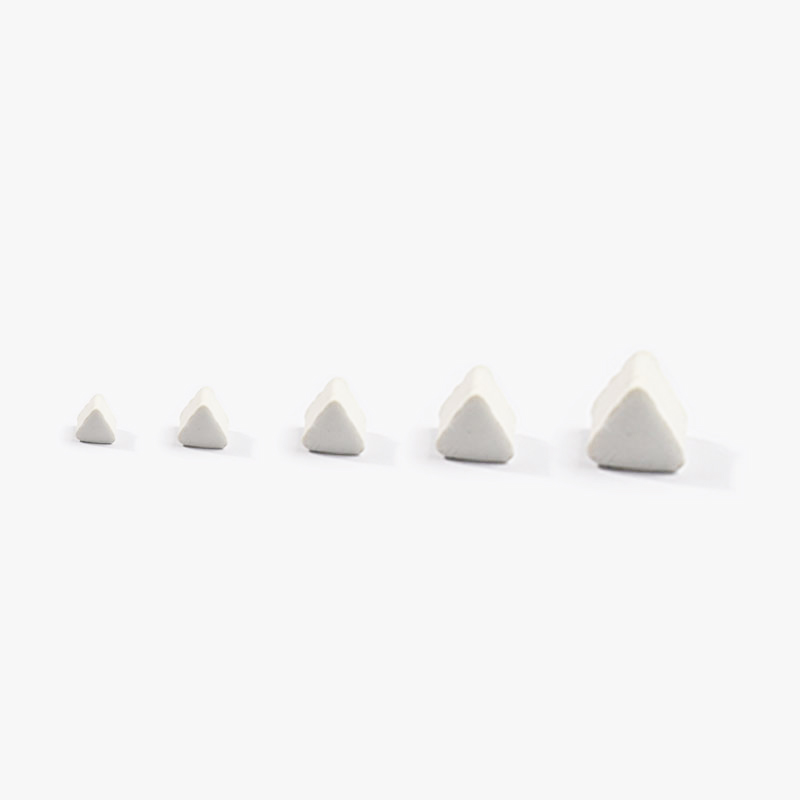
| Media | Best fit | Watch out for |
|---|---|---|
| Hardened steel media, balls and pins | Burnishing and bright finishing of stainless and hardened parts, and light edge consolidation where a cutting action is not wanted | Changes the surface by deformation rather than cutting, can work-harden or smear a soft surface, and needs corrosion protection and separation from acidic compounds |
| Magnetic pin or needle charge | Reaching small internal intersections, radial holes and thread entries on small precision parts such as spools, sleeves and drilled fittings | Limited by part size and shape, pins must be retrieved and inspected for breakage, and the result depends heavily on fixture and field design |
| Dry media, corn cob granules with a polishing compound | Final dry polish, light edge blending and drying after a wet stage on small parts and fittings | Almost no cutting action, absorbs compound and contaminates quickly, and must be kept separate per material family to avoid carry-over |
| Dry media, walnut shell with an abrasive or polishing compound | Light dry deburring, deflashing, drying and low-residue finishing of small parts and of features where a wet bath is difficult to remove | Low cutting energy so it cannot remove a substantial burr root, produces dust needing extraction, and consumption is high |
Every mass-finishing route is also a contact problem. Parts touch each other, the machine wall and any fixture, and each contact is a chance to mark, peen or bend a finished face. Compartmenting a charge, racking parts individually or running a smaller load with more media between parts changes the contact pattern, and it changes throughput in the same move. Where a machined gasket land, a ground spigot or a lapped sealing face must arrive unmarked, decide which faces are allowed to bear contact and design the load around that. A fixture can hold a part out of the mass, but it also shields the area behind it, so the shielded zone has to be finished another way or left as-machined. Record the contact plan with the load.
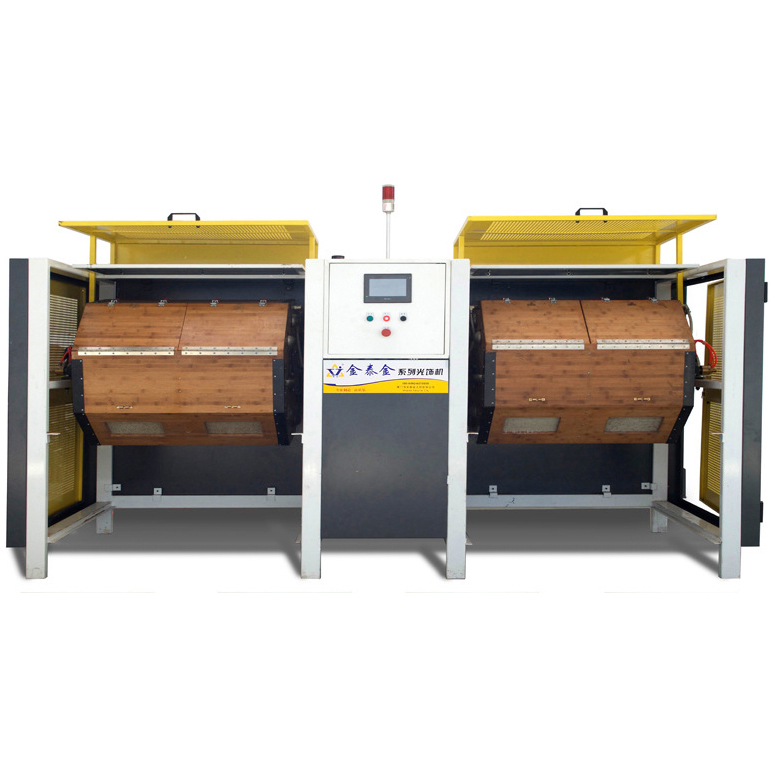
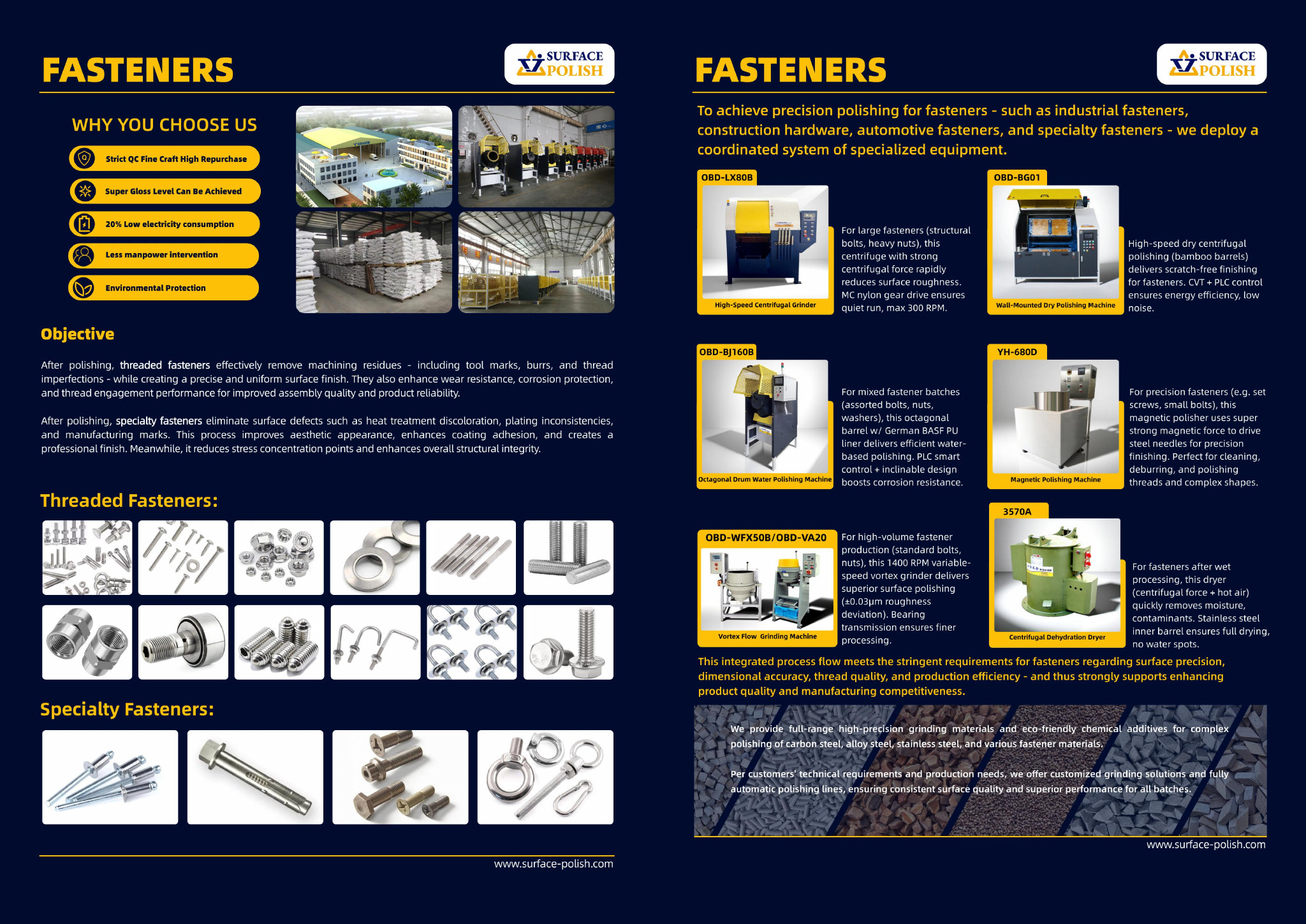
| Machine route | Where it fits | What it will not do |
|---|---|---|
| Dry polishing machine and dryer | Drying after a wet cycle and dry light polishing or deburring of small parts, including features where residual moisture is a problem | Removes little or no material, needs dust extraction when dry media is used, and does not replace a cutting stage for a substantial burr |
| Tub vibrator | Long parts such as manifold rails, shafts, long housings and stacked plate sets that cannot tumble in a bowl, with support or rotation along their length | Lower energy per unit area so heavy burrs take longer, and the tub needs floor space plus a defined part support method |
| Centrifugal barrel finishing machine | Short high-pressure cycles on small precision parts such as spools, sleeves, small valve bodies and drilled fittings | Rounds edges and can distort thin unsupported sections quickly, and needs balanced barrel loading, controlled stop time and careful fixturing |
| Grinding finishing machine | Heavier stock removal and thick burr roots on robust parts where clearing material in a shorter cycle matters more than the surface result | Aggressive edge rounding and a coarser surface, so it fits lapped seats, thin sections and tight edge bands poorly |
Media lodging is a geometry and media-condition problem, and it concentrates at intersections. A cross-drilling breaking into a bore, a blind tapped hole, a keyway, a snap-ring groove and a slot whose width approaches the medium section are all traps. The usual causes are a size class chosen against an average feature rather than the smallest one, a charge that has fractured into smaller pieces, and a secondary burr or fold that closes part of the opening while the part is running. Retrieval often costs more than the deburring itself, especially where the trap is inside a body that cannot be opened. Plan detection before the run: which passages are borescoped at an agreed angle, which holes are pin gauged, how a flush through a filter is collected, and how the part mass is compared.
| Failure mode | Likely cause | How to catch it |
|---|---|---|
| Tenacious compound film or reaction residue left in a gasket groove, thread or blind hole | A film-forming or silicate-bearing compound, insufficient rinse volume or temperature, or drying the part before it is genuinely clean | Wipe a defined area with solvent against a clean reference, check for a continuous water film on a rinsed sample, and inspect recessed features at magnification before packing |
| Media lodged in a cross-drilling, blind tapped hole, keyway, groove or internal passage | Size class chosen against an average feature rather than the smallest one, media fractured into smaller pieces during the cycle, or a secondary burr that closed part of the opening | Borescope agreed passages at a fixed angle, pin gauge every tapped hole, count the charge in and out where practical, flush through a filter and inspect the residue, and compare part mass before and after |
| Burr lip folded flat over the edge with the root still attached | Too light a cut for the burr thickness, a refinement-only pass used as the only stage, or a soft ductile material that rolls instead of fracturing | Draw a probe or lint-free wipe along the edge, examine at magnification under angled light, and take a sectioned or moulded replica sample where the feature is critical |
| Media fragments or abrasive fines embedded in a soft surface or machined groove | Impingement from excessive energy or charge mass, fractured media left in the working charge, or cross-contamination from a previous material family | Inspect at magnification under angled light, use a tape lift or solvent wipe on the suspect area, and screen the charge for broken media and accumulated fines |
Düsseldorf is the state capital of North Rhine-Westphalia and its chamber of industry and commerce represents around 103,000 member companies from industry, trade and services in the city and the ten towns of Kreis Mettmann. The city's economic development agency puts about 100,000 jobs in classic production companies and industry-related services and cites concrete machinery sites, including a new hall built by Komatsu Germany in Benrath for the world's largest hydraulic excavator and the Konecranes crane-technology plant in Benrath; the former Vallourec tube works in Reisholz is being redeveloped as the industrial and commercial park 'The Tube'. Messe Düsseldorf gives the city a metal-processing anchor: it hosts the wire (wire and cable) and Tube (tube and pipe) world-leading trade fairs. Health and life sciences are a second growth pole, and more than 100 local companies have committed to CO2 reduction targets under the city's climate pact.
For this brief the relevant part of that base is energy: More than 100 companies based in Düsseldorf have joined the Düsseldorfer Klimapakt, committing to CO2 reduction targets and monitoring, which the city's economic development agency manages as part of its energy and environmental business support.
Düsseldorf's industrial base is concentrated in machine building, tube and pipe processing, crane and construction machinery and their supplier tier, and the city's trade-fair profile (Tube, wire) reflects exactly the cutting, forming and joining processes that generate burrs, sharp edges and contaminated surfaces. Tube ends, machined bores, weld seams and hydraulic components are the typical parts where deburring, edge rounding and defined surface finish determine fit, seal performance and coating adhesion. Because buyers here compare process technology at Düsseldorf's metal fairs, they tend to evaluate finishing machinery and media with an explicit process route and throughput figure rather than a finish description alone.
Decide first whether the requirement is an edge condition (deburring, edge break for seals and hydraulics) or a defined roughness/cleanliness value, then specify the process route and throughput that Düsseldorf's machine-building and tube-processing suppliers must reproduce in series with documented, repeatable results.
Freight context: Düsseldorf Airport (DUS), Rhine ports and rail terminals of the RheinCargo network in the Düsseldorf/Neuss area, Messe Düsseldorf exhibition grounds (trade-fair logistics). The economic development agency presents Düsseldorf as having Germany's fourth-largest airport plus direct links to the overseas ports of Zeebrugge, Amsterdam, Rotterdam and Antwerp, and the RheinCargo network moves more than 50 million tonnes a year by rail and inland port across its Rhine sites. Machines can be brought in by air or via Rhine container/rail hubs, and the Düsseldorf/Neuss port group serves as the regional inland terminal.
Machinery placed on the German market must be CE marked, and the manufacturer is responsible for the conformity assessment, the technical file, the EU declaration of conformity and for affixing the mark; importers and distributors are separately obliged to ensure that only compliant, CE-marked products are placed on the EEA market (c3, c4). The customs authority is German customs (Zoll), part of the Generalzolldirektion, and the operator identification it issues, the EORI number, is a prerequisite for customs clearance in the European Union (c5, c6). In general EU practice a buyer's landed-cost plan therefore needs to cover the commodity-code classification that sets the duty rate, import VAT and the customs declaration, on top of the CE technical file and an identified EU-based economic operator who can act as importer or authorised representative; the technical documentation and the declaration of conformity must be available in the language required by the buyer's market surveillance authority.
German is the working language of drawings, contracts, test reports and conformity documentation, and German buyers normally expect English-language technical documentation to be supplied alongside it. Procurement is documentation-driven: the EU declaration of conformity, the technical file, and the identity of the EU-based importer or authorised representative are settled before the order, and the EORI registration and customs declaration are the importer's responsibility rather than the exporter's (c3, c4, c5). Germany is the world's leading machinery and equipment manufacturer, so quotations compete against established domestic builders on technical documentation and measurable process data rather than on price alone (c9). Payment, delivery and risk terms are normally fixed by written contract with a named Incoterm, and classification (commodity code) is commonly confirmed in writing before shipment because it drives the duty and the import declaration.
SurfacePolish supplies from Xiamen, China. The buyer's own destination rules, conformity marking, tariff classification and documentation responsibilities stay with the buyer; confirm them against the authorities named above before ordering.
Edge acceptance needs a reference object, because words like lightly broken or slightly rounded mean different things to different inspectors. Build a physical or photographic master at a stated magnification: a part or coupon showing the acceptable edge, the borderline case and the reject. For each controlled edge, express the requirement as either an edge break, meaning the sharp corner is removed to a small defined size, or an edge round, meaning a controlled radius band the edge must sit inside. Give a maximum where over-rounding is the risk, and a minimum where the edge must not stay sharp. State how the edge will be checked, whether by radius gauge, optical comparator, moulded replica or tactile comparison against the master, and at what frequency.
Results from a small trial machine do not transfer linearly to a production machine. A larger bowl, a longer tub or a bigger barrel changes the energy per part, the path a part travels and the ratio of media to part mass. Cycle time is not a simple scale factor: doubling the load does not double the time, and running the same time in a larger machine usually removes more material from the edges than expected. The load ratio, the media-to-part volume, the compound flow per unit of charge and the unloading method all shift. Treat scale-up as its own first-article exercise on the production machine, stepping up in load while checking the same features. A trial result is a direction to test at scale.
No. A trial reports what was observed on the parts that were sent, under the settings that were used on the machine that ran them. It does not establish what will happen across other heats, casting lots, machining sources or a full production charge, and it does not demonstrate how the process behaves once the media has worn. Treat the returned parts and the observation record as a direction to test at production scale. The next step is a production-representative batch on the machine the buyer will use, with the buyer's own first-article discipline, agreed sampling and the features that matter measured against the recorded baseline.
They can be run in the same equipment, but not safely in the same charge without a cleaning discipline. Carbon steel and cast iron leave fines and graphite that transfer to stainless parts, show up as rust staining or embedded particles, and are difficult to see at the machine. The practical approach is a dedicated charge per material family where volume allows, or a purge between families: run the machine with media and clean compound, flush the rinse tank, change or clean the drying medium and cloths, and inspect the media for embedded ferrous fines. Tell the finishing route which families will alternate, because changeover time is a real cost.
The finishing step is part of the route, and what it leaves behind matters to the next operation. Compound residue in a gasket groove or thread can interfere with welding, passivation or a coating bond, and a surface finished with an acid-bearing compound may need a defined rinse and neutralisation first. Mechanical work also changes the edge geometry a coating must cover, so an edge deliberately broken or rounded takes a coating differently from a sharp one. Tell the finishing route what comes next and agree the rinse, dry and handling between them. Where a hardened, high-strength steel is later plated, raise the embrittlement question with whoever owns that specification.
Use Dusseldorf, Germany as the destination on the enquiry and state whether the deliverable is equipment, media and compound, a representative sample review or a line concept. A destination does not imply local stock, a local service point or a local delivery time.
Buyers in the Düsseldorf district work in a DIN-centred regime: surface-texture specifications to ISO 21920, technical cleanliness to VDA 19.1 / ISO 16232 (relevant for hydraulic and powertrain parts), material certificates to EN 10204 (3.1) and, in suppliers to the vehicle industry, IATF 16949 with VDA 6.3 audits. Imported finishing equipment additionally needs CE marking under the EU Machinery Regulation for placing on the EEA market.
Sources were retrieved on 2026-09-29 and describe the local industrial and trade context only. They do not evidence any SurfacePolish project, shipment, installation or service in Dusseldorf.
The buyer wants the fin edges and thread entries deburred without peening the soft aluminium, rounding the O-ring bore lip or bending the fins.
Send the material, dimensions, approximate weight, batch quantity, the incoming condition and photographs of the difficult features. Mark which features must not be contacted by media and state how the result will be inspected. This form carries source reference PSEO-0368; quote it if you prefer an additional manual reference.
Open the SurfacePolish enquiry form Email a prepared enquiry
No price, lead time, certification or result is promised here. Confirm whether a sample trial is available for the specific part and what the trial can and cannot show.
Page PSEO-0368 · revised 2026-09-29 · cross-border equipment, media and scoped sample review. City context is sourced and cited above.
Use this local checker to identify missing part and inspection information. It prepares a technical-review brief; it does not approve a machine, process recipe or production result.
Complete the part details to prepare a review brief.
Email : info@surface-polish.com


 IPv6 network supported


 +86-592-2381506