A buyer in London, United Kingdom in energy equipment has a grey cast iron compressor casing where the machined bore edges and drilled oil gallery entries need deburring despite graphite smearing and cast-iron dust. SurfacePolish supplies finishing machines, media and compounds across borders, and a free sample trial returns representative parts from Xiamen with an observation record and a proposed media, compound and cycle direction. This brief is written for a buyer in London working on energy equipment; it describes equipment, media and a scoped sample review, not a local polishing service.
What is the smallest internal passage, cross-drilling or tapped hole the charge must never plug, and how would a lodged medium be found and removed?
Which edges on this part are functional, such as gasket lands, seat bands, stem guides, metering lands and thread entries, and which only need to be free of a sharp edge?
Which material families and heat-treatment states share the equipment, and what separation is needed to avoid ferrous or graphite carry-over onto stainless parts?
Name the burr before choosing a cut energy. A Poisson burr pushed sideways by tool pressure sits along a machined edge; a rollover caps the edge where the tool exits; a tear leaves a ragged fragment on a ductile material; and a secondary burr forms on the far side of a drilled or tapped feature. They do not respond to the same charge. A thin rollover on stainless can be blended away by a light refinement pass, while a thick tear on a casting may need a heavier cutting stage before any edge blending begins. What matters is the burr root, the material still attached below the visible lip. An edge that looks clean can still carry a root that later releases a particle into a hydraulic or gas circuit. Record how that judgement was made.
Route selection starts from the tightest edge limit on the drawing, then works backwards to the least energetic machine that can still remove the burr root in a workable cycle. Energy in mass finishing comes from relative motion and contact pressure, so a disc machine or a high-amplitude bowl cuts faster and rounds every edge in proportion. That is efficient where the edge requirement is generous and wasteful where a seat land or a thread entry must keep a defined break. A gentler barrel or tub route spends more time to buy back edge control. Ask what the drawing allows at each controlled edge, how much of the burr is root rather than lip, and whether the part can tolerate the longer cycle the gentler route needs.
| Machine route | Where it fits | What it will not do |
|---|---|---|
| Grinding finishing machine | Heavier stock removal and thick burr roots on robust parts where clearing material in a shorter cycle matters more than the surface result | Aggressive edge rounding and a coarser surface, so it fits lapped seats, thin sections and tight edge bands poorly |
| Tub vibrator | Long parts such as manifold rails, shafts, long housings and stacked plate sets that cannot tumble in a bowl, with support or rotation along their length | Lower energy per unit area so heavy burrs take longer, and the tub needs floor space plus a defined part support method |
| Barrel finishing machine and rotary barrel tumbler | Gentle, low-impingement deburring of small, fragile or precision parts and mixed fitting batches where edge protection matters more than speed | Long cycles, no visibility while the barrel runs, and internal features can collect media and compound that must be retrieved at unload |
| Centrifugal barrel finishing machine | Short high-pressure cycles on small precision parts such as spools, sleeves, small valve bodies and drilled fittings | Rounds edges and can distort thin unsupported sections quickly, and needs balanced barrel loading, controlled stop time and careful fixturing |
Shape and size class decide where the charge can go and how it cuts when it gets there. An angle-cut triangle presents a point and a sharp edge, so it works into a corner or a thread entry and cuts hard; a sphere rolls and makes softer, more uniform contact; a cylinder or oval lies along a face and blends rather than digs. Size then sets the access limit: the medium must be comfortably smaller than the smallest opening it is expected to clear, and comfortably larger than any opening it must never enter. Those two constraints are often only a size class apart, which is why thread entries, cross-drillings and slot widths need listing before a charge is ordered. Media that fractures in service defeats the original sizing, so screen the working charge.
| Media | Best fit | Watch out for |
|---|---|---|
| Plastic media triangles and pyramids in a soft to medium grade | Deburring aluminium, brass and other soft or thin-walled parts where surface marking and edge rounding must stay minimal | Slow cut rate, media deforms and wears out of shape, and a worn charge behaves noticeably differently from a fresh one |
| Dry media, walnut shell with an abrasive or polishing compound | Light dry deburring, deflashing, drying and low-residue finishing of small parts and of features where a wet bath is difficult to remove | Low cutting energy so it cannot remove a substantial burr root, produces dust needing extraction, and consumption is high |
| Alumina-bearing grinding media in a dense ceramic bond | Heavy stock removal and consistent cutting on hard or work-hardened parts with generous edge limits, such as robust flanges and heavy fittings | High removal energy rounds functional edges quickly and is a poor match for thin plates, thin-wall castings and lapped sealing faces |
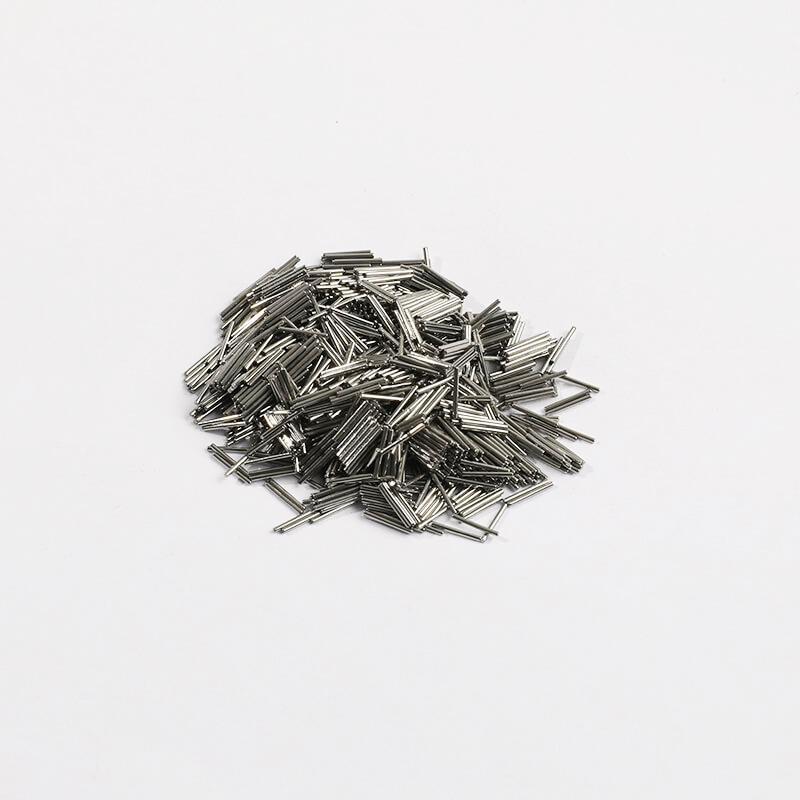
| Magnetic pin or needle charge | Reaching small internal intersections, radial holes and thread entries on small precision parts such as spools, sleeves and drilled fittings | Limited by part size and shape, pins must be retrieved and inspected for breakage, and the result depends heavily on fixture and field design |
A burr can be bent flat instead of removed, and a bent burr is more dangerous than an obvious one. Light contact rolls a thin lip over the edge and blends it into the surface; under a bench light the edge looks finished, while the root is still attached and now forms a thin flag that can fatigue or break off in service. This is a particular risk on ductile materials, on thread entries, and on edges that were only lightly touched by a refinement pass. Visual inspection alone will not reliably separate a removed burr from a folded one. Use a tactile check with a probe or a lint-free wipe drawn along the edge, look at the edge at magnification under angled light, and take a sectioned or replica sample where the feature is critical.
| Failure mode | Likely cause | How to catch it |
|---|---|---|
| Burr still present on an internal cross-drilling intersection after finishing | No credible access route for the charge, a medium too large to enter the passage, or a cycle too short for the intersection to see enough contact | Borescope the intersection at the agreed angle on sample parts, section one representative part to expose the wall, and compare against the recorded as-received condition |
| Uneven result across a batch, with over-finished edges in one zone and untouched areas in another | Part position in the charge, shielding by fixtures or other parts, a worn charge that cuts differently from a fresh one, or masking that leaked | Mark fixed measurement and inspection points on several parts, compare parts from the top, middle and bottom of the load, and record charge age against the result |
| Media lodged in a cross-drilling, blind tapped hole, keyway, groove or internal passage | Size class chosen against an average feature rather than the smallest one, media fractured into smaller pieces during the cycle, or a secondary burr that closed part of the opening | Borescope agreed passages at a fixed angle, pin gauge every tapped hole, count the charge in and out where practical, flush through a filter and inspect the residue, and compare part mass before and after |
| Staining, pitting or a corrosion question on a hardened high-strength part after a wet cycle | Acid-bearing compound or contaminated rinse water, long dwell between finishing and drying, or no protective rinse for the interval before the buyer's next operation | Inspect within an agreed interval after drying, wipe a defined area with a white cloth, compare against a retained reference, and route any embrittlement question to whoever owns the downstream coating or plating specification |
London's published trade profile is services-led rather than goods-led: ONS estimates place London's total trade surplus at £59.4 billion in 2023, with services exports of £213.1 billion, while ONS also records the capital as having the value of services exports higher than any UK region in 2023. The Greater London Authority publishes the city's data through the London Datastore, which holds over a thousand datasets on the capital. Deep-sea container freight for the capital region is handled by Thames-side terminals such as DP World's London Gateway rather than by inner-London wharves.
The nearest part of that base to this brief is food: ONS records London as the UK region with the highest total trade surplus in 2023, reflecting the scale of the capital's traded-goods and services economy including its consumer and food supply base.
London's published trade profile is dominated by services rather than by goods production, so finishing capacity serving the capital is generally not located in the capital. Deburring, edge and cleanliness requirements for London-specified work therefore have to be written into the purchase specification and the technical file, with an acceptance test agreed in advance, rather than settled against an assumed local plant practice.
A London-based buyer should decide up front whether the finishing step will run in-house or at a supplier, and write the edge or cleanliness acceptance test into the purchase order, because the equipment is imported and the technical file and Declaration of Conformity must be held by a manufacturer or a UK-established economic operator.
Freight context: London Gateway (DP World), deep-sea container terminal on the Thames, Thames-side port estate controlled under the Port of London Authority regime. ONS records London as the UK region with the highest total trade surplus in 2023 (£59.4 billion) and shows the capital importing £89.8 billion of goods against £41.8 billion of goods exports, so incoming machinery and media for London buyers are landed and cleared outside the capital, principally at Thames-side deep-sea terminals.
China does not appear in the alphabetical list of trade agreements in effect published by the Department for Business and Trade, so Chinese-origin machinery imported into the UK cannot claim a preferential agreement rate. Duty is instead determined by the commodity code declared on the import declaration, and the UK's customs authority is HM Revenue and Customs (HMRC), which ONS also names as the largest single data source behind UK trade-in-goods statistics. Because a GB-prefixed EORI number is a precondition for importing into England, Scotland or Wales, a Chinese seller's UK buyer must already hold that registration before any machine ships.
English is the working language of contracts, drawings and conformity paperwork, so quotations, technical files and Declarations of Conformity should be supplied in English. UK manufacturers have now recovered above 2019 output levels in every English region and devolved nation except Northern Ireland, and the sector is concentrated in food and drink and transport equipment, with the North West the largest manufacturing region by total output. Buyers typically expect the UKCA/CE route, a Declaration of Conformity and a UK-established economic operator to be identified before order, and they need commercial invoices, customs declarations and the C79 retained in a form their finance team can use for import VAT recovery. No source verified in this research establishes a mandated payment instrument, so payment structure should be treated as commercial negotiation rather than a regulatory requirement.
SurfacePolish supplies from Xiamen, China. The buyer's own destination rules, conformity marking, tariff classification and documentation responsibilities stay with the buyer; confirm them against the authorities named above before ordering.
Write acceptance around measurement locations, not around a single number for the part. Mass finishing produces a gradient: an edge or a corner receives far more work than a flat face, and a recessed or shielded area receives less. A roughness value quoted without a location, a parameter, a cut-off length and an evaluation direction cannot be reproduced by anyone else and cannot be defended later. For each controlled surface, name the feature, the position on it, the parameter, the cut-off, the evaluation length and the direction relative to the machining lay. Reference the surface texture convention the buyer already uses, such as the ISO 4287 and ISO 4288 families or ASME B46.1, rather than inventing a house definition. Agree the instrument before the first part is measured.
Consistency in production comes from a maintenance schedule for the consumables, not from locking the machine settings. Compound concentration drifts as it is carried out on parts and as the bath is topped up with water; media wears and breaks; fines accumulate in the bath and in the rinse; screens clog. Each of those changes the process gradually, so the first sign is usually a slow trend in edge condition or surface result rather than a sudden failure. Set the schedule before production starts: how often concentration and pH are checked and corrected, when the charge is screened, when media is measured against the specified size class and topped up or replaced, when the bath is dumped and the machine purged, and when the rinse water is changed.



Size the charge well below the smallest opening it could enter, and treat every passage as a retrieval point rather than assuming it stays clear. List the tightest hole, slot, thread and cross-drilling first, then choose a size class against that geometry instead of the average part. Screen the working charge, because fractured media produces smaller pieces that defeat the original sizing. Plan detection: a borescope at an agreed angle, a pin gauge in every tapped hole, a count of the charge in and out where practical, a flush collected through a filter, and a part mass check. For London buyers preparing a trial, include the smallest passage.
Mass finishing removes material mainly at edges and corners, so a critical dimension across a flat face usually moves very little, but thin and slender parts can distort. Part-on-part impacts, fixture pressure and long cycles in a high-energy machine can dish a heat-exchanger plate, bend a thin diaphragm or spring a long unsupported section. The effect depends on section stiffness, load ratio, media mass and support method, and it can be small enough to be missed until assembly. If flatness matters, say so before the trial, nominate the measurement points, and check the same points after finishing rather than judging the plate by eye.
The visible lip is the part of the burr that is easy to see and easy to blend flat. The root is the material still connected to the parent surface underneath it, and it is the part that can break free later as a particle, especially in a flowing gas or hydraulic circuit. A light refinement pass can roll the lip over and make the edge look finished while leaving the root attached. Deburring is therefore judged on whether the root has been removed, which usually means removing a small amount of parent material at the edge rather than only wiping the surface. Agree how that judgement will be made.
Use London, United Kingdom as the destination on the enquiry and state whether the deliverable is equipment, media and compound, a representative sample review or a line concept. A destination does not imply local stock, a local service point or a local delivery time.
London buyers work to the same Great Britain regime as the rest of England: UKCA or CE marking with a Declaration of Conformity, HSE duties on work equipment and machinery, and COSHH for the compounds, media and dust arising from finishing.
Sources were retrieved on 2026-09-29 and describe the local industrial and trade context only. They do not evidence any SurfacePolish project, shipment, installation or service in London.
The buyer must remove machining burrs at the bore edges and gallery entries while dealing with graphite smearing and fine cast-iron dust in the charge.
Send the material, dimensions, approximate weight, batch quantity, the incoming condition and photographs of the difficult features. Mark which features must not be contacted by media and state how the result will be inspected. This form carries source reference PSEO-0228; quote it if you prefer an additional manual reference.
Open the SurfacePolish enquiry form Email a prepared enquiry
No price, lead time, certification or result is promised here. Confirm whether a sample trial is available for the specific part and what the trial can and cannot show.
Page PSEO-0228 · revised 2026-09-29 · cross-border equipment, media and scoped sample review. City context is sourced and cited above.
Use this local checker to identify missing part and inspection information. It prepares a technical-review brief; it does not approve a machine, process recipe or production result.
Complete the part details to prepare a review brief.
Email : info@surface-polish.com


 IPv6 network supported


 +86-592-2381506