A buyer in Sheffield, United Kingdom working on energy equipment has an Inconel turbine disk whose broached rim slot edges need a consistent break without disturbing the profile. SurfacePolish supplies finishing machines, media and compounds across borders and runs a free sample trial, sending representative parts to Xiamen and returning them with an observation record plus a proposed media, compound and cycle direction for the buyer's engineers. This brief is written for a buyer in Sheffield working on energy equipment; it describes equipment, media and a scoped sample review, not a local polishing service.
Which material families and heat-treatment states share the equipment, and what separation is needed to avoid ferrous or graphite carry-over onto stainless parts?
Which edges on this part are functional, such as gasket lands, seat bands, stem guides, metering lands and thread entries, and which only need to be free of a sharp edge?
What is the smallest internal passage, cross-drilling or tapped hole the charge must never plug, and how would a lodged medium be found and removed?
Treat the batch, not the individual part, as the unit that gets controlled. A charge holds a defined mass of parts sharing a material family, a burr condition and an edge requirement. Mix a thin heat-exchanger plate with a heavy valve body and the light part absorbs energy it did not need while the heavy part shields its own critical edges. Batch definition also fixes traceability. If two heats of duplex stainless or two casting lots run together, a defect found later cannot be tied back to a charge, a media age or a compound batch. Keep part numbers, material grades and heat-treatment states in separate runs, label the charge, and record how many parts were loaded and in what orientation.
Every mass-finishing route is also a contact problem. Parts touch each other, the machine wall and any fixture, and each contact is a chance to mark, peen or bend a finished face. Compartmenting a charge, racking parts individually or running a smaller load with more media between parts changes the contact pattern, and it changes throughput in the same move. Where a machined gasket land, a ground spigot or a lapped sealing face must arrive unmarked, decide which faces are allowed to bear contact and design the load around that. A fixture can hold a part out of the mass, but it also shields the area behind it, so the shielded zone has to be finished another way or left as-machined. Record the contact plan with the load.
| Machine route | Where it fits | What it will not do |
|---|---|---|
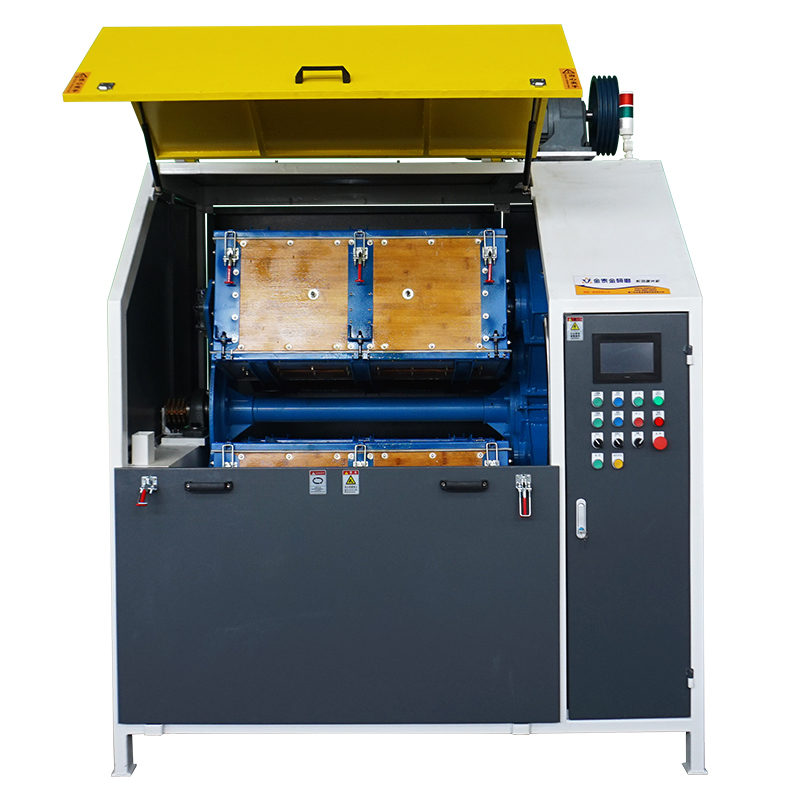
| Grinding finishing machine | Heavier stock removal and thick burr roots on robust parts where clearing material in a shorter cycle matters more than the surface result | Aggressive edge rounding and a coarser surface, so it fits lapped seats, thin sections and tight edge bands poorly |
| Magnetic finishing machine | Small precision parts with internal intersections, radial holes and thread entries that a bulk charge cannot reach | Limited by part size and material, pins must be retrieved and checked, and it does not level or refine large flat surfaces |
| Dry polishing machine and dryer | Drying after a wet cycle and dry light polishing or deburring of small parts, including features where residual moisture is a problem | Removes little or no material, needs dust extraction when dry media is used, and does not replace a cutting stage for a substantial burr |
| Tub vibrator | Long parts such as manifold rails, shafts, long housings and stacked plate sets that cannot tumble in a bowl, with support or rotation along their length | Lower energy per unit area so heavy burrs take longer, and the tub needs floor space plus a defined part support method |
Match media hardness and density to the workpiece, not to the finish someone wants to see. A heavy-cut ceramic cuts carbon and stainless steel edges and also cuts them quickly, which is useful for a thick Poisson burr on a flange and risky on a soft aluminium housing where the same charge peens and smears the surface. Plastic media gives up cut rate to stay gentle on soft alloys and thin sections, and steel media changes the mechanism: instead of cutting, it burnishes and can work-harden a surface. Alumina-bearing or grinding media sit at the aggressive end and suit robust, hard parts with generous edge limits. The decision is a three-way match between part hardness, burr root thickness and the tightest edge allowance. Where a hard body carries a delicate machined land, two stages beat one harder charge.
| Media | Best fit | Watch out for |
|---|---|---|
| Dry media, corn cob granules with a polishing compound | Final dry polish, light edge blending and drying after a wet stage on small parts and fittings | Almost no cutting action, absorbs compound and contaminates quickly, and must be kept separate per material family to avoid carry-over |
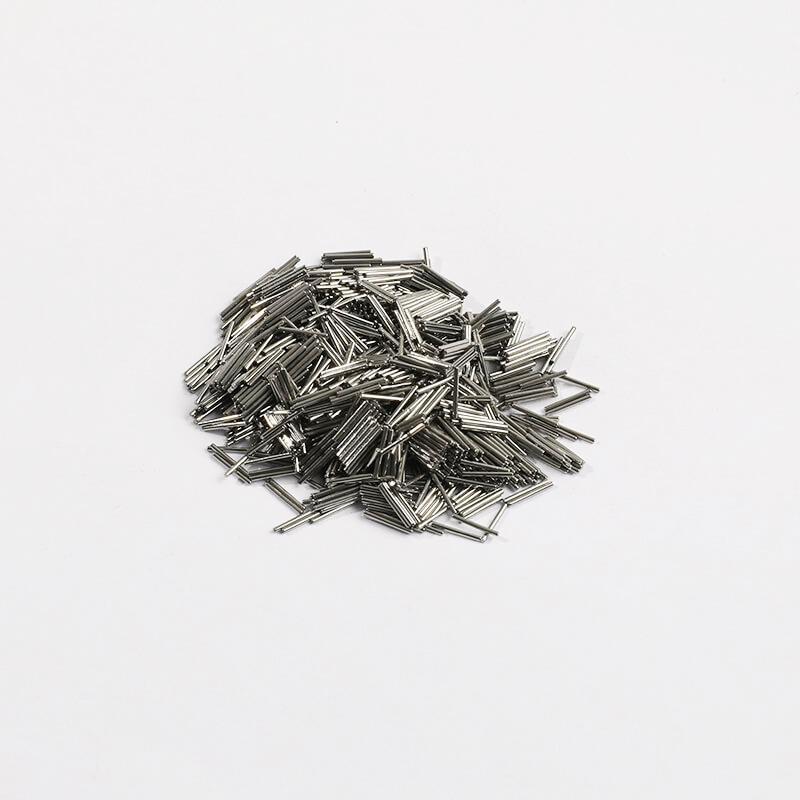
| Hardened steel media, balls and pins | Burnishing and bright finishing of stainless and hardened parts, and light edge consolidation where a cutting action is not wanted | Changes the surface by deformation rather than cutting, can work-harden or smear a soft surface, and needs corrosion protection and separation from acidic compounds |
| Heavy-cut ceramic, angle-cut triangles in a coarse size class | Removing a substantial or thick burr root from open external edges, flange corners, cast bosses and large tapped entries on steel and stainless parts | Cuts controlled edges and gasket lands as readily as burrs, leaves a coarse surface, and lodges in slots whose width approaches the media section |
| Plastic media triangles and pyramids in a soft to medium grade | Deburring aluminium, brass and other soft or thin-walled parts where surface marking and edge rounding must stay minimal | Slow cut rate, media deforms and wears out of shape, and a worn charge behaves noticeably differently from a fresh one |
Mass finishing acts on the whole section, not only on the edge, so flatness and wall thickness deserve their own screening on thin and slender parts. Heat-exchanger plates, thin diaphragms, long unsupported shafts and thin-wall pump components can bend, dish or lose flatness under part-on-part impacts and fixture pressure even when the surface result looks correct. The distortion is often small and shows up later as an assembly problem, a gasket that will not seat, or a plate stack with uneven contact. Fixtures and masking solve some of it but introduce their own marks: a masked face keeps its as-machined condition and may show a boundary where the media reached, and a rack can leave contact witness marks. Screen those outcomes on the drawing.
| Failure mode | Likely cause | How to catch it |
|---|---|---|
| Burr lip folded flat over the edge with the root still attached | Too light a cut for the burr thickness, a refinement-only pass used as the only stage, or a soft ductile material that rolls instead of fracturing | Draw a probe or lint-free wipe along the edge, examine at magnification under angled light, and take a sectioned or moulded replica sample where the feature is critical |
| Staining, pitting or a corrosion question on a hardened high-strength part after a wet cycle | Acid-bearing compound or contaminated rinse water, long dwell between finishing and drying, or no protective rinse for the interval before the buyer's next operation | Inspect within an agreed interval after drying, wipe a defined area with a white cloth, compare against a retained reference, and route any embrittlement question to whoever owns the downstream coating or plating specification |
| Burr still present on an internal cross-drilling intersection after finishing | No credible access route for the charge, a medium too large to enter the passage, or a cycle too short for the intersection to see enough contact | Borescope the intersection at the agreed angle on sample parts, section one representative part to expose the wall, and compare against the recorded as-received condition |
| Media fragments or abrasive fines embedded in a soft surface or machined groove | Impingement from excessive energy or charge mass, fractured media left in the working charge, or cross-contamination from a previous material family | Inspect at magnification under angled light, use a tape lift or solvent wipe on the suspect area, and screen the charge for broken media and accumulated fines |
Sheffield is the lead city of the South Yorkshire Mayoral Combined Authority, which describes its vision as building on the region's strengths in innovation and advanced manufacturing and brings together Barnsley, Doncaster, Rotherham and Sheffield. Invest South Yorkshire presents the region as the UK's first Investment Zone, notes that stainless steel was founded there over 90 years ago, and lists aerospace, automotive, energy, logistics, nuclear and rail among its distinctive capabilities alongside the Advanced Manufacturing Research Centre and the iPort Doncaster intermodal site. The University of Sheffield AMRC works across aerospace, defence and nuclear and clean energy, with capabilities that include subtractive manufacturing, castings, fabrication and automation.
For this brief the relevant part of that base is energy: The AMRC lists 'Nuclear and clean energy' as one of its three sectors, and Invest South Yorkshire lists energy and nuclear among the region's distinctive capabilities and the UKAEA fusion technology facility among its strategic assets.
South Yorkshire's advanced manufacturing base combines hard-metal machining, castings and fabricated assemblies, all of which produce burrs and edge conditions that are controlled before assembly, inspection or coating. Because AMRC's aerospace, defence and nuclear programmes are located in the region, edge and surface requirements on that work stream are usually written as measurable acceptance criteria rather than left to visual judgement.
A Sheffield buyer should fix the edge-quality acceptance criterion - for example a defined edge-break size or a surface-texture parameter - before choosing between vibratory, barrel or disc finishing, because the region's aerospace and nuclear workflows will not accept an undefined 'deburred' requirement.
Freight context: iPort Doncaster (intermodal rail freight site listed by Invest South Yorkshire as a strategic asset), Doncaster Sheffield Airport (held within the South Yorkshire MCA's business portfolio). Invest South Yorkshire lists logistics and rail among the region's distinctive capabilities and publishes an investment portfolio of strategic assets including the iPort Doncaster intermodal site; transport in the region is coordinated by the MCA's Travel South Yorkshire arm, and the MCA holds the Doncaster Sheffield Airport portfolio.
China does not appear in the alphabetical list of trade agreements in effect published by the Department for Business and Trade, so Chinese-origin machinery imported into the UK cannot claim a preferential agreement rate. Duty is instead determined by the commodity code declared on the import declaration, and the UK's customs authority is HM Revenue and Customs (HMRC), which ONS also names as the largest single data source behind UK trade-in-goods statistics. Because a GB-prefixed EORI number is a precondition for importing into England, Scotland or Wales, a Chinese seller's UK buyer must already hold that registration before any machine ships.
Importers need a GB-prefixed Economic Operators Registration and Identification (EORI) number, an import declaration carrying the correct commodity code, and retained commercial invoices plus the Import VAT Certificate (C79) so import VAT can be reclaimed. Machinery placed on the Great Britain market must be marked UKCA or CE: the manufacturer must draw up and retain technical documentation including a Declaration of Conformity, apply the correct marking with identification details, and cooperate with market surveillance; an authorised representative must be established in the UK. Under the Product Safety and Metrology (Amendment) Regulations 2024 the UK continues to recognise CE marking alongside or in place of UKCA for the Great Britain market, so either route can be used for most product types. Duty and import VAT are calculated from the customs value declared, and the commodity code also determines whether an import licence is needed.
SurfacePolish supplies from Xiamen, China. The buyer's own destination rules, conformity marking, tariff classification and documentation responsibilities stay with the buyer; confirm them against the authorities named above before ordering.
Edge acceptance needs a reference object, because words like lightly broken or slightly rounded mean different things to different inspectors. Build a physical or photographic master at a stated magnification: a part or coupon showing the acceptable edge, the borderline case and the reject. For each controlled edge, express the requirement as either an edge break, meaning the sharp corner is removed to a small defined size, or an edge round, meaning a controlled radius band the edge must sit inside. Give a maximum where over-rounding is the risk, and a minimum where the edge must not stay sharp. State how the edge will be checked, whether by radius gauge, optical comparator, moulded replica or tactile comparison against the master, and at what frequency.
A sample trial reports what happened to the parts that were tested under the settings that were used. It cannot establish capability across other heats, casting lots or machining sources; it cannot demonstrate uniformity across a full production charge, because a trial load is small; and it cannot show how the process behaves after a charge has worn, how a coating or weld will take to the finished surface, how the part will behave in a corrosive or high-cycle service environment, or whether any cleanliness, hydrogen or regulatory requirement is met. Those questions belong to the buyer's own qualification. Close the gap deliberately: define a verification batch on production equipment, decide how many charges will be monitored, and state in advance what result would stop the route.

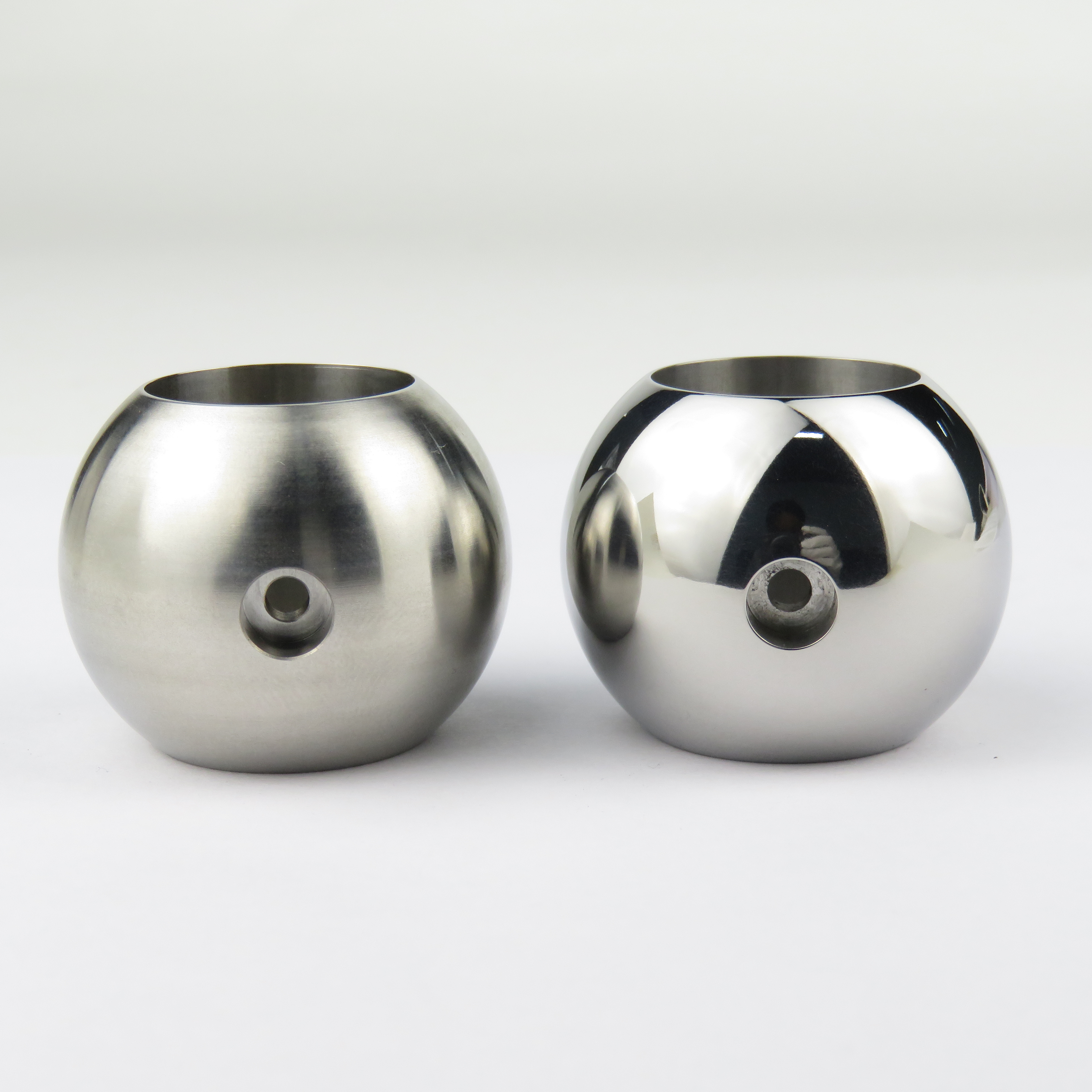
Size the charge well below the smallest opening it could enter, and treat every passage as a retrieval point rather than assuming it stays clear. List the tightest hole, slot, thread and cross-drilling first, then choose a size class against that geometry instead of the average part. Screen the working charge, because fractured media produces smaller pieces that defeat the original sizing. Plan detection: a borescope at an agreed angle, a pin gauge in every tapped hole, a count of the charge in and out where practical, a flush collected through a filter, and a part mass check. For Sheffield buyers preparing a trial, include the smallest passage.
Mass finishing removes material mainly at edges and corners, so a critical dimension across a flat face usually moves very little, but thin and slender parts can distort. Part-on-part impacts, fixture pressure and long cycles in a high-energy machine can dish a heat-exchanger plate, bend a thin diaphragm or spring a long unsupported section. The effect depends on section stiffness, load ratio, media mass and support method, and it can be small enough to be missed until assembly. If flatness matters, say so before the trial, nominate the measurement points, and check the same points after finishing rather than judging the plate by eye.
An edge break means the sharp corner is removed, usually to a small defined size, and the intent is that no sharp edge or wire edge remains. An edge round means the edge is held inside a controlled radius band, often with both a minimum and a maximum, because the function depends on the contour, for example where a seal seats or a coating must cover the edge uniformly. Specifying only the word deburr leaves the size open, and mass finishing rounds every edge in proportion to the energy used. For each controlled edge, state which of the two applies, the size or band, and how it will be measured.
Use Sheffield, United Kingdom as the destination on the enquiry and state whether the deliverable is equipment, media and compound, a representative sample review or a line concept. A destination does not imply local stock, a local service point or a local delivery time.
Equipment placed on the Great Britain market needs UKCA or CE marking with a Declaration of Conformity, and HSE's work equipment and machinery and COSHH regimes apply on site. For aerospace and nuclear work in the region, buyers generally flow down the prime contractor's quality and assurance requirements rather than relying on general machining tolerances alone.
Sources were retrieved on 2026-09-29 and describe the local industrial and trade context only. They do not evidence any SurfacePolish project, shipment, installation or service in Sheffield.
The buyer must break the sharp slot edges consistently around the disk without reworking the broached profile or rounding the bolted flange face.
Send the material, dimensions, approximate weight, batch quantity, the incoming condition and photographs of the difficult features. Mark which features must not be contacted by media and state how the result will be inspected. This form carries source reference PSEO-0238; quote it if you prefer an additional manual reference.
Open the SurfacePolish enquiry form Email a prepared enquiry
No price, lead time, certification or result is promised here. Confirm whether a sample trial is available for the specific part and what the trial can and cannot show.
Page PSEO-0238 · revised 2026-09-29 · cross-border equipment, media and scoped sample review. City context is sourced and cited above.
Use this local checker to identify missing part and inspection information. It prepares a technical-review brief; it does not approve a machine, process recipe or production result.
Complete the part details to prepare a review brief.
Email : info@surface-polish.com


 IPv6 network supported


 +86-592-2381506