A buyer in Maastricht, Netherlands in energy equipment has a forged F316 weld-neck flange whose bore and bolt-hole entry burrs must be removed without disturbing the serrated raised face. SurfacePolish supplies finishing machines, media and compounds across borders and runs a free sample trial, returning representative parts from Xiamen with an observation record and a proposed media, compound and cycle direction. This brief is written for a buyer in Maastricht working on energy equipment; it describes equipment, media and a scoped sample review, not a local polishing service.
Is deburring done before or after heat treatment, and in what metallurgical and surface condition does the part arrive at the finishing step?
Does the drawing state an edge break or an edge round at each controlled edge, and what maximum radius applies where over-rounding is the risk?
Which edges on this part are functional, such as gasket lands, seat bands, stem guides, metering lands and thread entries, and which only need to be free of a sharp edge?
Name the burr before choosing a cut energy. A Poisson burr pushed sideways by tool pressure sits along a machined edge; a rollover caps the edge where the tool exits; a tear leaves a ragged fragment on a ductile material; and a secondary burr forms on the far side of a drilled or tapped feature. They do not respond to the same charge. A thin rollover on stainless can be blended away by a light refinement pass, while a thick tear on a casting may need a heavier cutting stage before any edge blending begins. What matters is the burr root, the material still attached below the visible lip. An edge that looks clean can still carry a root that later releases a particle into a hydraulic or gas circuit. Record how that judgement was made.
Internal intersections are a different problem from external surface refinement, and no amount of extra energy in a bowl fixes them. A cross-drilling meeting a main bore creates a burr on the inside wall that external media rarely reaches. Access routes include a small media size class that can enter the passage, magnetic finishing where a pin or needle charge is driven into the feature on small parts, or a targeted mechanical method outside mass finishing. Each has a boundary: a size class small enough to enter a passage is also small enough to lodge in it, magnetic pins are limited by part size and by retrieval, and blind features with no exit cannot be flushed clean. Decide per feature which access route is credible, and how the result will be seen.
| Machine route | Where it fits | What it will not do |
|---|---|---|
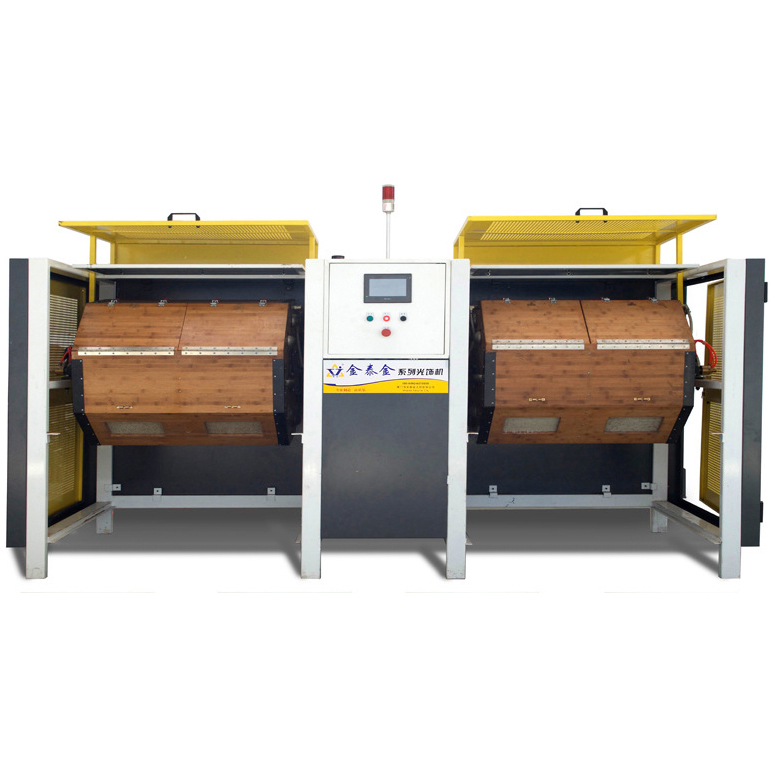
| Vibratory finishing machine (bowl) | General deburring and refinement of valve bodies, flange plates, pump components and fittings that fit the bowl and can move freely in the charge | No access to deep internal passages, constant part-on-part contact, and finished faces need separation or fixture protection |
| Barrel finishing machine and rotary barrel tumbler | Gentle, low-impingement deburring of small, fragile or precision parts and mixed fitting batches where edge protection matters more than speed | Long cycles, no visibility while the barrel runs, and internal features can collect media and compound that must be retrieved at unload |
| Grinding finishing machine | Heavier stock removal and thick burr roots on robust parts where clearing material in a shorter cycle matters more than the surface result | Aggressive edge rounding and a coarser surface, so it fits lapped seats, thin sections and tight edge bands poorly |
| Magnetic finishing machine | Small precision parts with internal intersections, radial holes and thread entries that a bulk charge cannot reach | Limited by part size and material, pins must be retrieved and checked, and it does not level or refine large flat surfaces |
The compound is a chemistry decision that outlives the finishing cycle. It controls cutting behaviour, keeps the media and the part clean, suspends fines, and determines what film remains on the part when it leaves the machine. Acidic families clean and brighten some stainless grades but leave a surface that must be rinsed and neutralised carefully, and they are the wrong choice where a hardened, high-strength steel later sees a plating or coating step. Alkaline and neutral cleaning families are gentler on mixed loads but may not hold the same cutting performance. Silicate-bearing or film-forming compounds can leave a tenacious residue in a gasket groove or a blind hole. Check compatibility in both directions: the material being finished, and the residue against the buyer's next operation.
| Media | Best fit | Watch out for |
|---|---|---|
| Fine ceramic spheres or small porcelain shapes in a light size class | Refinement and edge blending after a cutting stage, and light deburring of small fittings, thread entries and tighter external geometry | Small sizes enter and retain in fine passages and cross-drillings, and the charge changes size and cut rate as it wears |
| Plastic media triangles and pyramids in a soft to medium grade | Deburring aluminium, brass and other soft or thin-walled parts where surface marking and edge rounding must stay minimal | Slow cut rate, media deforms and wears out of shape, and a worn charge behaves noticeably differently from a fresh one |
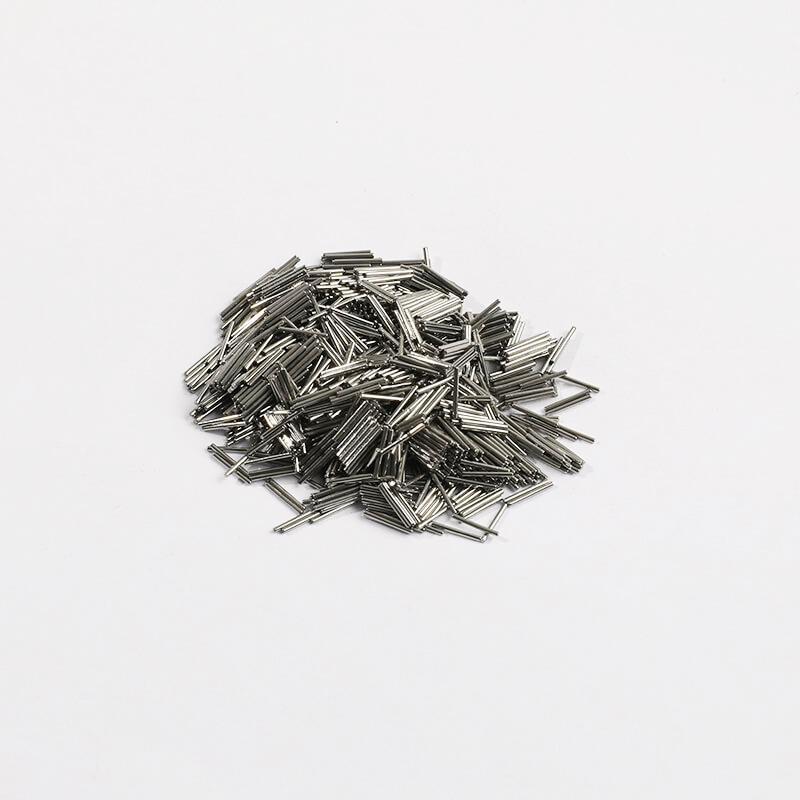
| Magnetic pin or needle charge | Reaching small internal intersections, radial holes and thread entries on small precision parts such as spools, sleeves and drilled fittings | Limited by part size and shape, pins must be retrieved and inspected for breakage, and the result depends heavily on fixture and field design |
| Heavy-cut ceramic, angle-cut triangles in a coarse size class | Removing a substantial or thick burr root from open external edges, flange corners, cast bosses and large tapped entries on steel and stainless parts | Cuts controlled edges and gasket lands as readily as burrs, leaves a coarse surface, and lodges in slots whose width approaches the media section |
Mass finishing acts on the whole section, not only on the edge, so flatness and wall thickness deserve their own screening on thin and slender parts. Heat-exchanger plates, thin diaphragms, long unsupported shafts and thin-wall pump components can bend, dish or lose flatness under part-on-part impacts and fixture pressure even when the surface result looks correct. The distortion is often small and shows up later as an assembly problem, a gasket that will not seat, or a plate stack with uneven contact. Fixtures and masking solve some of it but introduce their own marks: a masked face keeps its as-machined condition and may show a boundary where the media reached, and a rack can leave contact witness marks. Screen those outcomes on the drawing.
| Failure mode | Likely cause | How to catch it |
|---|---|---|
| Thread entry deformation, a damaged lead thread or a burr folded into the first threads | Aggressive media at an unprotected thread entry, media lodging in the thread and working against it, or handling damage at load and unload | Run a go and no-go thread gauge on every tapped feature in the sample, inspect the first threads under magnification, and check the entry chamfer against the drawing |
| Controlled edge rounded past the drawing limit, or an edge left sharper than the specified break | Cycle too long or energy too high for the edge allowance, dense or coarse media, an unmasked functional edge, or a drawing requirement that never stated a maximum radius | Measure a defined edge feature before and after with a radius gauge, optical comparator or moulded replica, compare against the maximum on the drawing, and check the same feature on parts from different positions in the load |
| Staining, pitting or a corrosion question on a hardened high-strength part after a wet cycle | Acid-bearing compound or contaminated rinse water, long dwell between finishing and drying, or no protective rinse for the interval before the buyer's next operation | Inspect within an agreed interval after drying, wipe a defined area with a white cloth, compare against a retained reference, and route any embrittlement question to whoever owns the downstream coating or plating specification |
| Uneven result across a batch, with over-finished edges in one zone and untouched areas in another | Part position in the charge, shielding by fixtures or other parts, a worn charge that cuts differently from a fresh one, or masking that leaked | Mark fixed measurement and inspection points on several parts, compare parts from the top, middle and bottom of the load, and record charge age against the result |
Maastricht's economy combines a life-sciences campus with an established production base in the city and its surrounding region. The Brightlands Maastricht Health Campus is part of the Brightlands open-innovation community in Limburg, which reports over 32,000 innovative entrepreneurs, researchers and students working on sustainability, health and digitisation, and the campus concentrates researchers, entrepreneurs and students on healthcare, medicine and life sciences with imaging and analytical facilities used by medical start-ups. Alongside that, the Maastricht Maakt industry platform represents 16 production companies in the city, with employers including Tata Steel, Sappi, the Regout Group, SteelSolutions, Mosa, FENZI AGT and SunChemical, and says its operators, technicians and logistics staff work in sectors such as chemistry, food and production. Sappi's Maastricht mill employs nearly 500 people and produces around 260,000 tons of coated woodfree paper and paperboard a year. Maastricht Aachen Airport is part of the national aviation infrastructure and, after Schiphol, the only Dutch airport with a cargo function; the province of Limburg is a shareholder and funds the airport.
The nearest part of that base to this brief is machinery: The Maastricht Maakt industry platform represents 16 production companies in the city, whose work it describes as machine-based and skilled manufacturing, and its listed employers include Tata Steel, Sappi, the Regout Group, SteelSolutions, Mosa, FENZI AGT and SunChemical.
Maastricht and the surrounding Limburg region combine medical-technology work, steel and metal processing, paper production and glass and food manufacturing. Medical-technology and life-sciences activity on the Brightlands Maastricht Health Campus involves stainless and titanium instruments, implants, device housings and precision components, where deburring, edge rounding, passivation and residue-free cleaning are quality requirements, while the city's steel, metal and equipment producers need burr and edge control on machined and cut parts before assembly, coating or further processing. Limburg's wider Brightlands network also includes the Chemelot chemical campus, which adds stainless process and laboratory equipment with comparable cleanliness and corrosion expectations.
A buyer here should settle the documentation and cleanliness standard first, because medical and life-sciences supply chains normally require validated, repeatable processes with defined residue limits, whereas general metal parts usually need no more than a specified burr height and Ra.
Freight context: Maastricht Aachen Airport (cargo function). Maastricht Aachen Airport is the only Dutch airport other than Schiphol with a cargo function and is part of the national aviation infrastructure, which gives the region an air-freight option for urgent parts or samples; the province of Limburg is a shareholder and has funded infrastructure and route development. Machinery arriving by sea is declared to Dutch Customs at its EU point of entry, and the importer needs an EORI number.
Goods entering the Netherlands from outside the EU must be declared to Dutch Customs (Douane, part of the Belastingdienst); the importer needs an EORI number, import duty is calculated on the customs value (goods value plus transport and insurance to the EU external border), and import VAT is paid at the border unless an article 23 permit or a fiscal representative is used. CE marking is mandatory for most machinery placed on the EEA market: the Machinery Regulation replaced the Machinery Directive and manufacturers must comply with the new requirements by 20 January 2027. The importer must verify that the conformity assessment was carried out correctly, that CE marking is applied properly, that the technical file is present and complete, and that the user manual is supplied in the correct language; the manufacturer's EC Declaration of Conformity must be kept. Dutch companies imported over EUR 140 billion of machinery and appliances in 2024, 24% of total Dutch goods imports.
The Dutch standards body is NEN (Nederlands Normalisatie-instituut), which publishes and maintains the NEN and NEN-EN-ISO standards; the content of a standard is set by a NEN standards committee made up of the organisations concerned, not by NEN itself. For surface finishing NEN publishes NEN-EN-ISO 2080, which defines the terms for the general types of surface-finishing processes with emphasis on practical use in metal finishing, under the standards committee for metallic coatings and corrosion of metals and alloys. Machinery safety, EMC, low-voltage, ATEX, RoHS and ecodesign requirements reach Dutch buyers through the CE directives and regulations referenced by KVK, with the Machinery Regulation applying from 20 January 2027.
SurfacePolish supplies from Xiamen, China. The buyer's own destination rules, conformity marking, tariff classification and documentation responsibilities stay with the buyer; confirm them against the authorities named above before ordering.
Write acceptance around measurement locations, not around a single number for the part. Mass finishing produces a gradient: an edge or a corner receives far more work than a flat face, and a recessed or shielded area receives less. A roughness value quoted without a location, a parameter, a cut-off length and an evaluation direction cannot be reproduced by anyone else and cannot be defended later. For each controlled surface, name the feature, the position on it, the parameter, the cut-off, the evaluation length and the direction relative to the machining lay. Reference the surface texture convention the buyer already uses, such as the ISO 4287 and ISO 4288 families or ASME B46.1, rather than inventing a house definition. Agree the instrument before the first part is measured.
Consistency in production comes from a maintenance schedule for the consumables, not from locking the machine settings. Compound concentration drifts as it is carried out on parts and as the bath is topped up with water; media wears and breaks; fines accumulate in the bath and in the rinse; screens clog. Each of those changes the process gradually, so the first sign is usually a slow trend in edge condition or surface result rather than a sudden failure. Set the schedule before production starts: how often concentration and pH are checked and corrected, when the charge is screened, when media is measured against the specified size class and topped up or replaced, when the bath is dumped and the machine purged, and when the rinse water is changed.

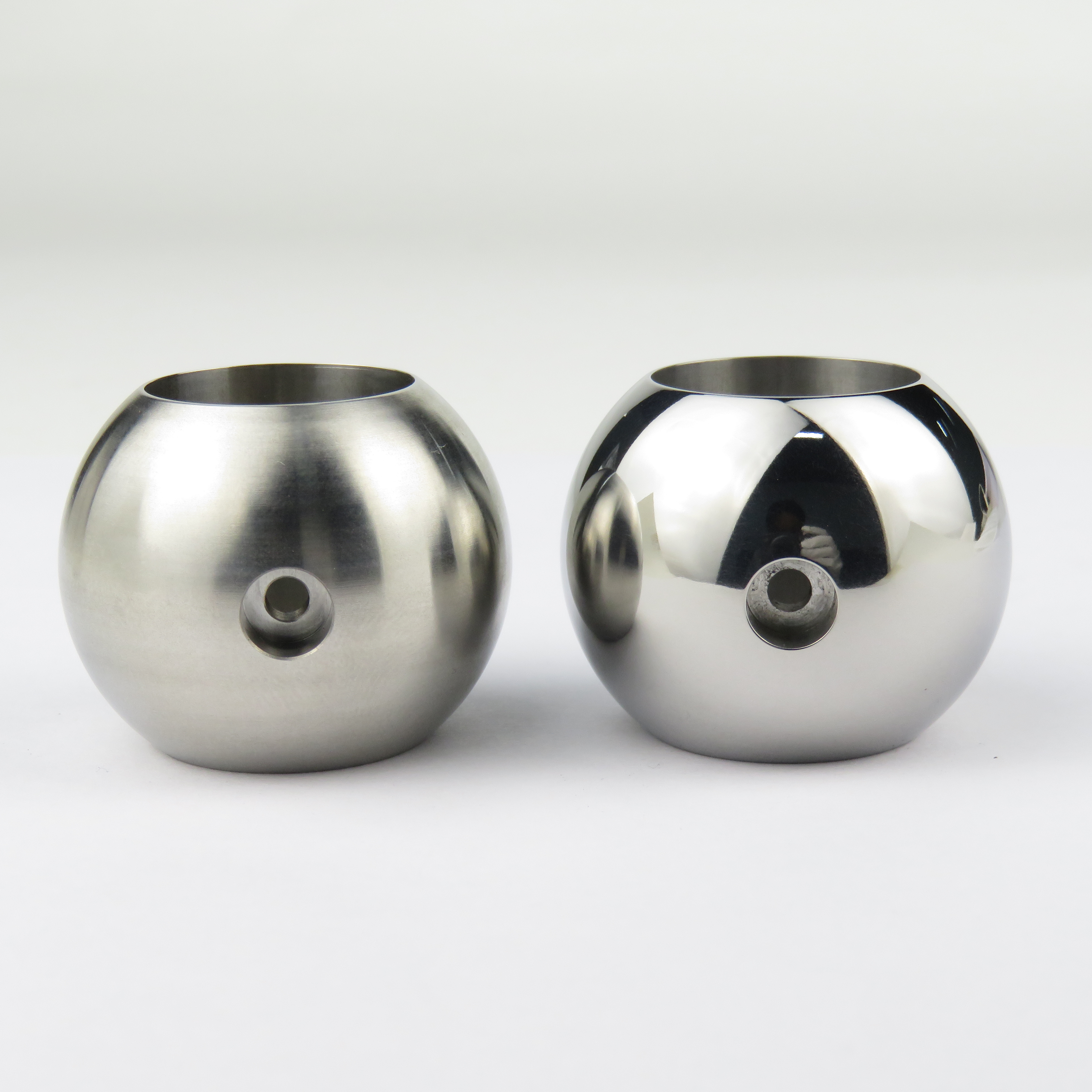
Mass finishing removes material mainly at edges and corners, so a critical dimension across a flat face usually moves very little, but thin and slender parts can distort. Part-on-part impacts, fixture pressure and long cycles in a high-energy machine can dish a heat-exchanger plate, bend a thin diaphragm or spring a long unsupported section. The effect depends on section stiffness, load ratio, media mass and support method, and it can be small enough to be missed until assembly. If flatness matters, say so before the trial, nominate the measurement points, and check the same points after finishing rather than judging the plate by eye.
Protect it deliberately rather than relying on a gentle setting. Options include masking or plugging the face, fixturing the part so the land is held out of the mass, orienting the part so the land sees less contact, or choosing a media shape and size that blends rather than digs. Each has a cost: a masked face keeps its as-machined condition and can show a boundary line, a fixture shields the area behind it, and fixturing reduces how many parts fit in a load. Mark the land on the drawing, give it a maximum edge radius, and agree how it will be checked. Test the arrangement on the real part.
They can be run in the same equipment, but not safely in the same charge without a cleaning discipline. Carbon steel and cast iron leave fines and graphite that transfer to stainless parts, show up as rust staining or embedded particles, and are difficult to see at the machine. The practical approach is a dedicated charge per material family where volume allows, or a purge between families: run the machine with media and clean compound, flush the rinse tank, change or clean the drying medium and cloths, and inspect the media for embedded ferrous fines. Tell the finishing route which families will alternate, because changeover time is a real cost.
Use Maastricht, Netherlands as the destination on the enquiry and state whether the deliverable is equipment, media and compound, a representative sample review or a line concept. A destination does not imply local stock, a local service point or a local delivery time.
Buyers here would reference the CE machinery regime (Machinery Regulation from 20 January 2027) and the Dutch/EN-ISO surface-finishing standards published by NEN, such as NEN-EN-ISO 2080. For medical and life-sciences customers the binding requirements are normally the customer's own cleanliness and validation specification, with ISO 13485 as the customary quality-system reference for medical devices.
Sources were retrieved on 2026-09-29 and describe the local industrial and trade context only. They do not evidence any SurfacePolish project, shipment, installation or service in Maastricht.
The buyer must remove the machining burr at the bore and bolt-hole entries while leaving the serrated raised face untouched.
Send the material, dimensions, approximate weight, batch quantity, the incoming condition and photographs of the difficult features. Mark which features must not be contacted by media and state how the result will be inspected. This form carries source reference PSEO-0698; quote it if you prefer an additional manual reference.
Open the SurfacePolish enquiry form Email a prepared enquiry
No price, lead time, certification or result is promised here. Confirm whether a sample trial is available for the specific part and what the trial can and cannot show.
Page PSEO-0698 · revised 2026-09-29 · cross-border equipment, media and scoped sample review. City context is sourced and cited above.
Use this local checker to identify missing part and inspection information. It prepares a technical-review brief; it does not approve a machine, process recipe or production result.
Complete the part details to prepare a review brief.
Email : info@surface-polish.com


 IPv6 network supported


 +86-592-2381506