A buyer in Stuttgart, Germany working on energy equipment has an Inconel turbine disk whose broached rim slot edges need a consistent break without disturbing the profile. SurfacePolish supplies finishing machines, media and compounds across borders and runs a free sample trial, sending representative parts to Xiamen and returning them with an observation record plus a proposed media, compound and cycle direction for the buyer's engineers. This brief is written for a buyer in Stuttgart working on energy equipment; it describes equipment, media and a scoped sample review, not a local polishing service.
What is the smallest internal passage, cross-drilling or tapped hole the charge must never plug, and how would a lodged medium be found and removed?
Is deburring done before or after heat treatment, and in what metallurgical and surface condition does the part arrive at the finishing step?
Does the drawing state an edge break or an edge round at each controlled edge, and what maximum radius applies where over-rounding is the risk?
Name the burr before choosing a cut energy. A Poisson burr pushed sideways by tool pressure sits along a machined edge; a rollover caps the edge where the tool exits; a tear leaves a ragged fragment on a ductile material; and a secondary burr forms on the far side of a drilled or tapped feature. They do not respond to the same charge. A thin rollover on stainless can be blended away by a light refinement pass, while a thick tear on a casting may need a heavier cutting stage before any edge blending begins. What matters is the burr root, the material still attached below the visible lip. An edge that looks clean can still carry a root that later releases a particle into a hydraulic or gas circuit. Record how that judgement was made.
High-pressure routes, disc machines, grinding finishing machines and centrifugal barrels, earn their place when a heavy burr or a large batch makes the gentle options impractical. The trade is paid in three currencies. Edge rounding accelerates, so controlled edges need masking, orientation control or a shorter cycle. Distortion risk rises on thin walls, thin plates and unsupported sections, because the same pressure that cuts a burr can also move material. And the charge has to be balanced: centrifugal barrels in particular need an even barrel weight and a planned stop time, or the load shifts and results vary between barrels. Ask whether the part family has enough edge tolerance and section stiffness to absorb that energy. If it does not, the gentler route usually costs less overall.
| Machine route | Where it fits | What it will not do |
|---|---|---|
| Tub vibrator | Long parts such as manifold rails, shafts, long housings and stacked plate sets that cannot tumble in a bowl, with support or rotation along their length | Lower energy per unit area so heavy burrs take longer, and the tub needs floor space plus a defined part support method |
| Vibratory finishing machine (bowl) | General deburring and refinement of valve bodies, flange plates, pump components and fittings that fit the bowl and can move freely in the charge | No access to deep internal passages, constant part-on-part contact, and finished faces need separation or fixture protection |
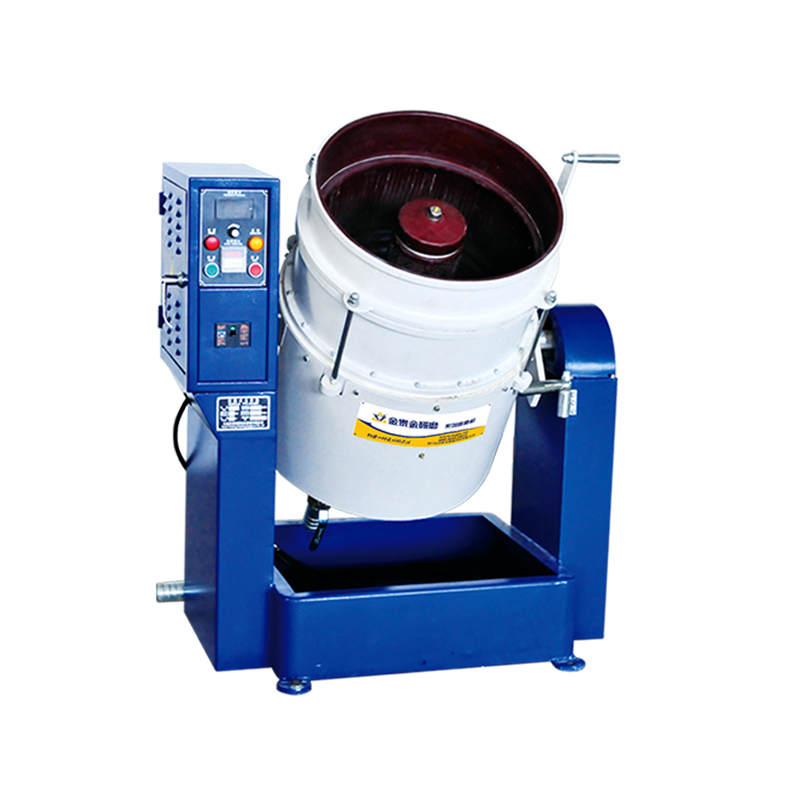
| Centrifugal barrel finishing machine | Short high-pressure cycles on small precision parts such as spools, sleeves, small valve bodies and drilled fittings | Rounds edges and can distort thin unsupported sections quickly, and needs balanced barrel loading, controlled stop time and careful fixturing |
| Disc finishing machine | Fast, high-energy cycles on small to medium robust parts, including batches of fittings and small housings that need a quick cut | High contact pressure rounds edges quickly and can mark or deform thin and soft parts, with results sensitive to load and disc condition |
Compound delivered at the wrong concentration or flow makes the same media behave like a different charge. Too little and the abrasive cut becomes dry and marking increases; too much and cutting slows while foam and carry-over rise. Flow rate matters as much as dose, because it is the flow that carries fines away from the part and keeps the working zone consistent across a long cycle. Water quality belongs in the same discussion: hardness, pH and dissolved solids in the make-up water shift the compound's behaviour, and a plant that changes its water source can change its results without touching a machine setting. Where the fluid is recirculated, filtration and turnover decide how much swarf and broken media stay in suspension and how often the bath is dumped.
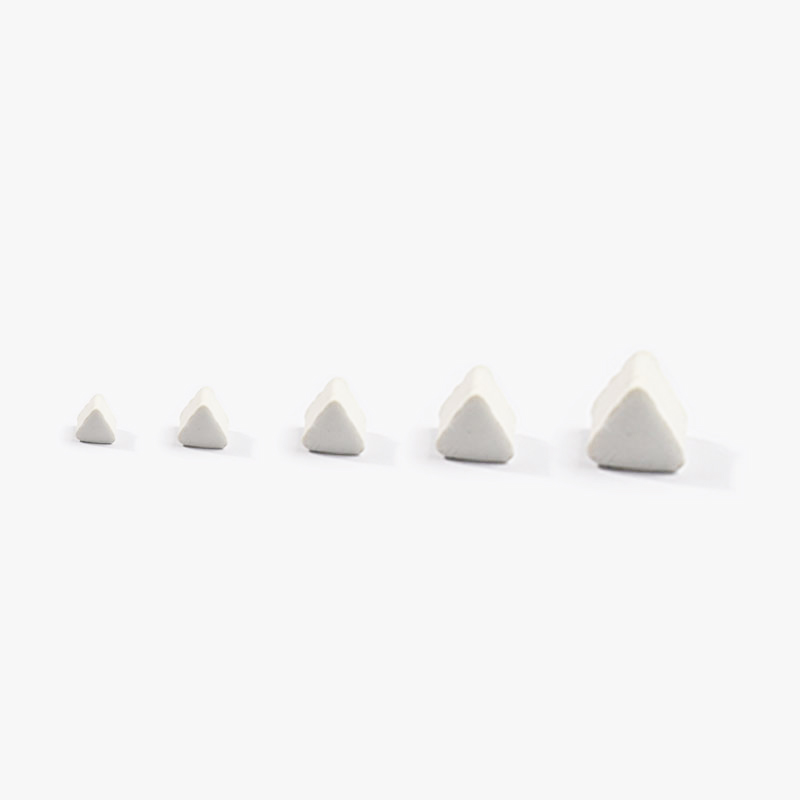
| Media | Best fit | Watch out for |
|---|---|---|
| Hardened steel media, balls and pins | Burnishing and bright finishing of stainless and hardened parts, and light edge consolidation where a cutting action is not wanted | Changes the surface by deformation rather than cutting, can work-harden or smear a soft surface, and needs corrosion protection and separation from acidic compounds |
| Heavy-cut ceramic, angle-cut triangles in a coarse size class | Removing a substantial or thick burr root from open external edges, flange corners, cast bosses and large tapped entries on steel and stainless parts | Cuts controlled edges and gasket lands as readily as burrs, leaves a coarse surface, and lodges in slots whose width approaches the media section |
| Plastic media triangles and pyramids in a soft to medium grade | Deburring aluminium, brass and other soft or thin-walled parts where surface marking and edge rounding must stay minimal | Slow cut rate, media deforms and wears out of shape, and a worn charge behaves noticeably differently from a fresh one |
| Alumina-bearing grinding media in a dense ceramic bond | Heavy stock removal and consistent cutting on hard or work-hardened parts with generous edge limits, such as robust flanges and heavy fittings | High removal energy rounds functional edges quickly and is a poor match for thin plates, thin-wall castings and lapped sealing faces |
A burr can be bent flat instead of removed, and a bent burr is more dangerous than an obvious one. Light contact rolls a thin lip over the edge and blends it into the surface; under a bench light the edge looks finished, while the root is still attached and now forms a thin flag that can fatigue or break off in service. This is a particular risk on ductile materials, on thread entries, and on edges that were only lightly touched by a refinement pass. Visual inspection alone will not reliably separate a removed burr from a folded one. Use a tactile check with a probe or a lint-free wipe drawn along the edge, look at the edge at magnification under angled light, and take a sectioned or replica sample where the feature is critical.
| Failure mode | Likely cause | How to catch it |
|---|---|---|
| Ferrous specking, rust staining or graphite smearing on stainless parts after a shared run | Carbon steel or cast iron fines carried over in the charge, machine, rinse tank or drying cloth, or a purge that was too short between material families | Compare against a retained reference part, inspect suspect areas at magnification, examine the charge and rinse for embedded ferrous fines, and review the changeover record against the batch history |
| Thread entry deformation, a damaged lead thread or a burr folded into the first threads | Aggressive media at an unprotected thread entry, media lodging in the thread and working against it, or handling damage at load and unload | Run a go and no-go thread gauge on every tapped feature in the sample, inspect the first threads under magnification, and check the entry chamfer against the drawing |
| Media fragments or abrasive fines embedded in a soft surface or machined groove | Impingement from excessive energy or charge mass, fractured media left in the working charge, or cross-contamination from a previous material family | Inspect at magnification under angled light, use a tape lift or solvent wipe on the suspect area, and screen the charge for broken media and accumulated fines |
| Burr lip folded flat over the edge with the root still attached | Too light a cut for the burr thickness, a refinement-only pass used as the only stage, or a soft ductile material that rolls instead of fracturing | Draw a probe or lint-free wipe along the edge, examine at magnification under angled light, and take a sectioned or moulded replica sample where the feature is critical |
The Stuttgart region is a statutory regional body covering 179 municipalities whose industrial profile is built on mobility, mechanical engineering, bio/medical technology and aerospace. Region Stuttgart describes the area as the birthplace region of the automobile and the location of what it calls Europe's most significant automotive cluster, with Mercedes-Benz, Porsche, Bosch, Mahle, Eberspächer, Mann+Hummel and Vector Informatik among the internationally active companies rooted there (s2). Mechanical engineering in the region is dominated by special-purpose machines and single-unit production, and generates close to one third of Baden-Württemberg's turnover in the sector, with an export ratio above 65 percent (s1). Bio- and medical technology is clustered across Stuttgart, Tübingen, Reutlingen and Neckar Alb, with more than 200 companies and BioRegio STERN as the sector contact point (s3), and aerospace is represented by firms such as Tesat-Spacecom and Thales alongside small and medium-sized producers (s4). The city itself presents Stuttgart as one of Germany's strongest export metropolitan regions (s5).
The nearest part of that base to this brief is aerospace: Internationally active aerospace firms such as Tesat-Spacecom and Thales, together with many small and medium-sized companies, develop and produce high-tech solutions in the Stuttgart region and export them worldwide (s4).
In a base built on special-purpose machines and single-unit production, housings, shafts, guides and welded frames are typically machined in small batches, so edge condition after milling, turning and laser cutting is frequently determined by the operator unless a deburring or edge-specification step is defined. The automotive and aerospace suppliers in the same region work to drawing-level edge, radius and surface requirements, and medical-technology production adds a cleanliness dimension because parts pass through shared contract-manufacturing chains where loose particles and media residue have to be controlled before packing.
The first question for a Stuttgart buyer is whether the part is a single-unit special-machine component with a drawing-specific edge requirement or a series component where a repeatable mass-finishing process can be qualified; the second is which measuring method and cleanliness level the customer's drawing actually cites, because that decides whether a vibratory or centrifugal process is adequate or whether edge work has to stay manual.
Freight context: Hafen Stuttgart (trimodal container terminal and rail freight yard), Stuttgart Airport. Hafen Stuttgart moved 3.194 million tonnes by water and rail in 2020, of which 2.185 million tonnes went by rail, plus 28,759 containers (52,847 TEU) through its trimodal container terminal and rail yard (s6). The water-side goods mix is led by construction materials, mineral-oil products and iron/steel/scrap (s6). Machines or sample parts consigned to Stuttgart can therefore be cleared through a seaport and forwarded inland by rail or barge rather than by road alone.
Germany sits inside the EU customs union, so Chinese-origin industrial machinery enters against the EU's common commercial tariff rather than a German national tariff, and the duty that applies is determined by the commodity code declared on the import declaration. China is one of the EU's largest goods trading partners and the EU has long run a goods deficit with it, while the Commission characterises the relationship as simultaneously partnership, competition and systemic rivalry (c1, c2). The Commission publishes the EU's trade agreements; no agreement with China appears in that overview, so Chinese-origin goods cannot claim a preferential origin rate and are assessed under the standard tariff (c8). German customs is administered by the Zoll under the Generalzolldirektion, and the importer must hold an EORI number - valid throughout the European Union and replacing the former German customs number - before goods can be cleared (c5, c6).
Machinery placed on the German market must be CE marked, and the manufacturer is responsible for the conformity assessment, the technical file, the EU declaration of conformity and for affixing the mark; importers and distributors are separately obliged to ensure that only compliant, CE-marked products are placed on the EEA market (c3, c4). The customs authority is German customs (Zoll), part of the Generalzolldirektion, and the operator identification it issues, the EORI number, is a prerequisite for customs clearance in the European Union (c5, c6). In general EU practice a buyer's landed-cost plan therefore needs to cover the commodity-code classification that sets the duty rate, import VAT and the customs declaration, on top of the CE technical file and an identified EU-based economic operator who can act as importer or authorised representative; the technical documentation and the declaration of conformity must be available in the language required by the buyer's market surveillance authority.
SurfacePolish supplies from Xiamen, China. The buyer's own destination rules, conformity marking, tariff classification and documentation responsibilities stay with the buyer; confirm them against the authorities named above before ordering.
Write acceptance around measurement locations, not around a single number for the part. Mass finishing produces a gradient: an edge or a corner receives far more work than a flat face, and a recessed or shielded area receives less. A roughness value quoted without a location, a parameter, a cut-off length and an evaluation direction cannot be reproduced by anyone else and cannot be defended later. For each controlled surface, name the feature, the position on it, the parameter, the cut-off, the evaluation length and the direction relative to the machining lay. Reference the surface texture convention the buyer already uses, such as the ISO 4287 and ISO 4288 families or ASME B46.1, rather than inventing a house definition. Agree the instrument before the first part is measured.
Results from a small trial machine do not transfer linearly to a production machine. A larger bowl, a longer tub or a bigger barrel changes the energy per part, the path a part travels and the ratio of media to part mass. Cycle time is not a simple scale factor: doubling the load does not double the time, and running the same time in a larger machine usually removes more material from the edges than expected. The load ratio, the media-to-part volume, the compound flow per unit of charge and the unloading method all shift. Treat scale-up as its own first-article exercise on the production machine, stepping up in load while checking the same features. A trial result is a direction to test at scale.
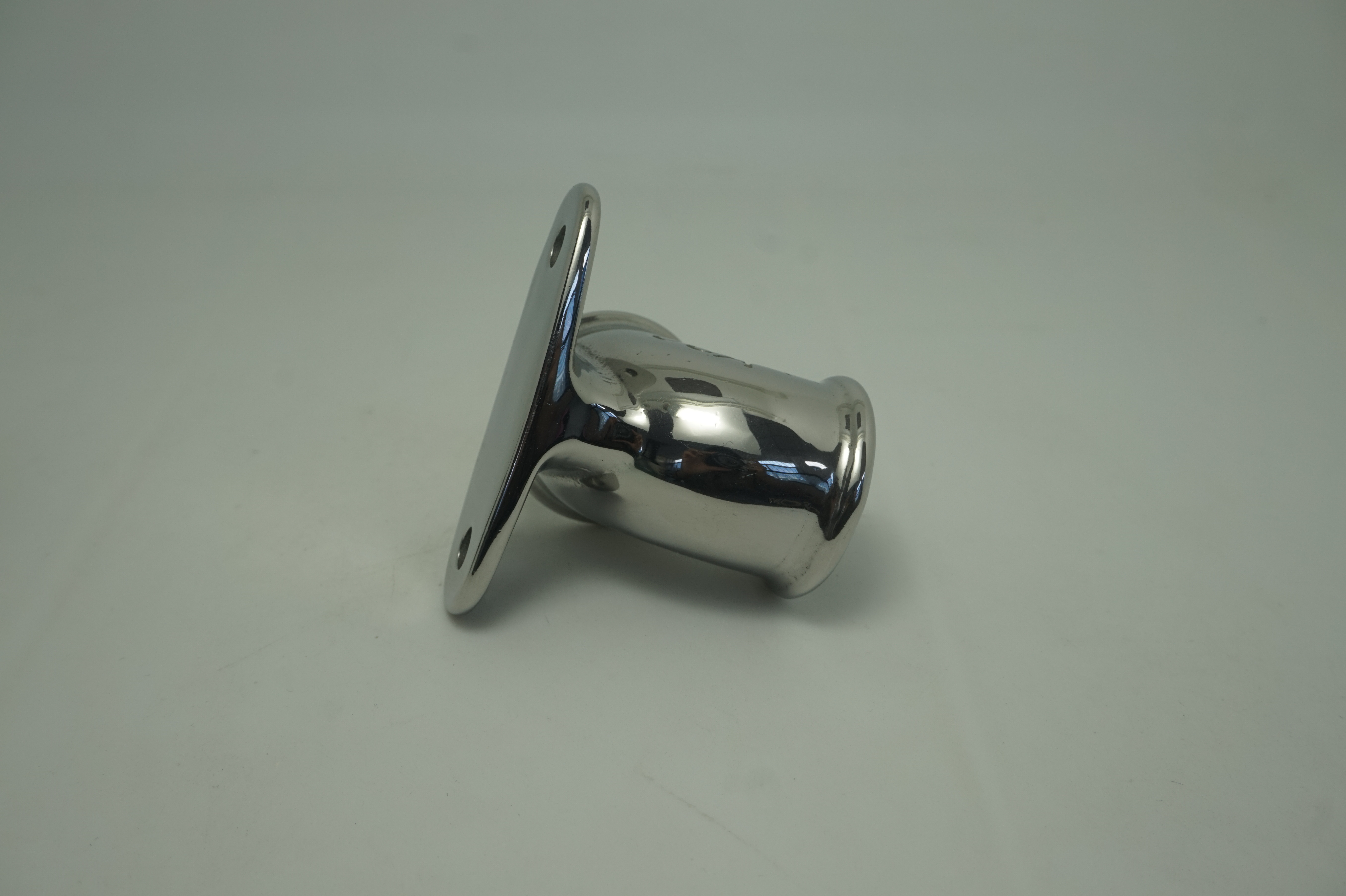
The visible lip is the part of the burr that is easy to see and easy to blend flat. The root is the material still connected to the parent surface underneath it, and it is the part that can break free later as a particle, especially in a flowing gas or hydraulic circuit. A light refinement pass can roll the lip over and make the edge look finished while leaving the root attached. Deburring is therefore judged on whether the root has been removed, which usually means removing a small amount of parent material at the edge rather than only wiping the surface. Agree how that judgement will be made.
Use more than one method, because each misses something. Visual inspection under angled light at magnification catches obvious sharp edges, wire edges and remaining burr fragments. A tactile check with a probe, a fine needle or a lint-free wipe drawn along the edge catches lips that have been folded flat. A radius gauge, optical comparator or moulded replica gives an edge size, and a profilometer or surface roughness tester with a suitable cut-off and traversing direction gives a profile across the edge when the geometry allows it. Microscopy helps on small features and when documenting a dispute. Compare against a master agreed before the batch.
They can be run in the same equipment, but not safely in the same charge without a cleaning discipline. Carbon steel and cast iron leave fines and graphite that transfer to stainless parts, show up as rust staining or embedded particles, and are difficult to see at the machine. The practical approach is a dedicated charge per material family where volume allows, or a purge between families: run the machine with media and clean compound, flush the rinse tank, change or clean the drying medium and cloths, and inspect the media for embedded ferrous fines. Tell the finishing route which families will alternate, because changeover time is a real cost.
Use Stuttgart, Germany as the destination on the enquiry and state whether the deliverable is equipment, media and compound, a representative sample review or a line concept. A destination does not imply local stock, a local service point or a local delivery time.
A Stuttgart buyer's surface, edge and cleanliness specifications are normally written against DIN/EN/ISO texts, with CE marking and the EU declaration of conformity as the conformity route for the machine itself (c3, c7). Automotive and aerospace suppliers in the region additionally work to their customers' sector requirements, which the VDA organises for the German automotive industry (c10).
Sources were retrieved on 2026-09-29 and describe the local industrial and trade context only. They do not evidence any SurfacePolish project, shipment, installation or service in Stuttgart.
The buyer must break the sharp slot edges consistently around the disk without reworking the broached profile or rounding the bolted flange face.
Send the material, dimensions, approximate weight, batch quantity, the incoming condition and photographs of the difficult features. Mark which features must not be contacted by media and state how the result will be inspected. This form carries source reference PSEO-0308; quote it if you prefer an additional manual reference.
Open the SurfacePolish enquiry form Email a prepared enquiry
No price, lead time, certification or result is promised here. Confirm whether a sample trial is available for the specific part and what the trial can and cannot show.
Page PSEO-0308 · revised 2026-09-29 · cross-border equipment, media and scoped sample review. City context is sourced and cited above.
Use this local checker to identify missing part and inspection information. It prepares a technical-review brief; it does not approve a machine, process recipe or production result.
Complete the part details to prepare a review brief.
Email : info@surface-polish.com


 IPv6 network supported


 +86-592-2381506