A buyer in Berlin, Germany in marine components is weighing whether a 1.8 m bronze propeller blade can be polished by machine or must stay hand work. SurfacePolish supplies finishing machines, media and compounds across borders and offers a free sample trial on representative sections, which return from Xiamen with an observed condition and a proposed media, compound and cycle direction to feed the buyer's own automation feasibility study. This brief is written for a buyer in Berlin working on marine components; it describes equipment, media and a scoped sample review, not a local polishing service.
Which features on this part are functional, such as seal faces, journals, tapers, keyways and weld toes, and which are only cosmetic?
Does the part family repeat often enough, with stable geometry, to justify a cell rather than a batch machine or hand work?
Can the charge or the tool reach the surfaces that matter, and which enclosed passages and blind holes can never be reached at all?
Two 316L parts made to the same drawing can behave differently because of how they were produced. Cast material carries a skin and porosity; wrought plate has a rolling direction; duplex and super-duplex grades respond to heat input differently from austenitic grades, and a weld heat-affected zone finishes at a different rate from the parent metal. Hardfacing, weld overlay, and bronze or nickel-aluminium-bronze castings each cut in their own way. Record the grade, the product form, the heat treatment or stress relief, the welding process and the as-received condition, whether machined, plasma cut, grit blasted or still carrying mill scale and heat tint. Note who owns the pre-finish cleanliness step and what the part must be free of, because oil, marking ink and salt carry-over contaminate a charge and change how it cuts.
Compound carries the work: it cleans the part and the media, holds fines in suspension, inhibits corrosion and controls foam. A mildly alkaline or near-neutral family is typical for ferrous work, and dose is set by measured concentration rather than by eye. On stainless and duplex marine parts the chloride content is the variable to control, because chlorides left in a pit, a crevice or a thread root can start pitting long after the part leaves the shop, and both tap water and recycled rinse water carry them. Confirm the water that will actually be used, add a rinse step that reaches the same features the finishing step reached, and dry the part rather than letting it drain and stain. Foam, residue and drag-out into a clean area are part of compound selection, not afterthoughts.
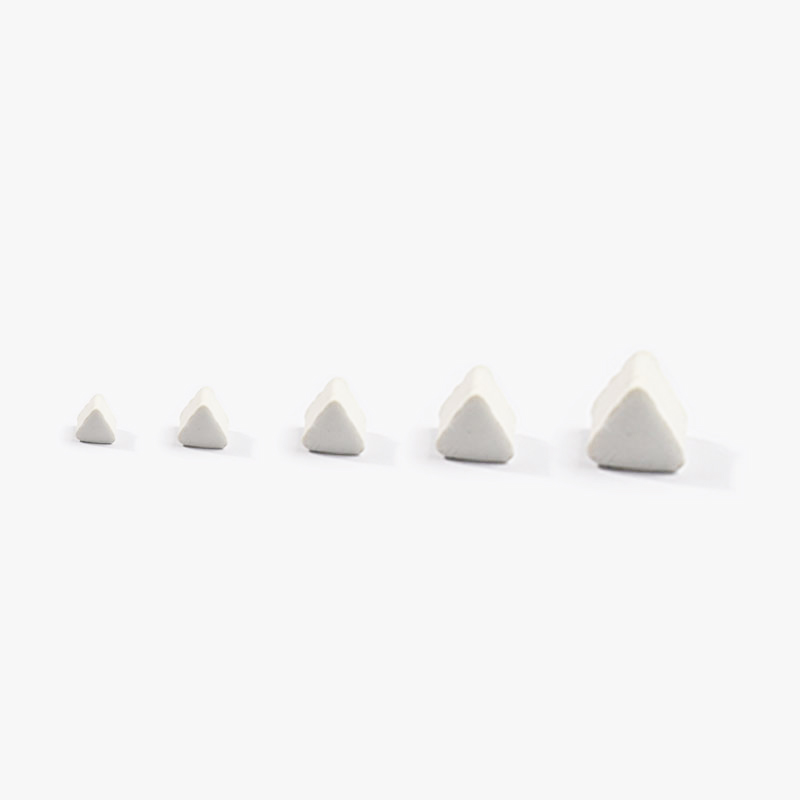
| Media | Best fit | Watch out for |
|---|---|---|
| Aluminium oxide grinding media in a dense ceramic bond | Heavier stock removal or a more consistent cut on robust stainless and duplex parts with thick edges and cast skin | High removal energy rounds functional edges quickly and is a poor match for thin panels or a knife-edge seat |
| Chloride-free mildly alkaline or near-neutral compound, liquid or powder | Cleaning, corrosion inhibition and fines suspension on stainless and duplex marine work where retained chlorides would risk pitting in service | Dose drifts with drag-out and water hardness, foam can hide the load, and rinse water must reach the same features the compound reached |
| Dry media such as walnut shell and corn cob with a dry polishing machine | Drying, light polishing and luster on parts that must leave the line dry, and on assemblies where a wet residue would be difficult to remove | Generates dust and needs extraction, cannot cut a burr, and organic media can carry moisture and contamination into a clean area |
| Fine ceramic or porcelain shapes in a small size class | Refinement and light edge blending after a cutting stage, and reaching tighter external geometry on small valve parts and fittings | Small sizes enter and lodge in cross-drillings and fine slots, and media wear shrinks the charge so the finish drifts over its life |
There are two fundamentally different ways to place a robot in a finishing line, and they fail for different reasons. In the part-handler arrangement the arm grips the part and presents it to a fixed machine, belt or buffing wheel; the arm needs payload for the part plus the gripper, but its motion is simple and repeatable. In the tool-carrier arrangement the arm holds the grinder, sander or polishing head and moves it over a fixtured part; reach must now cover the whole surface, and the arm has to absorb the reaction force of the tool while holding controlled contact. Tool-carrier cells suit large fabrications that are impractical to lift and turn, and they are harder, because force control, tool wear and path accuracy all matter at once. Part-handler cells suit smaller, lighter parts with high volume.
| Machine route | Where it fits | What it will not do |
|---|---|---|
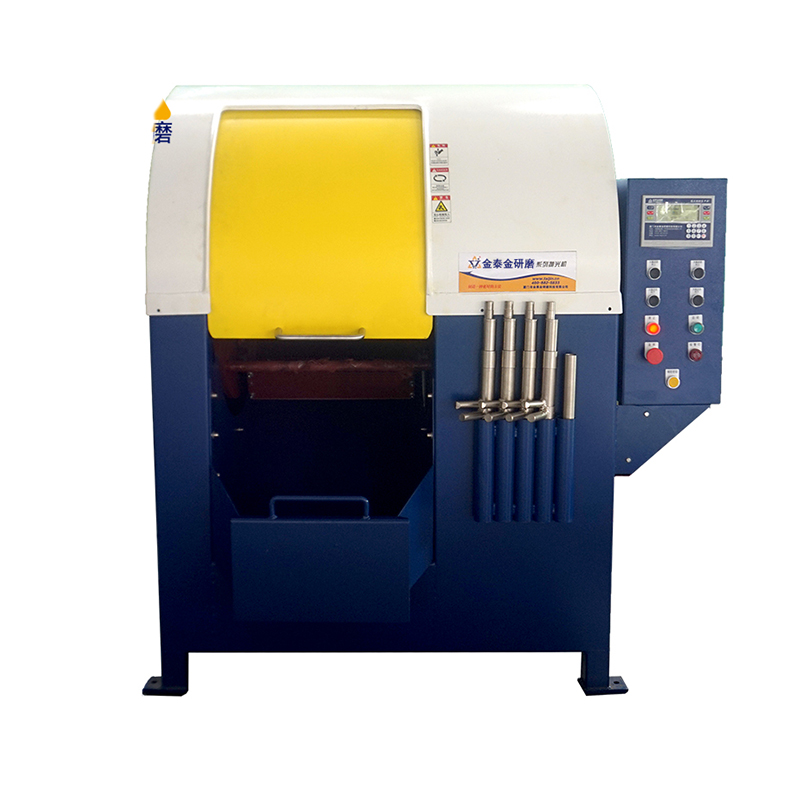
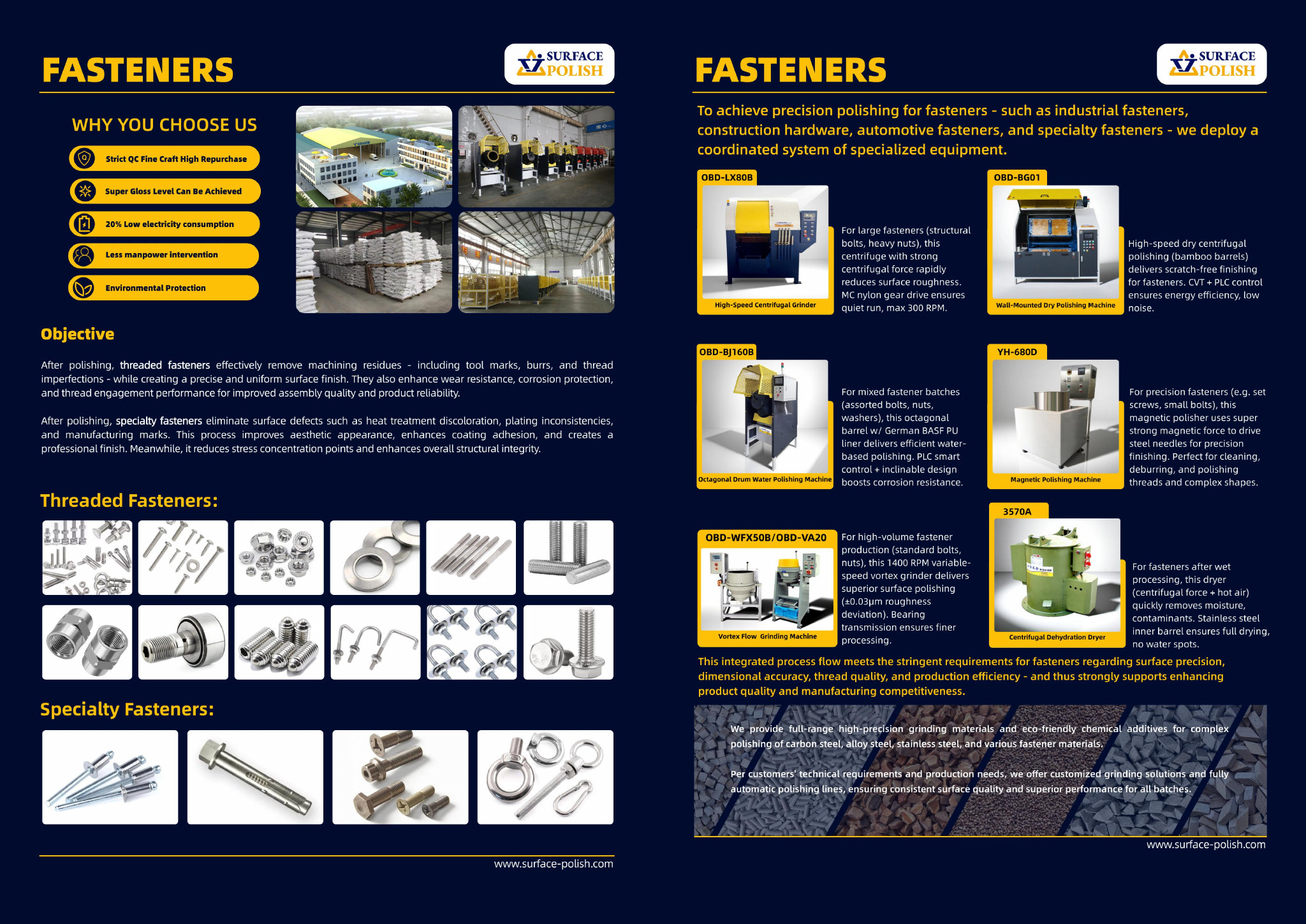
| Rotary barrel finishing machine | Gentle deburring of small fragile components and mixed fitting batches with generous compound flow and low part-on-part energy | Long cycles with no visibility while running, and internal passages collect media and compound that must be retrieved at unload |
| Dry polishing machine and dryer | Drying parts after a wet stage and producing a dry polished surface with organic media where a wet residue would be hard to remove | No cutting action, needs dust extraction, and organic media must be kept dry and clean or it transfers contamination to the part |
| Grinding finishing machine | Taking off a heavy machining burr or a defined stock layer before a refinement pass on robust stainless and duplex work | High removal energy cuts functional edges fast, so geometry assessment and a short controlled cycle matter more than on any other route |
| Magnetic finishing machine | Fine deburring and light refinement of small precise features such as narrow slots, small bores and stainless fittings | A small working envelope that excludes large fabrications, with pin media that can lodge in fine passages and must be retrieved |
Rounding is the purpose of most finishing and also the most common way a marine part is ruined. A weld toe that should retain a defined radius, a bore lip a gasket seals against, a knife edge on a valve seat and the flank of a keyway all lose geometry when a charge or a belt works them too long. The failure is progressive rather than sudden: early passes improve the surface and later passes quietly cross the limit. Set a maximum radius or a minimum remaining edge on the drawing, shield or mask the features that must hold it, and measure the same edge before and after with an optical comparator, a radius gauge or a moulded replica. On a robot-held tool, edge exposure is a function of path and pressure, so a few extra seconds in one corner is enough.
| Failure mode | Likely cause | How to catch it |
|---|---|---|
| Abrasive grain embedded in a soft or gummy surface | Coated abrasive or bonded wheel used on bronze, aluminium or a work-hardened surface at excessive pressure, or a loaded belt that has stopped cutting and started smearing | Inspect under low-angle light and a magnifier, wipe with a solvent-soaked cloth, and check the part after a light refinement pass rather than only as it leaves the coarse operation |
| Keyway, spline or taper geometry lost to edge rounding | The feature was exposed to the charge without masking, or a tool-carrier path ran along the flank of the feature instead of stopping short of it | Check width, flank angle and edge break with a gauge or comparator at marked stations before and after, and confirm the protected feature against the drawing tolerance |
| Medium wedged in tube-sheet holes or perforated plate openings | Hole diameter close to the media section, cylindrical or conical media that aligns with the hole, or a charge left to drain in the part at unload | Pin gauge a sample of holes across the plate, tap and back-flush each sample, and inspect the plate under oblique light for a medium sitting flush with the surface |
| Over-grind step or gouge at a path transition or belt change | Two passes overlapping at different pressures, a fresh belt run at the setting that suited a worn one, or an operator touching up a transition by hand without recording it | Inspect each transition zone at a fixed viewing distance under consistent lighting, and compare the zone against the surrounding surface with a roughness reading on both sides |
Berlin has more than 750 industrial establishments with 20 or more employees, which together generated turnover of more than 37 billion euros (s1). The branches the city lists as important are the chemical and pharmaceutical industry, the food and tobacco industry, the metal industry, the electrical and electronics industry, mechanical engineering and transport technology (s2). Berlin's economic administration also describes the city as a life-science location with 380 medical-technology and digital-health companies, 300 biotechnology firms, 35 pharmaceutical companies and 151 hospitals (s3), and records energy and environmental technology as both a production and an R&D field (s4). Around 230,000 people in the capital region work in transport, mobility and logistics, within a joint cluster that includes automotive, rail technology, logistics and traffic telematics (s5, s6), and Berlin Partner operates as the city's business and technology promotion agency (s7).
The nearest part of that base to this brief is machinery: Mechanical engineering (Maschinenbau) is listed among Berlin's important industrial branches, in a base of more than 750 industrial establishments with 20 or more employees (s2, s1).
Berlin's mix of mechanical engineering, metal working, electrical equipment, medical technology and food production means both metal components with drawing-level edge and surface requirements and hygienic stainless parts that must be free of burrs and residue before use. Medical-technology and biotech firms in the city add documented cleanliness expectations, while the metal and machine-building shops typically need flexible, small-batch deburring rather than a single high-volume line.
A Berlin buyer should decide first whether the part is a metal component judged on edge condition and surface finish or a hygienic part that must also be free of media residue and loose particles, and then confirm which inspection method the customer accepts, because that choice determines the media, the compound and whether the process can be run in the same shop as other work.
Freight context: Berlin Brandenburg Airport (BER), BEHALA Westhafen trimodal inland port (Berlin). BEHALA, the Berlin port and warehousing company, is based at Westhafenstrasse 1 in Berlin and operates the city's trimodal freight centres (s8). Around 230,000 people in the capital region work in transport, mobility and logistics (s6), and Berlin Brandenburg Airport is the air-freight and courier gateway for the region; a full machine normally arrives by sea and is moved inland by rail or road, while sample parts can be flown into BER.
Germany sits inside the EU customs union, so Chinese-origin industrial machinery enters against the EU's common commercial tariff rather than a German national tariff, and the duty that applies is determined by the commodity code declared on the import declaration. China is one of the EU's largest goods trading partners and the EU has long run a goods deficit with it, while the Commission characterises the relationship as simultaneously partnership, competition and systemic rivalry (c1, c2). The Commission publishes the EU's trade agreements; no agreement with China appears in that overview, so Chinese-origin goods cannot claim a preferential origin rate and are assessed under the standard tariff (c8). German customs is administered by the Zoll under the Generalzolldirektion, and the importer must hold an EORI number - valid throughout the European Union and replacing the former German customs number - before goods can be cleared (c5, c6).
Machinery placed on the German market must be CE marked, and the manufacturer is responsible for the conformity assessment, the technical file, the EU declaration of conformity and for affixing the mark; importers and distributors are separately obliged to ensure that only compliant, CE-marked products are placed on the EEA market (c3, c4). The customs authority is German customs (Zoll), part of the Generalzolldirektion, and the operator identification it issues, the EORI number, is a prerequisite for customs clearance in the European Union (c5, c6). In general EU practice a buyer's landed-cost plan therefore needs to cover the commodity-code classification that sets the duty rate, import VAT and the customs declaration, on top of the CE technical file and an identified EU-based economic operator who can act as importer or authorised representative; the technical documentation and the declaration of conformity must be available in the language required by the buyer's market surveillance authority.
SurfacePolish supplies from Xiamen, China. The buyer's own destination rules, conformity marking, tariff classification and documentation responsibilities stay with the buyer; confirm them against the authorities named above before ordering.
Where a part sits in a charge changes what happens to it. Parts at the bottom carry more load and see more part-on-part contact; parts near the wall of a bowl can be bypassed; parts at the ends of a tub can be underworked. A sampling plan that draws from one position will not describe the lot. Agree the sample size, the positions sampled and the order in which parts are drawn, and include a control part measured only at the start and at the end. In a cell, the equivalent is the first part after a tool change, the first part of a shift and the part after a fixture change. Keep each sampled part with its settings record, and define in advance what happens to a lot when one sample falls outside the acceptance band.
Send parts that represent the extremes, not the average. Include the part with the tightest internal passage, the thinnest section, the largest surface to be finished and the most restricted access. Include one weld sample made with the production welding procedure, because a weld toe finishes differently from parent metal. Include an as-received reject so the starting condition is documented, and mark the measurement points and controlled features on each part before shipping. Record the material grade, product form, heat treatment, as-received condition and the cleanliness requirement the part must eventually meet. Label everything and pack it so nothing is damaged in transit. A trial run on a convenient sample answers a question the buyer did not ask.
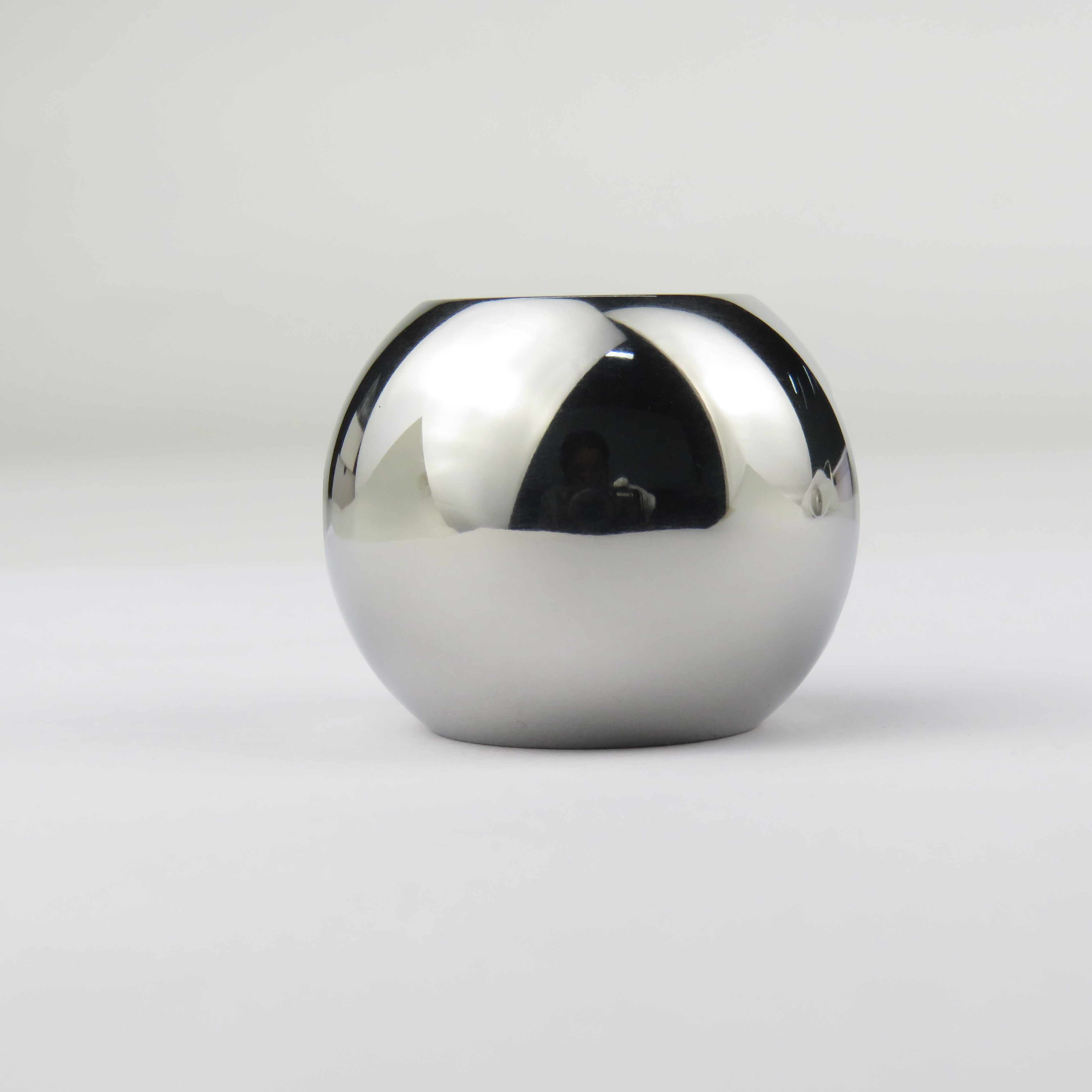
A trial cannot promise a roughness value, an edge radius, a tolerance, a cycle time, a capacity or a cost, and it does not qualify a process for a classification society or any regulated use. It also cannot verify the reach, payload or accuracy of a robot the buyer has not yet selected, or the behaviour of a fixture that does not exist. One or a few parts do not describe variation across a lot, a shift or a media charge. Treat the trial as evidence about the parts tested, then close the remaining gaps with the buyer's own line trials and first-article discipline.
Partly, and the split is the useful part of the question. A robot can hold a grinder, sander or polishing head over a repeatable path with controlled pressure, which suits long weld runs, flat panels and consistent edges. It struggles where access is restricted, where the surface is free-form and required pressure changes continuously, and where a person compensates for part-to-part variation by feel. Work out which features recur in the same place on every part and which move; automate the first group and leave the second with an operator, or send parts to a machine route that already produces the surface in bulk.
Send parts that represent the extremes of the family: the tightest internal passage, the thinnest section, the largest surface, the worst access, and one weld made with the production procedure. Add an as-received reject so the starting condition is documented, and mark the controlled features and measurement points before shipping. Include a note of the material grade, product form, heat treatment and the cleanliness requirement the part must eventually meet. Parts travel to the factory in Xiamen from Germany and come back with an observed condition and a proposed media, compound and cycle direction for the buyer to evaluate.
Use Berlin, Germany as the destination on the enquiry and state whether the deliverable is equipment, media and compound, a representative sample review or a line concept. A destination does not imply local stock, a local service point or a local delivery time.
Berlin buyers write surface, edge and cleanliness requirements against DIN/EN/ISO texts and place machinery on the German market through CE marking with an EU declaration of conformity (c3, c7). Medical-technology and life-science customers add their own documentation and cleanliness requirements, and the VDA framework applies where the same parts feed automotive programmes (c10).
Sources were retrieved on 2026-09-29 and describe the local industrial and trade context only. They do not evidence any SurfacePolish project, shipment, installation or service in Berlin.
The buyer is asking whether polishing of the blade face can be automated at all or must stay hand work.
Send the material, dimensions, approximate weight, batch quantity, the incoming condition and photographs of the difficult features. Mark which features must not be contacted by media and state how the result will be inspected. This form carries source reference PSEO-0346; quote it if you prefer an additional manual reference.
Open the SurfacePolish enquiry form Email a prepared enquiry
No price, lead time, certification or result is promised here. Confirm whether a sample trial is available for the specific part and what the trial can and cannot show.
Page PSEO-0346 · revised 2026-09-29 · cross-border equipment, media and scoped sample review. City context is sourced and cited above.
Use this local checker to identify missing part and inspection information. It prepares a technical-review brief; it does not approve a machine, process recipe or production result.
Complete the part details to prepare a review brief.
Email : info@surface-polish.com


 IPv6 network supported


 +86-592-2381506