A buyer in Hanover, Germany working on marine components has a 220 kg 316L pump casing whose flange face and seawater passage must survive weld dressing intact. SurfacePolish supplies finishing machines, media and compounds across borders and runs a free sample trial: representative parts ship to the factory in Xiamen and come back with an observed condition and a proposed media, compound and cycle direction for the buyer's own review. This brief is written for a buyer in Hanover working on marine components; it describes equipment, media and a scoped sample review, not a local polishing service.
What is the largest dimension and the greatest mass that must be presented, and can the part be turned or supported without distorting it?
Which acceptance criteria, measurement locations and functional checks must exist before any route, robot or otherwise, can be compared fairly?
Which features on this part are functional, such as seal faces, journals, tapers, keyways and weld toes, and which are only cosmetic?
Mass finishing works where a charge can flow across the surface. Sort the part into accessible and inaccessible zones and be literal about it. An open external weld run on a bracket, a cast cleat or the outside of a small valve body is reachable. The inside of a closed box section, the back of a stiffener, a narrow seawater passage and the root of a deep groove are not, whatever the medium is. Concave pockets hold media and release it slowly; sharp internal corners trap it. That map decides whether the whole part, or only some faces of it, can go to a tumbling route, and whether the remainder needs a tool that can be aimed at a surface, by hand or by an arm. Accessibility, more often than finish, is what ends the mass-finishing option.
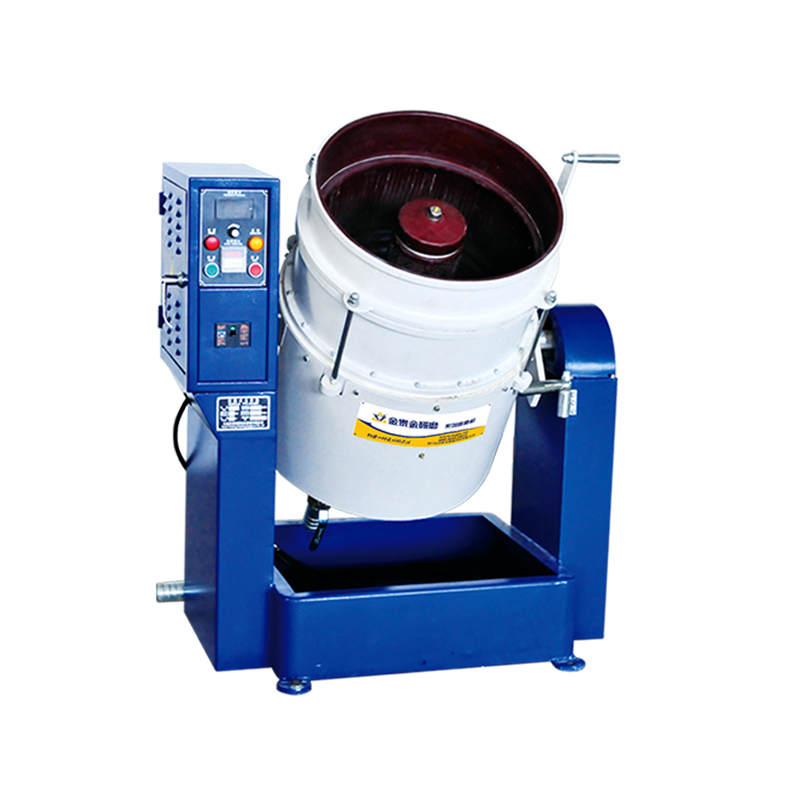
Vibratory finishing usually deserves the first look, because it removes the hand work a robot would otherwise have to reproduce. A bowl takes small and medium fittings, cast cleats, brackets, fasteners and machined valve internals and processes them in bulk with no part-specific path to teach. A tub takes long parts that cannot turn inside a bowl, such as rail sections, pipe spools and linear weldments, provided they can be supported along their length. Both routes trade part-on-part contact for simplicity, so visible faces need separation or racking. Their limits are geometric: no access to internal passages, no way to hold one radius precisely, and no tolerance for parts whose weight would crush the charge or be crushed by it. Where a bowl or tub reaches the surface, automating load and unload is a smaller problem than automating the finishing motion.
| Machine route | Where it fits | What it will not do |
|---|---|---|
| Vibratory finishing machine (bowl) | Bulk deburring and refinement of small and medium marine fittings, cast cleats, brackets and machined valve internals that can tumble without racking | Continuous part-on-part contact and no access to internal passages; visible faces and heavy parts need separation, racking or a different route |
| Tub vibrator | Long parts that cannot rotate in a bowl, such as rail sections, pipe spools, linear weldments and long shafts, provided they can be supported along their length | Lower energy per unit area, so heavy weld dressing takes longer, and a long tub needs floor space plus a support method that does not mark the part |
| Magnetic finishing machine | Fine deburring and light refinement of small precise features such as narrow slots, small bores and stainless fittings | A small working envelope that excludes large fabrications, with pin media that can lodge in fine passages and must be retrieved |
| Dry polishing machine and dryer | Drying parts after a wet stage and producing a dry polished surface with organic media where a wet residue would be hard to remove | No cutting action, needs dust extraction, and organic media must be kept dry and clean or it transfers contamination to the part |
Compound carries the work: it cleans the part and the media, holds fines in suspension, inhibits corrosion and controls foam. A mildly alkaline or near-neutral family is typical for ferrous work, and dose is set by measured concentration rather than by eye. On stainless and duplex marine parts the chloride content is the variable to control, because chlorides left in a pit, a crevice or a thread root can start pitting long after the part leaves the shop, and both tap water and recycled rinse water carry them. Confirm the water that will actually be used, add a rinse step that reaches the same features the finishing step reached, and dry the part rather than letting it drain and stain. Foam, residue and drag-out into a clean area are part of compound selection, not afterthoughts.
| Media | Best fit | Watch out for |
|---|---|---|
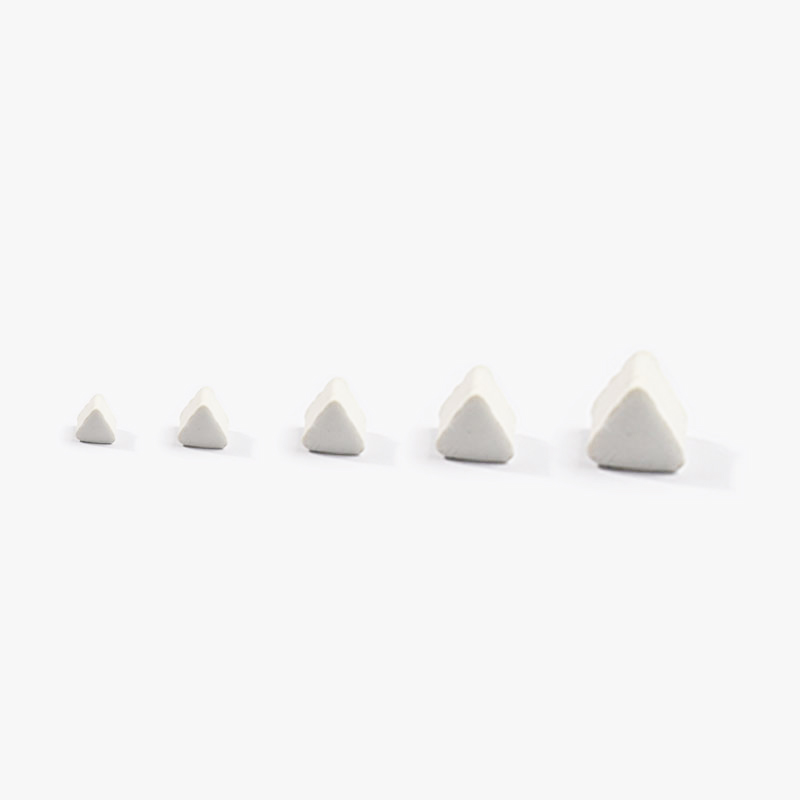
| Heavy-cut ceramic angle-cut triangles in a coarse size class | Breaking the edge of a machined or cast marine fitting and removing a substantial burr on robust stainless before a refinement stage | Cuts corners and weld toes aggressively and can round a seat or keyway, and the coarse section may not enter narrow passages at all |
| Chloride-free mildly alkaline or near-neutral compound, liquid or powder | Cleaning, corrosion inhibition and fines suspension on stainless and duplex marine work where retained chlorides would risk pitting in service | Dose drifts with drag-out and water hardness, foam can hide the load, and rinse water must reach the same features the compound reached |
| Aluminium oxide grinding media in a dense ceramic bond | Heavier stock removal or a more consistent cut on robust stainless and duplex parts with thick edges and cast skin | High removal energy rounds functional edges quickly and is a poor match for thin panels or a knife-edge seat |
| Bonded abrasive, nonwoven and buffing tool set for an arm or hand tool | Cutting weld toes, blending edges and building luster on large fabrications and free-form surfaces that no batch machine can reach | Each belt, wheel and compound has its own wear curve and pressure window; grain can embed in soft metal and polishing compound leaves a film that must be removed before coating or passivation |
A pump or valve body has seawater passages, a drain boss and a row of blind tapped flange holes. A welded fabrication has an enclosed stiffener cavity or an open-ended box section. Each of these is a place where a medium, a broken fragment of medium or a slug of compound can settle and stay. The part passes a visual check on the outside and the problem appears after assembly, when a passage is restricted or a fastener will not seat. Size the medium below the smallest opening it can enter, count the charge in and out where the batch allows, borescope the smallest passage at an agreed angle, pin gauge or thread gauge the holes, and rinse through a filter so the discharge can be inspected. Blind features that were never mapped are the usual source.
| Failure mode | Likely cause | How to catch it |
|---|---|---|
| Dwell mark or flat spot where a robot-held tool paused, slowed or changed direction | Waypoint spacing or path speed poorly set, a tool change or program transition in the middle of a visible surface, or missing compensation for tool wear along the path | Photograph the surface under raking light and compare first and last parts of a run, and measure at fixed points along the path to locate any step or band |
| Medium wedged in tube-sheet holes or perforated plate openings | Hole diameter close to the media section, cylindrical or conical media that aligns with the hole, or a charge left to drain in the part at unload | Pin gauge a sample of holes across the plate, tap and back-flush each sample, and inspect the plate under oblique light for a medium sitting flush with the surface |
| Compound film, burnished residue or dried detergent left on a sealing face | Rinse that did not reach the same features the finishing step reached, compound drag-out from the charge, or a part allowed to drain and dry in position instead of being dried deliberately | Wipe the sealing face with a clean white cloth and a defined solvent, inspect the wipe, and borescope any groove or land the rinse may not have reached |
| Abrasive grain embedded in a soft or gummy surface | Coated abrasive or bonded wheel used on bronze, aluminium or a work-hardened surface at excessive pressure, or a loaded belt that has stopped cutting and started smearing | Inspect under low-angle light and a magnifier, wipe with a solvent-soaked cloth, and check the part after a light refinement pass rather than only as it leaves the coarse operation |
Hanover is the capital of Lower Saxony and combines a large manufacturing plant with a trade-fair and logistics economy. Volkswagen Nutzfahrzeuge (Volkswagen Commercial Vehicles) is based at the Hanover site and describes itself as one of Lower Saxony's largest employers, which anchors a vehicle-industry supplier base in the region. The city's exhibition grounds host the HANNOVER MESSE, presented by the city as the world's largest industrial trade fair, with exhibitors from mechanical engineering, the electrical and digital industry and the energy sector, and its main display areas are automation and digitalisation, energy and industrial infrastructure, and research and technology transfer. Hanover's port group (Städtische Häfen Hannover) operates four ports on the Mittellandkanal and its branch canals, with the Lindener Hafen serving chemicals, mineral oil, forwarding, the vehicle industry, construction, recycling and steel trade, and the airport adds an air-freight centre with around 60,000 tonnes annual capacity. EuroBLECH, the international sheet-metal working technology fair, is also held on the Hanover exhibition grounds.
The nearest part of that base to this brief is machinery: The HANNOVER MESSE in Hanover is presented as the world's largest industrial trade fair with exhibiting companies from mechanical engineering, and the Lindener Hafen lists steel trading and construction among its dominant industries.
Hanover's production base is commercial-vehicle manufacturing with its supplier tier, steel trading and steel processing, and the sheet-metal working technology community that gathers at EuroBLECH on the city's exhibition grounds. Those processes - cutting, forming, punching, welding and machining of steel and sheet - are exactly where burrs, sharp edges and oxide or oil films must be removed before welding, coating or assembly. Because a large share of Hanover's metalworking demand is job-shop and supplier production rather than one dominant end product, finishing choices usually have to cover a mixed part spectrum in one installation.
Because Hanover's metalworking base is broad and supplier-driven, the first question is which part spectrum and edge/cleanliness standard one installation must cover (for example EN 1090 steel construction edges versus VDA 19.1 cleanliness for vehicle parts), and whether the process must be reproducible across mixed batch sizes rather than optimised for a single part.
Freight context: Hannover Airport (HAJ) with its air-freight centre, Hafen Hannover: Lindener Hafen, Nordhafen with the Container Terminal Hannover, and the Rail Terminal Hannover-Leinetor, Mittellandkanal / Stichkanal connections and the Hanover motorway junction (A2/A7). The port operates two combined-transport facilities with services to northern Italy and the German North Sea ports, so seaborne containers destined for Hanover can be handled inland rather than only at the coast, and Hannover Airport adds an air-freight centre with around 60,000 tonnes annual capacity. For incoming finishing machines and sample parts, Hanover offers inland-waterway/rail container handling, road freight on the A2/A7 and air freight at HAJ.
Germany sits inside the EU customs union, so Chinese-origin industrial machinery enters against the EU's common commercial tariff rather than a German national tariff, and the duty that applies is determined by the commodity code declared on the import declaration. China is one of the EU's largest goods trading partners and the EU has long run a goods deficit with it, while the Commission characterises the relationship as simultaneously partnership, competition and systemic rivalry (c1, c2). The Commission publishes the EU's trade agreements; no agreement with China appears in that overview, so Chinese-origin goods cannot claim a preferential origin rate and are assessed under the standard tariff (c8). German customs is administered by the Zoll under the Generalzolldirektion, and the importer must hold an EORI number - valid throughout the European Union and replacing the former German customs number - before goods can be cleared (c5, c6).
German is the working language of drawings, contracts, test reports and conformity documentation, and German buyers normally expect English-language technical documentation to be supplied alongside it. Procurement is documentation-driven: the EU declaration of conformity, the technical file, and the identity of the EU-based importer or authorised representative are settled before the order, and the EORI registration and customs declaration are the importer's responsibility rather than the exporter's (c3, c4, c5). Germany is the world's leading machinery and equipment manufacturer, so quotations compete against established domestic builders on technical documentation and measurable process data rather than on price alone (c9). Payment, delivery and risk terms are normally fixed by written contract with a named Incoterm, and classification (commodity code) is commonly confirmed in writing before shipment because it drives the duty and the import declaration.
SurfacePolish supplies from Xiamen, China. The buyer's own destination rules, conformity marking, tariff classification and documentation responsibilities stay with the buyer; confirm them against the authorities named above before ordering.
Where a part sits in a charge changes what happens to it. Parts at the bottom carry more load and see more part-on-part contact; parts near the wall of a bowl can be bypassed; parts at the ends of a tub can be underworked. A sampling plan that draws from one position will not describe the lot. Agree the sample size, the positions sampled and the order in which parts are drawn, and include a control part measured only at the start and at the end. In a cell, the equivalent is the first part after a tool change, the first part of a shift and the part after a fixture change. Keep each sampled part with its settings record, and define in advance what happens to a lot when one sample falls outside the acceptance band.
Before a cell can be justified, the manual work has to be counted in a form a cell design can use. Time the finishing operation per unit of surface: per metre of weld, per square metre of panel, per edge, per bore. Separate that from handling, meaning finding the part, loading it, turning it, changing a belt, inspecting it and putting it down, because handling is often what a robot is really bought for. Note the variability: how long the same feature takes on a good part and on a difficult one. Then estimate the volume over which those hours recur, and compare it with a cell that earns only while it is running and loaded. Where setup and changeover dominate the hours, automating the finishing motion will not change the economics much.
A positioner is often the cheaper answer to reach. Turning the part to present a new face to a fixed tool or to a smaller machine can remove the need for a long-reach arm and reduce the payload the arm must carry. The trade is an extra axis with its own repeatability, and a fixture that has to locate on every face it turns to. A robot arm earns its place where the tool must travel over a surface that cannot practicably be turned, or where the same motion repeats on many parts. Decide from geometry and volume, not from technology, and prove the surface before either is bought.
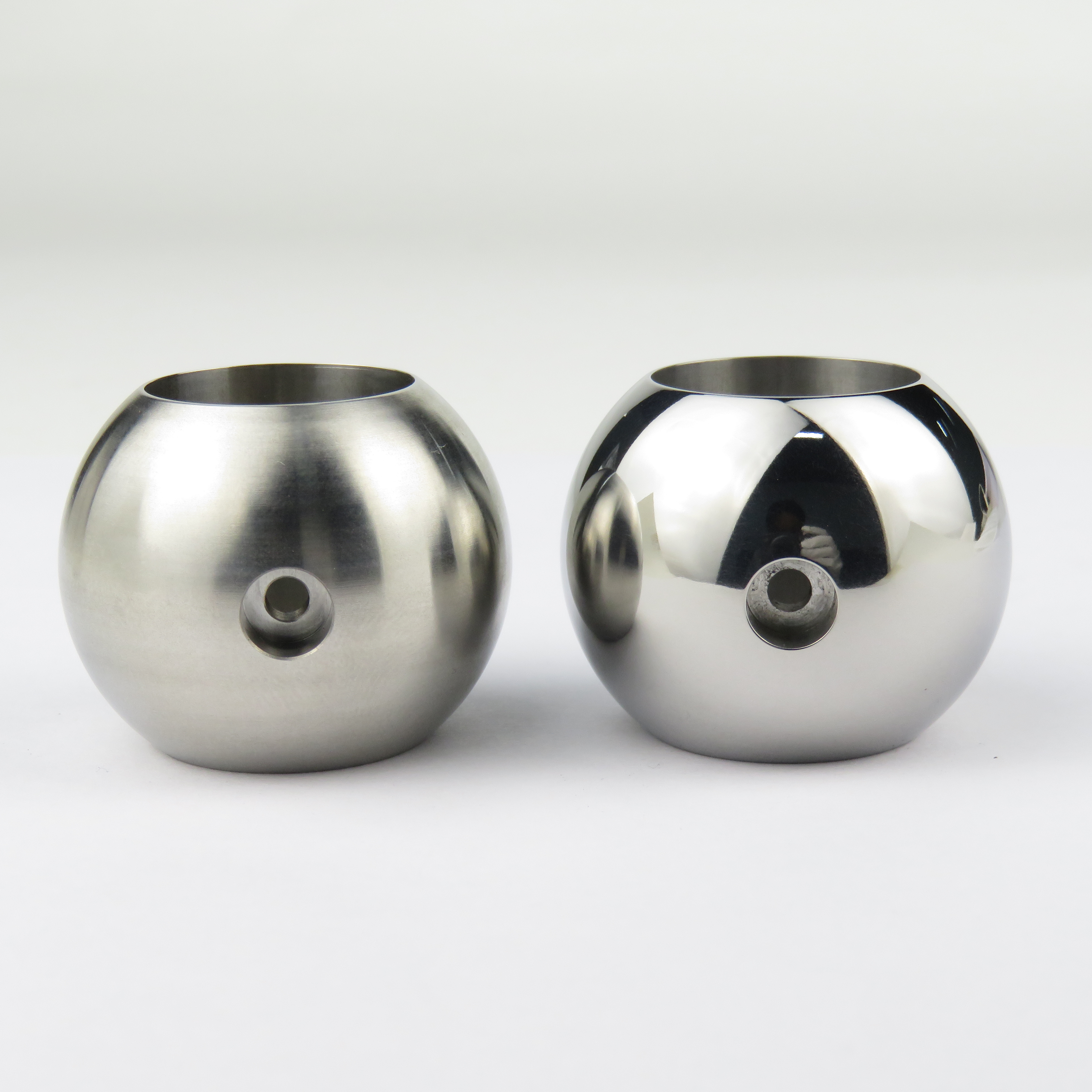
A free-form surface gives the tool no straight reference, so the tool has to follow changing curvature while holding constant contact pressure and surface speed. On a large blade the arm must reach the whole face, which pushes against reach and stiffness limits, and the wheel or belt wears as it travels, so pressure has to be adjusted along the path. Heat builds wherever the tool dwells. Hand polishing works because an operator feels all of this continuously. Automating it needs force control, a path generated from a model, and tool-wear compensation, and it still needs a process that has first been proved by hand at the bench.
Usually contamination rather than the material itself. Carbon steel media, carbon steel brushes, a machine also used for carbon steel work, grinding dust settling on a wet surface, bare-hand handling and chloride carried in rinse water can all leave something behind that starts to stain. It often appears first at a weld, a pit or a thread root. Segregate stainless work, use dedicated tooling, control the rinse water, dry the part promptly, and check with a wipe test or a free-iron check if the buyer wants one. Whether passivation follows mechanical finishing is the buyer's decision and its own requirement to define in Germany.
Use Hanover, Germany as the destination on the enquiry and state whether the deliverable is equipment, media and compound, a representative sample review or a line concept. A destination does not imply local stock, a local service point or a local delivery time.
Hanover buyers work within the DIN system: surface-texture specification to ISO 21920, technical cleanliness to VDA 19.1 / ISO 16232 where hydraulic or powertrain parts are involved, material certificates to EN 10204 (3.1), and for steel construction work the EN 1090 execution classes. Automotive suppliers operate to IATF 16949 with VDA 6.3, and machines placed on the EEA market must carry CE marking under the EU Machinery Regulation.
Sources were retrieved on 2026-09-29 and describe the local industrial and trade context only. They do not evidence any SurfacePolish project, shipment, installation or service in Hanover.
The buyer wants the weld repairs dressed and the outside cleaned up without rounding the flange face or leaving medium in the seawater passage.
Send the material, dimensions, approximate weight, batch quantity, the incoming condition and photographs of the difficult features. Mark which features must not be contacted by media and state how the result will be inspected. This form carries source reference PSEO-0396; quote it if you prefer an additional manual reference.
Open the SurfacePolish enquiry form Email a prepared enquiry
No price, lead time, certification or result is promised here. Confirm whether a sample trial is available for the specific part and what the trial can and cannot show.
Page PSEO-0396 · revised 2026-09-29 · cross-border equipment, media and scoped sample review. City context is sourced and cited above.
Use this local checker to identify missing part and inspection information. It prepares a technical-review brief; it does not approve a machine, process recipe or production result.
Complete the part details to prepare a review brief.
Email : info@surface-polish.com


 IPv6 network supported


 +86-592-2381506