A buyer in Hiroshima, Japan working on marine components has a duplex tube sheet with 800 drilled holes whose edges must be broken evenly without trapping medium. SurfacePolish supplies finishing machines, media and compounds across borders and runs a free sample trial: a cut section of the tube sheet travels to Xiamen and returns with an observed condition and a proposed media, compound and cycle direction for the buyer's own inspection. This brief is written for a buyer in Hiroshima working on marine components; it describes equipment, media and a scoped sample review, not a local polishing service.
What starting condition and cleanliness baseline will the part arrive in, and who owns the pre-finish step?
Does the part family repeat often enough, with stable geometry, to justify a cell rather than a batch machine or hand work?
Can the charge or the tool reach the surfaces that matter, and which enclosed passages and blind holes can never be reached at all?
Two 316L parts made to the same drawing can behave differently because of how they were produced. Cast material carries a skin and porosity; wrought plate has a rolling direction; duplex and super-duplex grades respond to heat input differently from austenitic grades, and a weld heat-affected zone finishes at a different rate from the parent metal. Hardfacing, weld overlay, and bronze or nickel-aluminium-bronze castings each cut in their own way. Record the grade, the product form, the heat treatment or stress relief, the welding process and the as-received condition, whether machined, plasma cut, grit blasted or still carrying mill scale and heat tint. Note who owns the pre-finish cleanliness step and what the part must be free of, because oil, marking ink and salt carry-over contaminate a charge and change how it cuts.
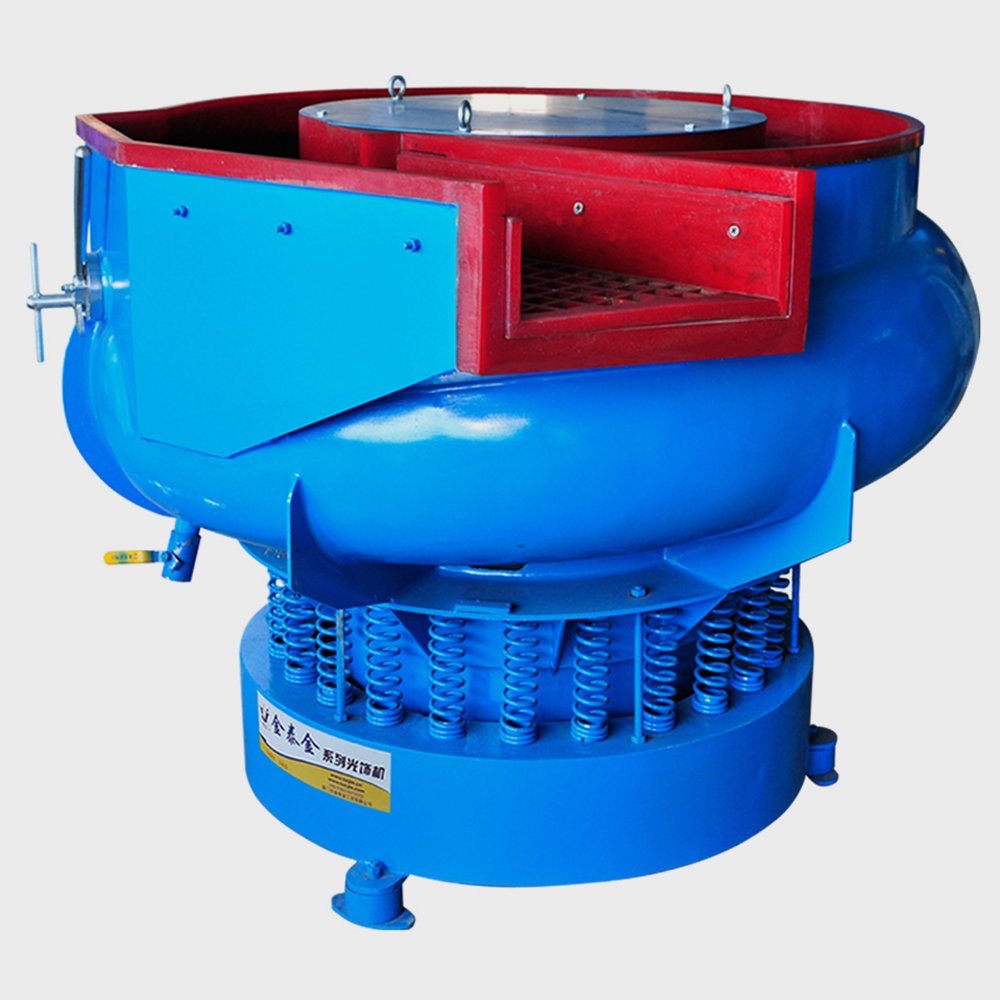
Vibratory finishing usually deserves the first look, because it removes the hand work a robot would otherwise have to reproduce. A bowl takes small and medium fittings, cast cleats, brackets, fasteners and machined valve internals and processes them in bulk with no part-specific path to teach. A tub takes long parts that cannot turn inside a bowl, such as rail sections, pipe spools and linear weldments, provided they can be supported along their length. Both routes trade part-on-part contact for simplicity, so visible faces need separation or racking. Their limits are geometric: no access to internal passages, no way to hold one radius precisely, and no tolerance for parts whose weight would crush the charge or be crushed by it. Where a bowl or tub reaches the surface, automating load and unload is a smaller problem than automating the finishing motion.
| Machine route | Where it fits | What it will not do |
|---|---|---|
| Centrifugal barrel finishing machine | Short, aggressive cycles on small precision items such as valve trim, inserts and small stainless components with fine edge requirements | Rounds edges and can distort thin unsupported sections quickly, and results are sensitive to charge weight, speed and stop time |
| Vibratory finishing machine (bowl) | Bulk deburring and refinement of small and medium marine fittings, cast cleats, brackets and machined valve internals that can tumble without racking | Continuous part-on-part contact and no access to internal passages; visible faces and heavy parts need separation, racking or a different route |
| Rotary barrel finishing machine | Gentle deburring of small fragile components and mixed fitting batches with generous compound flow and low part-on-part energy | Long cycles with no visibility while running, and internal passages collect media and compound that must be retrieved at unload |
| Dry polishing machine and dryer | Drying parts after a wet stage and producing a dry polished surface with organic media where a wet residue would be hard to remove | No cutting action, needs dust extraction, and organic media must be kept dry and clean or it transfers contamination to the part |
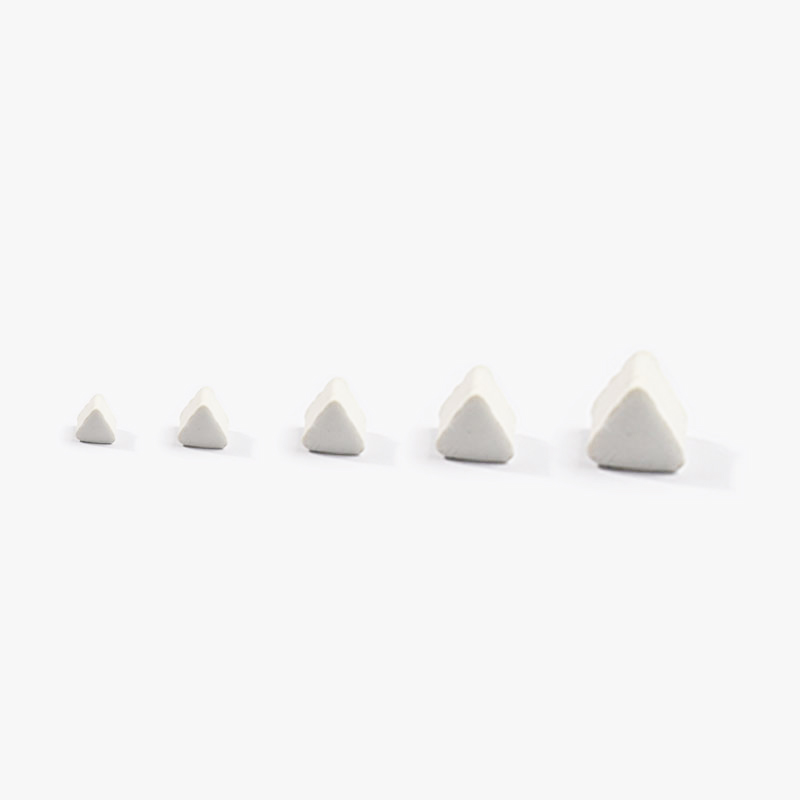
Plastic media suits parts whose surfaces must not be peened, marked or rounded aggressively. Aluminium brackets, bronze and nickel-aluminium-bronze castings, thin sheet components and any part with a cosmetic face respond better to plastic triangles, cones or pyramids in a soft to medium grade than to ceramic. The trade is removal rate: plastic cuts slowly, deforms as it wears, and a worn charge behaves noticeably differently from a fresh one, so cycles set on new media drift. Some shapes float or segregate in a bowl and starve part of the load. In marine work plastic media is often the right first stage where a light machining burr, an adhesive residue or a paint-adjacent edge has to come off without changing the geometry a gasket or a seal depends on.
| Media | Best fit | Watch out for |
|---|---|---|
| Plastic triangles, cones and pyramids in a soft to medium grade | Deburring aluminium brackets, bronze castings and cosmetic faces where marking and edge loss must stay small | Slow cut rate, media deforms as it wears, and a worn charge behaves quite differently from a fresh one |
| Bonded abrasive, nonwoven and buffing tool set for an arm or hand tool | Cutting weld toes, blending edges and building luster on large fabrications and free-form surfaces that no batch machine can reach | Each belt, wheel and compound has its own wear curve and pressure window; grain can embed in soft metal and polishing compound leaves a film that must be removed before coating or passivation |
| Dry media such as walnut shell and corn cob with a dry polishing machine | Drying, light polishing and luster on parts that must leave the line dry, and on assemblies where a wet residue would be difficult to remove | Generates dust and needs extraction, cannot cut a burr, and organic media can carry moisture and contamination into a clean area |
| Steel media including balls, pins and shaped shot | Bright burnished finishing and edge blending on stainless components where appearance matters and stock removal must stay low | Transfers iron to stainless and leaves free iron that blooms in chloride service, so it needs a dedicated charge, an inhibiting compound and magnetic or screen separation |
Rounding is the purpose of most finishing and also the most common way a marine part is ruined. A weld toe that should retain a defined radius, a bore lip a gasket seals against, a knife edge on a valve seat and the flank of a keyway all lose geometry when a charge or a belt works them too long. The failure is progressive rather than sudden: early passes improve the surface and later passes quietly cross the limit. Set a maximum radius or a minimum remaining edge on the drawing, shield or mask the features that must hold it, and measure the same edge before and after with an optical comparator, a radius gauge or a moulded replica. On a robot-held tool, edge exposure is a function of path and pressure, so a few extra seconds in one corner is enough.
| Failure mode | Likely cause | How to catch it |
|---|---|---|
| Over-grind step or gouge at a path transition or belt change | Two passes overlapping at different pressures, a fresh belt run at the setting that suited a worn one, or an operator touching up a transition by hand without recording it | Inspect each transition zone at a fixed viewing distance under consistent lighting, and compare the zone against the surrounding surface with a roughness reading on both sides |
| Rust bloom and tea staining appearing on a finished stainless surface within days | Free iron from carbon steel media or brushes, a machine shared with carbon steel work, airborne grinding dust on a wet surface, bare-hand handling, or chloride carried in rinse water | Wipe a defined area with a white cloth and record what it shows, run a free-iron check if the buyer wants one, and inspect welds, pits and thread roots under good light after the part has stood for a period |
| Distortion and loss of flatness on a thin welded panel after dressing | Residual weld stress released by material removal, heat from a grinding or polishing pass, or a support scheme that allowed the panel to deflect while it was worked | Measure flatness with a straightedge and feeler or a dial gauge on a stand at marked grid points before and after, with the same support scheme used both times |
| Abrasive grain embedded in a soft or gummy surface | Coated abrasive or bonded wheel used on bronze, aluminium or a work-hardened surface at excessive pressure, or a loaded belt that has stopped cutting and started smearing | Inspect under low-angle light and a magnifier, wipe with a solvent-soaked cloth, and check the part after a light refinement pass rather than only as it leaves the coarse operation |
Hiroshima Prefecture's industrial base is organised around automobiles and their supply chain: the prefecture's industry department describes a Hiroshima automotive industry-academia-government collaboration council founded in 2015 by six organisations with a 2030 vision, together with a car-technology innovation centre that supports automotive suppliers, and a separate division for automotive industry promotion and for advanced manufacturing and new technology development. Aircraft is a second organised cluster: the prefecture's Hiroshima Aircraft Industry Promotion Association (エアクラフトひろしま) builds an aircraft supply chain with more than 150 member companies and organisations, mainly manufacturers in the prefecture, and the prefecture also runs a carbon-neutral manufacturing business programme. Hiroshima Port is designated an international hub port (国際拠点港湾) serving the Hiroshima Bay industrial zone.
The nearest part of that base to this brief is machinery: The prefecture maintains a division responsible for automotive-related industry promotion and for the advancement and new-technology development of manufacturing (ものづくり), alongside a car-technology innovation centre for its automotive suppliers.
Automotive parts produced around Hiroshima - machined, stamped and cast components - are deburred and edge-conditioned before assembly, painting or inspection, and the prefecture's supplier-development programmes put supplier process capability under review. Aircraft supply-chain work adds documented process control and cleanliness expectations, so surface condition and edge quality have to be repeatable and recordable rather than merely visually acceptable.
A Hiroshima buyer should first settle which customer regime governs the part - automotive drawing tolerances for edge break and burrs, or an aircraft flow-down requiring documented process control and cleanliness - because that determines how much of the finishing process has to be specified, recorded and verified rather than judged by eye.
Freight context: 広島港 (Hiroshima Port), 国際拠点港湾. The prefecture's port authority office states that it manages and promotes the international hub port Hiroshima Port together with the ports in Etajima City, serving the Hiroshima Bay industrial zone; that makes Hiroshima Port the natural route for incoming finishing machines and for outbound sample parts.
The customs authority is Japan Customs, the Customs and Tariff Bureau of the Ministry of Finance, with regional customs at Tokyo, Yokohama, Nagoya, Osaka and Kobe. Any person importing goods must declare them to the Director-General of Customs and obtain an import permit after examination and payment of customs duty and consumption tax. The declaration is normally filed by the importer or by a customs broker acting as proxy, on a triplicate import (customs duty payment) declaration form (Customs form C-5020) supported by the invoice, the bill of lading or air waybill, a certificate of origin where a WTO rate applies, certificates of origin for preferential rates, packing lists and freight and insurance documents where required, plus any licence or certificate demanded by laws other than the Customs Law. More than 90 per cent of import procedures are computerised. A JIS Mark certificate is a separate, voluntary third-party scheme; foreign exporters are eligible to apply, and certification bodies must comply with ISO/IEC 17065.
Documentation and technical communication are Japanese-language in practice: JISC states that the documents submitted for JIS certification-body accreditation must be written in Japanese, and drawings, inspection sheets and purchase specifications from Japanese buyers are normally issued in Japanese. Import declarations are filed in triplicate and importers commonly use licensed customs brokers, so the commercial invoice, packing list and origin documents must be complete and consistent with the declared commodity code. As general industry practice in Japan, industrial buyers qualify a supplier on documentation, quality-management evidence and a defined inspection standard before volume orders, and expect a named Japanese-speaking contact for technical and commercial follow-up.
SurfacePolish supplies from Xiamen, China. The buyer's own destination rules, conformity marking, tariff classification and documentation responsibilities stay with the buyer; confirm them against the authorities named above before ordering.
Where a part sits in a charge changes what happens to it. Parts at the bottom carry more load and see more part-on-part contact; parts near the wall of a bowl can be bypassed; parts at the ends of a tub can be underworked. A sampling plan that draws from one position will not describe the lot. Agree the sample size, the positions sampled and the order in which parts are drawn, and include a control part measured only at the start and at the end. In a cell, the equivalent is the first part after a tool change, the first part of a shift and the part after a fixture change. Keep each sampled part with its settings record, and define in advance what happens to a lot when one sample falls outside the acceptance band.
Automation repeats a result; it does not create one. The first question in a feasibility study is whether any route can produce the required condition on this geometry at all, and that question is answered on a bench or in a machine, not in a cell. Establish the achievable condition and its sensitivity to pressure, speed and time on plain samples of the actual material. Only when a surface can be reproduced by hand under recorded settings does it make sense to ask whether an arm can hold those settings over a whole part. Many projects invert this order, buy the arm first and then discover the requirement was never attainable on the geometry in question. A short process trial on real coupons is cheap compared with a cell designed around a surface that cannot be produced.
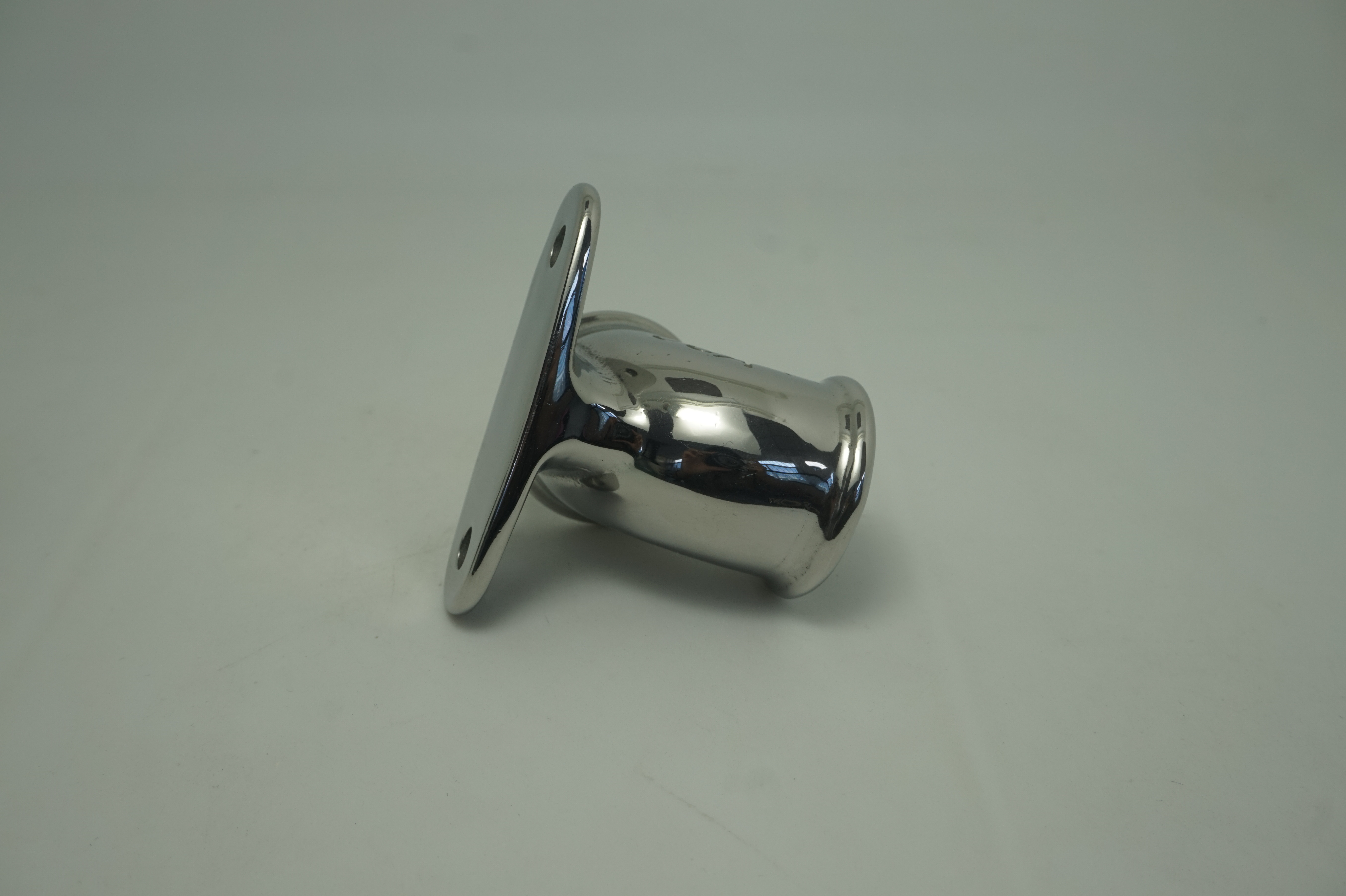
Usually contamination rather than the material itself. Carbon steel media, carbon steel brushes, a machine also used for carbon steel work, grinding dust settling on a wet surface, bare-hand handling and chloride carried in rinse water can all leave something behind that starts to stain. It often appears first at a weld, a pit or a thread root. Segregate stainless work, use dedicated tooling, control the rinse water, dry the part promptly, and check with a wipe test or a free-iron check if the buyer wants one. Whether passivation follows mechanical finishing is the buyer's decision and its own requirement to define in Japan.
The part has to arrive in a repeatable position and condition. That means a defined locating datum, a fixture or positioner that holds the part without distorting it, a starting condition that varies within a stated band, and a family whose geometry does not change on every job. The controlled features should be the same on every variant, and the part should be clean enough that oil or marking ink does not change how a tool cuts. If the part arrives different each time, the cell will spend its hours being adjusted rather than finishing, and the cost per part will not behave the way the original estimate assumed.
No. SurfacePolish supplies finishing machines, media and compounds across borders and discusses a finishing line concept within a defined scope. There is no robotic polishing cell to sell, install or commission, and no automation delivery promise attaches to anything described here. The robotic content is a feasibility and line-design discussion: what a robot can and cannot replace, what has to be fixed about a part, a fixture or a part family before automation is possible, and how a cell compares with a machine route or with hand work. Any cell a buyer builds is specified, integrated and accepted by the buyer and its own integrator, not by SurfacePolish.
Use Hiroshima, Japan as the destination on the enquiry and state whether the deliverable is equipment, media and compound, a representative sample review or a line concept. A destination does not imply local stock, a local service point or a local delivery time.
Japanese buyers work to JIS (Japanese Industrial Standards) administered through the Japanese Industrial Standards Committee (JISC); the official JIS database allows standards to be read but not printed, so buyers normally work from purchased or licensed copies and from the JIS number cited on drawings. Management-system certification to ISO 9001 is commonly required as general industry practice, and aerospace customers flow down their own additional process and documentation requirements.
Sources were retrieved on 2026-09-29 and describe the local industrial and trade context only. They do not evidence any SurfacePolish project, shipment, installation or service in Hiroshima.
The buyer needs the drilled hole edges broken consistently without medium wedging in the holes or damaging the gasket face.
Send the material, dimensions, approximate weight, batch quantity, the incoming condition and photographs of the difficult features. Mark which features must not be contacted by media and state how the result will be inspected. This form carries source reference PSEO-0866; quote it if you prefer an additional manual reference.
Open the SurfacePolish enquiry form Email a prepared enquiry
No price, lead time, certification or result is promised here. Confirm whether a sample trial is available for the specific part and what the trial can and cannot show.
Page PSEO-0866 · revised 2026-09-29 · cross-border equipment, media and scoped sample review. City context is sourced and cited above.
Use this local checker to identify missing part and inspection information. It prepares a technical-review brief; it does not approve a machine, process recipe or production result.
Complete the part details to prepare a review brief.
Email : info@surface-polish.com


 IPv6 network supported


 +86-592-2381506