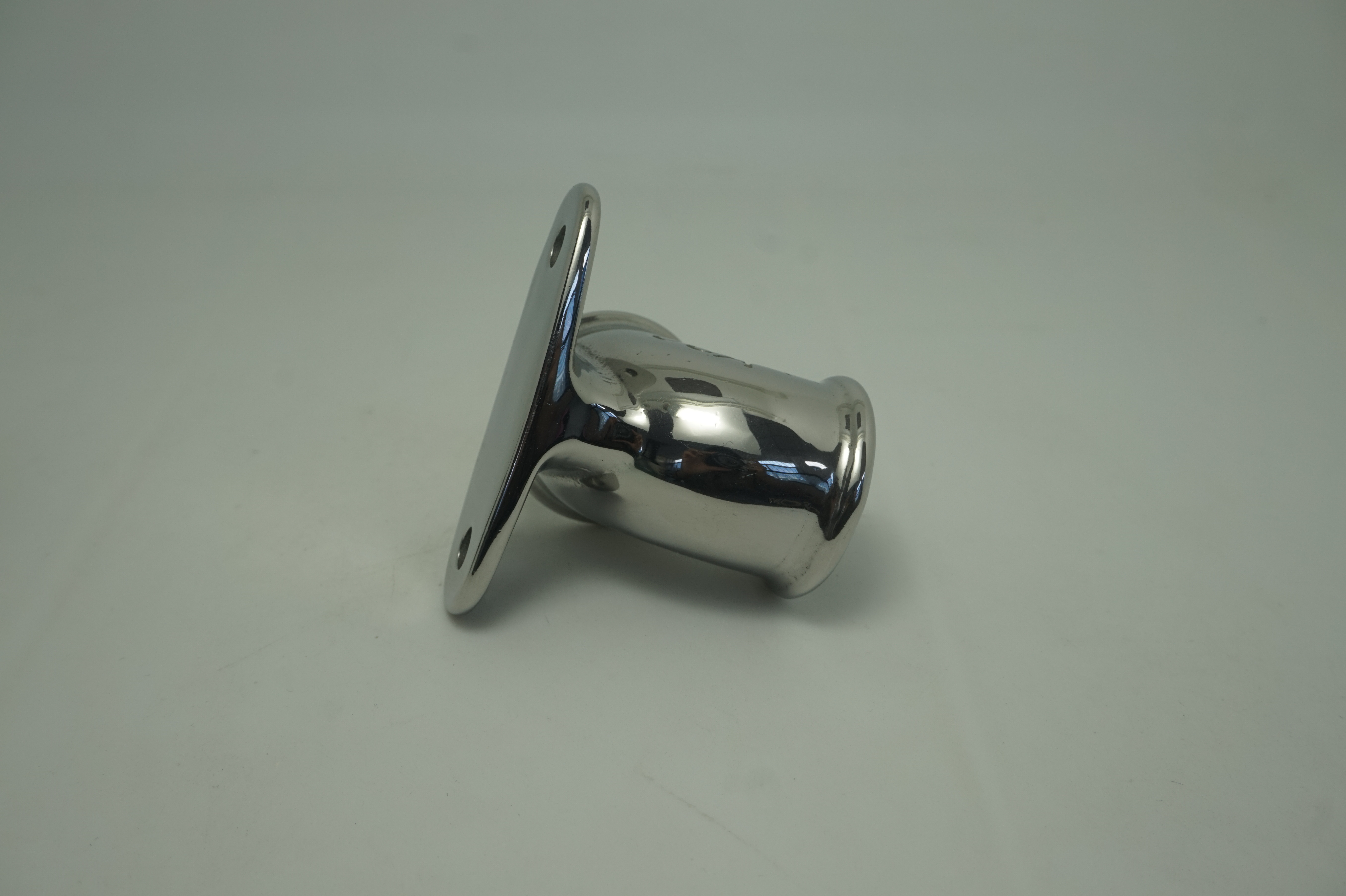
A buyer in Hyderabad, India in marine components produces around 400 cast deck fittings a month in three sizes and is asking whether the finishing step is worth automating. SurfacePolish supplies finishing machines, media and compounds across borders and offers a free sample trial on representative castings, which return from Xiamen with an observed condition and a proposed media, compound and cycle direction and the handling pattern the volume implies. This brief is written for a buyer in Hyderabad working on marine components; it describes equipment, media and a scoped sample review, not a local polishing service.
Does the part family repeat often enough, with stable geometry, to justify a cell rather than a batch machine or hand work?
Can the charge or the tool reach the surfaces that matter, and which enclosed passages and blind holes can never be reached at all?
Which features on this part are functional, such as seal faces, journals, tapers, keyways and weld toes, and which are only cosmetic?
Mass finishing works where a charge can flow across the surface. Sort the part into accessible and inaccessible zones and be literal about it. An open external weld run on a bracket, a cast cleat or the outside of a small valve body is reachable. The inside of a closed box section, the back of a stiffener, a narrow seawater passage and the root of a deep groove are not, whatever the medium is. Concave pockets hold media and release it slowly; sharp internal corners trap it. That map decides whether the whole part, or only some faces of it, can go to a tumbling route, and whether the remainder needs a tool that can be aimed at a surface, by hand or by an arm. Accessibility, more often than finish, is what ends the mass-finishing option.
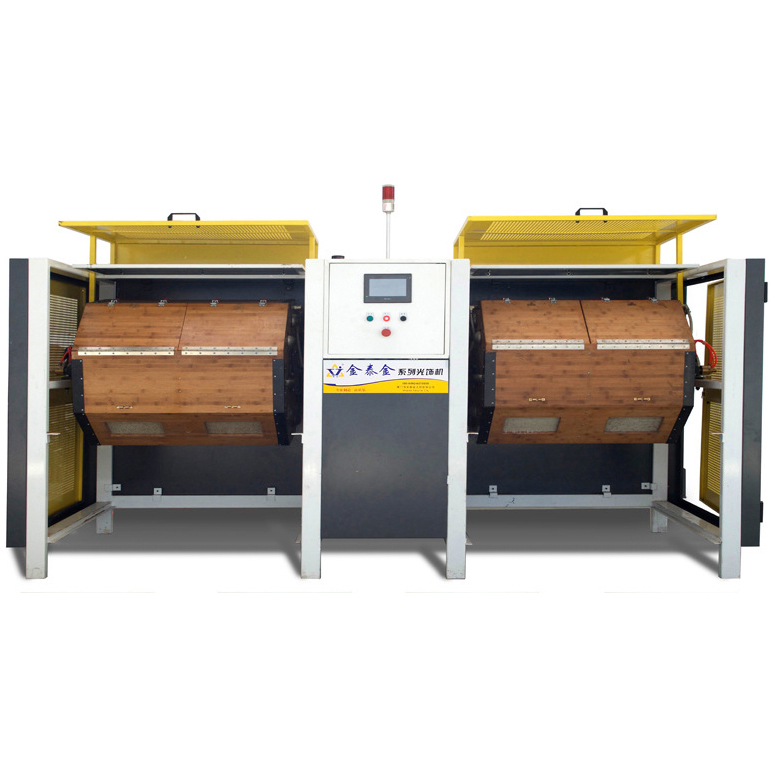
Rotary barrels, disc machines and centrifugal barrel machines cover the high-energy end. A disc machine cuts quickly on small robust parts and suits uniform batches of fittings, while a centrifugal barrel machine produces short, aggressive cycles on small precision items. A rotary barrel is gentler on fragile or thin components but runs long and hides the part while it runs. All three require the part to fit a defined working volume and to tolerate contact with other parts or with a rotating disc. None of them accepts a four-metre shaft or a two-hundred-kilogram casting. In a marine part mix they handle the small-part tail of the family, such as fasteners, small fittings, inserts and valve trim, while the large fabrications go to a tub, a hand-held tool or a considered robot cell.
| Machine route | Where it fits | What it will not do |
|---|---|---|
| Vibratory finishing machine (bowl) | Bulk deburring and refinement of small and medium marine fittings, cast cleats, brackets and machined valve internals that can tumble without racking | Continuous part-on-part contact and no access to internal passages; visible faces and heavy parts need separation, racking or a different route |
| Tub vibrator | Long parts that cannot rotate in a bowl, such as rail sections, pipe spools, linear weldments and long shafts, provided they can be supported along their length | Lower energy per unit area, so heavy weld dressing takes longer, and a long tub needs floor space plus a support method that does not mark the part |
| Centrifugal barrel finishing machine | Short, aggressive cycles on small precision items such as valve trim, inserts and small stainless components with fine edge requirements | Rounds edges and can distort thin unsupported sections quickly, and results are sensitive to charge weight, speed and stop time |
| Magnetic finishing machine | Fine deburring and light refinement of small precise features such as narrow slots, small bores and stainless fittings | A small working envelope that excludes large fabrications, with pin media that can lodge in fine passages and must be retrieved |
Steel media produces a bright, burnished surface on stainless components with low stock removal and good edge blending. On marine work the contamination question comes first. Carbon steel media and carbon steel brushes leave free iron on an austenitic or duplex surface, and free iron in a chloride environment is where rust bloom begins. A steel charge needs its own machine or a documented separation protocol, a corrosion-inhibiting compound, magnetic or screen separation at unload, and a finishing sequence that removes transferred iron before the part ships. Stainless steel media reduces the risk but does not remove it. Whether the part is then passivated is the buyer's decision; a recognised practice such as ASTM B912 describes a passivation treatment for stainless steel and belongs in the requirements the buyer defines and verifies.
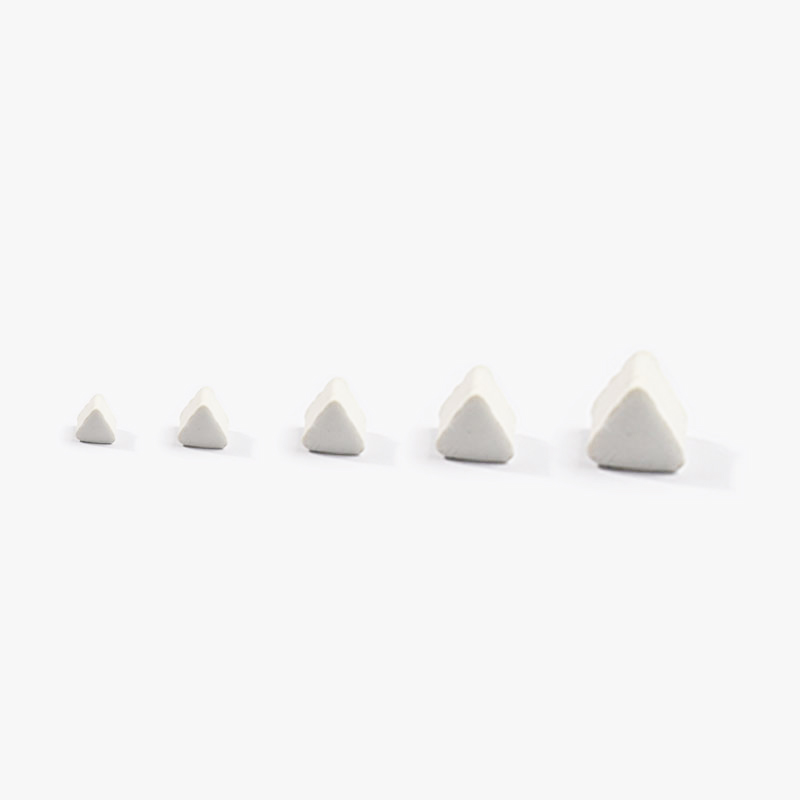
| Media | Best fit | Watch out for |
|---|---|---|
| Plastic triangles, cones and pyramids in a soft to medium grade | Deburring aluminium brackets, bronze castings and cosmetic faces where marking and edge loss must stay small | Slow cut rate, media deforms as it wears, and a worn charge behaves quite differently from a fresh one |
| Aluminium oxide grinding media in a dense ceramic bond | Heavier stock removal or a more consistent cut on robust stainless and duplex parts with thick edges and cast skin | High removal energy rounds functional edges quickly and is a poor match for thin panels or a knife-edge seat |
| Heavy-cut ceramic angle-cut triangles in a coarse size class | Breaking the edge of a machined or cast marine fitting and removing a substantial burr on robust stainless before a refinement stage | Cuts corners and weld toes aggressively and can round a seat or keyway, and the coarse section may not enter narrow passages at all |
| Chloride-free mildly alkaline or near-neutral compound, liquid or powder | Cleaning, corrosion inhibition and fines suspension on stainless and duplex marine work where retained chlorides would risk pitting in service | Dose drifts with drag-out and water hardness, foam can hide the load, and rinse water must reach the same features the compound reached |
Rounding is the purpose of most finishing and also the most common way a marine part is ruined. A weld toe that should retain a defined radius, a bore lip a gasket seals against, a knife edge on a valve seat and the flank of a keyway all lose geometry when a charge or a belt works them too long. The failure is progressive rather than sudden: early passes improve the surface and later passes quietly cross the limit. Set a maximum radius or a minimum remaining edge on the drawing, shield or mask the features that must hold it, and measure the same edge before and after with an optical comparator, a radius gauge or a moulded replica. On a robot-held tool, edge exposure is a function of path and pressure, so a few extra seconds in one corner is enough.
| Failure mode | Likely cause | How to catch it |
|---|---|---|
| Compound film, burnished residue or dried detergent left on a sealing face | Rinse that did not reach the same features the finishing step reached, compound drag-out from the charge, or a part allowed to drain and dry in position instead of being dried deliberately | Wipe the sealing face with a clean white cloth and a defined solvent, inspect the wipe, and borescope any groove or land the rinse may not have reached |
| Rust bloom and tea staining appearing on a finished stainless surface within days | Free iron from carbon steel media or brushes, a machine shared with carbon steel work, airborne grinding dust on a wet surface, bare-hand handling, or chloride carried in rinse water | Wipe a defined area with a white cloth and record what it shows, run a free-iron check if the buyer wants one, and inspect welds, pits and thread roots under good light after the part has stood for a period |
| Over-grind step or gouge at a path transition or belt change | Two passes overlapping at different pressures, a fresh belt run at the setting that suited a worn one, or an operator touching up a transition by hand without recording it | Inspect each transition zone at a fixed viewing distance under consistent lighting, and compare the zone against the surrounding surface with a roughness reading on both sides |
| Clamping indentations and part-on-part impact marks on a visible face | Gripper or fixture force applied on a finished or visible surface, no protective interface at the contact point, or parts left free to collide in a batch charge | Inspect all contact points and visible faces under raking light against a reference part, and record the fixture contact scheme used so marks can be traced to a specific clamp or pocket |
Hyderabad's industrial base combines pharmaceuticals and life sciences with aerospace and defence manufacturing and heavy electrical equipment. The city is the registered-office base of Aurobindo Pharma, an Indian generics manufacturer, and Telangana's apex chamber, the Federation of Telangana Chambers of Commerce and Industry (established 1917), runs its industry programmes at Federation House in the city. Tata Advanced Systems' Boeing joint venture delivered the 250th AH-64 Apache fuselage from its Hyderabad facility, which the company says employs over 900 engineers and technicians. BHEL keeps a dedicated R&D centre in Hyderabad and lists a Heavy Power Equipment Plant (HPEP) in the city.
The nearest part of that base to this brief is medical: Aurobindo Pharma, an Indian generics manufacturer, has its registered office at Ameerpet, Hyderabad, and FTCCI runs pharma-industry programmes at Federation House in the city.
Hyderabad's mix of pharmaceutical equipment, aerospace structures and heavy electrical hardware puts deburring, edge quality and cleanliness on the production agenda: hygienic stainless components have to meet the equipment owner's cleaning and contamination requirements, while machined aerospace and power-equipment parts are checked for burrs and edge condition before assembly. Process selection also depends on whether media or compound residue can be fully removed from internal passages and crevices, which is a standard qualification question for safety-critical and hygienic parts.
Before choosing a finishing process, a Hyderabad buyer should settle whether acceptance is defined by edge condition on machined parts or by particulate and contamination cleanliness on hygienic stainless parts, and confirm on sample parts that the selected media and compound can be removed completely from the part's internal geometry.
Freight context: Hyderabad Begumpet Airport (Airports Authority of India). AAI maintains the Hyderabad airport page for Begumpet Airport and lists a cargo section. Imported machines and sample parts move under the standard Indian customs procedure — bill of entry and clearance at the airport or port of entry, or at an inland container depot — and notified products are checked for BIS compliance at import.
An Importer-Exporter Code (IEC) issued by DGFT is a key business identification number which is mandatory for exports or imports, and since the introduction of GST the IEC number is the same as the PAN of the firm (c6). The post-incorporation clearance list published by Invest India includes the IEC, a Customs- Special Valuation Branch reference and the grant of a Bureau of Indian Standards (BIS) licence, and it names the Central Board of Excise and Customs among the agencies in the framework (c10). The Foreign Trade Policy fixes the mandatory import documents as a bill of lading / airway bill / lorry receipt / railway receipt, a commercial invoice cum packing list and a bill of entry, with additional documents or NOCs possible for goods subject to product-specific compliance (c3); it also states that domestic laws, rules, orders, technical specifications and environmental, safety and health norms applicable to domestically produced goods apply mutatis mutandis to imports unless specifically exempted (c2), which is the basis on which a BIS quality-control order can bite on imported machinery. A landed-cost plan therefore needs the correct ITC(HS) classification and the basic customs duty and IGST that follow from it, plus the IEC, the bill of entry documentation and any BIS licence or registration obligation, and a related-party import can additionally be pulled into special customs valuation.
The Bureau of Indian Standards (BIS) describes itself as the National Standards Body of India and runs the country's product certification system, including products under compulsory certification, a foreign manufacturers certification scheme with nomination of an authorised Indian representative, and a registration scheme for manufacturers (c8, c9). Indian Standards (IS) issued by BIS are the reference texts Indian buyers write surface, coating and material specifications against, and BIS-recognised or BIS-empanelled laboratories are the test facilities used for certification work. Where a machine, media or compound falls under a BIS quality-control order, the licence or registration duty attaches to the product placed on the Indian market, so an overseas supplier should settle the applicable IS standard and the certification route before quoting.
SurfacePolish supplies from Xiamen, China. The buyer's own destination rules, conformity marking, tariff classification and documentation responsibilities stay with the buyer; confirm them against the authorities named above before ordering.
Acceptance should exist before finishing starts, on the drawing or in a document the drawing references. Name every controlled surface, the parameter and the cut-off to be used, the measurement direction and the locations where readings are taken, because a seal face, a bore and an outer wall respond differently to the same charge. State the maximum edge radius or the minimum remaining edge at any weld toe, bore lip, keyway or seat. Say what is acceptable visually and under what lighting and viewing distance. Add the functional checks and the cleanliness requirement, together with who performs them. Without this the first argument about a rejected lot becomes a discussion about opinion. A buyer who writes the criteria can also compare two route options on the same basis, whether the work is done in a machine, by hand or by an arm.
A comparison is useful only if one thing changes at a time. Run the same part, the same marks and the same measurement plan against two options, keeping compound, concentration, cycle or path, and charge age as close as possible. Where the trial runs in a machine, charge the two options separately rather than mixing them, and add the fresh-media effect to the list of variables, since a new charge cuts differently from an aged one. For a tool-carrier comparison, use the same belt or wheel specification and reset the tool life counter between runs. Randomise the order when more than two options are compared, and have the parts evaluated by someone who does not know which is which. Record everything on the same form and photograph each option under the same lighting.
No. SurfacePolish does not issue certification, qualification or approval for any regulated application, and nothing described here may be treated as such a claim. Requirements set by a classification society, a coating manufacturer or an end user are defined and verified by the buyer and its own inspection function. What SurfacePolish provides is equipment, media and compounds, a scoped discussion of a line concept, and observations from a sample trial on the parts tested under the settings used. Those observations can feed the buyer's own qualification work, but they do not replace it or shorten it.
Usually contamination rather than the material itself. Carbon steel media, carbon steel brushes, a machine also used for carbon steel work, grinding dust settling on a wet surface, bare-hand handling and chloride carried in rinse water can all leave something behind that starts to stain. It often appears first at a weld, a pit or a thread root. Segregate stainless work, use dedicated tooling, control the rinse water, dry the part promptly, and check with a wipe test or a free-iron check if the buyer wants one. Whether passivation follows mechanical finishing is the buyer's decision and its own requirement to define in India.
A positioner is often the cheaper answer to reach. Turning the part to present a new face to a fixed tool or to a smaller machine can remove the need for a long-reach arm and reduce the payload the arm must carry. The trade is an extra axis with its own repeatability, and a fixture that has to locate on every face it turns to. A robot arm earns its place where the tool must travel over a surface that cannot practicably be turned, or where the same motion repeats on many parts. Decide from geometry and volume, not from technology, and prove the surface before either is bought.
Use Hyderabad, India as the destination on the enquiry and state whether the deliverable is equipment, media and compound, a representative sample review or a line concept. A destination does not imply local stock, a local service point or a local delivery time.
India's national standards body is the Bureau of Indian Standards (BIS). Pharmaceutical and medical-device buyers in Hyderabad normally write finish, cleanliness and material requirements into their own equipment specifications and vendor qualification documents, on top of the applicable Indian Standards.
Sources were retrieved on 2026-09-29 and describe the local industrial and trade context only. They do not evidence any SurfacePolish project, shipment, installation or service in Hyderabad.
The buyer has steady volume and a narrow part family and wants to know whether the finishing step is worth automating.
Send the material, dimensions, approximate weight, batch quantity, the incoming condition and photographs of the difficult features. Mark which features must not be contacted by media and state how the result will be inspected. This form carries source reference PSEO-0956; quote it if you prefer an additional manual reference.
Open the SurfacePolish enquiry form Email a prepared enquiry
No price, lead time, certification or result is promised here. Confirm whether a sample trial is available for the specific part and what the trial can and cannot show.
Page PSEO-0956 · revised 2026-09-29 · cross-border equipment, media and scoped sample review. City context is sourced and cited above.
Use this local checker to identify missing part and inspection information. It prepares a technical-review brief; it does not approve a machine, process recipe or production result.
Complete the part details to prepare a review brief.
Email : info@surface-polish.com


 IPv6 network supported


 +86-592-2381506