A buyer in Liverpool, United Kingdom in marine components produces around 400 cast deck fittings a month in three sizes and is asking whether the finishing step is worth automating. SurfacePolish supplies finishing machines, media and compounds across borders and offers a free sample trial on representative castings, which return from Xiamen with an observed condition and a proposed media, compound and cycle direction and the handling pattern the volume implies. This brief is written for a buyer in Liverpool working on marine components; it describes equipment, media and a scoped sample review, not a local polishing service.
Which features on this part are functional, such as seal faces, journals, tapers, keyways and weld toes, and which are only cosmetic?
Does the part family repeat often enough, with stable geometry, to justify a cell rather than a batch machine or hand work?
What starting condition and cleanliness baseline will the part arrive in, and who owns the pre-finish step?
Automation needs repetition more than it needs difficulty. A family with stable geometry, a fixed set of controlled features and demand that recurs every week is a candidate; a one-off fabrication with a different weld layout each time is not, however much hand work it consumes. Establish the annual and monthly quantity, how many variants sit in the family, the size difference between the largest and smallest variant, and the takt a cell would have to meet. Then count the manual hours honestly: finishing, setup and fixture change, handling, inspection and rework. If setup and changeover dominate those hours, a robot may reproduce the same inefficiency with more capital behind it. If a few stable variants consume predictable hours, the arithmetic changes and a feasibility discussion is worth having.
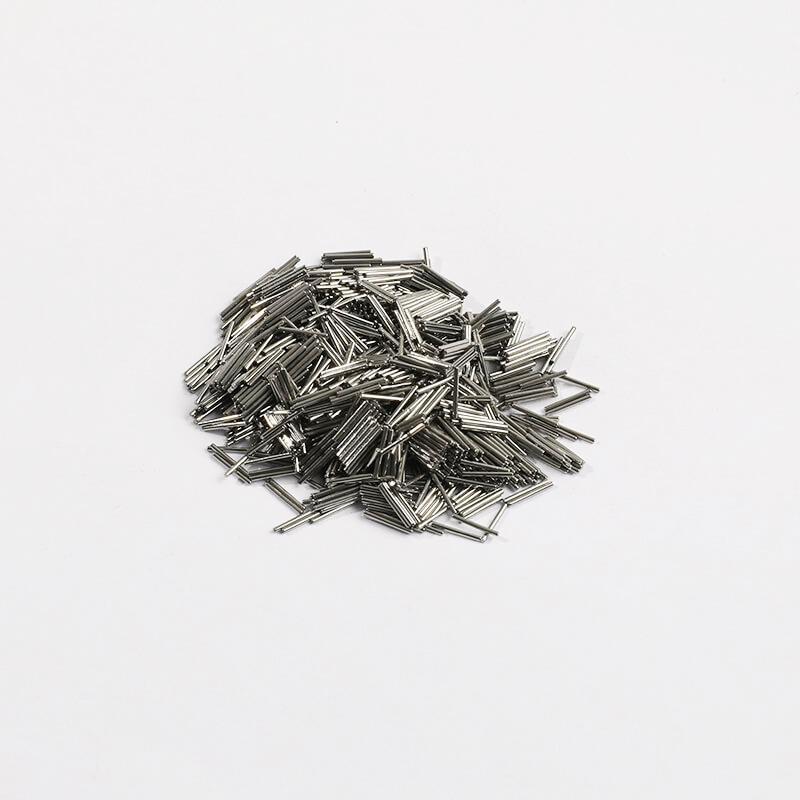
Steel media produces a bright, burnished surface on stainless components with low stock removal and good edge blending. On marine work the contamination question comes first. Carbon steel media and carbon steel brushes leave free iron on an austenitic or duplex surface, and free iron in a chloride environment is where rust bloom begins. A steel charge needs its own machine or a documented separation protocol, a corrosion-inhibiting compound, magnetic or screen separation at unload, and a finishing sequence that removes transferred iron before the part ships. Stainless steel media reduces the risk but does not remove it. Whether the part is then passivated is the buyer's decision; a recognised practice such as ASTM B912 describes a passivation treatment for stainless steel and belongs in the requirements the buyer defines and verifies.
| Media | Best fit | Watch out for |
|---|---|---|
| Plastic triangles, cones and pyramids in a soft to medium grade | Deburring aluminium brackets, bronze castings and cosmetic faces where marking and edge loss must stay small | Slow cut rate, media deforms as it wears, and a worn charge behaves quite differently from a fresh one |
| Bonded abrasive, nonwoven and buffing tool set for an arm or hand tool | Cutting weld toes, blending edges and building luster on large fabrications and free-form surfaces that no batch machine can reach | Each belt, wheel and compound has its own wear curve and pressure window; grain can embed in soft metal and polishing compound leaves a film that must be removed before coating or passivation |
| Steel media including balls, pins and shaped shot | Bright burnished finishing and edge blending on stainless components where appearance matters and stock removal must stay low | Transfers iron to stainless and leaves free iron that blooms in chloride service, so it needs a dedicated charge, an inhibiting compound and magnetic or screen separation |
| Fine ceramic or porcelain shapes in a small size class | Refinement and light edge blending after a cutting stage, and reaching tighter external geometry on small valve parts and fittings | Small sizes enter and lodge in cross-drillings and fine slots, and media wear shrinks the charge so the finish drifts over its life |
A robot reproduces whatever the fixture gives it. A large marine part has to locate on a repeatable datum, be clamped without forcing a thin panel out of shape, and be supported so that it neither sags nor shifts as material comes off. For tool-carrier work, adding a positioner or turntable can present several faces to the arm without re-clamping, which often reduces the reach and payload the arm itself must supply, at the cost of an extra axis with its own repeatability. Build the fixture around surfaces that are not being finished, use the datums the drawing already uses, and decide early whether clamping marks are acceptable on a visible face. A trial that cannot reproduce the production fixture will not predict production variation, however good the tool path looks.
| Machine route | Where it fits | What it will not do |
|---|---|---|
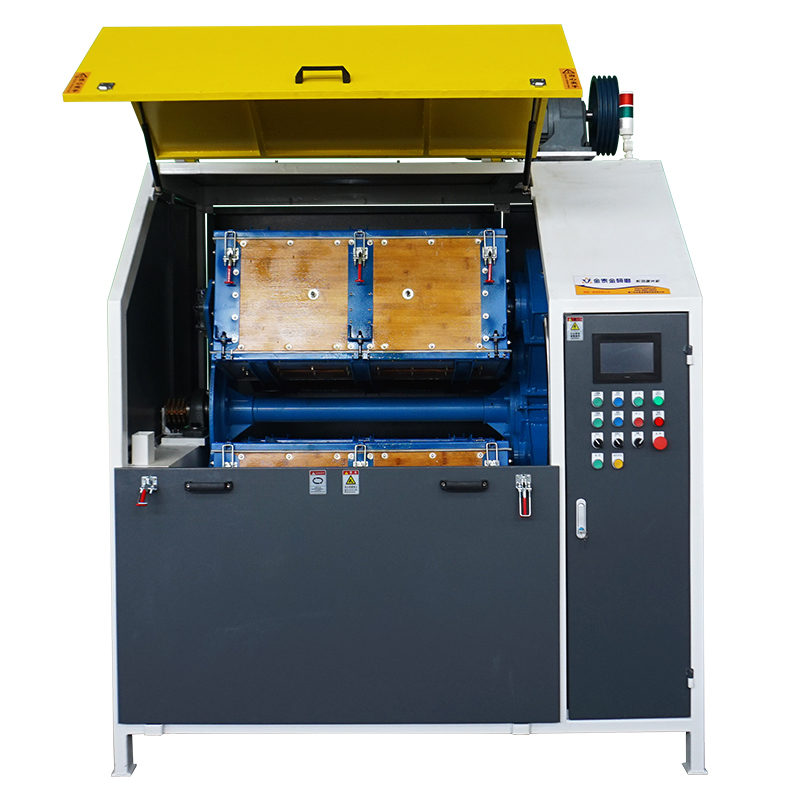
| Grinding finishing machine | Taking off a heavy machining burr or a defined stock layer before a refinement pass on robust stainless and duplex work | High removal energy cuts functional edges fast, so geometry assessment and a short controlled cycle matter more than on any other route |
| Disc finishing machine | Fast, high-energy edge breaking and surface refinement on small robust fittings and uniform batches where cycle time matters | High impingement and edge-loss risk on thin or soft parts, and the geometry must suit the disc working gap rather than a large weldment |
| Magnetic finishing machine | Fine deburring and light refinement of small precise features such as narrow slots, small bores and stainless fittings | A small working envelope that excludes large fabrications, with pin media that can lodge in fine passages and must be retrieved |
| Tub vibrator | Long parts that cannot rotate in a bowl, such as rail sections, pipe spools, linear weldments and long shafts, provided they can be supported along their length | Lower energy per unit area, so heavy weld dressing takes longer, and a long tub needs floor space plus a support method that does not mark the part |
Rounding is the purpose of most finishing and also the most common way a marine part is ruined. A weld toe that should retain a defined radius, a bore lip a gasket seals against, a knife edge on a valve seat and the flank of a keyway all lose geometry when a charge or a belt works them too long. The failure is progressive rather than sudden: early passes improve the surface and later passes quietly cross the limit. Set a maximum radius or a minimum remaining edge on the drawing, shield or mask the features that must hold it, and measure the same edge before and after with an optical comparator, a radius gauge or a moulded replica. On a robot-held tool, edge exposure is a function of path and pressure, so a few extra seconds in one corner is enough.
| Failure mode | Likely cause | How to catch it |
|---|---|---|
| Distortion and loss of flatness on a thin welded panel after dressing | Residual weld stress released by material removal, heat from a grinding or polishing pass, or a support scheme that allowed the panel to deflect while it was worked | Measure flatness with a straightedge and feeler or a dial gauge on a stand at marked grid points before and after, with the same support scheme used both times |
| Over-grind step or gouge at a path transition or belt change | Two passes overlapping at different pressures, a fresh belt run at the setting that suited a worn one, or an operator touching up a transition by hand without recording it | Inspect each transition zone at a fixed viewing distance under consistent lighting, and compare the zone against the surrounding surface with a roughness reading on both sides |
| Medium or a broken medium fragment lodged in a seawater passage, drain boss or internal cavity | Media size class too close to the smallest opening, a worn charge breaking down into smaller pieces, or an enclosed feature that was never mapped before the route was chosen | Count the charge in and out where the batch allows, borescope the smallest passage at an agreed angle, and flush the passage into a filter so the discharge can be examined |
| Clamping indentations and part-on-part impact marks on a visible face | Gripper or fixture force applied on a finished or visible surface, no protective interface at the contact point, or parts left free to collide in a batch charge | Inspect all contact points and visible faces under raking light against a reference part, and record the fixture contact scheme used so marks can be traced to a specific clamp or pocket |
Liverpool's industrial base is port-led: the Port of Liverpool operates two container terminals, the Royal Seaforth Container Terminal and the £400m Liverpool2 deep-water terminal, on both banks of the River Mersey. Peel Ports describes the port as the flagship handling hub of its 'Heart of Britain' steel and metals network and as a vital gateway for UK steel imports and distribution, and reports a record of over 702,000 tonnes of bulk steel and metals handled. Make UK classes the North West as the UK region with the highest total manufacturing output, and the Liverpool City Region Combined Authority is the area's statutory economic body.
For this brief the relevant part of that base is marine: Peel Ports describes the Port of Liverpool as one of the world's leading ports with deep-water berths, RoRo services, project cargo handling and multi-user warehousing, part of the Irish Sea Hub serving Glasgow, Dublin and Manchester.
Steel and metals handling at scale - the port reports a record of more than 702,000 tonnes of bulk steel and metals - supports a local base of stockholders, fabricators and processing firms whose plate, bar and sections need edge and surface conditioning before fabrication or dispatch. Media, machines and sample parts for that work can be landed at Liverpool2 or on the Manchester Ship Canal and moved inland on the same rail and road links that already carry the steel.
A Liverpool buyer should confirm the landed-cost and inland-movement plan at the same time as the machine specification, because equipment and media can clear through Liverpool2 or the Manchester Ship Canal, and the finishing acceptance criterion for steel work is normally defined by the customer's order rather than by a generic 'deburred' note.
Freight context: Port of Liverpool: Royal Seaforth Container Terminal and Liverpool2 (deep water), Port of Garston, Liverpool (ABP) - dry bulks and steel products, Liverpool Airport (11.5 miles from the port, per Peel Ports). Peel Ports states that the Port of Liverpool has direct deep-sea and short-sea connections including a niche Far East service, with a purpose-built rail terminal for onward movement, and lists road distances of 105 miles to Birmingham and 217 miles to London. ABP's Port of Garston, Liverpool handles around 500,000 tonnes of cargo a year including steel products, and ABP's Hams Hall terminal links the North West to Midlands distribution.
BSI is the UK's National Standards Body, and British Standards (BS, including adopted BS EN ISO texts) are the documents a UK buyer's surface-finish, edge and cleanliness specifications are normally written against and purchased through. On the plant side, HSE maintains the work equipment and machinery topic covering the safe supply and use of machinery, and the COSHH regime, which requires employers to identify, assess and control risks from hazardous substances - the regime that applies to finishing compounds, abrasive media and the dust and effluent they generate.
Importers need a GB-prefixed Economic Operators Registration and Identification (EORI) number, an import declaration carrying the correct commodity code, and retained commercial invoices plus the Import VAT Certificate (C79) so import VAT can be reclaimed. Machinery placed on the Great Britain market must be marked UKCA or CE: the manufacturer must draw up and retain technical documentation including a Declaration of Conformity, apply the correct marking with identification details, and cooperate with market surveillance; an authorised representative must be established in the UK. Under the Product Safety and Metrology (Amendment) Regulations 2024 the UK continues to recognise CE marking alongside or in place of UKCA for the Great Britain market, so either route can be used for most product types. Duty and import VAT are calculated from the customs value declared, and the commodity code also determines whether an import licence is needed.
SurfacePolish supplies from Xiamen, China. The buyer's own destination rules, conformity marking, tariff classification and documentation responsibilities stay with the buyer; confirm them against the authorities named above before ordering.
Where a part sits in a charge changes what happens to it. Parts at the bottom carry more load and see more part-on-part contact; parts near the wall of a bowl can be bypassed; parts at the ends of a tub can be underworked. A sampling plan that draws from one position will not describe the lot. Agree the sample size, the positions sampled and the order in which parts are drawn, and include a control part measured only at the start and at the end. In a cell, the equivalent is the first part after a tool change, the first part of a shift and the part after a fixture change. Keep each sampled part with its settings record, and define in advance what happens to a lot when one sample falls outside the acceptance band.
Before a cell can be justified, the manual work has to be counted in a form a cell design can use. Time the finishing operation per unit of surface: per metre of weld, per square metre of panel, per edge, per bore. Separate that from handling, meaning finding the part, loading it, turning it, changing a belt, inspecting it and putting it down, because handling is often what a robot is really bought for. Note the variability: how long the same feature takes on a good part and on a difficult one. Then estimate the volume over which those hours recur, and compare it with a cell that earns only while it is running and loaded. Where setup and changeover dominate the hours, automating the finishing motion will not change the economics much.

Partly, and the split is the useful part of the question. A robot can hold a grinder, sander or polishing head over a repeatable path with controlled pressure, which suits long weld runs, flat panels and consistent edges. It struggles where access is restricted, where the surface is free-form and required pressure changes continuously, and where a person compensates for part-to-part variation by feel. Work out which features recur in the same place on every part and which move; automate the first group and leave the second with an operator, or send parts to a machine route that already produces the surface in bulk.
No. SurfacePolish supplies finishing machines, media and compounds across borders and discusses a finishing line concept within a defined scope. There is no robotic polishing cell to sell, install or commission, and no automation delivery promise attaches to anything described here. The robotic content is a feasibility and line-design discussion: what a robot can and cannot replace, what has to be fixed about a part, a fixture or a part family before automation is possible, and how a cell compares with a machine route or with hand work. Any cell a buyer builds is specified, integrated and accepted by the buyer and its own integrator, not by SurfacePolish.
Mask or shield it, or choose a route that does not reach it. A taper and a keyway are usually damaged by the same edge rounding that improves the rest of the part, and a seal face suffers from peening or from a coarse medium. Practical options are a mechanical mask or boot, leaving a stock allowance that is finished later by a controlled operation, holding the part in a fixture that excludes the protected zone, or selecting a gentler medium and a shorter cycle. Measure the feature before and after at marked points, and put a maximum radius or a minimum remaining edge on the drawing.
Use Liverpool, United Kingdom as the destination on the enquiry and state whether the deliverable is equipment, media and compound, a representative sample review or a line concept. A destination does not imply local stock, a local service point or a local delivery time.
Equipment placed on the Great Britain market needs UKCA or CE marking with a Declaration of Conformity, and HSE's work equipment and machinery and COSHH regimes cover operation and the media, compounds and dust involved. Steel and metals buyers additionally work to the material, inspection and certification requirements written into their own order specification for the finished component.
Sources were retrieved on 2026-09-29 and describe the local industrial and trade context only. They do not evidence any SurfacePolish project, shipment, installation or service in Liverpool.
The buyer has steady volume and a narrow part family and wants to know whether the finishing step is worth automating.
Send the material, dimensions, approximate weight, batch quantity, the incoming condition and photographs of the difficult features. Mark which features must not be contacted by media and state how the result will be inspected. This form carries source reference PSEO-0256; quote it if you prefer an additional manual reference.
Open the SurfacePolish enquiry form Email a prepared enquiry
No price, lead time, certification or result is promised here. Confirm whether a sample trial is available for the specific part and what the trial can and cannot show.
Page PSEO-0256 · revised 2026-09-29 · cross-border equipment, media and scoped sample review. City context is sourced and cited above.
Use this local checker to identify missing part and inspection information. It prepares a technical-review brief; it does not approve a machine, process recipe or production result.
Complete the part details to prepare a review brief.
Email : info@surface-polish.com


 IPv6 network supported


 +86-592-2381506