A buyer in Los Angeles, United States in marine components is weighing whether a 1.8 m bronze propeller blade can be polished by machine or must stay hand work. SurfacePolish supplies finishing machines, media and compounds across borders and offers a free sample trial on representative sections, which return from Xiamen with an observed condition and a proposed media, compound and cycle direction to feed the buyer's own automation feasibility study. This brief is written for a buyer in Los Angeles working on marine components; it describes equipment, media and a scoped sample review, not a local polishing service.
Which features on this part are functional, such as seal faces, journals, tapers, keyways and weld toes, and which are only cosmetic?
Can the charge or the tool reach the surfaces that matter, and which enclosed passages and blind holes can never be reached at all?
What starting condition and cleanliness baseline will the part arrive in, and who owns the pre-finish step?
Automation needs repetition more than it needs difficulty. A family with stable geometry, a fixed set of controlled features and demand that recurs every week is a candidate; a one-off fabrication with a different weld layout each time is not, however much hand work it consumes. Establish the annual and monthly quantity, how many variants sit in the family, the size difference between the largest and smallest variant, and the takt a cell would have to meet. Then count the manual hours honestly: finishing, setup and fixture change, handling, inspection and rework. If setup and changeover dominate those hours, a robot may reproduce the same inefficiency with more capital behind it. If a few stable variants consume predictable hours, the arithmetic changes and a feasibility discussion is worth having.
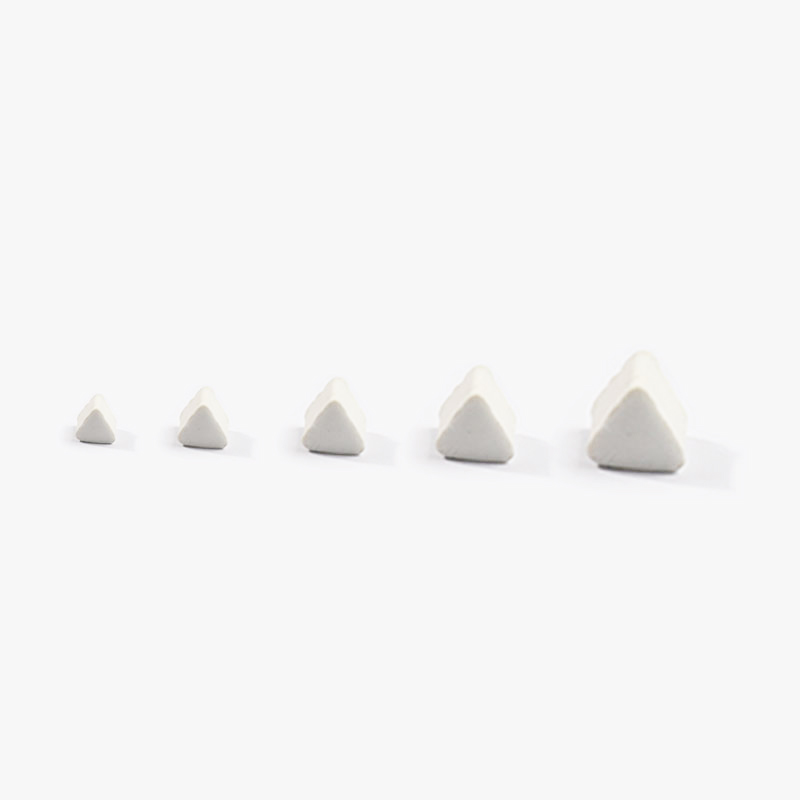
Ceramic media is chosen by shape and size class before the material name is considered. Angle-cut triangles cut edges and work into corners; cylinders and cones roll differently and can wedge; spheres are gentle and consistent but blend rather than cut. A coarse size class removes more per cycle and leaves a coarser texture, and it may not enter a narrow slot at all, while a fine class reaches tighter geometry and takes longer to move the same amount of material. On marine fittings and small castings, a medium triangle in a heavy-cut ceramic is a common starting point for edge break, followed by a finer shape for refinement. Media wear shrinks every piece, so the effective size class drifts upward in age: a charge that was correct when new can stop reaching a groove, or begin lodging in a hole, after weeks of use.
| Media | Best fit | Watch out for |
|---|---|---|
| Fine ceramic or porcelain shapes in a small size class | Refinement and light edge blending after a cutting stage, and reaching tighter external geometry on small valve parts and fittings | Small sizes enter and lodge in cross-drillings and fine slots, and media wear shrinks the charge so the finish drifts over its life |
| Heavy-cut ceramic angle-cut triangles in a coarse size class | Breaking the edge of a machined or cast marine fitting and removing a substantial burr on robust stainless before a refinement stage | Cuts corners and weld toes aggressively and can round a seat or keyway, and the coarse section may not enter narrow passages at all |
| Bonded abrasive, nonwoven and buffing tool set for an arm or hand tool | Cutting weld toes, blending edges and building luster on large fabrications and free-form surfaces that no batch machine can reach | Each belt, wheel and compound has its own wear curve and pressure window; grain can embed in soft metal and polishing compound leaves a film that must be removed before coating or passivation |
| Steel media including balls, pins and shaped shot | Bright burnished finishing and edge blending on stainless components where appearance matters and stock removal must stay low | Transfers iron to stainless and leaves free iron that blooms in chloride service, so it needs a dedicated charge, an inhibiting compound and magnetic or screen separation |
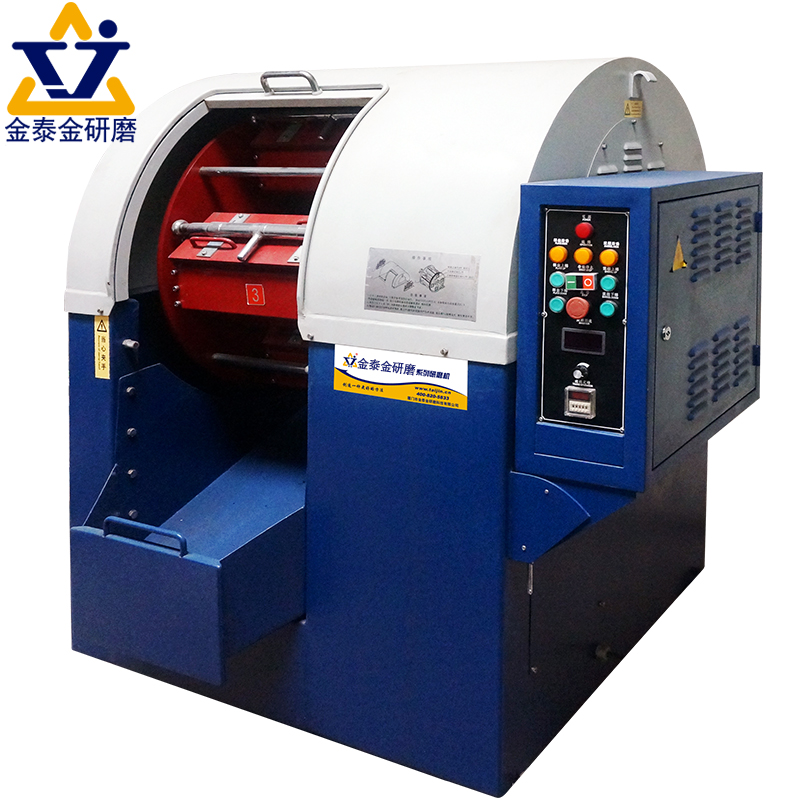
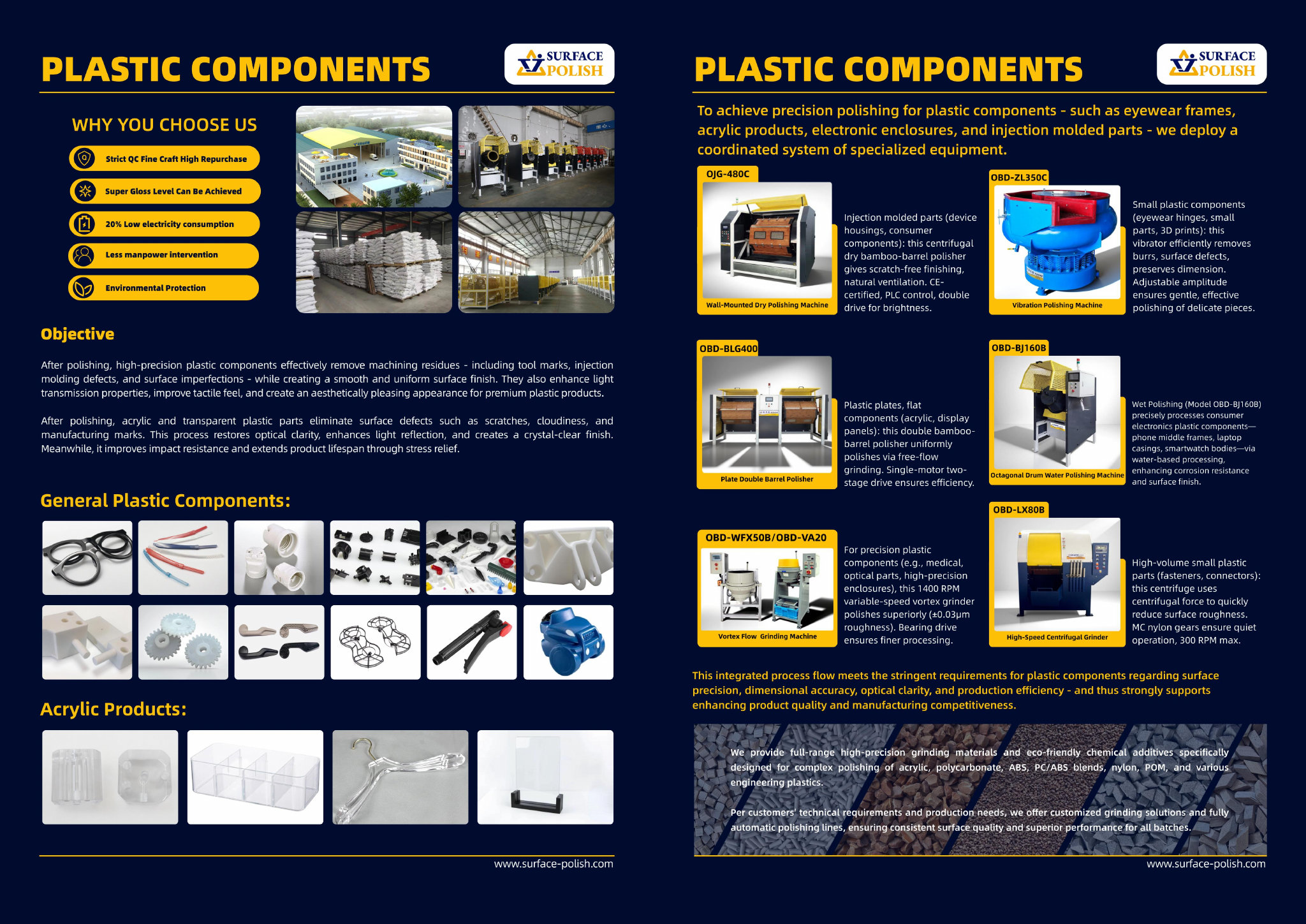
Rotary barrels, disc machines and centrifugal barrel machines cover the high-energy end. A disc machine cuts quickly on small robust parts and suits uniform batches of fittings, while a centrifugal barrel machine produces short, aggressive cycles on small precision items. A rotary barrel is gentler on fragile or thin components but runs long and hides the part while it runs. All three require the part to fit a defined working volume and to tolerate contact with other parts or with a rotating disc. None of them accepts a four-metre shaft or a two-hundred-kilogram casting. In a marine part mix they handle the small-part tail of the family, such as fasteners, small fittings, inserts and valve trim, while the large fabrications go to a tub, a hand-held tool or a considered robot cell.
| Machine route | Where it fits | What it will not do |
|---|---|---|
| Rotary barrel finishing machine | Gentle deburring of small fragile components and mixed fitting batches with generous compound flow and low part-on-part energy | Long cycles with no visibility while running, and internal passages collect media and compound that must be retrieved at unload |
| Centrifugal barrel finishing machine | Short, aggressive cycles on small precision items such as valve trim, inserts and small stainless components with fine edge requirements | Rounds edges and can distort thin unsupported sections quickly, and results are sensitive to charge weight, speed and stop time |
| Tub vibrator | Long parts that cannot rotate in a bowl, such as rail sections, pipe spools, linear weldments and long shafts, provided they can be supported along their length | Lower energy per unit area, so heavy weld dressing takes longer, and a long tub needs floor space plus a support method that does not mark the part |
| Magnetic finishing machine | Fine deburring and light refinement of small precise features such as narrow slots, small bores and stainless fittings | A small working envelope that excludes large fabrications, with pin media that can lodge in fine passages and must be retrieved |
Automation introduces a family of defects that hand work hides. Where an arm slows at a corner, dwells at a waypoint or waits for a tool change, the tool removes more material and leaves a flat spot or a visible step. Where two passes meet, a slight mismatch shows as a band. Tool wear makes the last third of a long path cut differently from the first third unless the cell compensates, and a loaded belt heats the surface instead of cutting it. These show up as texture variation rather than a measurable defect, so they are often accepted at the bench and rejected by the customer. Photograph the surface under raking light, compare the first and last part of a run, measure at fixed points along the path, and treat any visible change at a transition as a signal to review the path or the compensation.
| Failure mode | Likely cause | How to catch it |
|---|---|---|
| Medium or a broken medium fragment lodged in a seawater passage, drain boss or internal cavity | Media size class too close to the smallest opening, a worn charge breaking down into smaller pieces, or an enclosed feature that was never mapped before the route was chosen | Count the charge in and out where the batch allows, borescope the smallest passage at an agreed angle, and flush the passage into a filter so the discharge can be examined |
| Distortion and loss of flatness on a thin welded panel after dressing | Residual weld stress released by material removal, heat from a grinding or polishing pass, or a support scheme that allowed the panel to deflect while it was worked | Measure flatness with a straightedge and feeler or a dial gauge on a stand at marked grid points before and after, with the same support scheme used both times |
| Compound film, burnished residue or dried detergent left on a sealing face | Rinse that did not reach the same features the finishing step reached, compound drag-out from the charge, or a part allowed to drain and dry in position instead of being dried deliberately | Wipe the sealing face with a clean white cloth and a defined solvent, inspect the wipe, and borescope any groove or land the rinse may not have reached |
| Dwell mark or flat spot where a robot-held tool paused, slowed or changed direction | Waypoint spacing or path speed poorly set, a tool change or program transition in the middle of a visible surface, or missing compensation for tool wear along the path | Photograph the surface under raking light and compare first and last parts of a run, and measure at fixed points along the path to locate any step or band |
Los Angeles County's industrial base is anchored by the twin seaports: LAEDC describes the Port of Los Angeles and Port of Long Beach combined as the largest seaport complex in the Western Hemisphere and the handler of over 40% of all inbound containers for the United States, with a mature logistics economy of high-capacity rail, warehousing and distribution built around it. Aerospace is a signature strength, with LAEDC describing the region as designing the next generation of aircraft and space systems, while bioscience - therapeutics to med-tech - and healthcare sit alongside it as major regional employers. Los Angeles International Airport is a second trade gateway that LAEDC records as ranking 14th in the world and 5th in the United States in air cargo tonnage. The City of Los Angeles Economic and Workforce Development Department runs the city's business and workforce programmes, including legacy-business support and microloans for small businesses.
For this brief the relevant part of that base is marine: LAEDC states that the Port of Los Angeles and Port of Long Beach combined form the largest seaport complex in the Western Hemisphere, handling over 40% of all inbound containers for the United States.
The port-driven half of the base - container-handling equipment, truck and chassis components, marine hardware and terminal steelwork - is heavy fabricated and welded work where edge quality, weld dressing and coating adhesion determine service life in salt air. Aerospace and med-tech work in the same metro runs the other way, with tight burr-height and Ra limits on machined aluminium, titanium and stainless parts and strict cleanliness and cross-contamination control between alloys. Serving both from one shop normally means separate media and compound lines rather than one compromise process.
The first decision is whether the shop is finishing welded structural and marine fabrications or precision aerospace and med-tech parts, because the two need different burr and edge criteria, different media (cutting versus non-embedding) and, in the aerospace case, a documented process that the customer can qualify.
Freight context: Port of Los Angeles (San Pedro Bay), Port of Long Beach, Los Angeles International Airport (LAX), Alameda Corridor rail expressway. The Port of Los Angeles publishes monthly and annual container counts in Twenty-Foot Equivalent Units (TEUs); the calendar-year 2026 total stood at 7,038,973.25 TEUs at the time of research, against 10,239,318 TEUs for 2025. LAEDC describes the Los Angeles/Long Beach complex as the largest in the Western Hemisphere and the handler of over 40% of all inbound US containers, with BNSF and Union Pacific main lines and the 20-mile Alameda Corridor linking the ports to the transcontinental rail network. Imported machinery and sample parts would be entered through CBP at the seaport or at LAX.
The United States has no free-trade agreement with China, so Chinese industrial machinery enters under normal-trade-relations (MFN) duty rates in the Harmonized Tariff Schedule of the United States plus any Section 301 duty that applies to the specific HTSUS subheading. USTR's four-year-review modification of the Section 301 China technology-transfer investigation imposed additional Section 301 duties or increased existing rates on certain Chinese products in strategic sectors, and created a temporary exclusion process for machinery used in domestic manufacturing: chapters 84 and 85 of the HTSUS, which cover most machinery used in manufacturing processes, are the chapters that were made eligible for exclusion requests. CBP still administers Section 301 China duties, the four-year-review increases and product exclusions. The IEEPA-based additional ad valorem duties of 2025 - including the reciprocal-tariff actions and the China synthetic-opioid supply-chain duties imposed under Executive Orders 14195 and 14257 - were ordered terminated by Executive Order 14389 of 20 February 2026 and, as soon as practicable, are no longer collected. A buyer should therefore price the MFN rate plus any applicable Section 301 rate and check whether the machine's exact subheading is covered by a current exclusion, rather than assuming either the 2025 IEEPA tariffs or a blanket China rate still applies.
The customs authority is U.S. Customs and Border Protection (CBP), part of the Department of Homeland Security. The importer of record files an entry and then an entry summary (CBP Form 7501): '"Entry Summary" refers to the documentation necessary to enable U.S. Customs and Border Protection to assess duties, collect statistics, and determine whether other requirements of law have been met.' Classification is made in the Harmonized Tariff Schedule of the United States, and an importer may request a written CBP ruling on the correct HTSUS classification and rate of duty, which is the practical way to confirm the treatment of a finishing machine before shipment. Every article of foreign origin must be marked with the English name of its country of origin 'in a conspicuous place as legibly, indelibly, and permanently as the nature of the article (or container) will permit' under 19 U.S.C. 1304 and 19 CFR 134.11. The $800 de minimis (Section 321) exemption is no longer available for ordinary freight: CBP suspended it indefinitely for all modes other than the international postal network effective 24 June 2026, so even low-value sample parts and media must go through formal or informal entry and pay applicable duty. General US industry practice is that there is no single machinery conformity mark comparable to the EU's CE marking; buyers instead verify electrical components and control panels, machine guarding against workplace-safety requirements, and any customer-specific qualification.
SurfacePolish supplies from Xiamen, China. The buyer's own destination rules, conformity marking, tariff classification and documentation responsibilities stay with the buyer; confirm them against the authorities named above before ordering.
Treat the first article as the reference, not as a formality. Approve it against the written criteria, keep it with the settings used, and use it to reset expectations whenever a variable changes. Records worth having for each lot include the machine or cell identifier, the media type, size class, charge mass and charge age, the compound and its measured concentration, the cycle or path program and revision, the tool or belt type and its life counter, the fixture and datum scheme, and the inspection results with their measurement locations. For work done on a trial basis, the record should say plainly that the result applies to the parts and settings tested. Parts received without a settings record cannot be separated from the process that produced them, and repeatability becomes guesswork.
A comparison is useful only if one thing changes at a time. Run the same part, the same marks and the same measurement plan against two options, keeping compound, concentration, cycle or path, and charge age as close as possible. Where the trial runs in a machine, charge the two options separately rather than mixing them, and add the fresh-media effect to the list of variables, since a new charge cuts differently from an aged one. For a tool-carrier comparison, use the same belt or wheel specification and reset the tool life counter between runs. Randomise the order when more than two options are compared, and have the parts evaluated by someone who does not know which is which. Record everything on the same form and photograph each option under the same lighting.
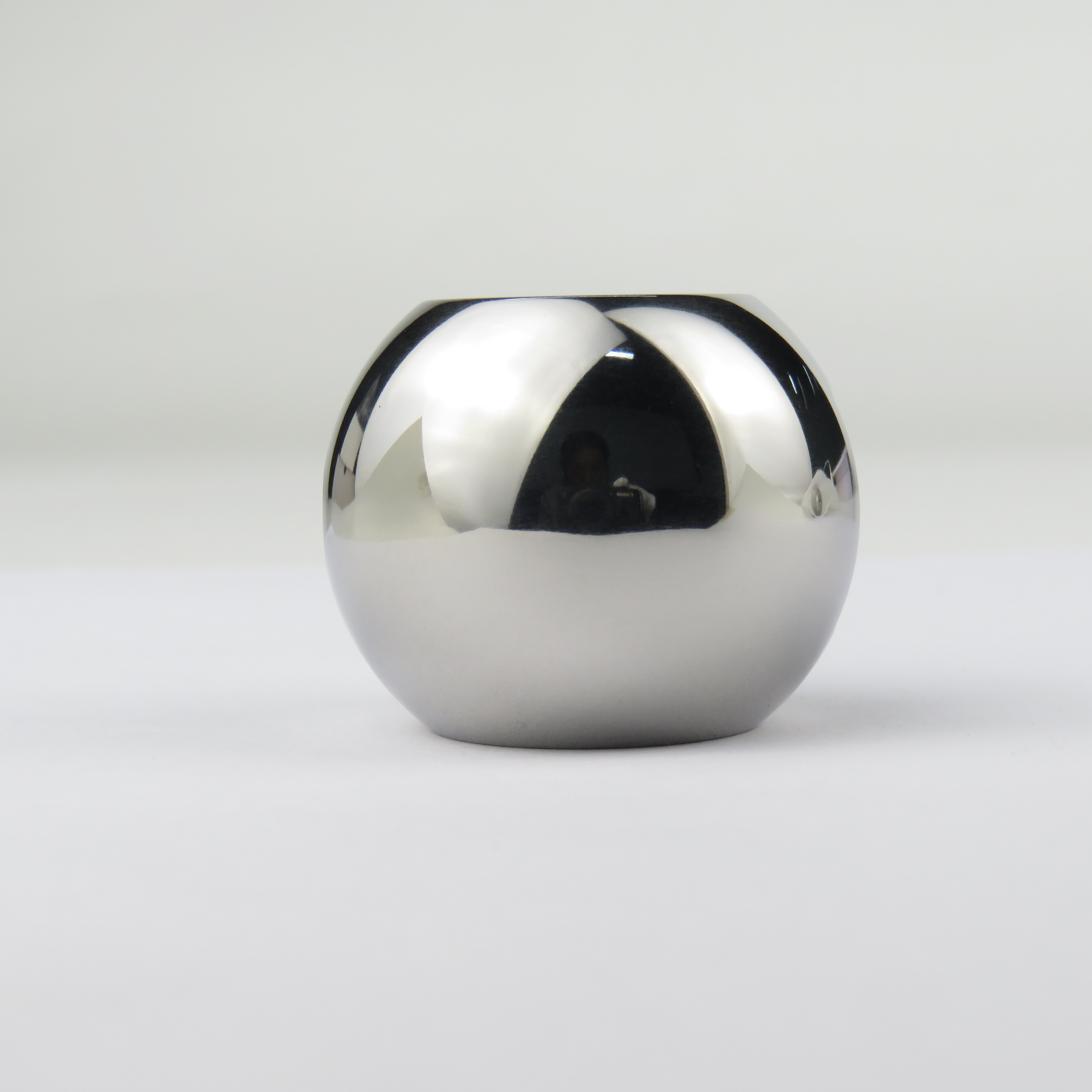
Partly, and the split is the useful part of the question. A robot can hold a grinder, sander or polishing head over a repeatable path with controlled pressure, which suits long weld runs, flat panels and consistent edges. It struggles where access is restricted, where the surface is free-form and required pressure changes continuously, and where a person compensates for part-to-part variation by feel. Work out which features recur in the same place on every part and which move; automate the first group and leave the second with an operator, or send parts to a machine route that already produces the surface in bulk.
Usually contamination rather than the material itself. Carbon steel media, carbon steel brushes, a machine also used for carbon steel work, grinding dust settling on a wet surface, bare-hand handling and chloride carried in rinse water can all leave something behind that starts to stain. It often appears first at a weld, a pit or a thread root. Segregate stainless work, use dedicated tooling, control the rinse water, dry the part promptly, and check with a wipe test or a free-iron check if the buyer wants one. Whether passivation follows mechanical finishing is the buyer's decision and its own requirement to define in United States.
A positioner is often the cheaper answer to reach. Turning the part to present a new face to a fixed tool or to a smaller machine can remove the need for a long-reach arm and reduce the payload the arm must carry. The trade is an extra axis with its own repeatability, and a fixture that has to locate on every face it turns to. A robot arm earns its place where the tool must travel over a surface that cannot practicably be turned, or where the same motion repeats on many parts. Decide from geometry and volume, not from technology, and prove the surface before either is bought.
Use Los Angeles, United States as the destination on the enquiry and state whether the deliverable is equipment, media and compound, a representative sample review or a line concept. A destination does not imply local stock, a local service point or a local delivery time.
A Los Angeles buyer works in the US voluntary-consensus system coordinated by ANSI, and aerospace and defence work adds programme-specific qualification, process approval and cleanliness requirements imposed by the prime contractor. Port, marine and general fabrication work is governed mainly by the buyer's own welding, coating and material specifications, with surface-finish and deburring acceptance fixed on the drawing or in the purchase order rather than by a single national finishing standard.
Sources were retrieved on 2026-09-29 and describe the local industrial and trade context only. They do not evidence any SurfacePolish project, shipment, installation or service in Los Angeles.
The buyer is asking whether polishing of the blade face can be automated at all or must stay hand work.
Send the material, dimensions, approximate weight, batch quantity, the incoming condition and photographs of the difficult features. Mark which features must not be contacted by media and state how the result will be inspected. This form carries source reference PSEO-0036; quote it if you prefer an additional manual reference.
Open the SurfacePolish enquiry form Email a prepared enquiry
No price, lead time, certification or result is promised here. Confirm whether a sample trial is available for the specific part and what the trial can and cannot show.
Page PSEO-0036 · revised 2026-09-29 · cross-border equipment, media and scoped sample review. City context is sourced and cited above.
Use this local checker to identify missing part and inspection information. It prepares a technical-review brief; it does not approve a machine, process recipe or production result.
Complete the part details to prepare a review brief.
Email : info@surface-polish.com


 IPv6 network supported


 +86-592-2381506
