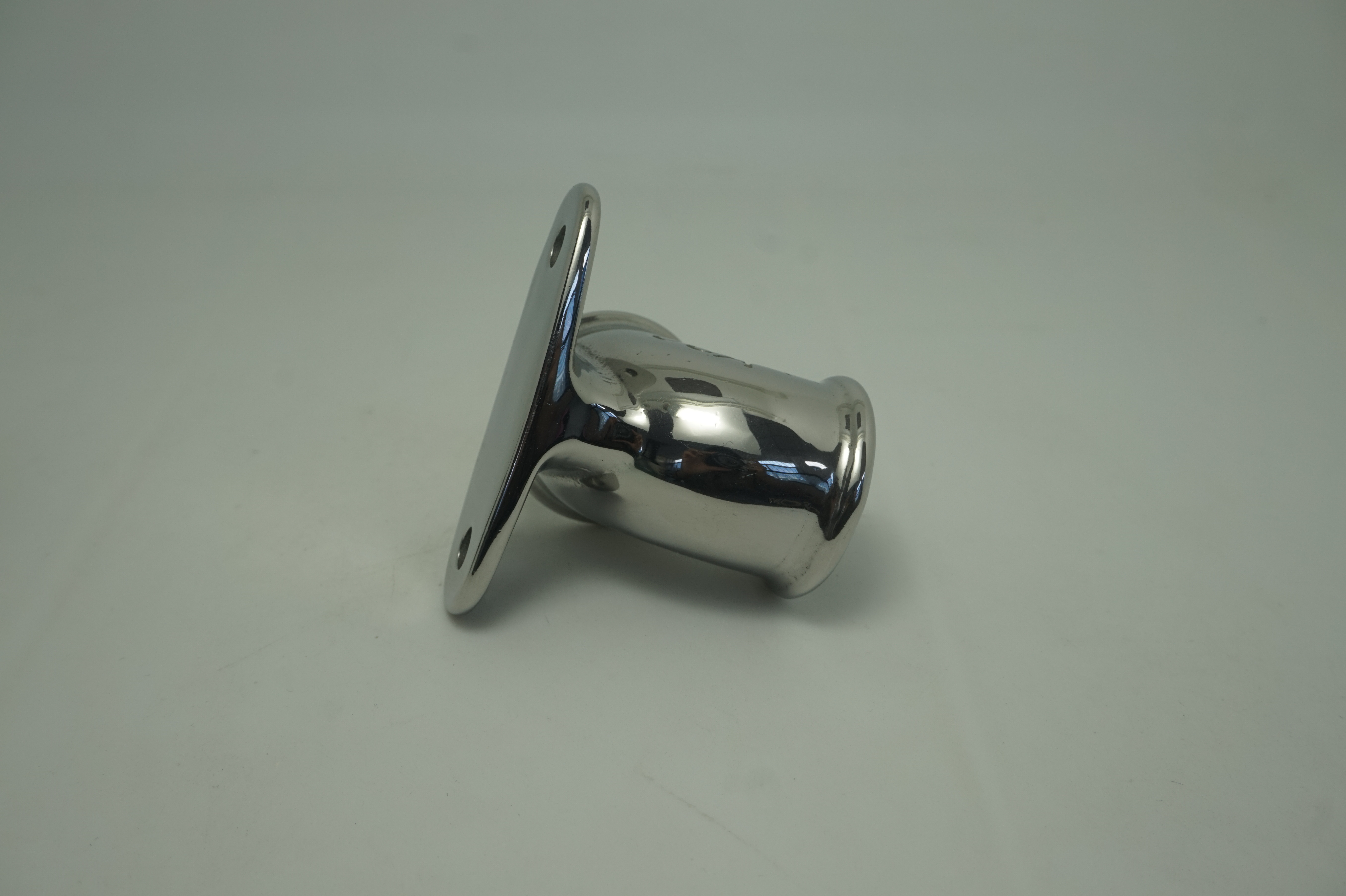
A buyer in Naples, Italy working on marine components has a 220 kg 316L pump casing whose flange face and seawater passage must survive weld dressing intact. SurfacePolish supplies finishing machines, media and compounds across borders and runs a free sample trial: representative parts ship to the factory in Xiamen and come back with an observed condition and a proposed media, compound and cycle direction for the buyer's own review. This brief is written for a buyer in Naples working on marine components; it describes equipment, media and a scoped sample review, not a local polishing service.
What starting condition and cleanliness baseline will the part arrive in, and who owns the pre-finish step?
What is the largest dimension and the greatest mass that must be presented, and can the part be turned or supported without distorting it?
Can the charge or the tool reach the surfaces that matter, and which enclosed passages and blind holes can never be reached at all?
Start by marking on the drawing which surfaces carry a function and which carry only appearance. On marine and offshore work the functional list is short and severe: seal faces on pump and valve bodies, bearing journals and taper seats on shaft components, keyways and splines, flange faces, bolted joint lands, fit bores, and the root of a weld that will be inspected. Everything else, such as the outside of a housing, a bracket web or a handrail run, can absorb a large change in texture. That split decides how much of the part may be exposed to a mass-finishing charge or to a robot-held abrasive without masking. One wrong assumption here, such as letting a coarse medium work a mating land, turns a reasonable route into scrap, so it is the first item a feasibility discussion should settle.
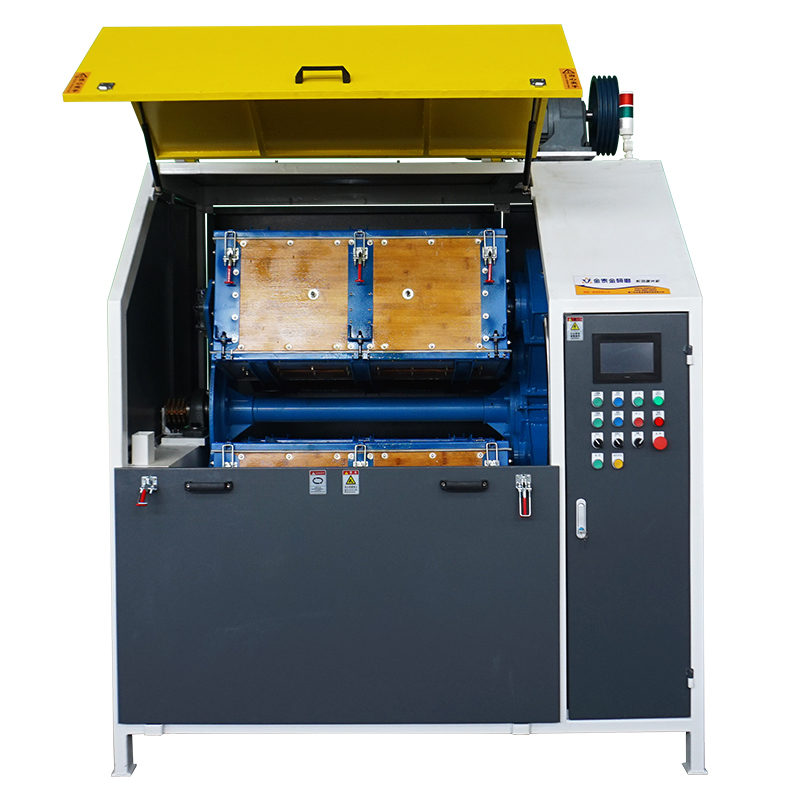
Rotary barrels, disc machines and centrifugal barrel machines cover the high-energy end. A disc machine cuts quickly on small robust parts and suits uniform batches of fittings, while a centrifugal barrel machine produces short, aggressive cycles on small precision items. A rotary barrel is gentler on fragile or thin components but runs long and hides the part while it runs. All three require the part to fit a defined working volume and to tolerate contact with other parts or with a rotating disc. None of them accepts a four-metre shaft or a two-hundred-kilogram casting. In a marine part mix they handle the small-part tail of the family, such as fasteners, small fittings, inserts and valve trim, while the large fabrications go to a tub, a hand-held tool or a considered robot cell.
| Machine route | Where it fits | What it will not do |
|---|---|---|
| Vibratory finishing machine (bowl) | Bulk deburring and refinement of small and medium marine fittings, cast cleats, brackets and machined valve internals that can tumble without racking | Continuous part-on-part contact and no access to internal passages; visible faces and heavy parts need separation, racking or a different route |
| Grinding finishing machine | Taking off a heavy machining burr or a defined stock layer before a refinement pass on robust stainless and duplex work | High removal energy cuts functional edges fast, so geometry assessment and a short controlled cycle matter more than on any other route |
| Centrifugal barrel finishing machine | Short, aggressive cycles on small precision items such as valve trim, inserts and small stainless components with fine edge requirements | Rounds edges and can distort thin unsupported sections quickly, and results are sensitive to charge weight, speed and stop time |
| Rotary barrel finishing machine | Gentle deburring of small fragile components and mixed fitting batches with generous compound flow and low part-on-part energy | Long cycles with no visibility while running, and internal passages collect media and compound that must be retrieved at unload |
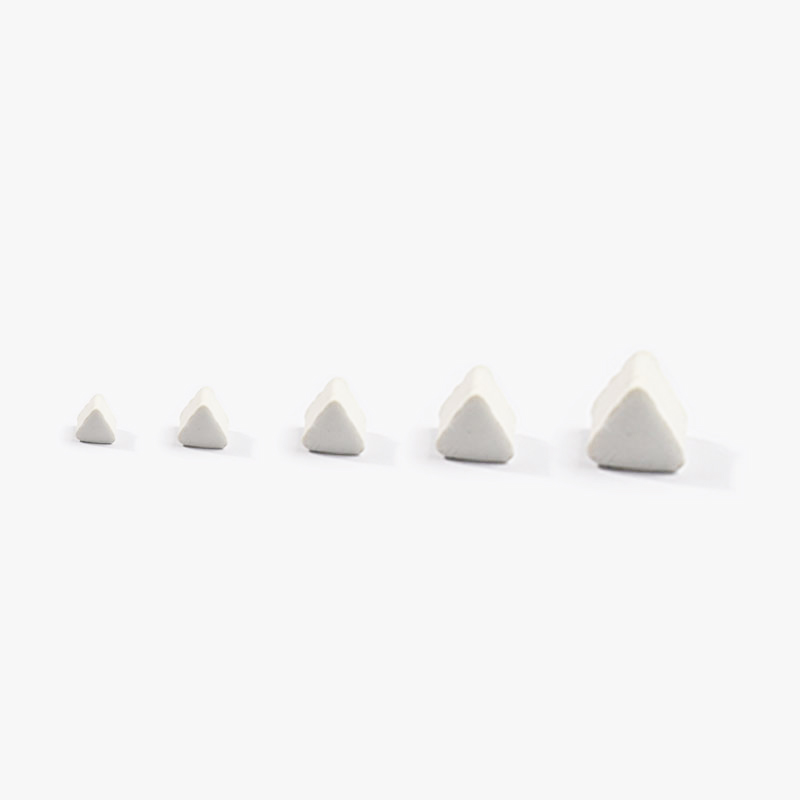
Plastic media suits parts whose surfaces must not be peened, marked or rounded aggressively. Aluminium brackets, bronze and nickel-aluminium-bronze castings, thin sheet components and any part with a cosmetic face respond better to plastic triangles, cones or pyramids in a soft to medium grade than to ceramic. The trade is removal rate: plastic cuts slowly, deforms as it wears, and a worn charge behaves noticeably differently from a fresh one, so cycles set on new media drift. Some shapes float or segregate in a bowl and starve part of the load. In marine work plastic media is often the right first stage where a light machining burr, an adhesive residue or a paint-adjacent edge has to come off without changing the geometry a gasket or a seal depends on.
| Media | Best fit | Watch out for |
|---|---|---|
| Aluminium oxide grinding media in a dense ceramic bond | Heavier stock removal or a more consistent cut on robust stainless and duplex parts with thick edges and cast skin | High removal energy rounds functional edges quickly and is a poor match for thin panels or a knife-edge seat |
| Fine ceramic or porcelain shapes in a small size class | Refinement and light edge blending after a cutting stage, and reaching tighter external geometry on small valve parts and fittings | Small sizes enter and lodge in cross-drillings and fine slots, and media wear shrinks the charge so the finish drifts over its life |
| Chloride-free mildly alkaline or near-neutral compound, liquid or powder | Cleaning, corrosion inhibition and fines suspension on stainless and duplex marine work where retained chlorides would risk pitting in service | Dose drifts with drag-out and water hardness, foam can hide the load, and rinse water must reach the same features the compound reached |
| Steel media including balls, pins and shaped shot | Bright burnished finishing and edge blending on stainless components where appearance matters and stock removal must stay low | Transfers iron to stainless and leaves free iron that blooms in chloride service, so it needs a dedicated charge, an inhibiting compound and magnetic or screen separation |
A pump or valve body has seawater passages, a drain boss and a row of blind tapped flange holes. A welded fabrication has an enclosed stiffener cavity or an open-ended box section. Each of these is a place where a medium, a broken fragment of medium or a slug of compound can settle and stay. The part passes a visual check on the outside and the problem appears after assembly, when a passage is restricted or a fastener will not seat. Size the medium below the smallest opening it can enter, count the charge in and out where the batch allows, borescope the smallest passage at an agreed angle, pin gauge or thread gauge the holes, and rinse through a filter so the discharge can be inspected. Blind features that were never mapped are the usual source.
| Failure mode | Likely cause | How to catch it |
|---|---|---|
| Medium wedged in tube-sheet holes or perforated plate openings | Hole diameter close to the media section, cylindrical or conical media that aligns with the hole, or a charge left to drain in the part at unload | Pin gauge a sample of holes across the plate, tap and back-flush each sample, and inspect the plate under oblique light for a medium sitting flush with the surface |
| Distortion and loss of flatness on a thin welded panel after dressing | Residual weld stress released by material removal, heat from a grinding or polishing pass, or a support scheme that allowed the panel to deflect while it was worked | Measure flatness with a straightedge and feeler or a dial gauge on a stand at marked grid points before and after, with the same support scheme used both times |
| Medium or a broken medium fragment lodged in a seawater passage, drain boss or internal cavity | Media size class too close to the smallest opening, a worn charge breaking down into smaller pieces, or an enclosed feature that was never mapped before the route was chosen | Count the charge in and out where the batch allows, borescope the smallest passage at an agreed angle, and flush the passage into a filter so the discharge can be examined |
| Compound film, burnished residue or dried detergent left on a sealing face | Rinse that did not reach the same features the finishing step reached, compound drag-out from the charge, or a part allowed to drain and dry in position instead of being dried deliberately | Wipe the sealing face with a clean white cloth and a defined solvent, inspect the wipe, and borescope any groove or land the rinse may not have reached |
The Chamber of Commerce's provincial economic profile records a broad manufacturing base alongside services: manufacturing accounts for 18% of provincial employment, behind public services and administration at 30.7% but ahead of commerce (14%), construction (9.5%) and transport (8.2%) (s2). The profile singles out mechanical, electromechanical and transport-equipment manufacturing as particularly significant, and records that the automotive and aeronautical industries are present through large plants that have generated a tier of specialised small and medium subcontracting firms (s1). The fishing and marine sector has an official support track: the chamber approved state-aid vouchers for modernising machinery and equipment for fishing firms in the Phlegraean communes (s5), and the wine sector of the province is promoted through chamber-organised export meetings with foreign buyers (s3). These chamber data are the provincial economic profile published by the Camera di Commercio di Napoli and its census base is historical, so the structural description should be read as the chamber's own profile rather than as current-year statistics.
For this brief the relevant part of that base is marine: The chamber's profile of the Naples port system records ship repairs among the main services offered and describes the shipbuilding and ship-repair firms working with the port's floating and masonry dry docks; the chamber separately approved machinery-modernisation vouchers for fishing firms in the Phlegraean communes.
Naples has an automotive and aeronautical plant base supplied by a local subcontracting tier, which is the part of the local market where deburring and edge control matter most: transmission and engine components, hydraulic fittings, structural brackets and machined castings, all of which reach a finishing operation before inspection. The port's shipbuilding and ship-repair activity adds a large-fabrication case where weld dressing and surface preparation, not fine deburring, set the requirement. Burr and residue control is the acceptance issue for both, and for the aerospace-supplying shops it is written into the customer's drawing.
The first question is whether the shop supplies the automotive or the aeronautical chain, because that decides which quality regime governs and whether a special-process approval is needed at all. Having settled that, the acceptance criterion for burr height or cleanliness should be taken from the customer's drawing rather than agreed bilaterally, since both chains audit against the prime's specification.
Freight context: Porto di Napoli, Aeroporto internazionale di Napoli (Capodichino). The chamber's profile of the provincial transport system records more than 370 firms operating port services with more than 5,200 employees, and lists ship repairs, port warehousing, container services, freight forwarding and ship's agency among the main services, alongside bulk trades in mineral oils, cereals and machinery and vehicles (s6). It describes the international airport at Naples as the most important in southern Italy for traffic volume and close to the city centre (s6). Machines can therefore be landed by sea and cleared in the port area, while sample parts normally move by air, which makes the airport the practical route for a small consignment.
The customs authority is the Agenzia delle Dogane e dei Monopoli (ADM), which is the regulatory, supervisory and control authority for customs and collects the duties. Goods arriving from China are cleared by customs before they can enter the single market and are released into free circulation by means of a customs declaration; the date of acceptance of that declaration is the date used to calculate and apply the import duty and any VAT or excise duty. Importers should settle in advance who lodges the declaration and under which VAT and EORI arrangements, and must ensure the machine carries CE marking and is supported by the EU declaration of conformity and technical file. Because the CE mark is compulsory for machinery covered by the EU machinery legislation and forbidden for products outside it, the conformity route must be settled before shipment rather than at the border.
The national standards body is UNI - Ente Italiano di Normazione, a private non-profit association founded over a century ago, which develops, publishes and disseminates voluntary technical standards and adopts the European and international standards as Italian editions. For finishing work the operative references are the surface-texture series UNI EN ISO 21920-1:2022, which fixes how the surface state (roughness, waviness, primary profile) is indicated on technical product documentation, and UNI EN ISO 21920-2:2022, which defines the terms, definitions and parameters used with profile methods. Machinery safety requirements come from the EU machinery legislation rather than from UNI alone: Machinery Directive 2006/42/EC applies to machinery placed on the EU market before 20 January 2027, after which Machinery Regulation (EU) 2023/1230 takes over.
SurfacePolish supplies from Xiamen, China. The buyer's own destination rules, conformity marking, tariff classification and documentation responsibilities stay with the buyer; confirm them against the authorities named above before ordering.
Acceptance should exist before finishing starts, on the drawing or in a document the drawing references. Name every controlled surface, the parameter and the cut-off to be used, the measurement direction and the locations where readings are taken, because a seal face, a bore and an outer wall respond differently to the same charge. State the maximum edge radius or the minimum remaining edge at any weld toe, bore lip, keyway or seat. Say what is acceptable visually and under what lighting and viewing distance. Add the functional checks and the cleanliness requirement, together with who performs them. Without this the first argument about a rejected lot becomes a discussion about opinion. A buyer who writes the criteria can also compare two route options on the same basis, whether the work is done in a machine, by hand or by an arm.
Automation repeats a result; it does not create one. The first question in a feasibility study is whether any route can produce the required condition on this geometry at all, and that question is answered on a bench or in a machine, not in a cell. Establish the achievable condition and its sensitivity to pressure, speed and time on plain samples of the actual material. Only when a surface can be reproduced by hand under recorded settings does it make sense to ask whether an arm can hold those settings over a whole part. Many projects invert this order, buy the arm first and then discover the requirement was never attainable on the geometry in question. A short process trial on real coupons is cheap compared with a cell designed around a surface that cannot be produced.

A positioner is often the cheaper answer to reach. Turning the part to present a new face to a fixed tool or to a smaller machine can remove the need for a long-reach arm and reduce the payload the arm must carry. The trade is an extra axis with its own repeatability, and a fixture that has to locate on every face it turns to. A robot arm earns its place where the tool must travel over a surface that cannot practicably be turned, or where the same motion repeats on many parts. Decide from geometry and volume, not from technology, and prove the surface before either is bought.
Usually contamination rather than the material itself. Carbon steel media, carbon steel brushes, a machine also used for carbon steel work, grinding dust settling on a wet surface, bare-hand handling and chloride carried in rinse water can all leave something behind that starts to stain. It often appears first at a weld, a pit or a thread root. Segregate stainless work, use dedicated tooling, control the rinse water, dry the part promptly, and check with a wipe test or a free-iron check if the buyer wants one. Whether passivation follows mechanical finishing is the buyer's decision and its own requirement to define in Italy.
No. SurfacePolish supplies finishing machines, media and compounds across borders and discusses a finishing line concept within a defined scope. There is no robotic polishing cell to sell, install or commission, and no automation delivery promise attaches to anything described here. The robotic content is a feasibility and line-design discussion: what a robot can and cannot replace, what has to be fixed about a part, a fixture or a part family before automation is possible, and how a cell compares with a machine route or with hand work. Any cell a buyer builds is specified, integrated and accepted by the buyer and its own integrator, not by SurfacePolish.
Use Naples, Italy as the destination on the enquiry and state whether the deliverable is equipment, media and compound, a representative sample review or a line concept. A destination does not imply local stock, a local service point or a local delivery time.
Naples-area buyers reference UNI and ISO standards for surface texture and cleanliness, and in the automotive and aerospace supply chains the qualification regimes their primes impose: IATF 16949 for automotive and AS/EN 9100 for aerospace, frequently with NADCAP special-process approval where surface treatment is involved. Because the province's automotive and aeronautical work runs through a subcontracting tier, the finish and cleanliness callouts usually reach a machine shop inside the customer's drawing and inspection plan rather than as a standalone finishing specification.
Sources were retrieved on 2026-09-29 and describe the local industrial and trade context only. They do not evidence any SurfacePolish project, shipment, installation or service in Naples.
The buyer wants the weld repairs dressed and the outside cleaned up without rounding the flange face or leaving medium in the seawater passage.
Send the material, dimensions, approximate weight, batch quantity, the incoming condition and photographs of the difficult features. Mark which features must not be contacted by media and state how the result will be inspected. This form carries source reference PSEO-0496; quote it if you prefer an additional manual reference.
Open the SurfacePolish enquiry form Email a prepared enquiry
No price, lead time, certification or result is promised here. Confirm whether a sample trial is available for the specific part and what the trial can and cannot show.
Page PSEO-0496 · revised 2026-09-29 · cross-border equipment, media and scoped sample review. City context is sourced and cited above.
Use this local checker to identify missing part and inspection information. It prepares a technical-review brief; it does not approve a machine, process recipe or production result.
Complete the part details to prepare a review brief.
Email : info@surface-polish.com


 IPv6 network supported


 +86-592-2381506