A buyer in Paris, France in marine components has 3 m spools with internal root welds that no batch machine can reach. SurfacePolish supplies finishing machines, media and compounds across borders and offers a free sample trial on cut sections and production welds, which return from Xiamen with an observed condition and a proposed media, compound and cycle direction showing what an accessible surface can and cannot be finished to. This brief is written for a buyer in Paris working on marine components; it describes equipment, media and a scoped sample review, not a local polishing service.
Can the charge or the tool reach the surfaces that matter, and which enclosed passages and blind holes can never be reached at all?
Which acceptance criteria, measurement locations and functional checks must exist before any route, robot or otherwise, can be compared fairly?
What starting condition and cleanliness baseline will the part arrive in, and who owns the pre-finish step?
Two 316L parts made to the same drawing can behave differently because of how they were produced. Cast material carries a skin and porosity; wrought plate has a rolling direction; duplex and super-duplex grades respond to heat input differently from austenitic grades, and a weld heat-affected zone finishes at a different rate from the parent metal. Hardfacing, weld overlay, and bronze or nickel-aluminium-bronze castings each cut in their own way. Record the grade, the product form, the heat treatment or stress relief, the welding process and the as-received condition, whether machined, plasma cut, grit blasted or still carrying mill scale and heat tint. Note who owns the pre-finish cleanliness step and what the part must be free of, because oil, marking ink and salt carry-over contaminate a charge and change how it cuts.
Ceramic media is chosen by shape and size class before the material name is considered. Angle-cut triangles cut edges and work into corners; cylinders and cones roll differently and can wedge; spheres are gentle and consistent but blend rather than cut. A coarse size class removes more per cycle and leaves a coarser texture, and it may not enter a narrow slot at all, while a fine class reaches tighter geometry and takes longer to move the same amount of material. On marine fittings and small castings, a medium triangle in a heavy-cut ceramic is a common starting point for edge break, followed by a finer shape for refinement. Media wear shrinks every piece, so the effective size class drifts upward in age: a charge that was correct when new can stop reaching a groove, or begin lodging in a hole, after weeks of use.
| Media | Best fit | Watch out for |
|---|---|---|
| Aluminium oxide grinding media in a dense ceramic bond | Heavier stock removal or a more consistent cut on robust stainless and duplex parts with thick edges and cast skin | High removal energy rounds functional edges quickly and is a poor match for thin panels or a knife-edge seat |
| Dry media such as walnut shell and corn cob with a dry polishing machine | Drying, light polishing and luster on parts that must leave the line dry, and on assemblies where a wet residue would be difficult to remove | Generates dust and needs extraction, cannot cut a burr, and organic media can carry moisture and contamination into a clean area |
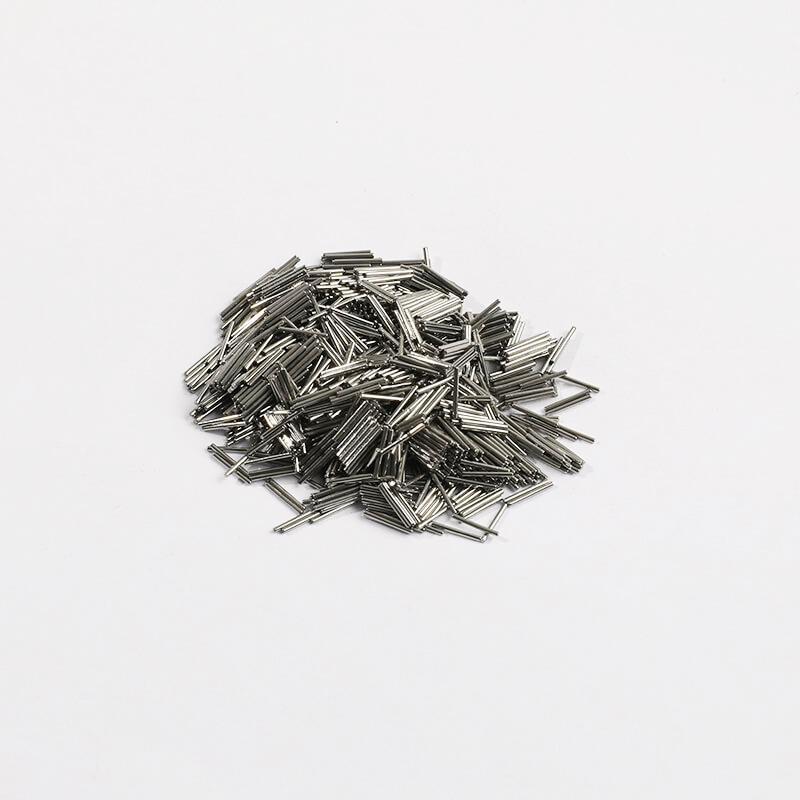
| Steel media including balls, pins and shaped shot | Bright burnished finishing and edge blending on stainless components where appearance matters and stock removal must stay low | Transfers iron to stainless and leaves free iron that blooms in chloride service, so it needs a dedicated charge, an inhibiting compound and magnetic or screen separation |
| Bonded abrasive, nonwoven and buffing tool set for an arm or hand tool | Cutting weld toes, blending edges and building luster on large fabrications and free-form surfaces that no batch machine can reach | Each belt, wheel and compound has its own wear curve and pressure window; grain can embed in soft metal and polishing compound leaves a film that must be removed before coating or passivation |
There are two fundamentally different ways to place a robot in a finishing line, and they fail for different reasons. In the part-handler arrangement the arm grips the part and presents it to a fixed machine, belt or buffing wheel; the arm needs payload for the part plus the gripper, but its motion is simple and repeatable. In the tool-carrier arrangement the arm holds the grinder, sander or polishing head and moves it over a fixtured part; reach must now cover the whole surface, and the arm has to absorb the reaction force of the tool while holding controlled contact. Tool-carrier cells suit large fabrications that are impractical to lift and turn, and they are harder, because force control, tool wear and path accuracy all matter at once. Part-handler cells suit smaller, lighter parts with high volume.
| Machine route | Where it fits | What it will not do |
|---|---|---|
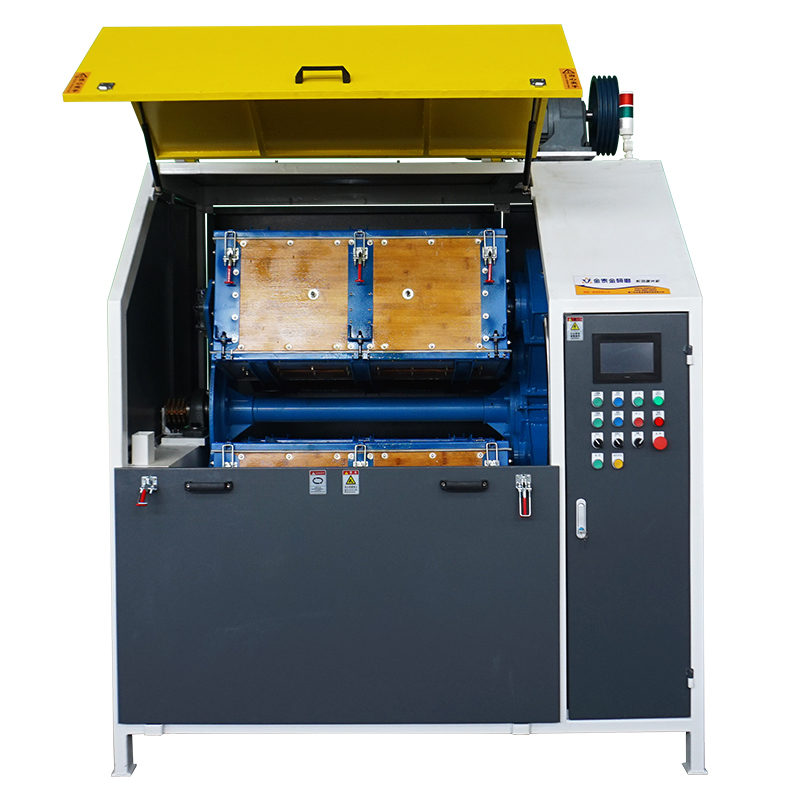
| Magnetic finishing machine | Fine deburring and light refinement of small precise features such as narrow slots, small bores and stainless fittings | A small working envelope that excludes large fabrications, with pin media that can lodge in fine passages and must be retrieved |
| Dry polishing machine and dryer | Drying parts after a wet stage and producing a dry polished surface with organic media where a wet residue would be hard to remove | No cutting action, needs dust extraction, and organic media must be kept dry and clean or it transfers contamination to the part |
| Centrifugal barrel finishing machine | Short, aggressive cycles on small precision items such as valve trim, inserts and small stainless components with fine edge requirements | Rounds edges and can distort thin unsupported sections quickly, and results are sensitive to charge weight, speed and stop time |
| Disc finishing machine | Fast, high-energy edge breaking and surface refinement on small robust fittings and uniform batches where cycle time matters | High impingement and edge-loss risk on thin or soft parts, and the geometry must suit the disc working gap rather than a large weldment |
A pump or valve body has seawater passages, a drain boss and a row of blind tapped flange holes. A welded fabrication has an enclosed stiffener cavity or an open-ended box section. Each of these is a place where a medium, a broken fragment of medium or a slug of compound can settle and stay. The part passes a visual check on the outside and the problem appears after assembly, when a passage is restricted or a fastener will not seat. Size the medium below the smallest opening it can enter, count the charge in and out where the batch allows, borescope the smallest passage at an agreed angle, pin gauge or thread gauge the holes, and rinse through a filter so the discharge can be inspected. Blind features that were never mapped are the usual source.
| Failure mode | Likely cause | How to catch it |
|---|---|---|
| Rust bloom and tea staining appearing on a finished stainless surface within days | Free iron from carbon steel media or brushes, a machine shared with carbon steel work, airborne grinding dust on a wet surface, bare-hand handling, or chloride carried in rinse water | Wipe a defined area with a white cloth and record what it shows, run a free-iron check if the buyer wants one, and inspect welds, pits and thread roots under good light after the part has stood for a period |
| Dwell mark or flat spot where a robot-held tool paused, slowed or changed direction | Waypoint spacing or path speed poorly set, a tool change or program transition in the middle of a visible surface, or missing compensation for tool wear along the path | Photograph the surface under raking light and compare first and last parts of a run, and measure at fixed points along the path to locate any step or band |
| Dimensional drift on a bearing journal, bore or machined fit | Too much stock removed at the feature, stress redistribution in a long or thin part, or clamping force that pulled the part out of shape during finishing | Micrometer or bore gauge the same stations before and after at a controlled temperature, and re-check after the clamps are released to separate clamping deflection from real drift |
| Clamping indentations and part-on-part impact marks on a visible face | Gripper or fixture force applied on a finished or visible surface, no protective interface at the contact point, or parts left free to collide in a batch charge | Inspect all contact points and visible faces under raking light against a reference part, and record the fixture contact scheme used so marks can be traced to a specific clamp or pocket |
Paris itself is employment-dense rather than plant-dense: INSEE counted 188 002 establishments in the commune at the end of 2024, of which 2,6 % were in industry, and 1 811 255 jobs at the place of work in 2023. The industrial base that matters to a finishing buyer sits in the Ile-de-France region around the city, where Choose Paris Region reports 1 800 companies in aeronautics, space and defence and 192 800 jobs in aeronautics and space (INSEE data), plus a heavy-maintenance concentration on and around the airport platforms. Those firms are supplied by a dense subcontracting tier of machining, sheet-metal, surface-treatment and assembly shops across the Paris basin, and the region also carries electronics and health/life-science manufacturing. Aerospace and defence is the flagship cluster: ASTech Paris Region is the dedicated competitiveness cluster, and the region hosts Safran, Thales, Dassault Aviation (including a fuselage plant at Argenteuil) and MBDA.
The nearest part of that base to this brief is medical: The regional investment agency lists Health & HealthTech as one of the Paris Region's industry sectors with a dedicated expert and support track.
The aerospace and defence work done in the Paris basin turns on edge quality and surface integrity on structural and engine parts, on burr-free hydraulic and fuel-system components, and on controlled surface texture at mating and sealing faces. The same region's dense machining and sheet-metal subcontracting tier supplies those primes, so deburring and edge radius control is a recurring production cost rather than a niche operation. Because much of the work is audit-heavy, surface and cleanliness results normally have to be documented per part number rather than demonstrated on a sample.
Before selecting a finishing machine or media, a Paris-region buyer should settle whether the company will qualify the process in-house under its own EN 9100/ISO 9001 surveillance or will subcontract the operation, because that decision fixes the documentation, traceability and acceptance-test burden that the equipment must be able to support.
Freight context: Paris-Charles de Gaulle (CDG), Paris-Orly, Le Bourget, HAROPA Port (Gennevilliers / Limay / Seine axis). Choose Paris Region reports that Paris Region is the leading continental European airport hub, with two international airports (Paris Charles de Gaulle and Paris Orly), Le Bourget as Europe's top business airport, one military air base and 26 other airfields. HAROPA Port publishes 84,70 Mt of maritime traffic, 18,20 Mt of river traffic and 12 M m2 of logistics warehousing on the Seine axis, so machines can be flown into CDG or landed via Le Havre/Rouen and barged to the Paris area, while small sample parts normally move by express air.
The working language of French industrial procurement is French: tenders, drawings, inspection plans and technical dossiers are normally issued and answered in French, and quotations that omit French documentation slow down qualification. Buyers qualify a machine against a written specification and expect traceable material certificates, machine safety documentation and, where applicable, a CE declaration of conformity and a risk assessment; acceptance is often staged (documentary review, factory acceptance test, then commissioning). Payment and documentation norms are conventional EU practice: euro invoicing, SEPA or SWIFT bank transfer, Incoterms agreed in writing, and customs paperwork (commercial invoice, packing list, transport document, proof of origin where a preference is claimed) prepared for the declarant or customs representative. Because customs and tax authorisations are handled jointly through SOPRANO, non-EU sellers are normally advised to sell to an established French/EU importing entity rather than to act as importer of record themselves.
For imports from outside the EU the declarant must file a customs declaration whose form and content are fixed by the Union Customs Code and its implementing provisions; French Customs identifies classification, origin and value as the three fundamental notions and makes the common/national tariff consultable via RITA. The customs authority is the Direction generale des douanes et droits indirects (DGDDI), which also runs the Info Douane Service for formalities questions. Buyers should expect to need an EORI number and an EU VAT treatment, because customs and tax authorisations are handled together (SOPRANO). For machinery, the CE marking and the applicable EU product-safety directives are the compliance gate items to settle before shipment, and the French market surveillance authority is the DGCCRF; the tariff rate itself must be confirmed per HS code in RITA or the EU Access2Markets tariff tool, since it varies by machine type.
SurfacePolish supplies from Xiamen, China. The buyer's own destination rules, conformity marking, tariff classification and documentation responsibilities stay with the buyer; confirm them against the authorities named above before ordering.
Some checks decide whether the part works, and those belong to the buyer's engineering and quality functions. A pressure or leak test on a valve or pump body, a flow check through a passage, a fit check of a shaft in its bearing or a flange against its mate, a dye penetrant inspection of a dressed weld, and any corrosion or coating adhesion evaluation are buyer-side calls. The same applies to cleanliness: the buyer defines the method and the limit, and decides whether a mechanically finished part needs a passivation treatment afterwards. SurfacePolish can describe what was done to a part and what was observed on it, but it does not qualify a part for a class society, a coating specification or a service environment. Ask what evidence is needed before work starts, then plan the trial records to match.
A comparison is useful only if one thing changes at a time. Run the same part, the same marks and the same measurement plan against two options, keeping compound, concentration, cycle or path, and charge age as close as possible. Where the trial runs in a machine, charge the two options separately rather than mixing them, and add the fresh-media effect to the list of variables, since a new charge cuts differently from an aged one. For a tool-carrier comparison, use the same belt or wheel specification and reset the tool life counter between runs. Randomise the order when more than two options are compared, and have the parts evaluated by someone who does not know which is which. Record everything on the same form and photograph each option under the same lighting.
There is no universal number, but the shape of the answer is consistent: a small number of stable variants, each repeating often enough to amortise setup, with a predictable manual time content. Count the hours over a year, then subtract the hours a cell would still spend on loading, fixture changes, tool changes and inspection. If the remainder is small, a batch machine or a fixture change may be the better buy. Where a finishing route near Paris already produces an acceptable surface in bulk, automating load and unload is usually the smaller and more certain step than automating the finishing motion itself.
A positioner is often the cheaper answer to reach. Turning the part to present a new face to a fixed tool or to a smaller machine can remove the need for a long-reach arm and reduce the payload the arm must carry. The trade is an extra axis with its own repeatability, and a fixture that has to locate on every face it turns to. A robot arm earns its place where the tool must travel over a surface that cannot practicably be turned, or where the same motion repeats on many parts. Decide from geometry and volume, not from technology, and prove the surface before either is bought.
A trial cannot promise a roughness value, an edge radius, a tolerance, a cycle time, a capacity or a cost, and it does not qualify a process for a classification society or any regulated use. It also cannot verify the reach, payload or accuracy of a robot the buyer has not yet selected, or the behaviour of a fixture that does not exist. One or a few parts do not describe variation across a lot, a shift or a media charge. Treat the trial as evidence about the parts tested, then close the remaining gaps with the buyer's own line trials and first-article discipline.
Use Paris, France as the destination on the enquiry and state whether the deliverable is equipment, media and compound, a representative sample review or a line concept. A destination does not imply local stock, a local service point or a local delivery time.
A Paris-region buyer would write surface-finish and deburring requirements into drawings and inspection plans against ISO/NF EN surface-texture standards, and would qualify the supply chain against ISO 9001 plus the aerospace scheme EN 9100 and the defence-space quality regimes used by primes such as Safran, Thales and Dassault. Cleanliness and residue limits for fluid-wetted parts are usually specified per programme rather than from a single national norm.
Sources were retrieved on 2026-09-29 and describe the local industrial and trade context only. They do not evidence any SurfacePolish project, shipment, installation or service in Paris.
The buyer wants internal weld dressing that cannot be reached by any tumbling route and needs to know what can be finished from outside only.
Send the material, dimensions, approximate weight, batch quantity, the incoming condition and photographs of the difficult features. Mark which features must not be contacted by media and state how the result will be inspected. This form carries source reference PSEO-0506; quote it if you prefer an additional manual reference.
Open the SurfacePolish enquiry form Email a prepared enquiry
No price, lead time, certification or result is promised here. Confirm whether a sample trial is available for the specific part and what the trial can and cannot show.
Page PSEO-0506 · revised 2026-09-29 · cross-border equipment, media and scoped sample review. City context is sourced and cited above.
Use this local checker to identify missing part and inspection information. It prepares a technical-review brief; it does not approve a machine, process recipe or production result.
Complete the part details to prepare a review brief.
Email : info@surface-polish.com


 IPv6 network supported


 +86-592-2381506