A buyer in Rotterdam, Netherlands in marine components has 6 m rail assemblies whose weld dressing and visible finish must be consistent along the whole run. SurfacePolish supplies finishing machines, media and compounds across borders and offers a free sample trial: tube sections and a welded junction go to Xiamen and come back with an observed condition and a proposed media, compound and cycle direction for the buyer's own evaluation. This brief is written for a buyer in Rotterdam working on marine components; it describes equipment, media and a scoped sample review, not a local polishing service.
Can the charge or the tool reach the surfaces that matter, and which enclosed passages and blind holes can never be reached at all?
What is the largest dimension and the greatest mass that must be presented, and can the part be turned or supported without distorting it?
What starting condition and cleanliness baseline will the part arrive in, and who owns the pre-finish step?
Automation needs repetition more than it needs difficulty. A family with stable geometry, a fixed set of controlled features and demand that recurs every week is a candidate; a one-off fabrication with a different weld layout each time is not, however much hand work it consumes. Establish the annual and monthly quantity, how many variants sit in the family, the size difference between the largest and smallest variant, and the takt a cell would have to meet. Then count the manual hours honestly: finishing, setup and fixture change, handling, inspection and rework. If setup and changeover dominate those hours, a robot may reproduce the same inefficiency with more capital behind it. If a few stable variants consume predictable hours, the arithmetic changes and a feasibility discussion is worth having.
Vibratory finishing usually deserves the first look, because it removes the hand work a robot would otherwise have to reproduce. A bowl takes small and medium fittings, cast cleats, brackets, fasteners and machined valve internals and processes them in bulk with no part-specific path to teach. A tub takes long parts that cannot turn inside a bowl, such as rail sections, pipe spools and linear weldments, provided they can be supported along their length. Both routes trade part-on-part contact for simplicity, so visible faces need separation or racking. Their limits are geometric: no access to internal passages, no way to hold one radius precisely, and no tolerance for parts whose weight would crush the charge or be crushed by it. Where a bowl or tub reaches the surface, automating load and unload is a smaller problem than automating the finishing motion.
| Machine route | Where it fits | What it will not do |
|---|---|---|
| Tub vibrator | Long parts that cannot rotate in a bowl, such as rail sections, pipe spools, linear weldments and long shafts, provided they can be supported along their length | Lower energy per unit area, so heavy weld dressing takes longer, and a long tub needs floor space plus a support method that does not mark the part |
| Centrifugal barrel finishing machine | Short, aggressive cycles on small precision items such as valve trim, inserts and small stainless components with fine edge requirements | Rounds edges and can distort thin unsupported sections quickly, and results are sensitive to charge weight, speed and stop time |
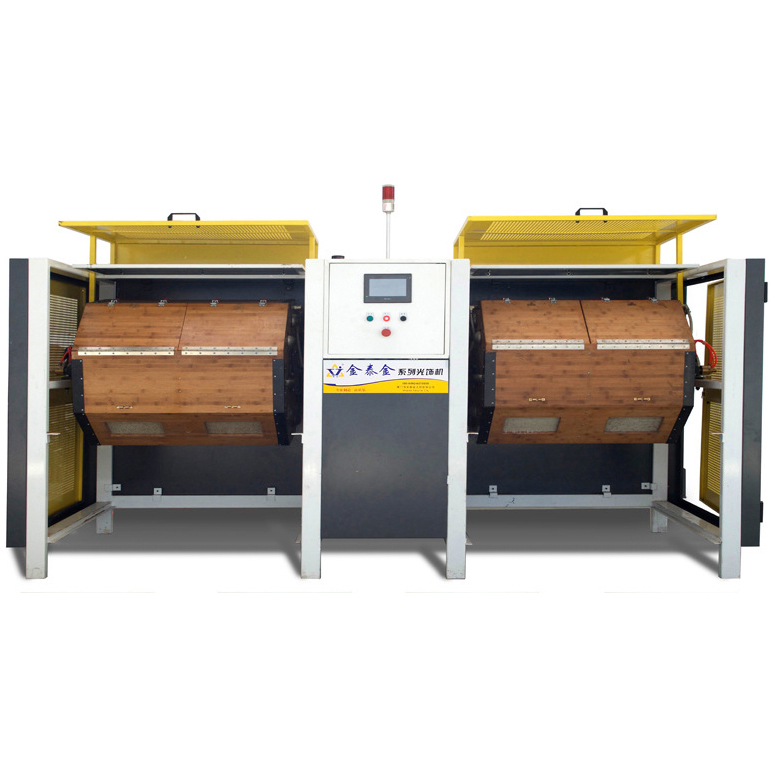
| Dry polishing machine and dryer | Drying parts after a wet stage and producing a dry polished surface with organic media where a wet residue would be hard to remove | No cutting action, needs dust extraction, and organic media must be kept dry and clean or it transfers contamination to the part |
| Rotary barrel finishing machine | Gentle deburring of small fragile components and mixed fitting batches with generous compound flow and low part-on-part energy | Long cycles with no visibility while running, and internal passages collect media and compound that must be retrieved at unload |
Plastic media suits parts whose surfaces must not be peened, marked or rounded aggressively. Aluminium brackets, bronze and nickel-aluminium-bronze castings, thin sheet components and any part with a cosmetic face respond better to plastic triangles, cones or pyramids in a soft to medium grade than to ceramic. The trade is removal rate: plastic cuts slowly, deforms as it wears, and a worn charge behaves noticeably differently from a fresh one, so cycles set on new media drift. Some shapes float or segregate in a bowl and starve part of the load. In marine work plastic media is often the right first stage where a light machining burr, an adhesive residue or a paint-adjacent edge has to come off without changing the geometry a gasket or a seal depends on.
| Media | Best fit | Watch out for |
|---|---|---|
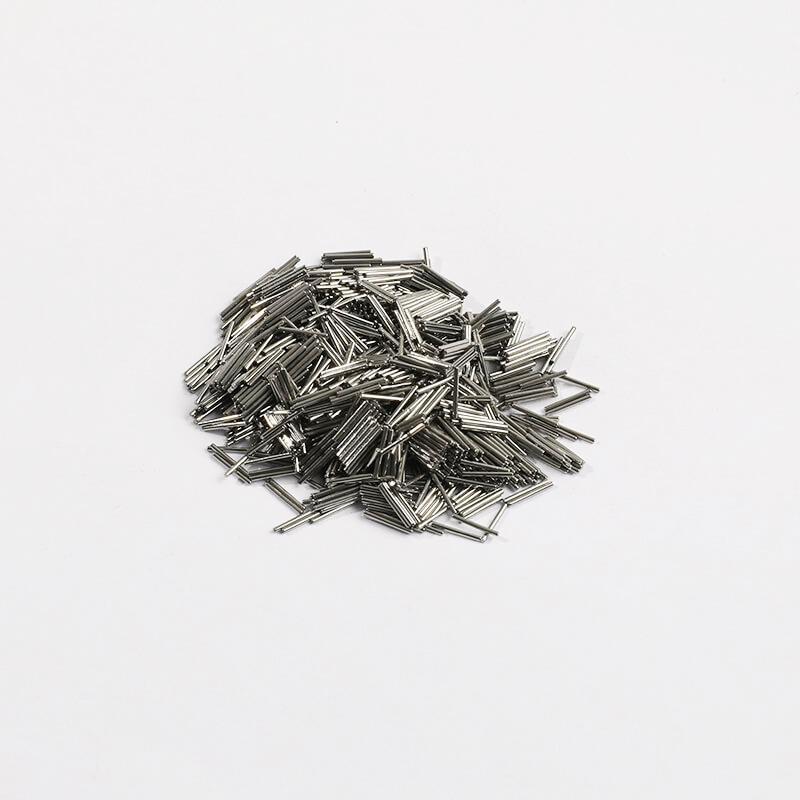
| Dry media such as walnut shell and corn cob with a dry polishing machine | Drying, light polishing and luster on parts that must leave the line dry, and on assemblies where a wet residue would be difficult to remove | Generates dust and needs extraction, cannot cut a burr, and organic media can carry moisture and contamination into a clean area |
| Aluminium oxide grinding media in a dense ceramic bond | Heavier stock removal or a more consistent cut on robust stainless and duplex parts with thick edges and cast skin | High removal energy rounds functional edges quickly and is a poor match for thin panels or a knife-edge seat |
| Chloride-free mildly alkaline or near-neutral compound, liquid or powder | Cleaning, corrosion inhibition and fines suspension on stainless and duplex marine work where retained chlorides would risk pitting in service | Dose drifts with drag-out and water hardness, foam can hide the load, and rinse water must reach the same features the compound reached |
| Bonded abrasive, nonwoven and buffing tool set for an arm or hand tool | Cutting weld toes, blending edges and building luster on large fabrications and free-form surfaces that no batch machine can reach | Each belt, wheel and compound has its own wear curve and pressure window; grain can embed in soft metal and polishing compound leaves a film that must be removed before coating or passivation |
Automation introduces a family of defects that hand work hides. Where an arm slows at a corner, dwells at a waypoint or waits for a tool change, the tool removes more material and leaves a flat spot or a visible step. Where two passes meet, a slight mismatch shows as a band. Tool wear makes the last third of a long path cut differently from the first third unless the cell compensates, and a loaded belt heats the surface instead of cutting it. These show up as texture variation rather than a measurable defect, so they are often accepted at the bench and rejected by the customer. Photograph the surface under raking light, compare the first and last part of a run, measure at fixed points along the path, and treat any visible change at a transition as a signal to review the path or the compensation.
| Failure mode | Likely cause | How to catch it |
|---|---|---|
| Clamping indentations and part-on-part impact marks on a visible face | Gripper or fixture force applied on a finished or visible surface, no protective interface at the contact point, or parts left free to collide in a batch charge | Inspect all contact points and visible faces under raking light against a reference part, and record the fixture contact scheme used so marks can be traced to a specific clamp or pocket |
| Weld toe, bore lip or free edge rounded past the drawing limit | Cycle too long, high-energy route or coarse dense media, a robot path that dwells at a corner, or a weld toe that was never given a maximum radius on the drawing | Measure the same edge before and after with an optical comparator, radius gauge or moulded replica, and compare against the maximum radius or minimum remaining edge specified |
| Dimensional drift on a bearing journal, bore or machined fit | Too much stock removed at the feature, stress redistribution in a long or thin part, or clamping force that pulled the part out of shape during finishing | Micrometer or bore gauge the same stations before and after at a controlled temperature, and re-check after the clamps are released to separate clamping deflection from real drift |
| Over-grind step or gouge at a path transition or belt change | Two passes overlapping at different pressures, a fresh belt run at the setting that suited a worn one, or an operator touching up a transition by hand without recording it | Inspect each transition zone at a fixed viewing distance under consistent lighting, and compare the zone against the surrounding surface with a roughness reading on both sides |
Rotterdam is the Dutch mainport and the centre of Europe's largest maritime, port and industrial complex, with refining, chemicals, bulk and container handling concentrated in the port and industrial area. Deltalinqs represents over 95% of the logistics, port and industrial enterprises in the mainport, with more than 700 member companies drawn from fourteen sectors; the mainport accounts for 2.9% of Dutch GDP and roughly 192,000 jobs in Rotterdam-Rijnmond, while the port as a whole supports over 500,000 jobs and more than EUR 60 billion of added value nationally. Municipal and provincial policy documents describe the cluster as the largest industry and energy cluster in Europe.
For this brief the relevant part of that base is marine: Rotterdam Partners, the city's trade and investment organisation, states that the port is the centre of Europe's biggest maritime cluster.
Refining, chemical, bulk and maritime maintenance in the port generates a steady flow of valves, pump and heat-exchanger components, flanges and machined spares, where burrs, sharp edges and surface condition affect sealing, flow and coating adhesion. This is mostly repair and overhaul work rather than high-volume series production, so batch flexibility and cross-contamination control between carbon steel, stainless and higher-alloy parts matter more than cycle time.
A Rotterdam-area buyer should first settle which material families one finishing line must handle — carbon steel, stainless, duplex or nickel alloy — and whether the parts are pre-coating (needing a defined Ra and cleanliness) or in-service spares (needing edge and burr control only), because that fixes the media and compound choice.
Freight context: Port of Rotterdam (Europoort and Botlek industrial areas, Waalhaven). The port combines deep-sea, short-sea, inland barge and rail freight, and 192,000 jobs in Rotterdam-Rijnmond are linked to the harbour. Machines and sample parts arriving from outside the EU are declared to Dutch Customs at the point of entry; the Deltalinqs membership base is dominated by logistics, port and industrial enterprises.
Goods entering the Netherlands from outside the EU must be declared to Dutch Customs (Douane, part of the Belastingdienst); the importer needs an EORI number, import duty is calculated on the customs value (goods value plus transport and insurance to the EU external border), and import VAT is paid at the border unless an article 23 permit or a fiscal representative is used. CE marking is mandatory for most machinery placed on the EEA market: the Machinery Regulation replaced the Machinery Directive and manufacturers must comply with the new requirements by 20 January 2027. The importer must verify that the conformity assessment was carried out correctly, that CE marking is applied properly, that the technical file is present and complete, and that the user manual is supplied in the correct language; the manufacturer's EC Declaration of Conformity must be kept. Dutch companies imported over EUR 140 billion of machinery and appliances in 2024, 24% of total Dutch goods imports.
The Dutch standards body is NEN (Nederlands Normalisatie-instituut), which publishes and maintains the NEN and NEN-EN-ISO standards; the content of a standard is set by a NEN standards committee made up of the organisations concerned, not by NEN itself. For surface finishing NEN publishes NEN-EN-ISO 2080, which defines the terms for the general types of surface-finishing processes with emphasis on practical use in metal finishing, under the standards committee for metallic coatings and corrosion of metals and alloys. Machinery safety, EMC, low-voltage, ATEX, RoHS and ecodesign requirements reach Dutch buyers through the CE directives and regulations referenced by KVK, with the Machinery Regulation applying from 20 January 2027.
SurfacePolish supplies from Xiamen, China. The buyer's own destination rules, conformity marking, tariff classification and documentation responsibilities stay with the buyer; confirm them against the authorities named above before ordering.
Acceptance should exist before finishing starts, on the drawing or in a document the drawing references. Name every controlled surface, the parameter and the cut-off to be used, the measurement direction and the locations where readings are taken, because a seal face, a bore and an outer wall respond differently to the same charge. State the maximum edge radius or the minimum remaining edge at any weld toe, bore lip, keyway or seat. Say what is acceptable visually and under what lighting and viewing distance. Add the functional checks and the cleanliness requirement, together with who performs them. Without this the first argument about a rejected lot becomes a discussion about opinion. A buyer who writes the criteria can also compare two route options on the same basis, whether the work is done in a machine, by hand or by an arm.
Automation repeats a result; it does not create one. The first question in a feasibility study is whether any route can produce the required condition on this geometry at all, and that question is answered on a bench or in a machine, not in a cell. Establish the achievable condition and its sensitivity to pressure, speed and time on plain samples of the actual material. Only when a surface can be reproduced by hand under recorded settings does it make sense to ask whether an arm can hold those settings over a whole part. Many projects invert this order, buy the arm first and then discover the requirement was never attainable on the geometry in question. A short process trial on real coupons is cheap compared with a cell designed around a surface that cannot be produced.
Size the medium below the smallest opening it could enter, and treat every passage as a retrieval point rather than assuming it stays clear. Map the tightest hole, slot or cross-drilling first, then pick a size class against that feature instead of an average. Add defined checks: borescope the smallest passage at an agreed angle, pin gauge and thread gauge the holes, and rinse through a filter so the discharge can be examined. For a trial shipped from Netherlands, send the part with the smallest passage so the medium choice is tested on the real feature rather than on a convenient sample.
Send parts that represent the extremes of the family: the tightest internal passage, the thinnest section, the largest surface, the worst access, and one weld made with the production procedure. Add an as-received reject so the starting condition is documented, and mark the controlled features and measurement points before shipping. Include a note of the material grade, product form, heat treatment and the cleanliness requirement the part must eventually meet. Parts travel to the factory in Xiamen from Netherlands and come back with an observed condition and a proposed media, compound and cycle direction for the buyer to evaluate.
Mask or shield it, or choose a route that does not reach it. A taper and a keyway are usually damaged by the same edge rounding that improves the rest of the part, and a seal face suffers from peening or from a coarse medium. Practical options are a mechanical mask or boot, leaving a stock allowance that is finished later by a controlled operation, holding the part in a fixture that excludes the protected zone, or selecting a gentler medium and a shorter cycle. Measure the feature before and after at marked points, and put a maximum radius or a minimum remaining edge on the drawing.
Use Rotterdam, Netherlands as the destination on the enquiry and state whether the deliverable is equipment, media and compound, a representative sample review or a line concept. A destination does not imply local stock, a local service point or a local delivery time.
Buyers here work to the CE machinery regime (Machinery Regulation replacing the Machinery Directive, compliance by 20 January 2027) and to the Dutch/EN-ISO surface-finishing standards published by NEN, such as NEN-EN-ISO 2080 for metal-finishing terminology. In the port and process industries, client specifications for coating preparation, cleanliness and material conformity usually sit on top of those base standards.
Sources were retrieved on 2026-09-29 and describe the local industrial and trade context only. They do not evidence any SurfacePolish project, shipment, installation or service in Rotterdam.
The buyer wants weld dressing and a consistent visible finish across long tubes that cannot be turned in a bowl.
Send the material, dimensions, approximate weight, batch quantity, the incoming condition and photographs of the difficult features. Mark which features must not be contacted by media and state how the result will be inspected. This form carries source reference PSEO-0616; quote it if you prefer an additional manual reference.
Open the SurfacePolish enquiry form Email a prepared enquiry
No price, lead time, certification or result is promised here. Confirm whether a sample trial is available for the specific part and what the trial can and cannot show.
Page PSEO-0616 · revised 2026-09-29 · cross-border equipment, media and scoped sample review. City context is sourced and cited above.
Use this local checker to identify missing part and inspection information. It prepares a technical-review brief; it does not approve a machine, process recipe or production result.
Complete the part details to prepare a review brief.
Email : info@surface-polish.com


 IPv6 network supported


 +86-592-2381506