A buyer in Wollongong, Australia working on marine components has a 220 kg 316L pump casing whose flange face and seawater passage must survive weld dressing intact. SurfacePolish supplies finishing machines, media and compounds across borders and runs a free sample trial: representative parts ship to the factory in Xiamen and come back with an observed condition and a proposed media, compound and cycle direction for the buyer's own review. This brief is written for a buyer in Wollongong working on marine components; it describes equipment, media and a scoped sample review, not a local polishing service.
What is the largest dimension and the greatest mass that must be presented, and can the part be turned or supported without distorting it?
What starting condition and cleanliness baseline will the part arrive in, and who owns the pre-finish step?
Which features on this part are functional, such as seal faces, journals, tapers, keyways and weld toes, and which are only cosmetic?
Start by marking on the drawing which surfaces carry a function and which carry only appearance. On marine and offshore work the functional list is short and severe: seal faces on pump and valve bodies, bearing journals and taper seats on shaft components, keyways and splines, flange faces, bolted joint lands, fit bores, and the root of a weld that will be inspected. Everything else, such as the outside of a housing, a bracket web or a handrail run, can absorb a large change in texture. That split decides how much of the part may be exposed to a mass-finishing charge or to a robot-held abrasive without masking. One wrong assumption here, such as letting a coarse medium work a mating land, turns a reasonable route into scrap, so it is the first item a feasibility discussion should settle.
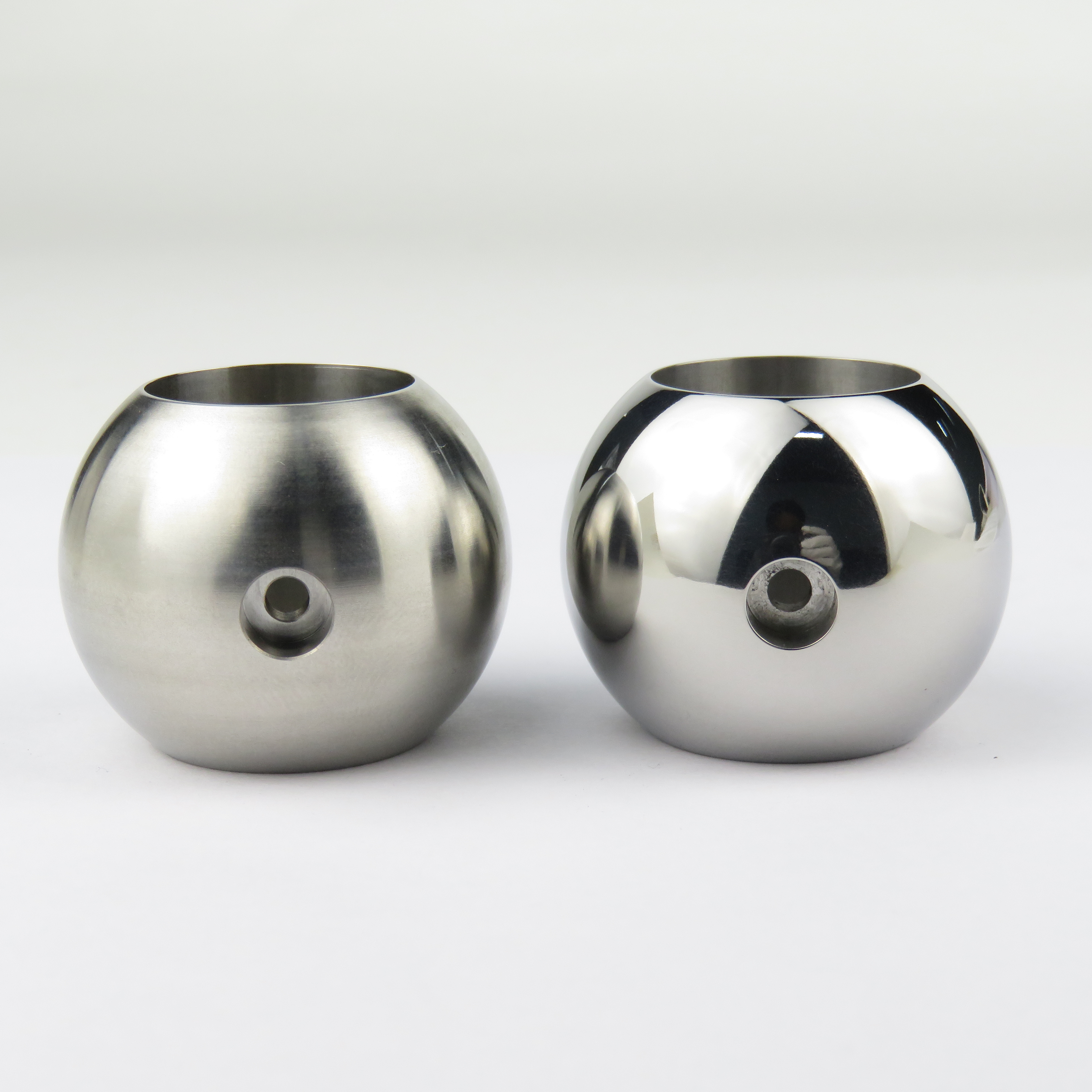
Steel media produces a bright, burnished surface on stainless components with low stock removal and good edge blending. On marine work the contamination question comes first. Carbon steel media and carbon steel brushes leave free iron on an austenitic or duplex surface, and free iron in a chloride environment is where rust bloom begins. A steel charge needs its own machine or a documented separation protocol, a corrosion-inhibiting compound, magnetic or screen separation at unload, and a finishing sequence that removes transferred iron before the part ships. Stainless steel media reduces the risk but does not remove it. Whether the part is then passivated is the buyer's decision; a recognised practice such as ASTM B912 describes a passivation treatment for stainless steel and belongs in the requirements the buyer defines and verifies.
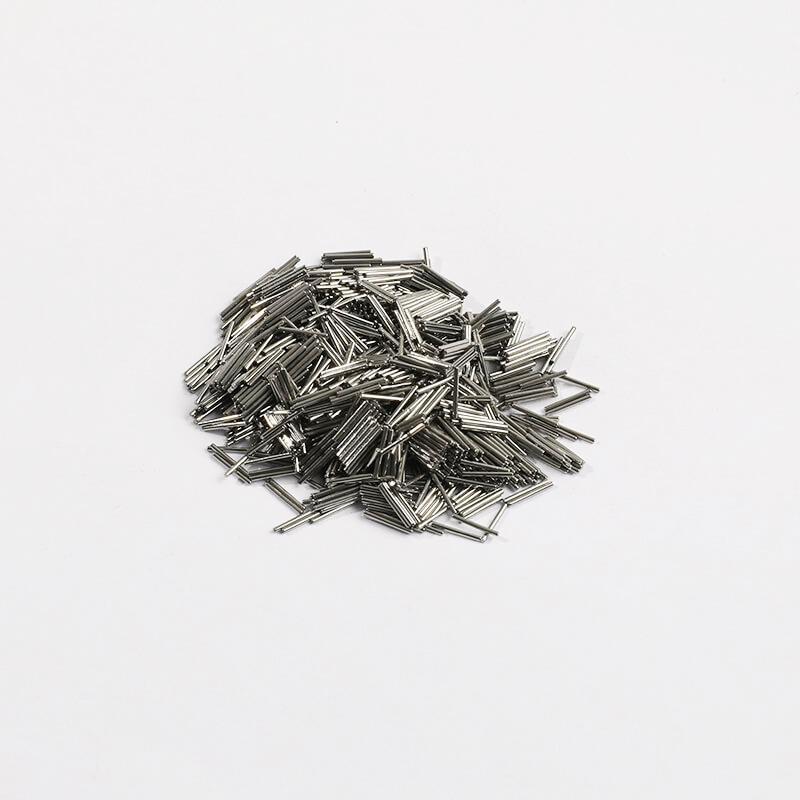
| Media | Best fit | Watch out for |
|---|---|---|
| Chloride-free mildly alkaline or near-neutral compound, liquid or powder | Cleaning, corrosion inhibition and fines suspension on stainless and duplex marine work where retained chlorides would risk pitting in service | Dose drifts with drag-out and water hardness, foam can hide the load, and rinse water must reach the same features the compound reached |
| Plastic triangles, cones and pyramids in a soft to medium grade | Deburring aluminium brackets, bronze castings and cosmetic faces where marking and edge loss must stay small | Slow cut rate, media deforms as it wears, and a worn charge behaves quite differently from a fresh one |
| Heavy-cut ceramic angle-cut triangles in a coarse size class | Breaking the edge of a machined or cast marine fitting and removing a substantial burr on robust stainless before a refinement stage | Cuts corners and weld toes aggressively and can round a seat or keyway, and the coarse section may not enter narrow passages at all |
| Bonded abrasive, nonwoven and buffing tool set for an arm or hand tool | Cutting weld toes, blending edges and building luster on large fabrications and free-form surfaces that no batch machine can reach | Each belt, wheel and compound has its own wear curve and pressure window; grain can embed in soft metal and polishing compound leaves a film that must be removed before coating or passivation |
A robot reproduces whatever the fixture gives it. A large marine part has to locate on a repeatable datum, be clamped without forcing a thin panel out of shape, and be supported so that it neither sags nor shifts as material comes off. For tool-carrier work, adding a positioner or turntable can present several faces to the arm without re-clamping, which often reduces the reach and payload the arm itself must supply, at the cost of an extra axis with its own repeatability. Build the fixture around surfaces that are not being finished, use the datums the drawing already uses, and decide early whether clamping marks are acceptable on a visible face. A trial that cannot reproduce the production fixture will not predict production variation, however good the tool path looks.
| Machine route | Where it fits | What it will not do |
|---|---|---|
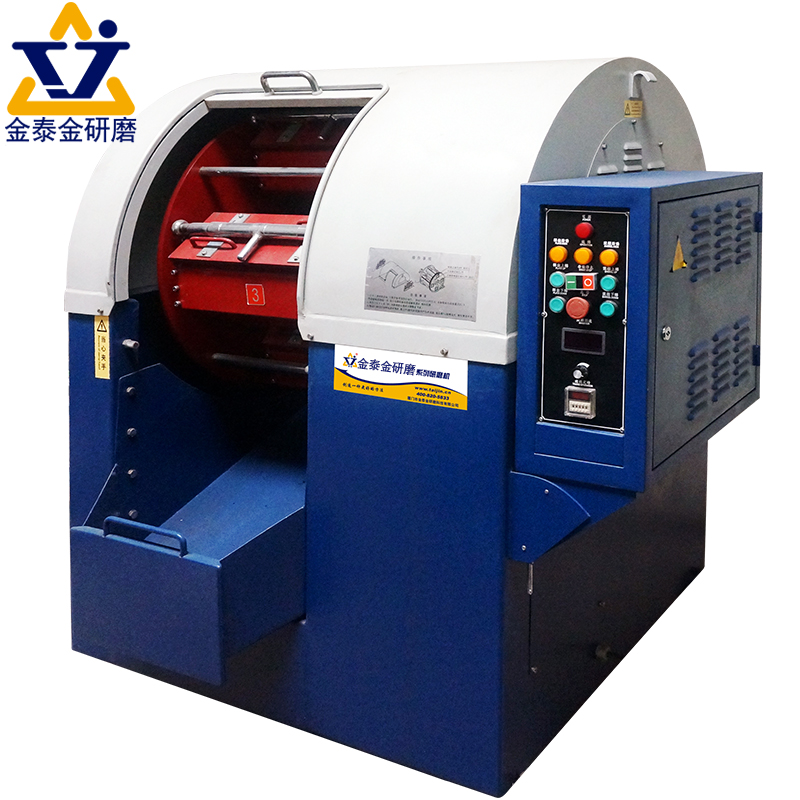
| Vibratory finishing machine (bowl) | Bulk deburring and refinement of small and medium marine fittings, cast cleats, brackets and machined valve internals that can tumble without racking | Continuous part-on-part contact and no access to internal passages; visible faces and heavy parts need separation, racking or a different route |
| Tub vibrator | Long parts that cannot rotate in a bowl, such as rail sections, pipe spools, linear weldments and long shafts, provided they can be supported along their length | Lower energy per unit area, so heavy weld dressing takes longer, and a long tub needs floor space plus a support method that does not mark the part |
| Disc finishing machine | Fast, high-energy edge breaking and surface refinement on small robust fittings and uniform batches where cycle time matters | High impingement and edge-loss risk on thin or soft parts, and the geometry must suit the disc working gap rather than a large weldment |
| Grinding finishing machine | Taking off a heavy machining burr or a defined stock layer before a refinement pass on robust stainless and duplex work | High removal energy cuts functional edges fast, so geometry assessment and a short controlled cycle matter more than on any other route |
A pump or valve body has seawater passages, a drain boss and a row of blind tapped flange holes. A welded fabrication has an enclosed stiffener cavity or an open-ended box section. Each of these is a place where a medium, a broken fragment of medium or a slug of compound can settle and stay. The part passes a visual check on the outside and the problem appears after assembly, when a passage is restricted or a fastener will not seat. Size the medium below the smallest opening it can enter, count the charge in and out where the batch allows, borescope the smallest passage at an agreed angle, pin gauge or thread gauge the holes, and rinse through a filter so the discharge can be inspected. Blind features that were never mapped are the usual source.
| Failure mode | Likely cause | How to catch it |
|---|---|---|
| Keyway, spline or taper geometry lost to edge rounding | The feature was exposed to the charge without masking, or a tool-carrier path ran along the flank of the feature instead of stopping short of it | Check width, flank angle and edge break with a gauge or comparator at marked stations before and after, and confirm the protected feature against the drawing tolerance |
| Dimensional drift on a bearing journal, bore or machined fit | Too much stock removed at the feature, stress redistribution in a long or thin part, or clamping force that pulled the part out of shape during finishing | Micrometer or bore gauge the same stations before and after at a controlled temperature, and re-check after the clamps are released to separate clamping deflection from real drift |
| Weld toe, bore lip or free edge rounded past the drawing limit | Cycle too long, high-energy route or coarse dense media, a robot path that dwells at a corner, or a weld toe that was never given a maximum radius on the drawing | Measure the same edge before and after with an optical comparator, radius gauge or moulded replica, and compare against the maximum radius or minimum remaining edge specified |
| Abrasive grain embedded in a soft or gummy surface | Coated abrasive or bonded wheel used on bronze, aluminium or a work-hardened surface at excessive pressure, or a loaded belt that has stopped cutting and started smearing | Inspect under low-angle light and a magnifier, wipe with a solvent-soaked cloth, and check the part after a light refinement pass rather than only as it leaves the coarse operation |
Wollongong is described by the NSW Government as Australia's 10th-largest city and the urban centre of the Illawarra and Shoalhaven region, which has a population of 422,558 and a large existing advanced manufacturing and engineering workforce. The region was traditionally known for steelmaking and coal mining, and that base still shows in the port's cargo: Port Kembla, NSW's third-largest port, facilitates the region's significant steel and mining industries and is the largest motor vehicle importation terminal in NSW. The NSW Government names defence, ICT, advanced manufacturing and professional services as the region's key industries, and the Australian Navy's Fleet Air Arm base at HMAS Albatross together with the Albatross Aviation Technology Park has made the Illawarra the home of naval aviation in Australia. Growth precincts are the Illawarra Renewable Energy Zone and the Port Kembla Hydrogen Hub, with an ambition to create Australia's first 5GW+ scale green hydrogen hub; the University of Wollongong produces 1,000 ICT and 600 engineering graduates a year with research in ICT, engineering, cyber and advanced materials.
For this brief the relevant part of that base is marine: Port Kembla is NSW's third-largest port with over 800 commercial vessels calling each year, and the region hosts the Royal Australian Navy's Fleet Air Arm base at HMAS Albatross, establishing a substantial naval and maritime presence in the Illawarra.
The Illawarra's steel and heavy engineering base means large volumes of flame-cut, laser-cut and machined steel plate and structural components that require edge deburring, slag and oxide removal and radius control before welding, painting or galvanising. Port Kembla's role as a vehicle import terminal and the region's naval aviation and defence work add stainless, aluminium and higher-value machined components where surface finish and cleanliness affect coating adhesion, corrosion performance and fit. Fabricators and maintainers in the region also handle refurbishment work where removing corrosion and old coatings without changing base dimensions is the constraint.
A Wollongong buyer should determine whether the finishing operation is part of weld preparation on structural steel, part of a corrosion-protection system where surface profile and cleanliness govern coating adhesion, or a final cosmetic requirement on visible work — and should confirm whether the specification demands a measurable anchor profile or edge radius rather than an unquantified 'clean' surface.
Freight context: Port Kembla (NSW's third-largest port, operated landside by NSW Ports), Shellharbour Airport, Illawarra rail and road corridor into Sydney, including the M1 Princes Motorway. Port Authority NSW records that over 800 commercial vessels call into Port Kembla each year, connecting the Illawarra's industries with the world; the port is the principal grain export port for southern and south-western NSW as well as the largest motor vehicle import terminal in NSW. The NSW Government notes the region is well connected to domestic and international markets with road and rail services into Sydney and other east coast hubs, plus Shellharbour Airport. Sea freight through Port Kembla is the natural route for incoming finishing machines, and the vehicle-import trade means regular scheduled roll-on/roll-off and container services into the port.
The national standards body is Standards Australia, which publishes Australian Standards (AS) and joint Australian/New Zealand Standards (AS/NZS); on their own, standards are voluntary and there is no general requirement for the public to comply, but state and Commonwealth governments often refer to AS or AS/NZS standards in legislation and they can then become mandatory. For finishing and machinery work, the applicable documents are the ones cited in the buyer's own contract, purchase specification, licence condition or safety management system, together with the marking rules in AS/NZS 4417.1 and AS/NZS 4417.2 for in-scope electrical equipment sold under the EESS.
Australia and China are parties to the China-Australia Free Trade Agreement (ChAFTA), signed on 17 June 2015 and in force since 20 December 2015; the Australian Border Force maintains a dedicated ChAFTA page and working tariff schedule, and FTAs give importers a route to preferential rates of duty where the rules of origin are met. China was Australia's largest source of imports in 2025 at $130.2b, up 12.5% on 2024, and 56% (69,567) of Australian business importers traded at least once with China in 2020-21. A Chinese supplier of finishing machines, media or compounds is therefore shipping into Australia's single largest import stream, and preferential duty depends on origin documentation rather than on a blanket zero-tariff guarantee for every product line.
SurfacePolish supplies from Xiamen, China. The buyer's own destination rules, conformity marking, tariff classification and documentation responsibilities stay with the buyer; confirm them against the authorities named above before ordering.
Some checks decide whether the part works, and those belong to the buyer's engineering and quality functions. A pressure or leak test on a valve or pump body, a flow check through a passage, a fit check of a shaft in its bearing or a flange against its mate, a dye penetrant inspection of a dressed weld, and any corrosion or coating adhesion evaluation are buyer-side calls. The same applies to cleanliness: the buyer defines the method and the limit, and decides whether a mechanically finished part needs a passivation treatment afterwards. SurfacePolish can describe what was done to a part and what was observed on it, but it does not qualify a part for a class society, a coating specification or a service environment. Ask what evidence is needed before work starts, then plan the trial records to match.
Automation repeats a result; it does not create one. The first question in a feasibility study is whether any route can produce the required condition on this geometry at all, and that question is answered on a bench or in a machine, not in a cell. Establish the achievable condition and its sensitivity to pressure, speed and time on plain samples of the actual material. Only when a surface can be reproduced by hand under recorded settings does it make sense to ask whether an arm can hold those settings over a whole part. Many projects invert this order, buy the arm first and then discover the requirement was never attainable on the geometry in question. A short process trial on real coupons is cheap compared with a cell designed around a surface that cannot be produced.
There is no universal number, but the shape of the answer is consistent: a small number of stable variants, each repeating often enough to amortise setup, with a predictable manual time content. Count the hours over a year, then subtract the hours a cell would still spend on loading, fixture changes, tool changes and inspection. If the remainder is small, a batch machine or a fixture change may be the better buy. Where a finishing route near Wollongong already produces an acceptable surface in bulk, automating load and unload is usually the smaller and more certain step than automating the finishing motion itself.
Partly, and the split is the useful part of the question. A robot can hold a grinder, sander or polishing head over a repeatable path with controlled pressure, which suits long weld runs, flat panels and consistent edges. It struggles where access is restricted, where the surface is free-form and required pressure changes continuously, and where a person compensates for part-to-part variation by feel. Work out which features recur in the same place on every part and which move; automate the first group and leave the second with an operator, or send parts to a machine route that already produces the surface in bulk.
No. SurfacePolish does not issue certification, qualification or approval for any regulated application, and nothing described here may be treated as such a claim. Requirements set by a classification society, a coating manufacturer or an end user are defined and verified by the buyer and its own inspection function. What SurfacePolish provides is equipment, media and compounds, a scoped discussion of a line concept, and observations from a sample trial on the parts tested under the settings used. Those observations can feed the buyer's own qualification work, but they do not replace it or shorten it.
Use Wollongong, Australia as the destination on the enquiry and state whether the deliverable is equipment, media and compound, a representative sample review or a line concept. A destination does not imply local stock, a local service point or a local delivery time.
Illawarra buyers reference Australian Standards maintained by Standards Australia for material conformity and surface condition, and steel suppliers and fabricators commonly work to Australian steel and welding standards together with client specification. Electrically powered equipment placed on the market must comply with the EESS and carry the Regulatory Compliance Mark under AS/NZS 4417.1 and AS/NZS 4417.2.
Sources were retrieved on 2026-09-29 and describe the local industrial and trade context only. They do not evidence any SurfacePolish project, shipment, installation or service in Wollongong.
The buyer wants the weld repairs dressed and the outside cleaned up without rounding the flange face or leaving medium in the seawater passage.
Send the material, dimensions, approximate weight, batch quantity, the incoming condition and photographs of the difficult features. Mark which features must not be contacted by media and state how the result will be inspected. This form carries source reference PSEO-0776; quote it if you prefer an additional manual reference.
Open the SurfacePolish enquiry form Email a prepared enquiry
No price, lead time, certification or result is promised here. Confirm whether a sample trial is available for the specific part and what the trial can and cannot show.
Page PSEO-0776 · revised 2026-09-29 · cross-border equipment, media and scoped sample review. City context is sourced and cited above.
Use this local checker to identify missing part and inspection information. It prepares a technical-review brief; it does not approve a machine, process recipe or production result.
Complete the part details to prepare a review brief.
Email : info@surface-polish.com


 IPv6 network supported


 +86-592-2381506