An automotive parts buyer in Cleveland, United States has a cast stainless housing whose cross-drilled burrs must come off with no media left behind and no change to a precision bore or gasket face. SurfacePolish supplies finishing equipment and consumables across borders and offers a free sample trial on parts shipped to Xiamen, returning observations and a proposed media, compound and cycle direction for the buyer's own verification. This brief is written for a buyer in Cleveland working on automotive parts; it describes equipment, media and a scoped sample review, not a local polishing service.
Which alloy family is the part, and has cold work, welding or heat treatment already changed its hardness, magnetic response or corrosion behaviour?
At what batch size, load fill ratio and media wear state does a trial observation still describe what series production will produce?
Which surfaces on this part carry a visible appearance grade, which are hidden, and which edges have a functional requirement rather than a cosmetic one?
What arrives at finishing often predicts the route better than the drawing does. Burrs sit at cross-drilling intersections, sheared edges and machined contours, heat tint comes from welding and laser cutting, and stamping flash, grinding marks, existing polished bands and handling scratches all behave differently under the same medium and compound. Baseline the incoming surface with roughness readings and consistent-lighting photographs at agreed locations, plus a written note on where the largest burrs sit. Cleanliness before processing also matters, because cutting fluid, marking ink, adhesive residue and shop dust load the medium and confound comparison. Batch size and mix enter here too: a load of thirty small brackets behaves differently from four large housings, and mixing families of different weight in one chamber risks damage to the lighter parts and cross-contamination between grades.
Geometry, not preference, sets media shape and size. Angle-cut triangles and similar forms reach slots, corners and recesses and cut faster on burrs; cylinders and balls blend broad surfaces more evenly and are kinder to edges; small media reaches tighter features but carries more edge impact per contact and is harder to separate. The usable window for any feature lies between media that is too small and packs or lodges and media that is too large to enter at all. For cross-drillings, gear teeth and narrow slots, work from the smallest opening on the drawing and pick a size class that flows through it without wedging. For stainless appearance parts, check the surface texture the shape leaves behind, because some forms produce overlapping impacts that read as a texture rather than as a polish.
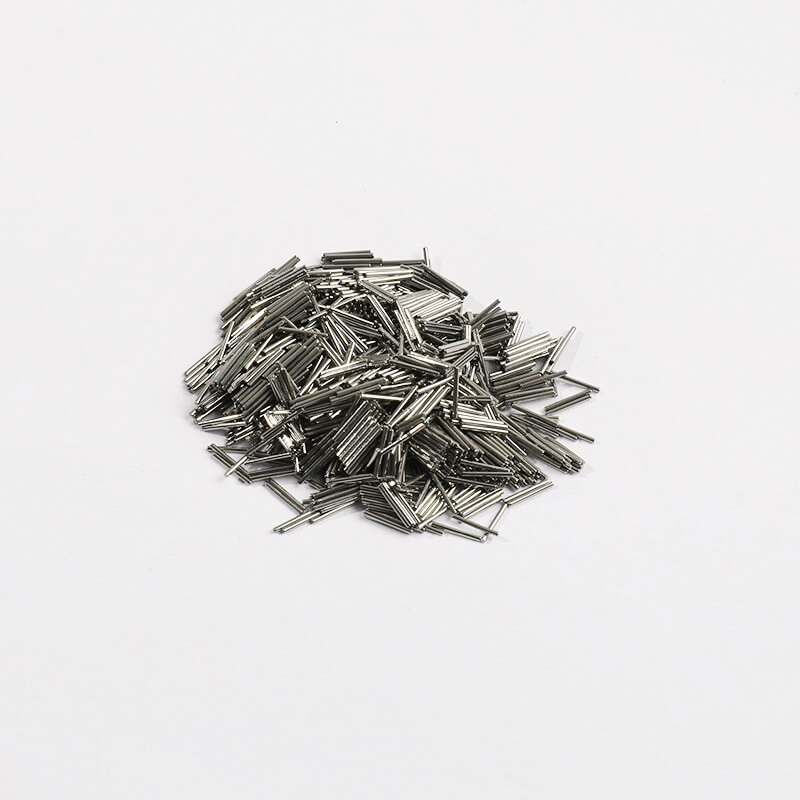
| Media | Best fit | Watch out for |
|---|---|---|
| Plastic media, polyester and urea based | Gentle deburring of delicate or thin stainless parts and of softer metals in mixed production, where edge loss must be minimised. | Low cutting power on stainless, can load with metal particles, and is generally the wrong tool for generating a stainless appearance finish. |
| Ceramic cylinders, balls and other rounded shapes | General surface refinement and blending on broad stainless faces where a more even texture and gentler edge action are wanted. | Does not reach sharp internal corners, and long enough running on thin sections can still round edges beyond a tight callout. |
| Magnetic stainless pins and fine needles for magnetic finishing | Deburring and brightening of intricate small stainless features, slots, gear teeth and blind holes where media cannot be allowed to lodge. | Suits small part envelopes only, and the route needs testing on magnetic grades before it is assumed to apply to a given part. |
| Porcelain and fine high-density ceramic media | Pre-polish refining stages on austenitic stainless appearance parts before a brightening stage, where a finer texture is the objective. | Limited cutting power on hard or work-hardened surfaces, and wear changes the charge gradually, so finish can drift between batches. |
Three routes answer narrow needs. Barrel and rotary finishing is the gentlest common bulk method, well suited to delicate, thin or threaded stainless parts such as small fittings, sensor bodies and precision pins, at the cost of longer cycles and less uniform coverage on large parts. Magnetic finishing uses small steel pins driven by a rotating field to deburr and brighten intricate internal features, slots, gear teeth and blind holes without lodging media in narrow passages, but it suits small part envelopes, and parts made from magnetic grades need to be tested before the route is assumed to apply. Dry polishing with a heated dryer handles post-wet drying, light scale and residue control after a wet stage; dry media alone does not cut stainless, and moisture left in a blind hole or a folded hem becomes a stain during storage.
| Machine route | Where it fits | What it will not do |
|---|---|---|
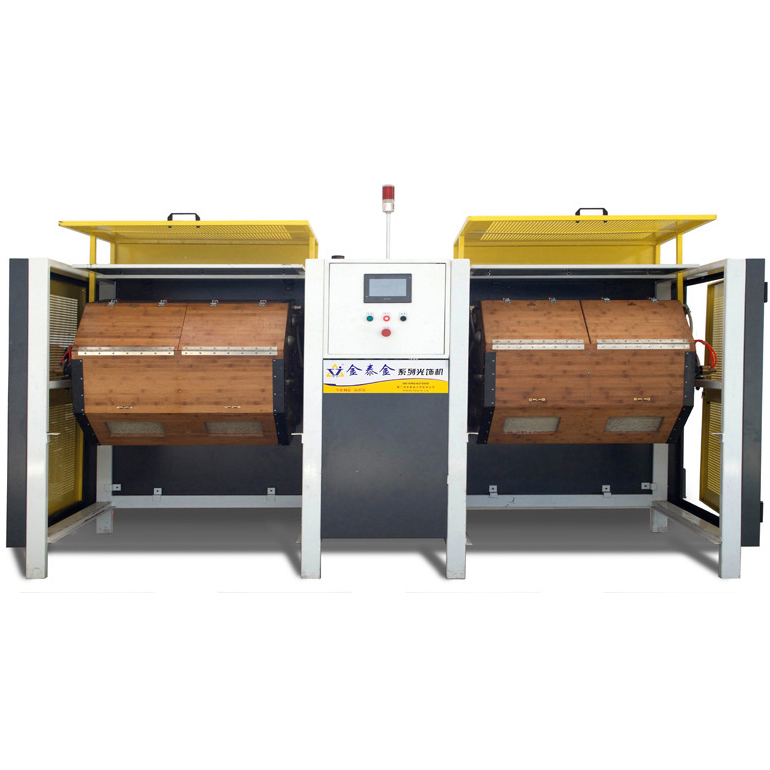
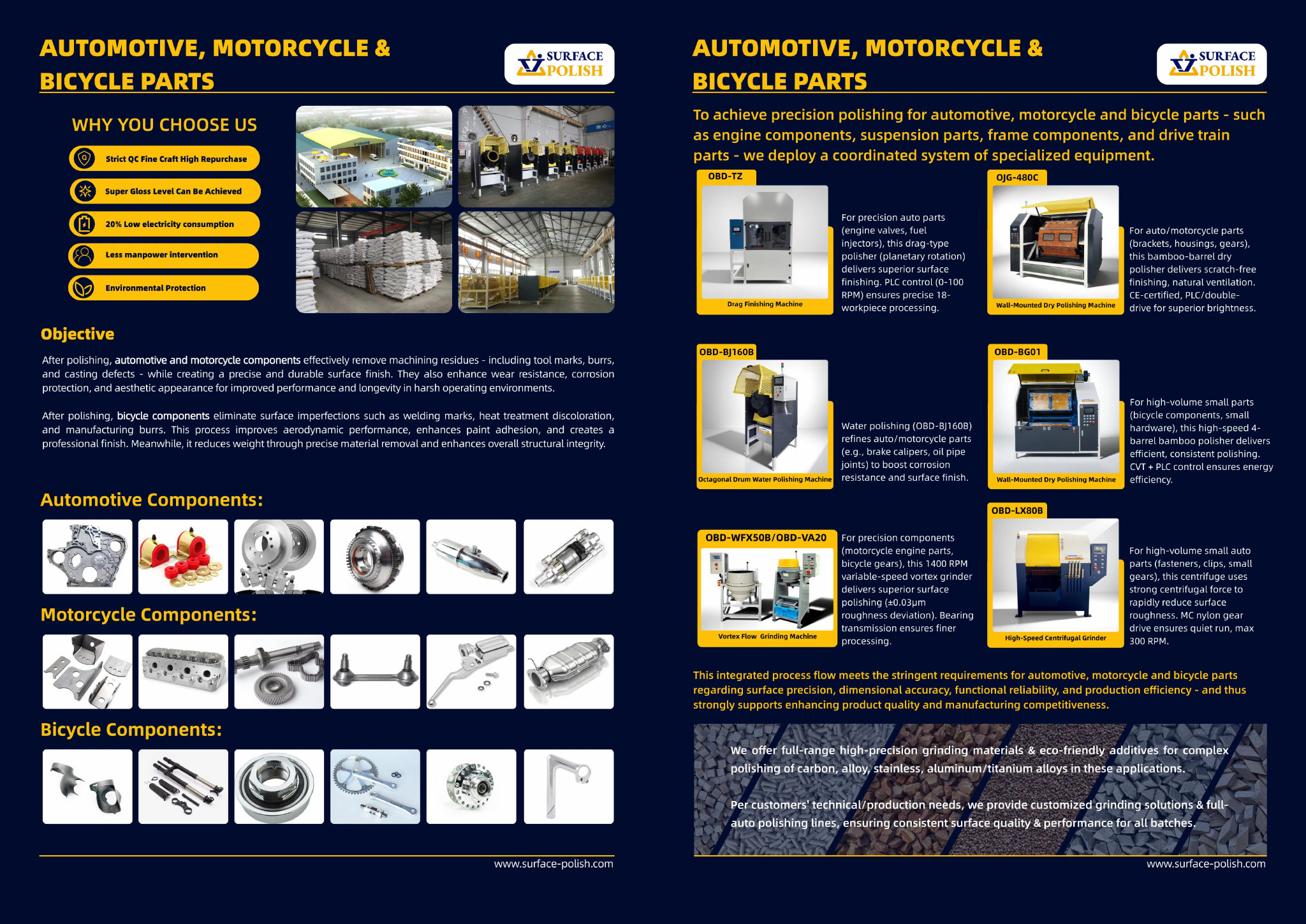
| Centrifugal barrel finishing machine | Very high energy deburring and edge radiusing of small, hard stainless parts in short cycles. | Rounds edges quickly and can exceed a tight radius within a short run; part size and shape are restricted and a substantial load is needed to justify the cycle. |
| Magnetic finishing machine | Small precise stainless parts with internal features, slots and blind holes that must be deburred without media lodging in the passages. | Works within a small part envelope, and the route has to be tested per grade because it depends on the part's magnetic response. |
| Dry polishing machine with heated dryer | Post-wet drying, residue control and light dry finishing of stainless parts that must leave the line dry and free of moisture in blind features. | Dry media does not cut stainless, and moisture trapped in a blind hole, hem or tight joint can cause staining if drying is not effective. |
| Continuous or indexed wet line with staged media charges | Multi-stage stainless finishing where deburring, refining and brightening are separated to control edge loss and texture progression. | Needs clear segregation between stages to prevent carry-over of coarse media or iron contamination, and adds handling and floor space. |
Stainless parts that emerge with speckled rust, a brown bloom or a grey smut have usually picked up foreign metal, and the source is often the shop rather than the alloy. Free iron can arrive from carbon steel parts run in the same machine or media, from worn steel components in the chamber, from steel racks and containers, from a wire brush used elsewhere, or from airborne grinding dust settling on a wet part. A ferroxyl-type test at agreed locations detects free iron, and a comparison against an untouched control part from the same batch makes the result interpretable. Because the visible bloom may take days to appear, agree an evaluation window and keep sample parts in defined conditions before judging. Prevention is segregation: dedicated media and machines for stainless, non-metallic or stainless handling, covered storage, and a check on incoming media for metallic debris.
| Failure mode | Likely cause | How to catch it |
|---|---|---|
| Rust blooms or speckling on austenitic or duplex parts after finishing | Free iron transferred from carbon steel, ferritic stainless or worn steel machine parts sharing the same media, chamber, racks or bench area. | Run a ferroxyl-type test for free iron at agreed locations, compare against an untouched part from the same batch, and repeat the check after a defined exposure period to catch delayed blooms. |
| Uneven finish, with one region bright and another dull on the same part | Positional effects in the media mass, dead zones in the chamber, shielding by neighbouring parts, or a poor fill ratio in the load. | Mark reference locations, photograph under fixed raking light, and measure the same feature at multiple points on the part and across parts in the load to separate positional variation from process variation. |
| Edge rounding beyond the specified radius on a functional edge | Cycle energy, time or media size class chosen for appearance rather than for the tightest edge callout on the drawing. | Measure edge radius at marked locations with an optical comparator or a cast impression before and after, and record the result against a written allowable band rather than judging it visually. |
| Discolouration or mottling that appears only after drying | Mineral or compound residue carried in the final rinse, hard or chloride-bearing water, or slow drying that leaves a film on the brightened surface. | Compare wet and dry appearance under fixed lighting on the same parts, wipe a sample with a white lint-free cloth and solvent, and check the site water supply for hardness and chloride content. |
Cleveland is a Great Lakes manufacturing economy. The Federal Reserve's Fourth District Beige Book reports demand for manufactured goods increasing at a robust pace, driven by data centre development and defence spending, and records manufacturers facing higher steel, copper and aluminium costs. NASA's Glenn Research Center has its main campus, Lewis Field, beside Cleveland Hopkins International Airport, with wind tunnels, drop towers, vacuum chambers and a research aircraft hangar, and a second Ohio campus at the Neil Armstrong Test Facility. The Port of Cleveland describes itself as one of the largest ports on the Great Lakes and reports about 13 million tons of cargo moving through Cleveland Harbor each year, tied to over 23,000 jobs. Case Western Reserve University sits within walking distance of three major hospitals and ranks among the top 25 private US universities in federal research spending, and Cleveland Clinic lists more than 300 locations.
The nearest part of that base to this brief is aerospace: NASA Glenn Research Center's main campus, Lewis Field, is located near Cleveland Hopkins International Airport and houses wind tunnels, drop towers, vacuum chambers and a research aircraft hangar, while the Beige Book cites defence spending as a driver of manufacturing demand.
Cleveland's mix of heavy machinery, aerospace components and medical devices puts finishing requirements at both ends of the tolerance range: large machined and welded components need weld dressing, edge blending and surface preparation before painting or coating, while bearing, coupling, hydraulic and pneumatic parts need controlled edge radii and low Ra to avoid stress risers, seal damage and leak paths. Medical and dental instrument work adds burr-free edges and passivation-grade cleanliness, and because much of the local base is job-shop and low-to-mid volume, changeover time between part families matters as much as cycle time.
The question to settle first is what the drawing actually controls - Ra alone, an edge-radius range, or a burr-free requirement verified by a defined method - because that decides between vibratory, barrel, centrifugal and disc processes and fixes the media and compound combination. The second practical point is the material and downstream step: ferrous or non-ferrous, wet or dry, and whether the part is passivated or coated afterwards, since those set compound chemistry, rinse quality and drying requirements.
Freight context: Port of Cleveland (Cleveland-Cuyahoga County Port Authority) on the Great Lakes / St. Lawrence Seaway, Cleveland Hopkins International Airport (CLE), Cleveland, Ohio (CBP port of entry 4101). The Port of Cleveland describes itself as an all-water seaway connecting the Atlantic Ocean to America's heartland and reports roughly 13 million tons of cargo a year through Cleveland Harbor; FAA final CY2025 data list Cleveland-Hopkins International with 4,855,943 enplanements and more than 40 nonstop destinations, and CBP lists Cleveland, Ohio (4101) as a port of entry. For a Chinese machine builder the practical routing is an ocean container to a US East Coast or St. Lawrence Seaway port, then inland truck or rail to Cleveland, with customs entry at Cleveland (4101) or at the port of unlading.
The United States has no single mandatory national finishing standard. The national standards system is voluntary and consensus-based, coordinated at national level by the American National Standards Institute (ANSI): ANSI published the United States Standards Strategy (USSS) 2025 on 6 January 2026, a strategy that 'guides how the U.S. develops standards and participates in international standardization', while the National Institute of Standards and Technology (NIST) is the federal measurement and standards agency and states that 'Technical standards keep us safe, enable technology to advance, and help businesses succeed.' In practice a buyer specifies surface finish, deburring, cleaning and coating requirements on the drawing or in the purchase order using the voluntary consensus standards maintained by bodies such as ASME and ASTM International and their ISO equivalents, and the acceptance criterion is the buyer's own specification rather than a government-issued finishing standard. Where a part is destined for a regulated product - pressure equipment, food-contact equipment, aerospace or medical devices - the relevant industry code or the customer's qualification requirement governs instead.
Business is conducted in US English. Units matter: US drawings and purchase orders frequently use inches, microinch Ra and US gallons, and a supplier that quotes only metric can be asked to reissue documentation. Buyers are US legal entities with an EIN and expect an identifiable contracting entity, a correct HTSUS classification, a commercial invoice, packing list and bill of lading, country-of-origin marking, and an importer of record for customs. Procurement is normally evidence-driven: process selection is expected to be justified by a trial run on the buyer's own sample parts with measured results (burr height, edge radius, Ra, cleanliness) and by media and compound data sheets, rather than by a capability claim. Payment terms in general US industrial practice are open account with net-30 to net-60 terms for established buyers, with letters of credit or advance payment more common for a first order from a new overseas supplier; no US buyer assumes Incoterms, warranty terms or spare-parts lead times unless they are stated in the quotation.
SurfacePolish supplies from Xiamen, China. The buyer's own destination rules, conformity marking, tariff classification and documentation responsibilities stay with the buyer; confirm them against the authorities named above before ordering.
Acceptance for a stainless automotive part should be settled before a machine or medium is proposed, because the acceptance rule determines which route is even capable. If the finish callout is a word like bright, inspection is whoever looks last; if it is a roughness range at a named location plus a physical visual master viewed under stated lighting, inspection becomes repeatable and the argument moves to the part. Set the sampling plan, the inspection method and the instrument or gage for each characteristic, and decide separately which features get a functional check as opposed to a cosmetic one. Write the rule into the purchase documentation along with the material grade, the marked measurement locations and the acceptance limits for edge condition. A supplier can then report observations against a defined rule instead of being asked to judge its own work.
A trial answers questions only if the parts represent the real range of variation. Send the difficult members of the family rather than an ideal sample: the thinnest wall, the tightest internal feature, the part with the worst incoming burr, the most visible face, and at least two parts that represent normal production condition. Include one part that was rejected for a finishing-related reason, so the trial addresses a defect that actually occurs. With the parts, send the drawing revision, the material grade and condition, the operations that created the current surface, the specified finish requirement, and any feature that must not be touched. A trial run on a single pristine sample tends to produce a pleasant result that says nothing about the batch the buyer will actually process.
Cost is governed by cycle time and the number of parts that fit in a load, by media consumption and replacement rate, and by labour for loading, unloading, separation, inspection and masking. Parts with several protected features cost more before the machine starts, because plugging and fixturing consume labour. A cycle that needs several stages for deburring, refining and brightening multiplies handling. Drying time and cleanliness verification add further steps, and mixing stainless with carbon steel in shared equipment forces either segregation or extra contamination checks. Ask for cost as a function of volume and batch size rather than as a single figure.
No, and relying on it creates two problems. Ferritic and martensitic grades are strongly magnetic, annealed austenitic grades are effectively non-magnetic but become weakly magnetic after cold work, and duplex grades sit between. A magnet cannot separate those cases, so it cannot support grade segregation or media selection. Worse, a mixed load lets a magnetic part transfer free iron to an austenitic neighbour. Identify parts positively from material certificates, heat numbers and markings, and settle separation by retrieval method, because magnetic retrieval works well on some grades and not at all on others.
Use a test that detects iron rather than one that detects appearance. A ferroxyl-type reagent applied at agreed locations, left for the specified time, and read against its own reference is the usual method, and it detects free iron before a rust bloom becomes visible. Test the same locations on every sample, keep an untouched control part from the same batch for comparison, and record the result with the date and the part identification. Because a bloom may appear only after days of exposure, agree a defined evaluation window and storage condition. SurfacePolish reports what a trial observed; test method and acceptance level remain the buyer's decision.
Use Cleveland, United States as the destination on the enquiry and state whether the deliverable is equipment, media and compound, a representative sample review or a line concept. A destination does not imply local stock, a local service point or a local delivery time.
For machined and welded industrial parts in Ohio the reference documents are normally ASME B46.1 (or ISO 4287/4288) for surface texture together with the drawing callouts for edge break and burr limits; automotive-adjacent suppliers work to IATF 16949 quality systems, aerospace suppliers to AS9100 with NADCAP-approved special processes, and coating work is checked against the specified salt-spray and adhesion tests.
Sources were retrieved on 2026-09-29 and describe the local industrial and trade context only. They do not evidence any SurfacePolish project, shipment, installation or service in Cleveland.
The buyer needs machining burrs removed at the cross-drillings with no media left in the passages and no measurable change to the bore or gasket face.
Send the material, dimensions, approximate weight, batch quantity, the incoming condition and photographs of the difficult features. Mark which features must not be contacted by media and state how the result will be inspected. This form carries source reference PSEO-0082; quote it if you prefer an additional manual reference.
Open the SurfacePolish enquiry form Email a prepared enquiry
No price, lead time, certification or result is promised here. Confirm whether a sample trial is available for the specific part and what the trial can and cannot show.
Page PSEO-0082 · revised 2026-09-29 · cross-border equipment, media and scoped sample review. City context is sourced and cited above.
Use this local checker to identify missing part and inspection information. It prepares a technical-review brief; it does not approve a machine, process recipe or production result.
Complete the part details to prepare a review brief.
Email : info@surface-polish.com


 IPv6 network supported


 +86-592-2381506
