An automation frame builder in Kyoto, Japan in robotics and automation handles 2 m aluminium axis beams whose machined ends and visible face need an even finish without bowing the profile. SurfacePolish supplies finishing machines, media and compounds across borders and offers a free sample trial: cut sections and one full length are shipped to Xiamen and returned with observations and a proposed media, compound and cycle direction for the buyer to assess. This brief is written for a buyer in Kyoto working on robotics and automation; it describes equipment, media and a scoped sample review, not a local polishing service.
Which alloys and tempers run through the shop, and how will media, machines and compounds be purged between aluminium, stainless and steel work?
Which surfaces on the part are functional, such as bearing bores, dowel holes, seal lands, ground mounting faces and threads, and which are only cosmetic?
How much of the incoming contamination, cutting oil, machining chip and handling damage is expected to be removed by finishing rather than by an earlier operation?
Automation work mixes scales in a way that catches buyers out. The same shop may finish a 40 kg robot base casting and a 30 g gripper jaw, and a machine sized for the casting will over-work the jaw. Load ratio, the mass of parts against the mass of the charge, is the variable that usually decides whether small parts come out even or rounded. Screen the family on its extremes: the heaviest part, the largest envelope, the thinnest unsupported wall and the smallest part that must meet the same appearance. Long linear-axis beams and thin cover plates distort under their own weight in a deep bed, while heavy castings need a chamber large enough to keep them moving. A shortlist built on the average part will miss both ends of the range.
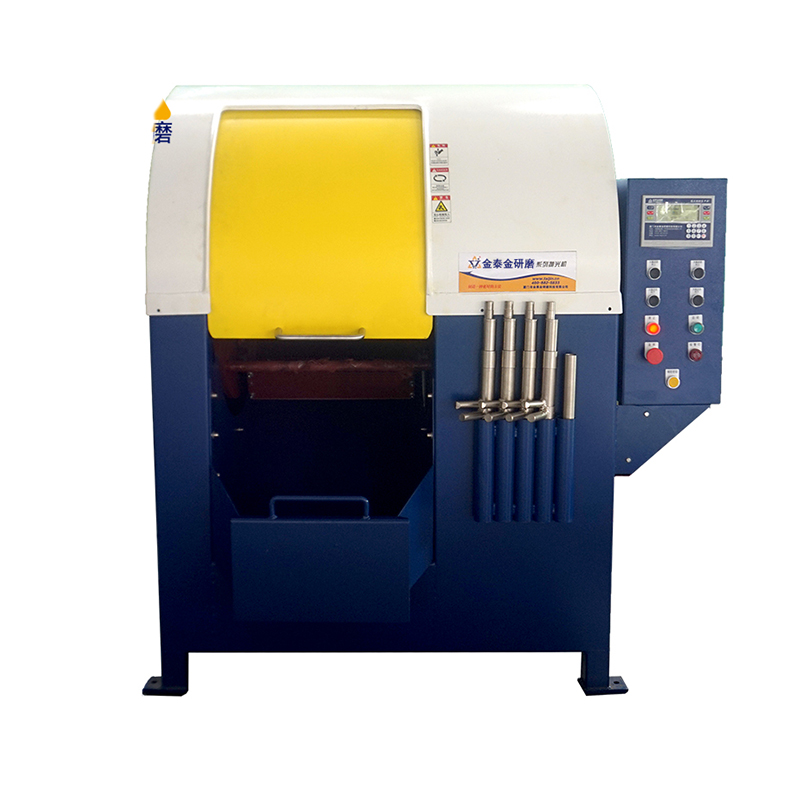
A round vibratory bowl is the usual starting point for machined automation parts that fit comfortably and can tumble without a fixture. Media circulates in a toroidal path and reaches external faces, open pockets and edges at moderate energy, and the open chamber lets an operator pull a part mid-cycle to look at a sensitive feature. Contact between parts is continuous, so finished mounting faces, thin cover plates and bright cosmetic panels need separation or compartmentalising within the charge. A bowl reaches external geometry only: internal passages, deep pockets and the underside of a flange depend on media size, compound flow and how the part sits in the load. Where a heavy milled burr has to come off first, a machine with higher removal energy may take the bulk of it, at the cost of faster edge loss.
| Machine route | Where it fits | What it will not do |
|---|---|---|
| Centrifugal barrel finishing machine | Small precise parts and short cycles with high contact pressure, such as spools, small inserts and compact machined components | Rounds edges and can distort thin unsupported sections quickly; results are sensitive to charge weight, speed and stop time |
| Barrel finishing machine, rotary barrel tumbling | Gentle deburring of small fragile parts and mixed batches of screw-machine components with a generous compound flow | Long cycles, no visibility while running, and internal features can collect media and compound that must be retrieved at unload |
| Dry polishing machine and dryer | Removing residual moisture after a wet cycle and reducing water spotting on aluminium and stainless surfaces with pockets and threads | A finishing step only; a dry part can still carry compound film, fines and media dust, so it is not a cleanliness release |
| Tub vibrator | Long parts such as linear-axis beams, manifolds and welded frames that cannot rotate in a bowl | Lower energy per unit area so heavy burrs take longer, and large tubs need floor space and a reliable part support method |
The material family of the media sets how much energy reaches the part. Plastic media is lighter and is the conservative choice for aluminium housings, thin cover plates and machined faces that must not be peened, at the cost of a slower cut and a shorter media life. Ceramic cuts harder and holds its shape longer, which suits removing a machining burr from steel and stainless parts and blending edges, but it marks soft aluminium and rounds functional edges faster. Steel media burnishes to a bright appearance and works well on stainless, and it is the wrong starting point for aluminium because it transfers iron and can leave spotting that appears later. Wear behaviour differs across all three: ceramic shrinks and generates sludge, plastic deforms and floats differently, and steel can fracture into slivers.
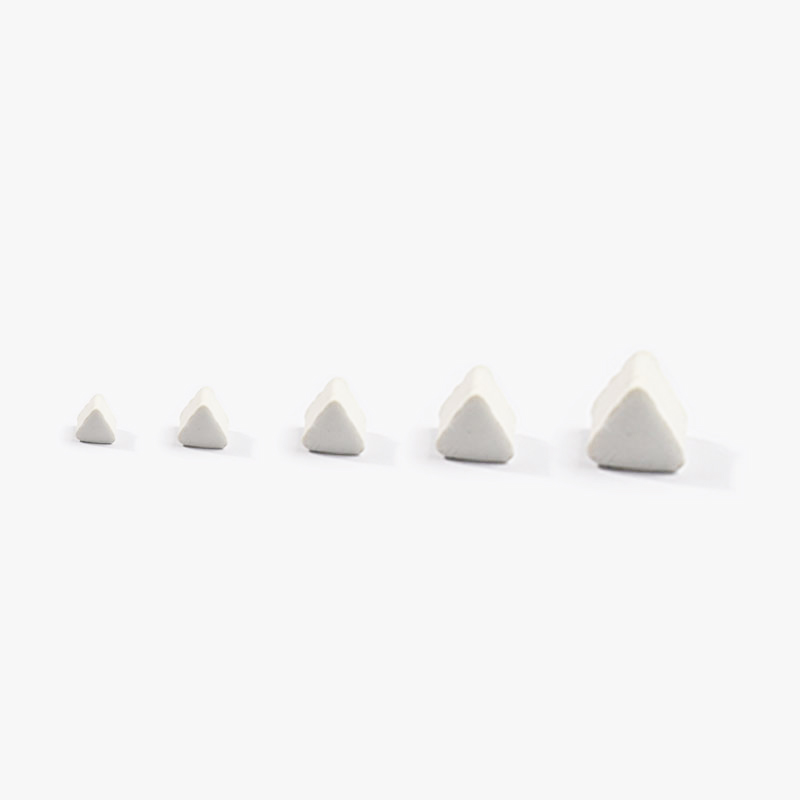
| Media | Best fit | Watch out for |
|---|---|---|
| Magnetic finishing pins and fine magnetic media | Small precise items such as spools, orifice plates, small valve parts and fine slot arrays where tumbling media cannot reach the feature | Limited working envelope, pins lodge in the same fine features they are chosen to reach, and the surface signature differs from tumbling |
| Fine ceramic or porcelain shapes in a small size class | Edge blending and surface refinement after a cutting stage, and reaching tighter external geometry on machined housings and brackets | Small sizes enter and retain in tapped holes and fine slots, and media wear shrinks the charge so the finish drifts over its life |
| Steel media, including balls and shaped pins | Bright finishing and edge blending on stainless automation components where appearance and a burnished surface matter | Transfers iron to aluminium and carbon steel, needs a corrosion-inhibiting compound, and must be separated magnetically or by screen at unload |
| Plastic cylinders and cones in a harder, denser grade | Longer cycles on mixed batches of small fittings and screw-machine parts where a repeatable light edge break is wanted without ceramic impact | Can float or segregate by shape in a bowl, and cylindrical forms can wedge in slots, keyways and cross-drillings |
A medium left in a tapped hole or a cross-drilled passage usually escapes the finishing area and is found later at assembly or at a functional test. It happens when the size class is too close to the opening, when a charge has worn or fractured into smaller pieces, or when a passage was never mapped as a retention risk. Tapped holes, keyways, seal grooves, cross-drillings and slots whose width approaches the media section are the usual places. Retrieval has to be designed rather than assumed: count the charge in and out where practical, use a pin or thread gauge on sampled holes, borescope the smallest passages at an agreed angle, and rinse through a filter for a visual check. Any medium found is a non-conformance to record, not something to wipe away and release.
| Failure mode | Likely cause | How to catch it |
|---|---|---|
| Water spotting, mineral rings or haze left after wet processing and drying | Hard or high-chloride rinse water, slow or uneven drying, or parts stacked wet so moisture is trapped in pockets and threads | Inspect dried parts under angled light for rings and haze, check the rinse water source and the drying method, and confirm that pockets and tapped holes drain before packing |
| Grey aluminium smear transferred onto stainless parts in a shared batch | Aluminium fines retained in media, compound or the machine sump after an aluminium lot, with no purge before the stainless lot | Check stainless surfaces under angled light for a dull grey film, review the changeover record, and inspect the charge and sump for retained fines |
| A ceramic, plastic or steel medium lodged in a tapped hole, keyway, cross-drilling or seal groove | Media size class too close to the opening, a charge that has worn or fractured into smaller pieces, or a retention feature that was never mapped | Count the charge in and out where practical, pin or thread gauge every hole, borescope the smallest passages at an agreed angle, and rinse through a filter for a visual check |
| Colour change or darkening on an aluminium face after the cycle | Compound chemistry unsuitable for aluminium, no effective corrosion inhibitor, or a delay between finishing and drying | Compare the finished face with an unprocessed coupon of the same alloy under the agreed light, and review the compound product, dose and rinse sequence for the lot |
Kyoto City is an inland manufacturing and research city that targets factory and head-office investment directly: its business-location pages set out a support scheme for companies that newly build or expand head offices and factories, together with a Kyoto-style global niche top-company development subsidy and incentives for office and laboratory space in designated induction areas. The city also runs a central wholesale market for food (中央卸売市場第一市場) with a published master plan and an attached food-culture museum, and it promotes regenerative medicine locally by soliciting hometown-tax donations under the banner of supporting iPS cell technology and regenerative medicine.
The nearest part of that base to this brief is medical: Kyoto City promotes support for iPS cell technology and regenerative medicine through its hometown-tax programme, indicating a regenerative-medicine and medical research base in the city.
Precision and niche manufacturers in and around Kyoto machine small, high-value parts - instrument, medical-device and electronic components - where burr removal and edge condition matter more than bulk material removal and where a scratched or rounded-over edge can scrap the part. Food-processing and food-equipment work adds cleanability and surface-integrity requirements on product-contact surfaces.
For a Kyoto buyer the first question is the scale and value of the part: for small precision and medical-related parts the decision turns on whether a bench-scale sample trial with a defined media and compound can demonstrate the required edge condition and surface finish before any machine size is chosen.
Freight context: 舞鶴港 (Maizuru Port), Kyoto Prefecture. Kyoto City itself has no seaport; Kyoto Prefecture's port administration covers 舞鶴港 (Maizuru Port) on the Japan Sea side, so incoming machines and outbound sample parts for a Kyoto buyer move by road or rail between the city and the Kansai gateways and ports.
The customs authority is Japan Customs, the Customs and Tariff Bureau of the Ministry of Finance, with regional customs at Tokyo, Yokohama, Nagoya, Osaka and Kobe. Any person importing goods must declare them to the Director-General of Customs and obtain an import permit after examination and payment of customs duty and consumption tax. The declaration is normally filed by the importer or by a customs broker acting as proxy, on a triplicate import (customs duty payment) declaration form (Customs form C-5020) supported by the invoice, the bill of lading or air waybill, a certificate of origin where a WTO rate applies, certificates of origin for preferential rates, packing lists and freight and insurance documents where required, plus any licence or certificate demanded by laws other than the Customs Law. More than 90 per cent of import procedures are computerised. A JIS Mark certificate is a separate, voluntary third-party scheme; foreign exporters are eligible to apply, and certification bodies must comply with ISO/IEC 17065.
The national standards body is the Japanese Industrial Standards Committee (JISC), which states that JIS covers industrial and mineral products, data, services and management systems under the Industrial Standardization Act. Its technical divisions include mechanical engineering, ferrous materials and metallurgy, nonferrous materials and metallurgy, ceramics, medical equipment and safety appliances, and aircraft and aviation, which are the divisions a finishing or deburring requirement is normally read against. Product certification runs through the JIS Mark Certification Scheme, operated by accredited certification bodies compliant with ISO/IEC 17065; as of March 2019 there were 24 JIS-accredited bodies, three of them outside Japan, with about 8,700 certifications issued, and the scheme explicitly covers foreign manufacturers, processors and exporters.
SurfacePolish supplies from Xiamen, China. The buyer's own destination rules, conformity marking, tariff classification and documentation responsibilities stay with the buyer; confirm them against the authorities named above before ordering.
A first-article part, finished under the intended production settings, is the reference every later batch is compared against. Keep it identified and protected with the measurement record and the settings that produced it. Production acceptance then rests on a sampling plan: the sample size, the frequency, which features are measured and which are only inspected visually. For a low-volume build, sampling by part may be workable; for a batch of small parts, sampling by position in the charge is more useful, because parts at different points in a bowl see different media conditions. Record where each sampled part sat. Agree the disposition rule in advance, including whether rework is allowed and how a reworked part is identified, so a failed sample leads to a defined action rather than an improvised one.
Scale-up is mostly about holding what produced the trial result. In production that means a media charge kept at a target mass, screened on a schedule with undersize and broken pieces removed and fresh media added to a recorded level. Compound should be metered to a concentration rather than poured by eye, and rinse water quality should be known and stable. Every lot needs an identity: part numbers, quantity, machine, media charge, compound, cycle time, operator, inspection result and disposition. Where the same machine handles aluminium and stainless, define the changeover, including media purge, machine cleaning and compound replacement, and record when it happened. Cycle counting is a simple control that is often skipped: a charge that has run a known number of hours can be scheduled for replacement before wear starts producing lodged media or a drifting finish.

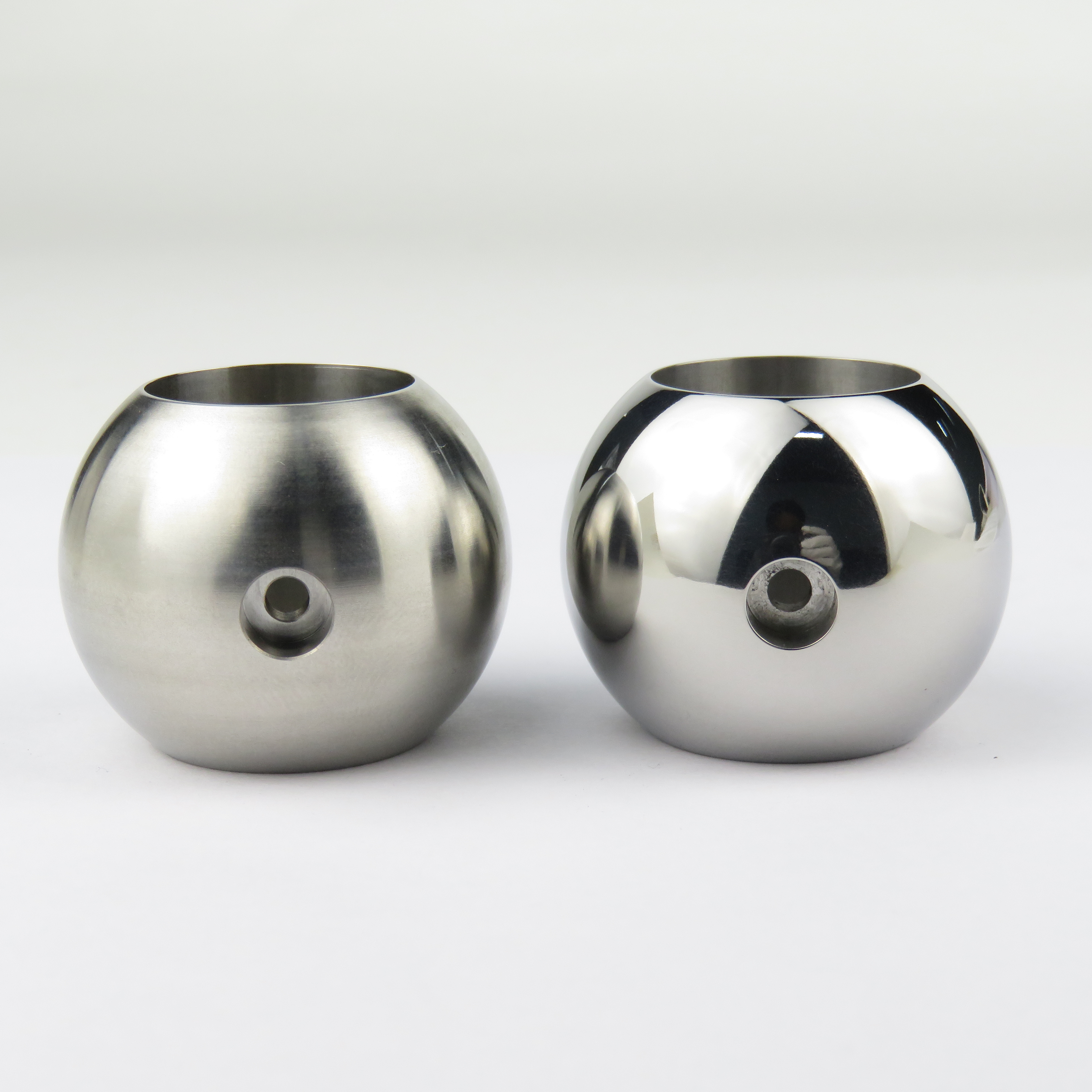
SurfacePolish does not coat, anodise or paint parts, and no finishing cycle here should be treated as a coating preparation specification. A coating or anodising step usually makes residue, smut and embedded debris more visible rather than less, and a compound film left in a bore becomes your problem at the next operation. Define what your own coating process requires and how you will verify it, then ask for the parts to be checked against that requirement. A trial can report what was observed on the tested surfaces and the settings used, but the fitness of a surface for a downstream coating step is your own process decision.
A bore cannot be protected by the cycle alone; it is protected by what is decided before the cycle. Masking or plugging the bore, keeping the part out of contact with heavy neighbours, choosing a lighter route and shortening the cycle all reduce the load the bore sees, but none of them guarantees a dimension. That is why the bore must be measured before and after at the same points, with a bore gauge or CMM, and compared with the drawing limit. SurfacePolish does not promise a tolerance or a result; the trial reports what was observed on the parts tested, and the dimensional acceptance decision stays with your own metrology and quality functions.
No. SurfacePolish does not supply or carry out electropolishing. Where an electrochemical treatment is part of a specification, it appears here only as a comparison point and as a reason to examine what a mechanical route can achieve on the same part, and the mechanical route can be discussed in terms of machine, media and compound options. A mechanical finish should not be presented as equivalent to an electropolished surface, and it does not reproduce what that process does. Where an electropolished finish is mandatory in your specification, that requirement stays with your own supply chain and your own engineering decision.
Use Kyoto, Japan as the destination on the enquiry and state whether the deliverable is equipment, media and compound, a representative sample review or a line concept. A destination does not imply local stock, a local service point or a local delivery time.
Japanese buyers work to JIS (Japanese Industrial Standards) administered through the Japanese Industrial Standards Committee (JISC), which also handles the national committee contacts for ISO and IEC work; specifications for surface finish, edge condition and material conformity are normally cited on drawings as JIS numbers or customer standards.
Sources were retrieved on 2026-09-29 and describe the local industrial and trade context only. They do not evidence any SurfacePolish project, shipment, installation or service in Kyoto.
The buyer needs the machined ends and the visible face refined evenly along 2 m without bowing the extrusion or loading it with media.
Send the material, dimensions, approximate weight, batch quantity, the incoming condition and photographs of the difficult features. Mark which features must not be contacted by media and state how the result will be inspected. This form carries source reference PSEO-0850; quote it if you prefer an additional manual reference.
Open the SurfacePolish enquiry form Email a prepared enquiry
No price, lead time, certification or result is promised here. Confirm whether a sample trial is available for the specific part and what the trial can and cannot show.
Page PSEO-0850 · revised 2026-09-29 · cross-border equipment, media and scoped sample review. City context is sourced and cited above.
Use this local checker to identify missing part and inspection information. It prepares a technical-review brief; it does not approve a machine, process recipe or production result.
Complete the part details to prepare a review brief.
Email : info@surface-polish.com


 IPv6 network supported


 +86-592-2381506