A linear motion component supplier in Stuttgart, Germany in robotics and automation has a hardened steel carriage block whose ground ways and mounting face must be left as they are while its edges are broken. SurfacePolish supplies finishing machines, media and compounds across borders and offers a free sample trial: representative blocks travel to Xiamen and return with observations plus a proposed media, compound and cycle direction for the buyer's own evaluation. This brief is written for a buyer in Stuttgart working on robotics and automation; it describes equipment, media and a scoped sample review, not a local polishing service.
How much of the incoming contamination, cutting oil, machining chip and handling damage is expected to be removed by finishing rather than by an earlier operation?
What is the smallest hole, slot, keyway or cross-drilling the charge must not enter or plug, and how will a lodged medium be detected and removed?
What is the size and mass spread inside one part family, and does one machine have to cover both a heavy casting and a small gripper jaw?
The mechanism that raised the burr matters more than its size. Milling a pocket leaves a rolled edge that folds over the top of a wall; turning leaves a fine feather on a bore lip; EDM leaves a recast layer that is hard, brittle and behaves differently under impact media; cross-drilling leaves a burr inside the intersection of two passages that no external media stream reaches; laser cutting leaves dross on a bracket edge; a weld leaves spatter and a heat-affected zone. Each of those responds to a different combination of energy, media shape and time. Ask for the routing that produced the part and not only the drawing, because a cycle written for a milled edge will under-work a recast layer while rounding a turned bore lip long before the recast layer has gone.
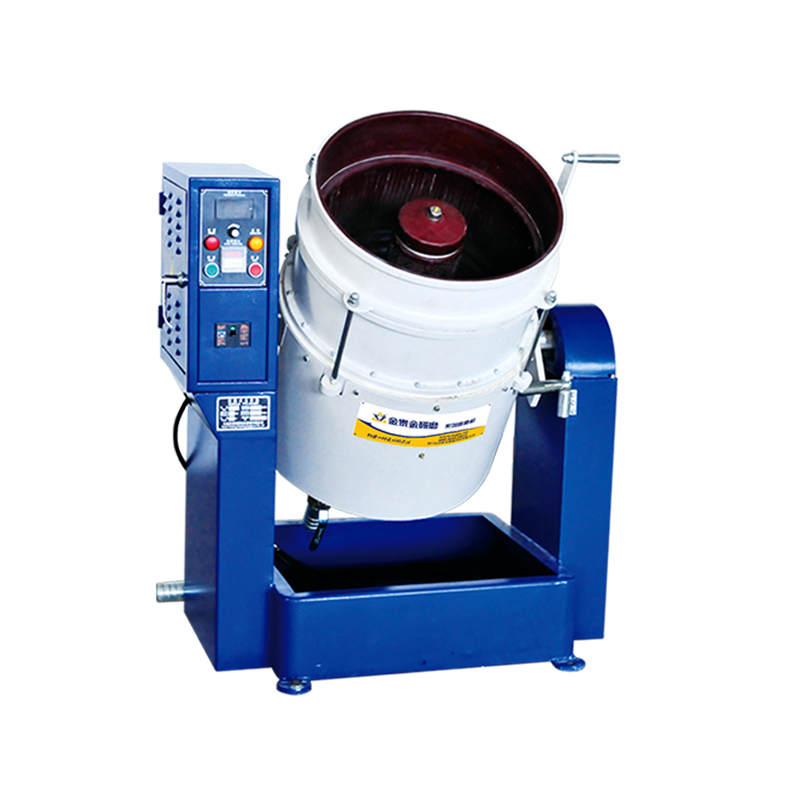
A round vibratory bowl is the usual starting point for machined automation parts that fit comfortably and can tumble without a fixture. Media circulates in a toroidal path and reaches external faces, open pockets and edges at moderate energy, and the open chamber lets an operator pull a part mid-cycle to look at a sensitive feature. Contact between parts is continuous, so finished mounting faces, thin cover plates and bright cosmetic panels need separation or compartmentalising within the charge. A bowl reaches external geometry only: internal passages, deep pockets and the underside of a flange depend on media size, compound flow and how the part sits in the load. Where a heavy milled burr has to come off first, a machine with higher removal energy may take the bulk of it, at the cost of faster edge loss.
| Machine route | Where it fits | What it will not do |
|---|---|---|
| Centrifugal barrel finishing machine | Small precise parts and short cycles with high contact pressure, such as spools, small inserts and compact machined components | Rounds edges and can distort thin unsupported sections quickly; results are sensitive to charge weight, speed and stop time |
| Vibratory finishing machine, bowl type | General deburring and refinement of machined housings, plates and brackets that fit and can tumble without racking, with easy mid-cycle inspection | Continuous part-on-part contact and no access to deep internal passages; thin plates and finished mounting faces need separation |
| Tub vibrator | Long parts such as linear-axis beams, manifolds and welded frames that cannot rotate in a bowl | Lower energy per unit area so heavy burrs take longer, and large tubs need floor space and a reliable part support method |
| Dry polishing machine and dryer | Removing residual moisture after a wet cycle and reducing water spotting on aluminium and stainless surfaces with pockets and threads | A finishing step only; a dry part can still carry compound film, fines and media dust, so it is not a cleanliness release |
Compound carries debris away, keeps the media from loading and buffers the chemistry against the metal. Alkaline and neutral families are common for general deburring and cleaning; acidic families may be chosen where a descale or brightening effect is wanted; silicate-bearing products can leave a tenacious film that is hard to remove from a bore or a sealing land. On aluminium an effective corrosion inhibitor usually matters, because the wrong chemistry darkens the surface during or after the cycle. Concentration, flow and temperature shift the result, so dosing should be metered rather than judged by eye, and rinse water hardness, chloride content and suspended solids all affect foaming and what remains behind. Where an anodise or paint step follows, the film and smut left by the cycle become the buyer's problem, so define how the surface will be checked.
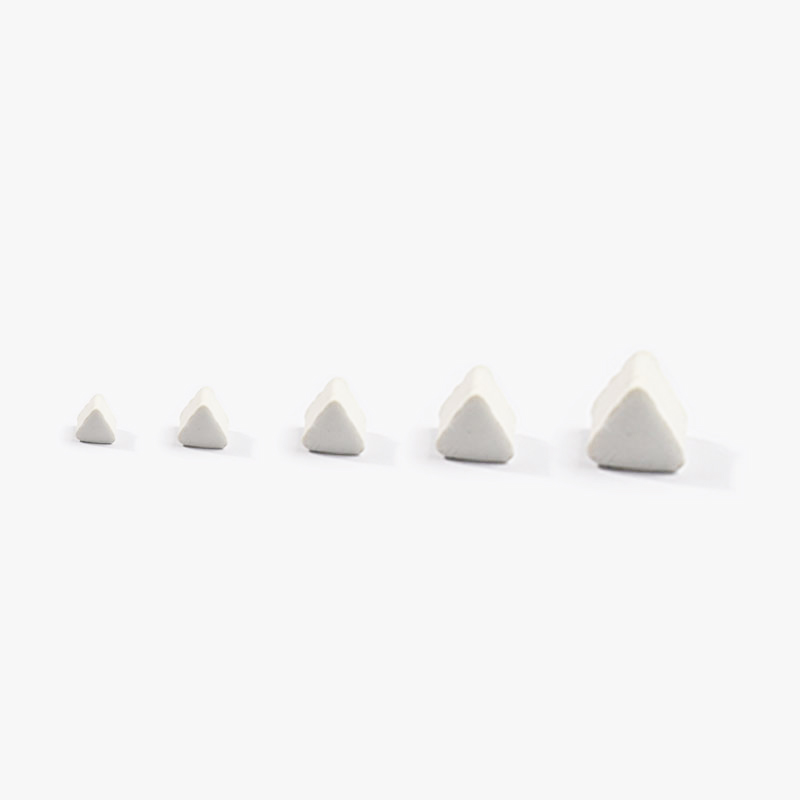
| Media | Best fit | Watch out for |
|---|---|---|
| Plastic cylinders and cones in a harder, denser grade | Longer cycles on mixed batches of small fittings and screw-machine parts where a repeatable light edge break is wanted without ceramic impact | Can float or segregate by shape in a bowl, and cylindrical forms can wedge in slots, keyways and cross-drillings |
| Plastic triangles, cones and pyramids in a soft to medium grade | Deburring aluminium housings, gripper plates and other soft alloy parts where surface marking and edge rounding must be kept to a minimum | Slow cut rate, media deforms and wears, and a worn charge behaves noticeably differently from a fresh one |
| Dry media such as walnut shell and corn cob | Drying assistance and light surface polish after a wet cycle, particularly on parts with pockets and threads that must not stay wet | Does not deburr or refine metal significantly, generates dust, and must not be treated as a cleanliness step |
| Steel media, including balls and shaped pins | Bright finishing and edge blending on stainless automation components where appearance and a burnished surface matter | Transfers iron to aluminium and carbon steel, needs a corrosion-inhibiting compound, and must be separated magnetically or by screen at unload |
Parts can pass a finish check and still fail because something moved. Thin machined webs, long beams and unsupported walls relax or distort under tumbling loads, so a housing that measured flat before the cycle fails a flatness or position check afterwards, and a soft aluminium part can pick up a bow that only shows on a surface plate. At the same time, media that cannot reach deep pockets, internal corners or the shielded side of a flange leave the original machining marks intact while the exposed faces are fully refined, and the difference becomes obvious once the part is assembled against a mating surface. Both outcomes are caught by measurement rather than by looking harder at the finish: record flatness, wall thickness and critical dimensions at the same points before and after, inspect at defined locations, and treat the batch record as the first place to look for the cause.
| Failure mode | Likely cause | How to catch it |
|---|---|---|
| Bearing bore, bore lip or dowel hole edge rounded past the drawing limit | High-energy route, over-long cycle, dense or coarse media, or a functional edge run without masking or a shielding fixture | Measure the defined edge feature before and after with an optical comparator, radius gauge or moulded replica, and compare it with the maximum radius on the drawing |
| Uneven finish with unrefined pockets, internal corners or the shielded side of a flange | Media cannot reach the feature at the chosen size or orientation, charge circulation is blocked, or the part was never repositioned during the cycle | Inspect at defined locations rather than judging the whole part, photograph the same feature before and after, and measure roughness only at the surfaces the drawing controls |
| A ceramic, plastic or steel medium lodged in a tapped hole, keyway, cross-drilling or seal groove | Media size class too close to the opening, a charge that has worn or fractured into smaller pieces, or a retention feature that was never mapped | Count the charge in and out where practical, pin or thread gauge every hole, borescope the smallest passages at an agreed angle, and rinse through a filter for a visual check |
| Burr remaining inside a cross-drilled intersection or an internal corner | Media too large to enter the intersection, part orientation that shields the feature, or a cycle stopped before that feature was reached | Borescope the intersection at a fixed angle, compare with a first-article reference, and use a pin or probe to feel for a lip on sampled parts |
The Stuttgart region is a statutory regional body covering 179 municipalities whose industrial profile is built on mobility, mechanical engineering, bio/medical technology and aerospace. Region Stuttgart describes the area as the birthplace region of the automobile and the location of what it calls Europe's most significant automotive cluster, with Mercedes-Benz, Porsche, Bosch, Mahle, Eberspächer, Mann+Hummel and Vector Informatik among the internationally active companies rooted there (s2). Mechanical engineering in the region is dominated by special-purpose machines and single-unit production, and generates close to one third of Baden-Württemberg's turnover in the sector, with an export ratio above 65 percent (s1). Bio- and medical technology is clustered across Stuttgart, Tübingen, Reutlingen and Neckar Alb, with more than 200 companies and BioRegio STERN as the sector contact point (s3), and aerospace is represented by firms such as Tesat-Spacecom and Thales alongside small and medium-sized producers (s4). The city itself presents Stuttgart as one of Germany's strongest export metropolitan regions (s5).
The nearest part of that base to this brief is machinery: Machine builders in the region generate close to one third of Baden-Württemberg's sector turnover, with a local profile dominated by special-purpose machines and single-unit production and an export ratio above 65 percent (s1).
In a base built on special-purpose machines and single-unit production, housings, shafts, guides and welded frames are typically machined in small batches, so edge condition after milling, turning and laser cutting is frequently determined by the operator unless a deburring or edge-specification step is defined. The automotive and aerospace suppliers in the same region work to drawing-level edge, radius and surface requirements, and medical-technology production adds a cleanliness dimension because parts pass through shared contract-manufacturing chains where loose particles and media residue have to be controlled before packing.
The first question for a Stuttgart buyer is whether the part is a single-unit special-machine component with a drawing-specific edge requirement or a series component where a repeatable mass-finishing process can be qualified; the second is which measuring method and cleanliness level the customer's drawing actually cites, because that decides whether a vibratory or centrifugal process is adequate or whether edge work has to stay manual.
Freight context: Hafen Stuttgart (trimodal container terminal and rail freight yard), Stuttgart Airport. Hafen Stuttgart moved 3.194 million tonnes by water and rail in 2020, of which 2.185 million tonnes went by rail, plus 28,759 containers (52,847 TEU) through its trimodal container terminal and rail yard (s6). The water-side goods mix is led by construction materials, mineral-oil products and iron/steel/scrap (s6). Machines or sample parts consigned to Stuttgart can therefore be cleared through a seaport and forwarded inland by rail or barge rather than by road alone.
Machinery placed on the German market must be CE marked, and the manufacturer is responsible for the conformity assessment, the technical file, the EU declaration of conformity and for affixing the mark; importers and distributors are separately obliged to ensure that only compliant, CE-marked products are placed on the EEA market (c3, c4). The customs authority is German customs (Zoll), part of the Generalzolldirektion, and the operator identification it issues, the EORI number, is a prerequisite for customs clearance in the European Union (c5, c6). In general EU practice a buyer's landed-cost plan therefore needs to cover the commodity-code classification that sets the duty rate, import VAT and the customs declaration, on top of the CE technical file and an identified EU-based economic operator who can act as importer or authorised representative; the technical documentation and the declaration of conformity must be available in the language required by the buyer's market surveillance authority.
DIN, the German Institute for Standardization, is the German standards body: German technical rules and standards from Germany and worldwide are distributed through DIN Media, its publishing house, and DIN adopts European and international standards at national level (c7). In practice a German buyer's surface, edge and cleanliness specifications are written against DIN/EN/ISO texts, while machinery conformity itself runs through the European CE route (CE marking plus technical file and EU declaration of conformity) rather than a separate national approval (c3, c7). In the automotive supply chain the VDA, whose members are the more than 620 companies producing for the German automotive industry, is the association through which sector supplier requirements and quality-management material are organised (c10).
SurfacePolish supplies from Xiamen, China. The buyer's own destination rules, conformity marking, tariff classification and documentation responsibilities stay with the buyer; confirm them against the authorities named above before ordering.
Roughness is only comparable when the measurement conditions are fixed. State the location by distance from a reference feature, the traverse direction relative to the machining or media marks, the cut-off and the evaluation length, then use the same conditions for the first article and for production checks. A reading taken along a bore axis and one taken around its circumference describe different surfaces. Curvature limits how a skid or shoe sits on the work, particularly in a small bore or on a narrow land, and a poorly seated pickup is not evidence. Take readings at several stations, because the ends of a part and the middle of a part often differ. Where visual appearance is what the customer sees, pair the number with a physical reference viewed at an agreed distance, since a surface can measure inside a band and still look wrong.
A sample trial answers a narrow question: what happened to these parts under these settings on this equipment. It does not prove that a production lot will be uniform, because load ratio, media age and operator practice all shift the outcome, and it does not transfer a result from a coupon to a complex housing. It cannot establish a particle count, a cleanliness level or fitness for any regulated application, and it does not show whether a machine or medium is approved or qualified for a buyer's process. It cannot establish a cycle time, a cost per part, a capacity or a delivery schedule, and it says nothing about how the surrounding handling or automation should be arranged. Treat the returned parts and the settings record as evidence for the buyer's own engineering and quality decision, and plan the production route with its own first-article and sampling discipline.
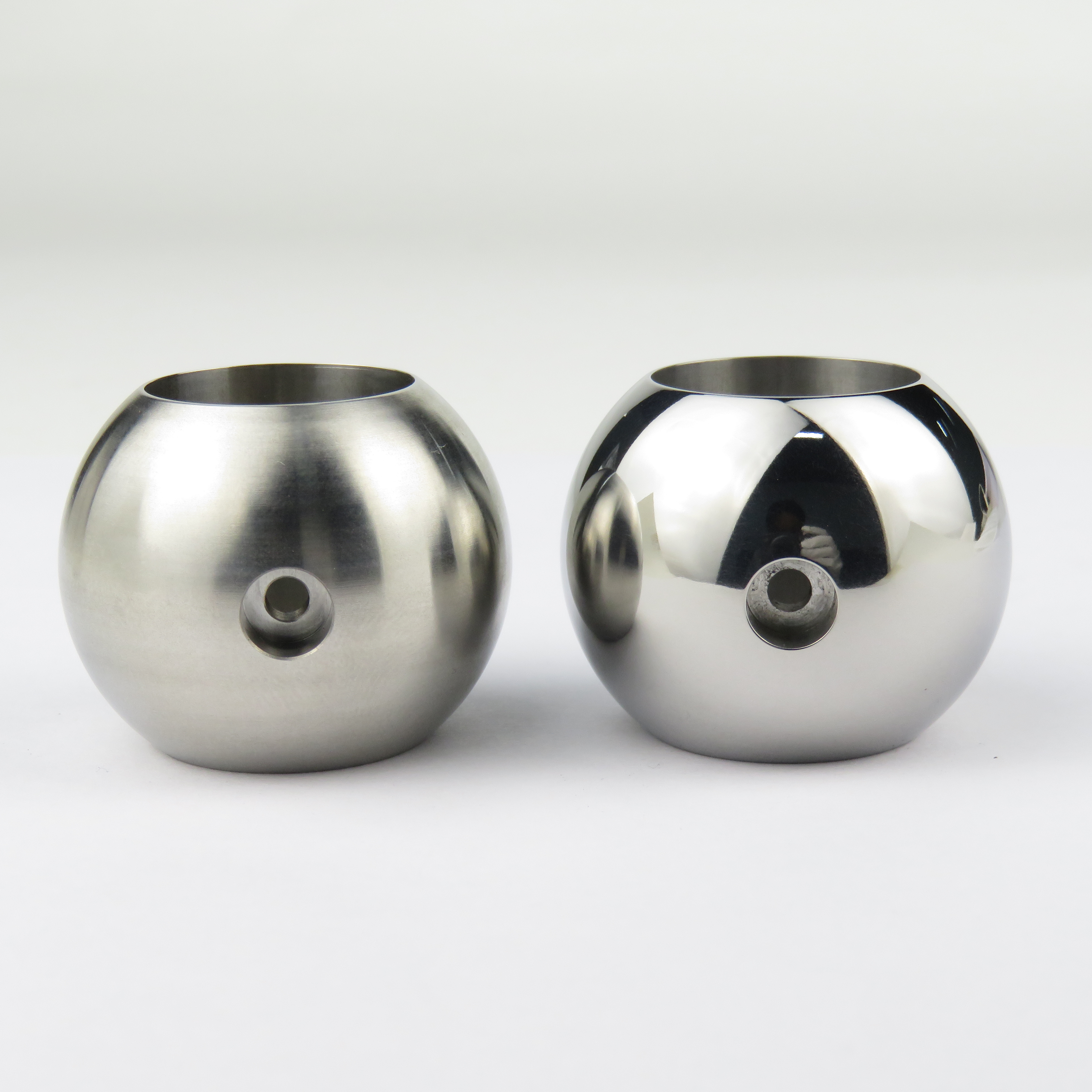
No. SurfacePolish does not supply or carry out electropolishing. Where an electrochemical treatment is part of a specification, it appears here only as a comparison point and as a reason to examine what a mechanical route can achieve on the same part, and the mechanical route can be discussed in terms of machine, media and compound options. A mechanical finish should not be presented as equivalent to an electropolished surface, and it does not reproduce what that process does. Where an electropolished finish is mandatory in your specification, that requirement stays with your own supply chain and your own engineering decision.
A trial shows what a given machine, charge and setting did to the parts tested, which is useful evidence but not a sizing study. Machine size depends on the largest envelope and mass in the family, the smallest part that must meet the same appearance, the load ratio you intend to run, and how many stages the part needs. Those are planning questions that belong in a line-concept discussion alongside the trial result. A part tested on a small machine may behave differently in a larger chamber, and a part run in a full production load may come out differently from one run in a light trial batch. Record both the settings and the load.
A bore cannot be protected by the cycle alone; it is protected by what is decided before the cycle. Masking or plugging the bore, keeping the part out of contact with heavy neighbours, choosing a lighter route and shortening the cycle all reduce the load the bore sees, but none of them guarantees a dimension. That is why the bore must be measured before and after at the same points, with a bore gauge or CMM, and compared with the drawing limit. SurfacePolish does not promise a tolerance or a result; the trial reports what was observed on the parts tested, and the dimensional acceptance decision stays with your own metrology and quality functions.
Use Stuttgart, Germany as the destination on the enquiry and state whether the deliverable is equipment, media and compound, a representative sample review or a line concept. A destination does not imply local stock, a local service point or a local delivery time.
A Stuttgart buyer's surface, edge and cleanliness specifications are normally written against DIN/EN/ISO texts, with CE marking and the EU declaration of conformity as the conformity route for the machine itself (c3, c7). Automotive and aerospace suppliers in the region additionally work to their customers' sector requirements, which the VDA organises for the German automotive industry (c10).
Sources were retrieved on 2026-09-29 and describe the local industrial and trade context only. They do not evidence any SurfacePolish project, shipment, installation or service in Stuttgart.
The buyer needs the milled and tapped edges broken lightly without removing material from the ground ways or softening the mounting face condition.
Send the material, dimensions, approximate weight, batch quantity, the incoming condition and photographs of the difficult features. Mark which features must not be contacted by media and state how the result will be inspected. This form carries source reference PSEO-0310; quote it if you prefer an additional manual reference.
Open the SurfacePolish enquiry form Email a prepared enquiry
No price, lead time, certification or result is promised here. Confirm whether a sample trial is available for the specific part and what the trial can and cannot show.
Page PSEO-0310 · revised 2026-09-29 · cross-border equipment, media and scoped sample review. City context is sourced and cited above.
Use this local checker to identify missing part and inspection information. It prepares a technical-review brief; it does not approve a machine, process recipe or production result.
Complete the part details to prepare a review brief.
Email : info@surface-polish.com


 IPv6 network supported


 +86-592-2381506