A pneumatics maker in Tilburg, Netherlands working in robotics and automation has a stainless actuator body whose bore lip and port threads must not be rounded or galled by edge finishing. SurfacePolish supplies finishing machines, media and compounds across borders and runs a free sample trial: the part goes to Xiamen, is processed under recorded settings, and returns with observations and a proposed media, compound and cycle direction for the buyer to verify. This brief is written for a buyer in Tilburg working on robotics and automation; it describes equipment, media and a scoped sample review, not a local polishing service.
Which alloys and tempers run through the shop, and how will media, machines and compounds be purged between aluminium, stainless and steel work?
What is the size and mass spread inside one part family, and does one machine have to cover both a heavy casting and a small gripper jaw?
What does the finishing step actually have to deliver before the next operation, whether that is assembly, anodising, painting or a functional test, and who defines that requirement?
Automation work mixes scales in a way that catches buyers out. The same shop may finish a 40 kg robot base casting and a 30 g gripper jaw, and a machine sized for the casting will over-work the jaw. Load ratio, the mass of parts against the mass of the charge, is the variable that usually decides whether small parts come out even or rounded. Screen the family on its extremes: the heaviest part, the largest envelope, the thinnest unsupported wall and the smallest part that must meet the same appearance. Long linear-axis beams and thin cover plates distort under their own weight in a deep bed, while heavy castings need a chamber large enough to keep them moving. A shortlist built on the average part will miss both ends of the range.
Compound carries debris away, keeps the media from loading and buffers the chemistry against the metal. Alkaline and neutral families are common for general deburring and cleaning; acidic families may be chosen where a descale or brightening effect is wanted; silicate-bearing products can leave a tenacious film that is hard to remove from a bore or a sealing land. On aluminium an effective corrosion inhibitor usually matters, because the wrong chemistry darkens the surface during or after the cycle. Concentration, flow and temperature shift the result, so dosing should be metered rather than judged by eye, and rinse water hardness, chloride content and suspended solids all affect foaming and what remains behind. Where an anodise or paint step follows, the film and smut left by the cycle become the buyer's problem, so define how the surface will be checked.
| Media | Best fit | Watch out for |
|---|---|---|
| Steel media, including balls and shaped pins | Bright finishing and edge blending on stainless automation components where appearance and a burnished surface matter | Transfers iron to aluminium and carbon steel, needs a corrosion-inhibiting compound, and must be separated magnetically or by screen at unload |
| Magnetic finishing pins and fine magnetic media | Small precise items such as spools, orifice plates, small valve parts and fine slot arrays where tumbling media cannot reach the feature | Limited working envelope, pins lodge in the same fine features they are chosen to reach, and the surface signature differs from tumbling |
| Dry media such as walnut shell and corn cob | Drying assistance and light surface polish after a wet cycle, particularly on parts with pockets and threads that must not stay wet | Does not deburr or refine metal significantly, generates dust, and must not be treated as a cleanliness step |
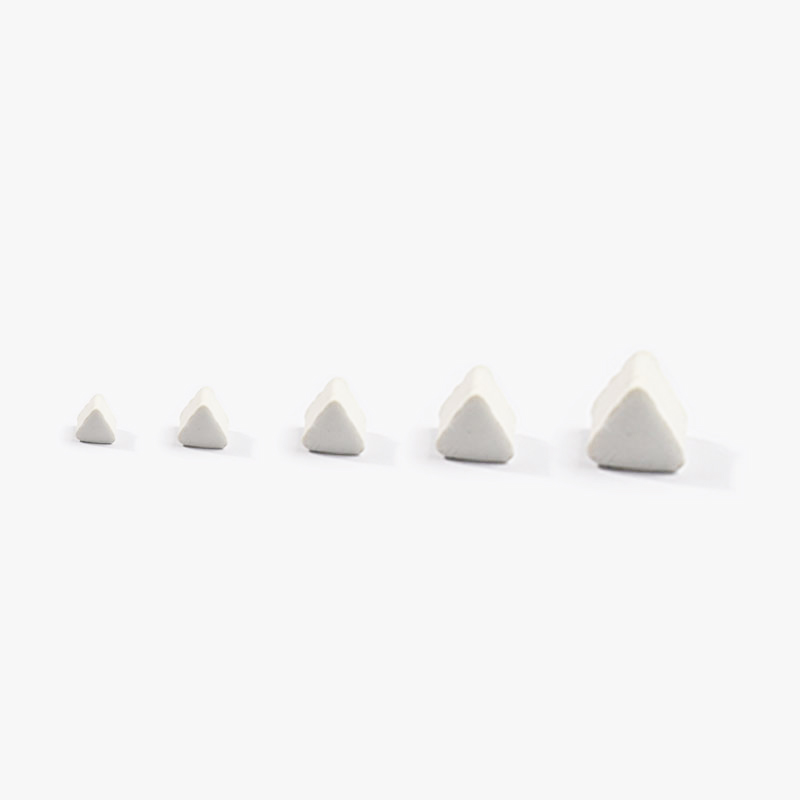
| Plastic triangles, cones and pyramids in a soft to medium grade | Deburring aluminium housings, gripper plates and other soft alloy parts where surface marking and edge rounding must be kept to a minimum | Slow cut rate, media deforms and wears, and a worn charge behaves noticeably differently from a fresh one |
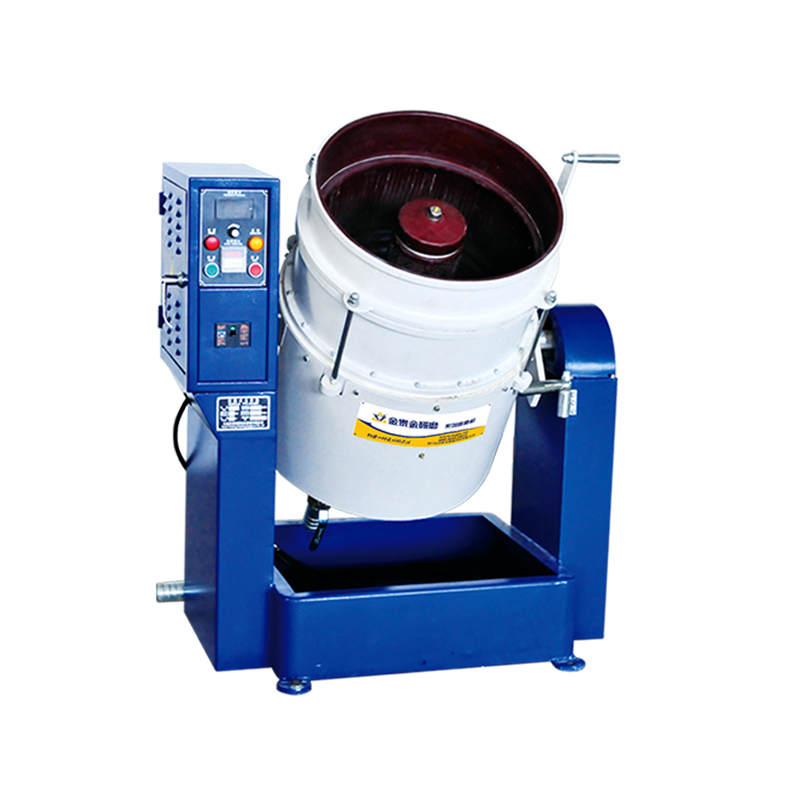
Long parts and heavy parts both fall outside a round bowl. A tub vibrator uses a rectangular chamber, so the working length extends along one axis while the bed stays shallow, which suits linear-axis beams, long manifolds and welded frames that cannot tumble end over end. The part is immersed or supported rather than turned, which removes bending risk from a divider, but energy per unit area is lower and a heavy burr takes longer. A grinding finishing machine works the other way, using higher removal energy to take off a defined layer or a heavy machining burr before refinement. That route cuts functional edges quickly and needs a tighter assessment of what may be removed. The deciding questions are part length, mass, how the part can be supported, and whether the critical face can be presented to the media at all.
| Machine route | Where it fits | What it will not do |
|---|---|---|
| Centrifugal barrel finishing machine | Small precise parts and short cycles with high contact pressure, such as spools, small inserts and compact machined components | Rounds edges and can distort thin unsupported sections quickly; results are sensitive to charge weight, speed and stop time |
| Disc finishing machine | Fast, high-energy edge breaking and surface refinement on small robust parts and uniform batches of gripper jaws, blocks and fittings | High impingement and edge-loss risk on thin, soft or aluminium parts, and the geometry must suit the disc working gap |
| Grinding finishing machine | Taking off a heavy machining burr, dross or a defined stock layer before a refinement pass on robust steel and stainless work | High removal energy cuts functional edges fast and demands a tighter assessment of what may be removed and how much |
| Dry polishing machine and dryer | Removing residual moisture after a wet cycle and reducing water spotting on aluminium and stainless surfaces with pockets and threads | A finishing step only; a dry part can still carry compound film, fines and media dust, so it is not a cleanliness release |
Edge rounding beyond limit is the failure that most often turns a finished automation part into scrap, because the features that round first are the ones that set position. A bearing bore lip, a dowel hole edge, a seal groove corner or the edge of a ground mounting land can lose a fraction of its geometry under a high-energy charge and still look uniform and polished. Coarse or dense media, an over-long cycle and a heavy load ratio all accelerate it, and aluminium rounds faster than stainless under the same conditions. Because the damage is invisible to a casual look, checking has to be deliberate: measure the feature before and after with an optical comparator, a radius gauge or a moulded replica, and compare the result with the limit on the drawing. Masking, a shielding fixture or a gentler medium are the usual mitigations to test.
| Failure mode | Likely cause | How to catch it |
|---|---|---|
| Bearing bore, bore lip or dowel hole edge rounded past the drawing limit | High-energy route, over-long cycle, dense or coarse media, or a functional edge run without masking or a shielding fixture | Measure the defined edge feature before and after with an optical comparator, radius gauge or moulded replica, and compare it with the maximum radius on the drawing |
| Thin plate, cover or housing distorted, bowed or dimensionally drifted after the cycle | Tumbling load on an unsupported thin section, part-on-part contact, or heat and pressure from a high-energy route | Measure flatness, wall thickness and critical dimensions at the same marked points as the pre-process baseline, on a surface plate or CMM |
| Impact marks, dents or a peened, rippled appearance on a visible aluminium face | Charge mass or load ratio too high, light parts left loose among heavy neighbours, or a soft alloy run on a route chosen for steel parts | Look for repeating mark patterns under angled light, compare a part run loose with the same part compartmentalised, and review the batch mix and load recorded for the lot |
| Uneven finish with unrefined pockets, internal corners or the shielded side of a flange | Media cannot reach the feature at the chosen size or orientation, charge circulation is blocked, or the part was never repositioned during the cycle | Inspect at defined locations rather than judging the whole part, photograph the same feature before and after, and measure roughness only at the surfaces the drawing controls |
Tilburg sits at the centre of Hart van Brabant, the Tilburg-Waalwijk region that has taken the title of Dutch logistics hotspot six times in seven years in the Logistiek.nl election, with a business community that co-funds the regional programme. Alongside that distribution base the region has an SME manufacturing sector of metalworking and machine-building firms, described by Midpoint Brabant as built on craftsmanship, flexibility and family-owned companies, which the regional programme supports on process optimisation, automation and productivity. Regional firms report direct rail freight connections with China and Poland.
For this brief the relevant part of that base is automation: Regional logistics and production processes in the Tilburg-Waalwijk area are described as largely automated and robotised, with the sector characterised as technology and AI rather than manual handling.
The SME manufacturing base in Hart van Brabant is dominated by metalworking and machine-building suppliers producing sheet-metal parts, frames, machined components and welded assemblies, where deburring and edge rounding are routine steps before coating, assembly or shipment. Automation-driven logistics equipment in the region adds wear parts and handling components where edge condition and surface roughness affect function.
A buyer in this region should settle the part mix before choosing a machine or media: what share is sheet metal and welded (needing edge and weld dressing), what share is machined (needing burr height and Ra control) and what share is simply pre-treatment before powder coating or galvanising.
Freight context: Tilburg-Waalwijk logistics region (Hart van Brabant), Direct rail freight connections to China and Poland. The region is a national logistics hotspot and local firms report direct rail freight links to China, which is relevant both for inbound machines and for returning sample parts. Equipment imported from outside the EU is declared to Dutch Customs at its point of entry and requires an EORI number.
Goods entering the Netherlands from outside the EU must be declared to Dutch Customs (Douane, part of the Belastingdienst); the importer needs an EORI number, import duty is calculated on the customs value (goods value plus transport and insurance to the EU external border), and import VAT is paid at the border unless an article 23 permit or a fiscal representative is used. CE marking is mandatory for most machinery placed on the EEA market: the Machinery Regulation replaced the Machinery Directive and manufacturers must comply with the new requirements by 20 January 2027. The importer must verify that the conformity assessment was carried out correctly, that CE marking is applied properly, that the technical file is present and complete, and that the user manual is supplied in the correct language; the manufacturer's EC Declaration of Conformity must be kept. Dutch companies imported over EUR 140 billion of machinery and appliances in 2024, 24% of total Dutch goods imports.
The Netherlands applies the EU's common commercial policy, so imports of Chinese industrial machinery enter under EU customs rules and WTO tariff treatment rather than under a bilateral EU-China free-trade agreement; the European Commission also maintains trade-defence measures on selected Chinese product categories, and China is a WTO member. EU-China trade in goods reached EUR 732 billion in 2024, and in 2025 manufactured goods were 97.3% of EU imports from China, with machinery and vehicles alone accounting for 54.4% — the single largest category. Chinese finishing machines, media and compounds therefore arrive in a very large, well-established EU import stream, and the buyer should expect MFN duty plus trade-defence measures where a specific product is covered.
SurfacePolish supplies from Xiamen, China. The buyer's own destination rules, conformity marking, tariff classification and documentation responsibilities stay with the buyer; confirm them against the authorities named above before ordering.
Roughness is only comparable when the measurement conditions are fixed. State the location by distance from a reference feature, the traverse direction relative to the machining or media marks, the cut-off and the evaluation length, then use the same conditions for the first article and for production checks. A reading taken along a bore axis and one taken around its circumference describe different surfaces. Curvature limits how a skid or shoe sits on the work, particularly in a small bore or on a narrow land, and a poorly seated pickup is not evidence. Take readings at several stations, because the ends of a part and the middle of a part often differ. Where visual appearance is what the customer sees, pair the number with a physical reference viewed at an agreed distance, since a surface can measure inside a band and still look wrong.
Change one variable at a time. If the question is media shape, hold the machine, load, compound, cycle time and part mix constant and change only the medium. If the question is cycle time, hold the charge and settings constant and stop at two or three defined intervals. Use adjacent coupons or parts from the same production lot so the only difference is the variable under test. Label the pieces before they run and have the returned parts judged in one session under the same light, rather than one at a time as they arrive. Where several people judge appearance, ask each to rank the parts before discussion so the strongest opinion does not set the answer. Running two changes at once produces a result that cannot be attributed to either.
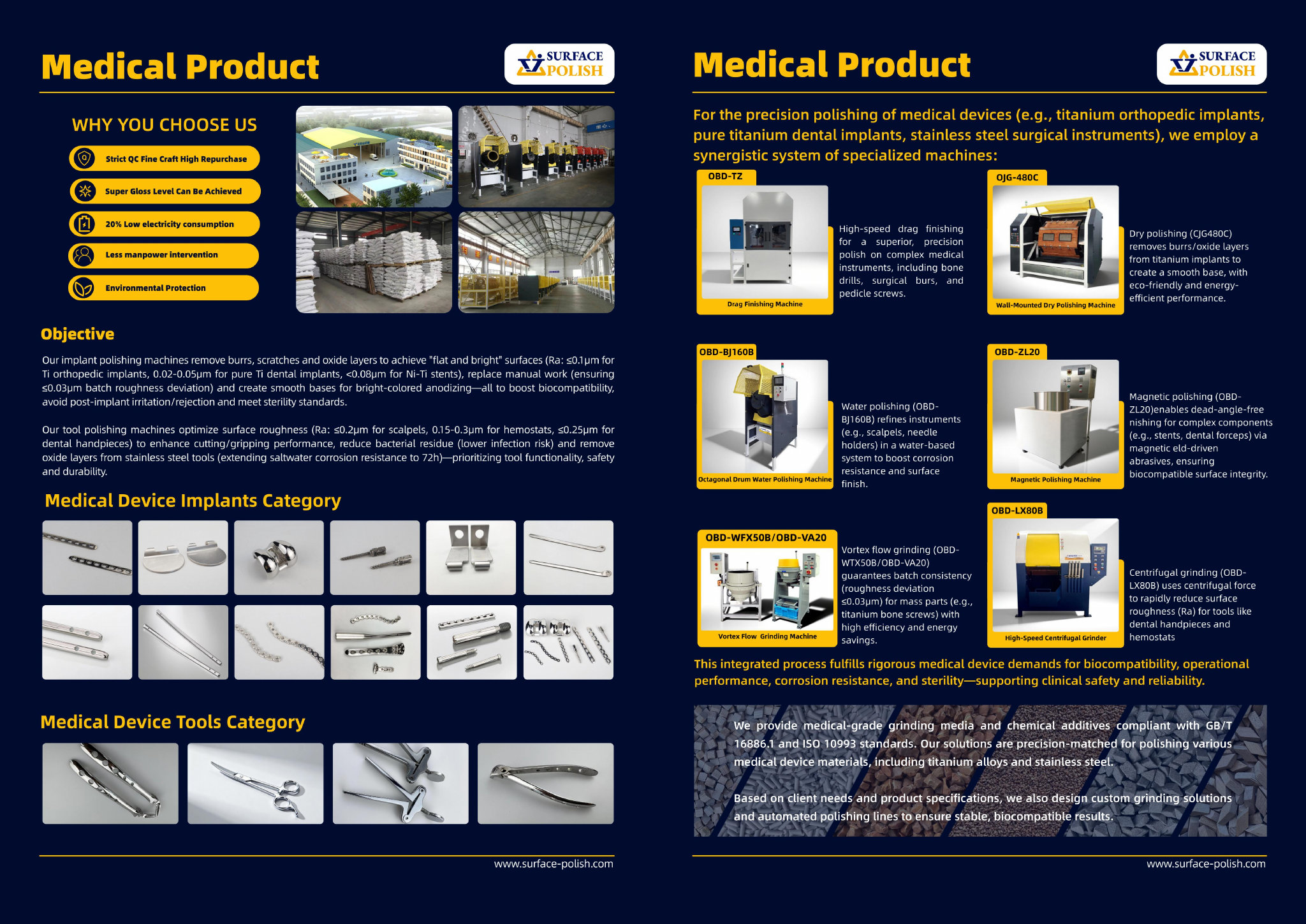
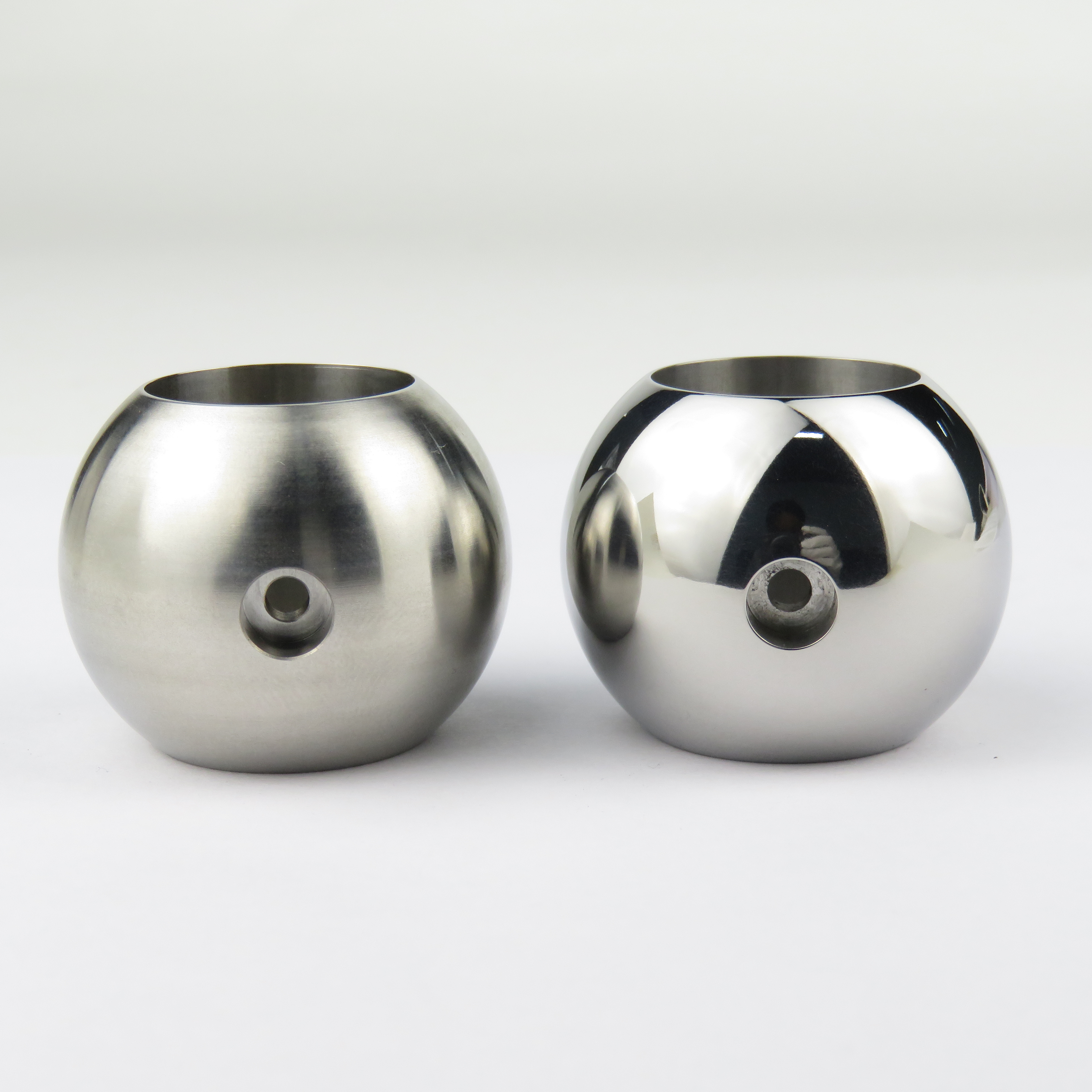
No. SurfacePolish supplies finishing machines, media and compounds across borders and runs a free sample trial on parts shipped to the factory in Xiamen. We do not design, integrate, program or commission robotic cells or automated handling lines, and no robotic polishing cell is offered here. What can be discussed is the part itself, the features that must be protected and the finishing step, and which loose-part machine and media route is worth testing. How parts are presented, loaded, unloaded and transferred is engineering scope you define and verify, and any machine or medium suggestion remains a starting point for your evaluation in Tilburg.
A bore cannot be protected by the cycle alone; it is protected by what is decided before the cycle. Masking or plugging the bore, keeping the part out of contact with heavy neighbours, choosing a lighter route and shortening the cycle all reduce the load the bore sees, but none of them guarantees a dimension. That is why the bore must be measured before and after at the same points, with a bore gauge or CMM, and compared with the drawing limit. SurfacePolish does not promise a tolerance or a result; the trial reports what was observed on the parts tested, and the dimensional acceptance decision stays with your own metrology and quality functions.
Yes. The offer is cross-border supply of finishing machines, media and compounds, together with a free sample trial and a scoped discussion of a finishing line concept. That means machine class, media and compound are considered as one question rather than three purchases, since a charge that suits one chamber may not suit another. The buyer keeps ownership of the part, the drawing and the acceptance criteria, and we do not verify the material, the upstream machining or the heat treatment. Bring the part family, the alloys, the size range and the features that must be protected into the discussion, along with the condition the parts arrive in.
Use Tilburg, Netherlands as the destination on the enquiry and state whether the deliverable is equipment, media and compound, a representative sample review or a line concept. A destination does not imply local stock, a local service point or a local delivery time.
Buyers here would reference the CE machinery regime (Machinery Regulation from 20 January 2027) and the Dutch/EN-ISO surface-finishing standards published by NEN, such as NEN-EN-ISO 2080. For parts moving into automotive or medical customers, the customer's own supplier standard and quality-system requirements are the binding specification.
Sources were retrieved on 2026-09-29 and describe the local industrial and trade context only. They do not evidence any SurfacePolish project, shipment, installation or service in Tilburg.
The buyer needs the external edges and port threads cleaned up while the bore and its lip keep the geometry the seal depends on.
Send the material, dimensions, approximate weight, batch quantity, the incoming condition and photographs of the difficult features. Mark which features must not be contacted by media and state how the result will be inspected. This form carries source reference PSEO-0650; quote it if you prefer an additional manual reference.
Open the SurfacePolish enquiry form Email a prepared enquiry
No price, lead time, certification or result is promised here. Confirm whether a sample trial is available for the specific part and what the trial can and cannot show.
Page PSEO-0650 · revised 2026-09-29 · cross-border equipment, media and scoped sample review. City context is sourced and cited above.
Use this local checker to identify missing part and inspection information. It prepares a technical-review brief; it does not approve a machine, process recipe or production result.
Complete the part details to prepare a review brief.
Email : info@surface-polish.com


 IPv6 network supported


 +86-592-2381506