A robotics manufacturer in Vancouver, Canada working in robotics and automation has an aluminium joint housing whose bearing bore, shoulder and dowel holes must survive deburring intact. SurfacePolish supplies finishing machines, media and compounds across borders and runs a free sample trial: representative parts travel to the factory in Xiamen and come back with observations and a proposed media, compound and cycle direction for the buyer's own review. This brief is written for a buyer in Vancouver working on robotics and automation; it describes equipment, media and a scoped sample review, not a local polishing service.
What is the smallest hole, slot, keyway or cross-drilling the charge must not enter or plug, and how will a lodged medium be detected and removed?
Which surfaces on the part are functional, such as bearing bores, dowel holes, seal lands, ground mounting faces and threads, and which are only cosmetic?
Which alloys and tempers run through the shop, and how will media, machines and compounds be purged between aluminium, stainless and steel work?
Two housings made to the same drawing can need different routes because of alloy and temper. A 6061-T6 machined body is soft enough to smear and peen under a heavy ceramic charge, and it marks where a steel charge has transferred iron. A 7075 part is stronger and cuts differently. Austenitic stainless work-hardens at the surface and responds to media pressure rather than to sharp cutting. Hardened 4140 or a nitrided seat may tolerate only a light edge break, because the finishing step cannot be allowed to remove the case. Castings can open porosity that machining had closed. Record the temper, the hardness range and the heat treatment, and establish whether an anodise, passivation or paint step follows, because that step usually sets the residue and smut limits the finishing cycle has to respect.
Inside any machine, the way parts are carried decides whether the finish is even and the geometry survives. Parts left loose together nibble each other along contact lines and produce bright impact marks on visible faces. Cradles that follow a casting, compartments, dividers and clip-on carriers present the same face to the media on every part and protect machined lands. Load ratio matters as much: too many parts in the charge reduces circulation and leaves shielded pockets unworked, while too few allows parts to be thrown against the chamber wall. Build the arrangement around the most delicate and the heaviest part in the family rather than an average one. Where a buyer plans automated loading or transfer between operations, the fixture interface, the orientation and the pick points belong to the buyer's own engineering scope and are defined and verified on that side.
| Machine route | Where it fits | What it will not do |
|---|---|---|
| Dry polishing machine and dryer | Removing residual moisture after a wet cycle and reducing water spotting on aluminium and stainless surfaces with pockets and threads | A finishing step only; a dry part can still carry compound film, fines and media dust, so it is not a cleanliness release |
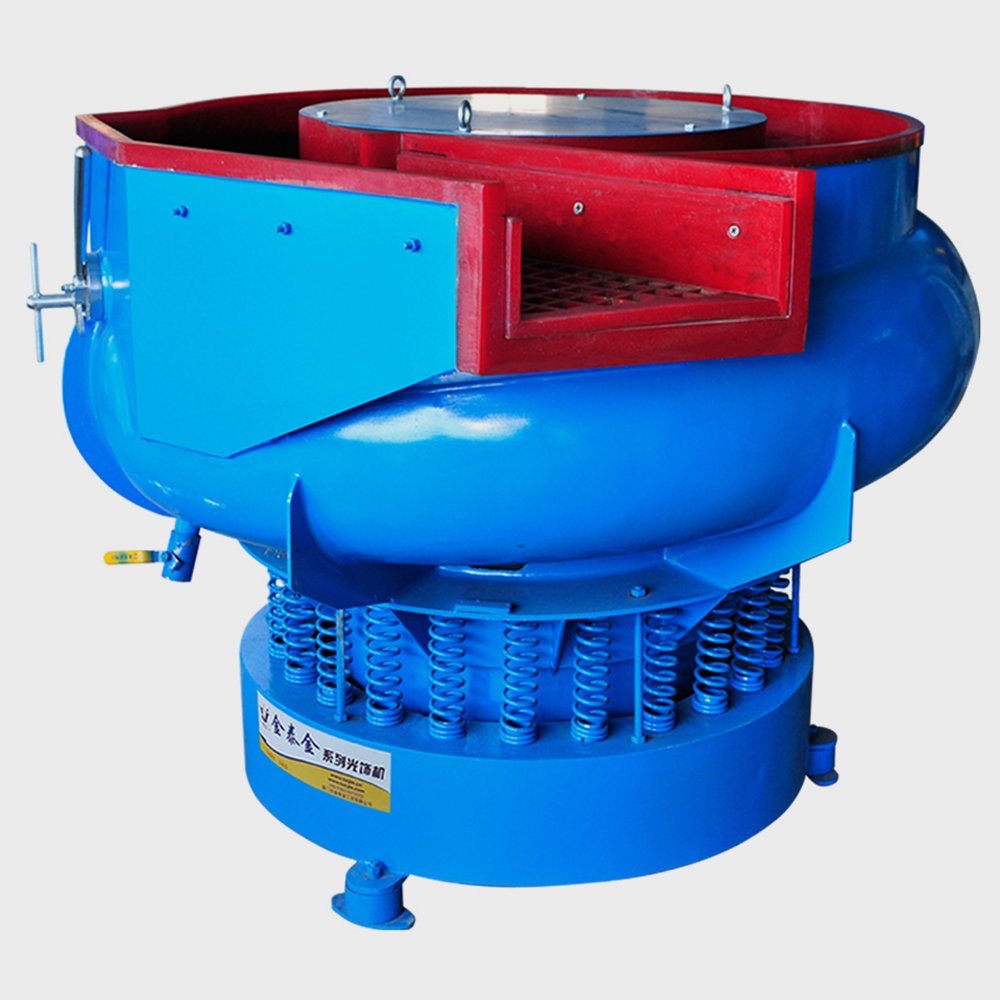
| Barrel finishing machine, rotary barrel tumbling | Gentle deburring of small fragile parts and mixed batches of screw-machine components with a generous compound flow | Long cycles, no visibility while running, and internal features can collect media and compound that must be retrieved at unload |
| Centrifugal barrel finishing machine | Small precise parts and short cycles with high contact pressure, such as spools, small inserts and compact machined components | Rounds edges and can distort thin unsupported sections quickly; results are sensitive to charge weight, speed and stop time |
| Magnetic finishing machine | Fine deburring and light refinement of small precise features such as small bores, narrow slots and fine internal radii | Small working envelope that excludes housings and long parts, with pin media that can lodge in the fine features it reaches |
Compound carries debris away, keeps the media from loading and buffers the chemistry against the metal. Alkaline and neutral families are common for general deburring and cleaning; acidic families may be chosen where a descale or brightening effect is wanted; silicate-bearing products can leave a tenacious film that is hard to remove from a bore or a sealing land. On aluminium an effective corrosion inhibitor usually matters, because the wrong chemistry darkens the surface during or after the cycle. Concentration, flow and temperature shift the result, so dosing should be metered rather than judged by eye, and rinse water hardness, chloride content and suspended solids all affect foaming and what remains behind. Where an anodise or paint step follows, the film and smut left by the cycle become the buyer's problem, so define how the surface will be checked.
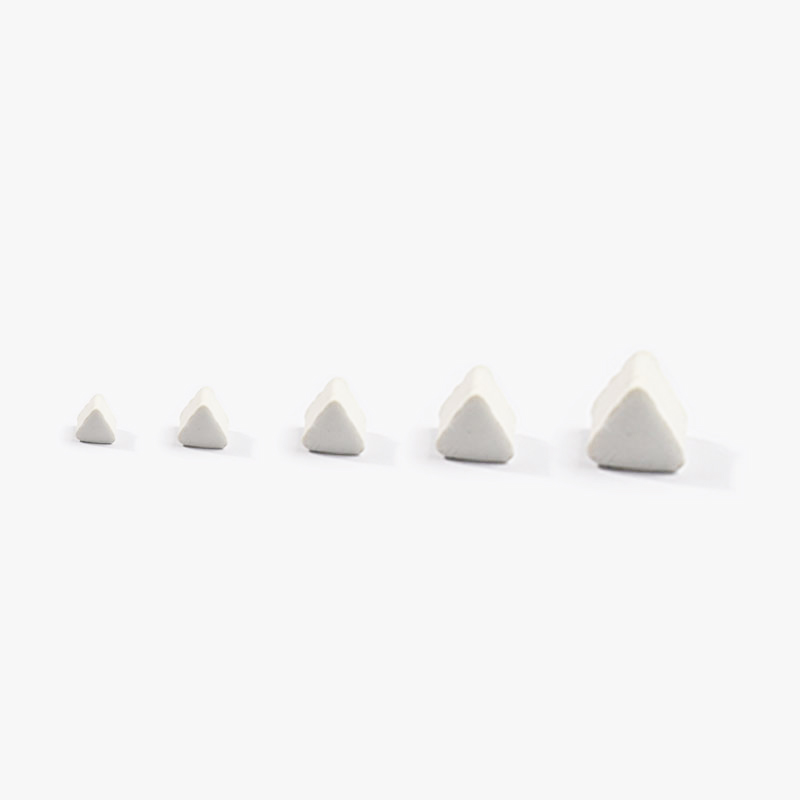
| Media | Best fit | Watch out for |
|---|---|---|
| Magnetic finishing pins and fine magnetic media | Small precise items such as spools, orifice plates, small valve parts and fine slot arrays where tumbling media cannot reach the feature | Limited working envelope, pins lodge in the same fine features they are chosen to reach, and the surface signature differs from tumbling |
| Plastic triangles, cones and pyramids in a soft to medium grade | Deburring aluminium housings, gripper plates and other soft alloy parts where surface marking and edge rounding must be kept to a minimum | Slow cut rate, media deforms and wears, and a worn charge behaves noticeably differently from a fresh one |
| Heavy-cut ceramic, angle-cut triangles in a coarse size class | Removing a substantial milled or turned burr from open external edges and pockets on steel and stainless automation parts before a refinement stage | Cuts functional edges and corners aggressively, leaves a coarse surface on aluminium, and lodges in slots whose width approaches the media section |
| Steel media, including balls and shaped pins | Bright finishing and edge blending on stainless automation components where appearance and a burnished surface matter | Transfers iron to aluminium and carbon steel, needs a corrosion-inhibiting compound, and must be separated magnetically or by screen at unload |
Edge rounding beyond limit is the failure that most often turns a finished automation part into scrap, because the features that round first are the ones that set position. A bearing bore lip, a dowel hole edge, a seal groove corner or the edge of a ground mounting land can lose a fraction of its geometry under a high-energy charge and still look uniform and polished. Coarse or dense media, an over-long cycle and a heavy load ratio all accelerate it, and aluminium rounds faster than stainless under the same conditions. Because the damage is invisible to a casual look, checking has to be deliberate: measure the feature before and after with an optical comparator, a radius gauge or a moulded replica, and compare the result with the limit on the drawing. Masking, a shielding fixture or a gentler medium are the usual mitigations to test.
| Failure mode | Likely cause | How to catch it |
|---|---|---|
| Threads rounded, galled or opened out by edge finishing | Media working the thread crest during a long or high-energy cycle, with no plugging or masking on the hole | Run go and no-go thread gauges on every sampled hole, inspect the crest at magnification, and confirm that plugs or masks were fitted and removed |
| Colour change or darkening on an aluminium face after the cycle | Compound chemistry unsuitable for aluminium, no effective corrosion inhibitor, or a delay between finishing and drying | Compare the finished face with an unprocessed coupon of the same alloy under the agreed light, and review the compound product, dose and rinse sequence for the lot |
| Uneven finish with unrefined pockets, internal corners or the shielded side of a flange | Media cannot reach the feature at the chosen size or orientation, charge circulation is blocked, or the part was never repositioned during the cycle | Inspect at defined locations rather than judging the whole part, photograph the same feature before and after, and measure roughness only at the surfaces the drawing controls |
| Thin plate, cover or housing distorted, bowed or dimensionally drifted after the cycle | Tumbling load on an unsupported thin section, part-on-part contact, or heat and pressure from a high-energy route | Measure flatness, wall thickness and critical dimensions at the same marked points as the pre-process baseline, on a surface plate or CMM |
Vancouver's industrial base is small in land area and high in value, and local business organisations treat industrial land supply itself as the binding constraint on manufacturing. The Greater Vancouver Board of Trade reports that from 2019 to 2023, over 5 million square feet of industrial investment were diverted to Calgary from Metro Vancouver because of limited land supply and regulatory barriers, and estimates that expanding industrial land supply by one per cent could support 126,100 new jobs and add CAD 12.2 billion to provincial GDP. The sectors that remain are tied to the port and to food processing: the Board of Trade frames its industrial-land campaign explicitly around unlocking "B.C.'s manufacturing and agri-food sectors" and maximising trade through the ports, and it notes that the region is home to Canada's largest and most diversified port. West of the city, the west coast gateway is rail- and container-intensive: Western Canada has 16,000 track miles of rail, employs 270,000-plus people in the transportation sector, and member ports import 2.4 million container TEUs annually, which is the infrastructure that bulk and project freight into the region depends on.
The nearest part of that base to this brief is food: The Greater Vancouver Board of Trade's industrial-land report and release are framed around unlocking B.C.'s manufacturing and agri-food sectors, and identify the provincial "50-50 Rule" on food-processor input sourcing as a barrier to year-round food processing operations.
Metro Vancouver's manufacturing is squeezed onto scarce industrial land, so equipment that fits a compact footprint and reduces rework is a direct way to protect throughput on an expensive site. The food-processing and agri-food base in the Fraser Valley runs stainless process equipment and packaging machinery where weld dressing, edge break and controlled surface roughness on product-contact surfaces are recurring requirements, and the port and rail gateway supports a machinery-repair and heavy-equipment service sector where hydraulic and structural steel components are reworked and returned to service. Deburring and surface conditioning in this market is therefore more about stainless process hardware and repair-and-overhaul components than about high-volume mass finishing.
A Vancouver buyer should settle the footprint-and-utilities question first, because industrial floor space is the scarcest input in Metro Vancouver: machine size, foundation, water supply, effluent handling and ventilation should be priced against the cost of the space they consume, not treated as line items after the equipment decision. The second question is whether the finish requirement is come-from the product-contact stainless side of the business, in which case cleaning and passivation matter more than Ra targets, or from a repair-and-overhaul customer with a written surface specification.
Freight context: Port of Vancouver (Vancouver Fraser Port Authority), Vancouver International Airport (YVR), Surrey and Vancouver intermodal rail yards, Canadian Pacific Kansas City and CN mainlines. Vancouver is Canada's Pacific gateway, and the western transportation forum records member ports importing 2.4 million container TEUs annually on a base of 16,000 track miles of rail across Western Canada. That makes the region the natural first point of entry for equipment coming from Asia, with onward movement by rail or truck; sample parts and media can be airfreighted through YVR. Port authority pages were not retrievable for direct citation during this research, so the gateway figures here come from the western Canadian transportation association and the regional board of trade.
China is one of Canada's ten principal merchandise trading partners and the second-largest single-country source of Canadian imports after the United States: Statistics Canada reported CAD 5,369 million of balance-of-payments imports from China in January 2025, against a CAD 2,299 million bilateral merchandise deficit that month. Canada has no free trade agreement with China, so Chinese-origin industrial machinery enters under the Most-Favoured-Nation (MFN) tariff column of the Canadian Customs Tariff; the preferential treatments listed in the tariff (CUSMA/UST and MXT, CETA/CEUT, CPTPP/CPTPT, UKT, KRT and others) do not include China, and preferential rates require proof of origin plus the applicable shipping rules, so a China-origin machine cannot claim them. Tariff classification is mandatory work, not a formality: vibratory, barrel, centrifugal and disc finishing machines are classified in Chapter 84 ("Nuclear reactors, boilers, machinery and mechanical appliances; parts thereof") according to the function of the machine, and the ten-digit Canadian tariff item drives both the duty rate and the statistics. A further landed-cost risk sits outside the tariff schedule: under the Special Import Measures Act (SIMA), the CBSA and the Canadian International Trade Tribunal may apply anti-dumping and countervailing duties to named goods, so a buyer should check the measures-in-force list for the specific product before assuming the MFN rate is the final duty.
Canada is a bilingual market for selling purposes: English is the working language of procurement outside Quebec, while Quebec buyers (Montreal, Quebec City) normally expect French-language quotations, technical documentation and after-sales support, and Quebec's Charter of the French Language makes French the default for commercial documentation in the province. Procurement expectations are formal and auditable: a Canadian industrial buyer will typically ask for the tariff classification and country of origin up front, expect a commercial invoice that satisfies the CBSA invoice requirements, and expect the seller to provide proof of origin for any preferential claim. Payment norms are bank-to-bank, with wire transfer or letter of credit rather than platform payment, and Canadian buyers commonly net-30 to net-60 from invoice, so a cross-border seller should price the working-capital gap into the offer. Certificates of origin for export documentation are issued through chambers of commerce, which is why chambers such as the Hamilton Chamber of Commerce and the Winnipeg Chamber of Commerce offer document certification. The current trade environment adds policy risk to landed cost: Canadian federal programs are explicitly framed around responding to U.S. tariffs, with the FedDev Ontario Regional Tariff Response Initiative described as supporting "businesses to respond to tariff pressures" in southern Ontario, and tariff and surtax measures can change by Order in Council, so quotations should state the tariff basis and the date on which the landed-cost calculation was made.
SurfacePolish supplies from Xiamen, China. The buyer's own destination rules, conformity marking, tariff classification and documentation responsibilities stay with the buyer; confirm them against the authorities named above before ordering.
Acceptance has to exist before a trial, in the drawing and the purchase specification, not as a verbal understanding afterwards. Name each controlled surface separately, because a bearing bore, a mounting land and an external cover will not respond to one media charge in the same way. State the parameter, the cut-off length, the measurement direction and the number of readings at each location. Where an edge limit applies, express it as a maximum radius or a required chamfer at a named feature rather than as a word such as deburred. Add the cleanliness requirement the part must meet and the method by which it will be judged, and say which faces are exempt. Settling those points early avoids the common dispute in which a supplier reports a surface and a buyer rejects on a feature that was never written down.
A trial can only be read against a documented starting point, so record the incoming condition before shipping. Photograph each critical feature at a fixed scale, measure roughness at marked locations with the instrument, cut-off and direction noted, check edge condition with a radius gauge or comparator, and record mass and critical dimensions. Note the as-received burr, existing scratches, cutting oil or coolant and the condition of any tapped hole. Keep one piece unprocessed as the baseline. When the parts come back, compare them against those records rather than against memory or photographs taken on a different day under different light. That pairing is also how the buyer distinguishes a change produced by the process from a feature the material already carried.
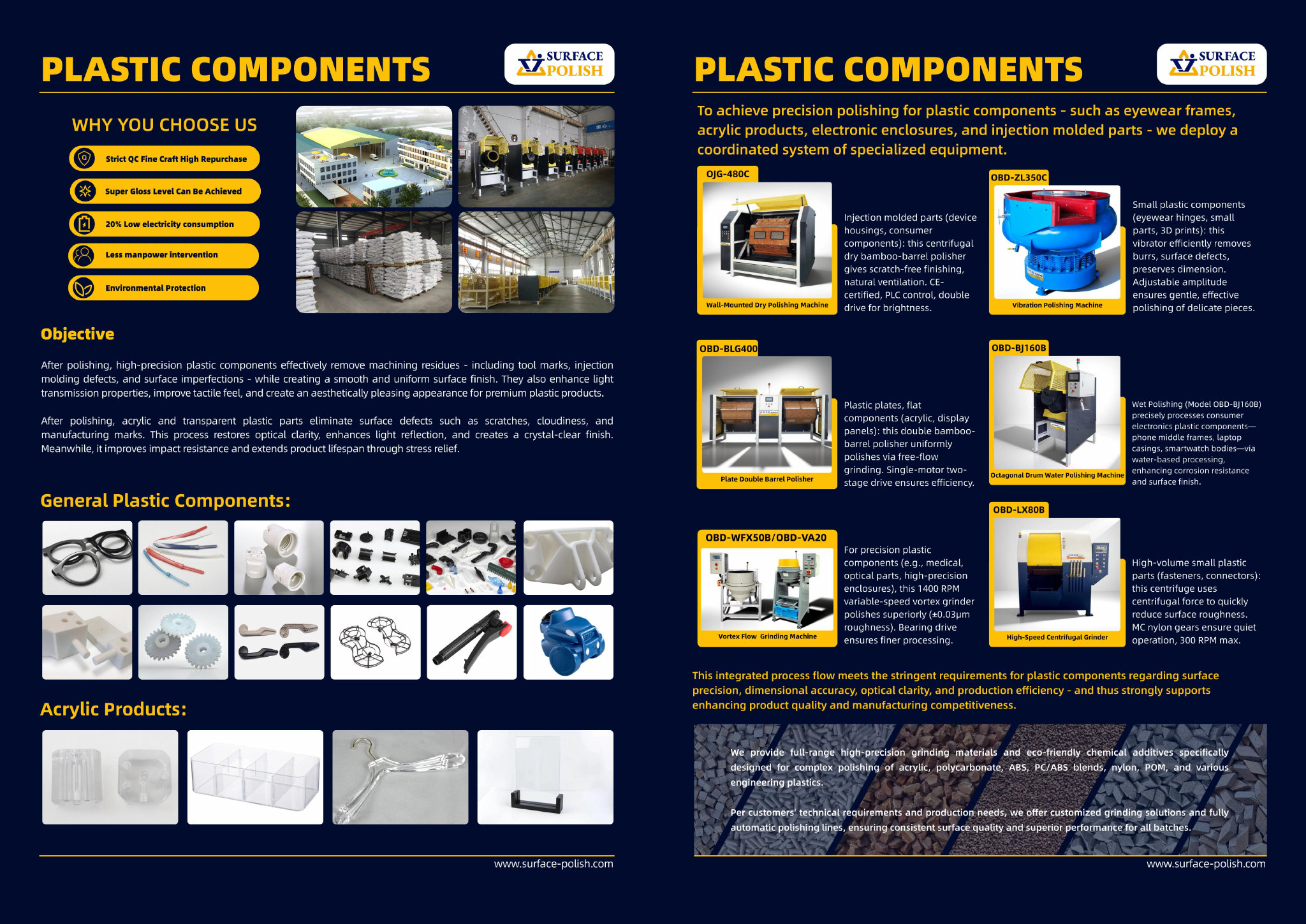
No. SurfacePolish supplies finishing machines, media and compounds across borders and runs a free sample trial on parts shipped to the factory in Xiamen. We do not design, integrate, program or commission robotic cells or automated handling lines, and no robotic polishing cell is offered here. What can be discussed is the part itself, the features that must be protected and the finishing step, and which loose-part machine and media route is worth testing. How parts are presented, loaded, unloaded and transferred is engineering scope you define and verify, and any machine or medium suggestion remains a starting point for your evaluation in Vancouver.
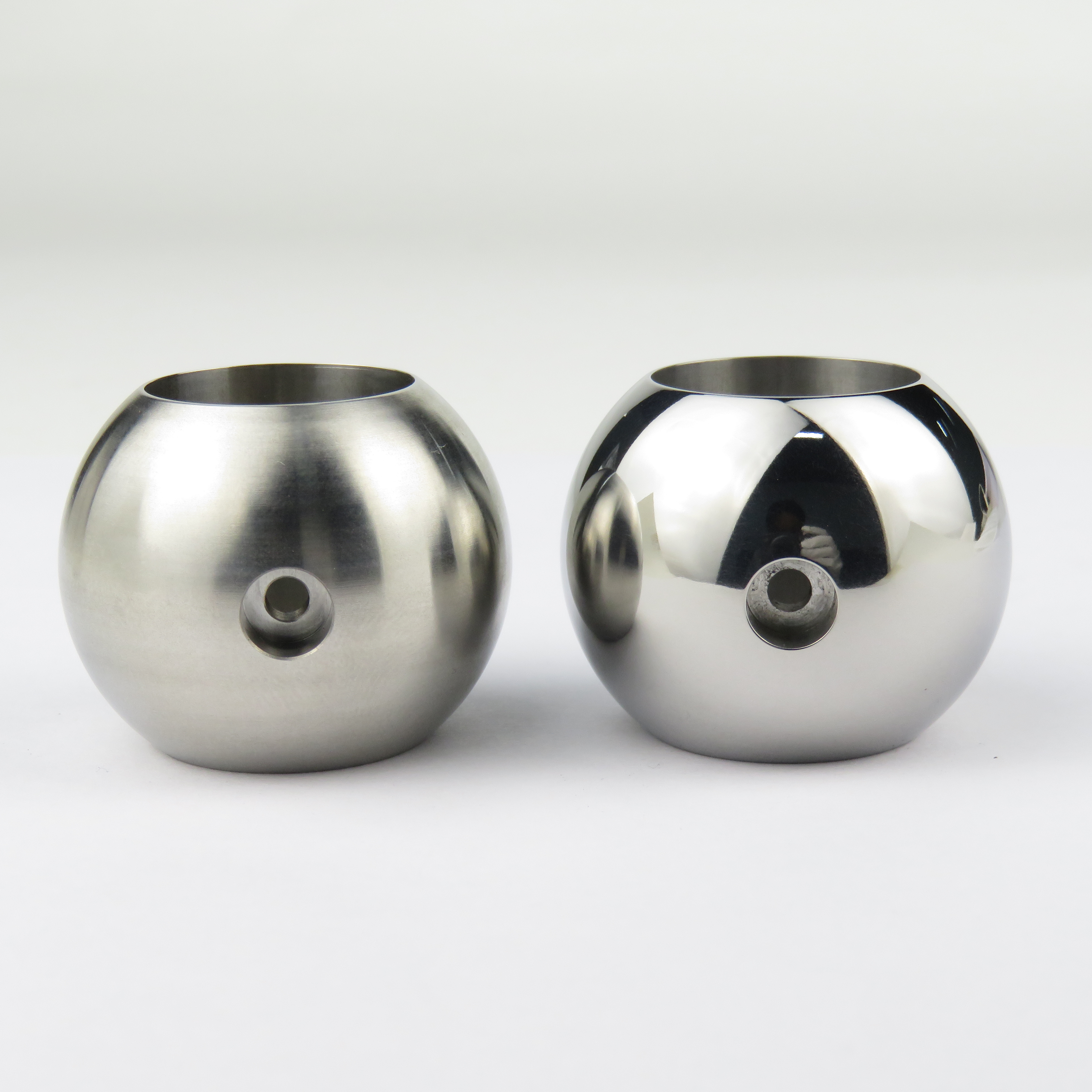
There is no single best medium, because aluminium is soft and the trade-off is between cut rate and surface damage. Plastic media is often the safer starting point where a machined face, a thin wall or a bore lip must be preserved, while a fine ceramic cuts faster if the edges tolerate more energy. The deciding variables are the smallest opening a medium could enter, the smallest radius that must not be rounded, and the surface condition the next operation needs. Media size class usually matters more than the broad material name. Send a marked-up part with its tightest feature and one controlled face, and let the trial compare two size classes.
No. SurfacePolish does not supply or carry out electropolishing. Where an electrochemical treatment is part of a specification, it appears here only as a comparison point and as a reason to examine what a mechanical route can achieve on the same part, and the mechanical route can be discussed in terms of machine, media and compound options. A mechanical finish should not be presented as equivalent to an electropolished surface, and it does not reproduce what that process does. Where an electropolished finish is mandatory in your specification, that requirement stays with your own supply chain and your own engineering decision.
Use Vancouver, Canada as the destination on the enquiry and state whether the deliverable is equipment, media and compound, a representative sample review or a line concept. A destination does not imply local stock, a local service point or a local delivery time.
A Vancouver buyer references Canadian electrical safety certification, WorkSafeBC requirements for machine guarding and safeguarding, and — where the plant handles food or beverages — the federal and provincial food-safety regime that governs product-contact surfaces and cleaning. Where the finishing step serves a marine or heavy-equipment customer, the acceptance criteria normally come from that customer's repair specification rather than from a national finishing standard.
Sources were retrieved on 2026-09-29 and describe the local industrial and trade context only. They do not evidence any SurfacePolish project, shipment, installation or service in Vancouver.
The buyer needs the milled edges broken and the external faces evened out without touching the bearing bore or closing a dowel hole.
Send the material, dimensions, approximate weight, batch quantity, the incoming condition and photographs of the difficult features. Mark which features must not be contacted by media and state how the result will be inspected. This form carries source reference PSEO-0130; quote it if you prefer an additional manual reference.
Open the SurfacePolish enquiry form Email a prepared enquiry
No price, lead time, certification or result is promised here. Confirm whether a sample trial is available for the specific part and what the trial can and cannot show.
Page PSEO-0130 · revised 2026-09-29 · cross-border equipment, media and scoped sample review. City context is sourced and cited above.
Use this local checker to identify missing part and inspection information. It prepares a technical-review brief; it does not approve a machine, process recipe or production result.
Complete the part details to prepare a review brief.
Email : info@surface-polish.com


 IPv6 network supported


 +86-592-2381506