A machine control panel maker in Venice, Italy supplying robotics and automation has a thin aluminium panel plate where the cut edges need deburring and the visible face needs an even finish without distortion. SurfacePolish supplies finishing machines, media and compounds across borders and runs a free sample trial: the plate is shipped to Xiamen and returned with observations plus a proposed media, compound and cycle direction for the buyer's own checks. This brief is written for a buyer in Venice working on robotics and automation; it describes equipment, media and a scoped sample review, not a local polishing service.
How much of the incoming contamination, cutting oil, machining chip and handling damage is expected to be removed by finishing rather than by an earlier operation?
What is the size and mass spread inside one part family, and does one machine have to cover both a heavy casting and a small gripper jaw?
Which surfaces on the part are functional, such as bearing bores, dowel holes, seal lands, ground mounting faces and threads, and which are only cosmetic?
Automation work mixes scales in a way that catches buyers out. The same shop may finish a 40 kg robot base casting and a 30 g gripper jaw, and a machine sized for the casting will over-work the jaw. Load ratio, the mass of parts against the mass of the charge, is the variable that usually decides whether small parts come out even or rounded. Screen the family on its extremes: the heaviest part, the largest envelope, the thinnest unsupported wall and the smallest part that must meet the same appearance. Long linear-axis beams and thin cover plates distort under their own weight in a deep bed, while heavy castings need a chamber large enough to keep them moving. A shortlist built on the average part will miss both ends of the range.
A round vibratory bowl is the usual starting point for machined automation parts that fit comfortably and can tumble without a fixture. Media circulates in a toroidal path and reaches external faces, open pockets and edges at moderate energy, and the open chamber lets an operator pull a part mid-cycle to look at a sensitive feature. Contact between parts is continuous, so finished mounting faces, thin cover plates and bright cosmetic panels need separation or compartmentalising within the charge. A bowl reaches external geometry only: internal passages, deep pockets and the underside of a flange depend on media size, compound flow and how the part sits in the load. Where a heavy milled burr has to come off first, a machine with higher removal energy may take the bulk of it, at the cost of faster edge loss.
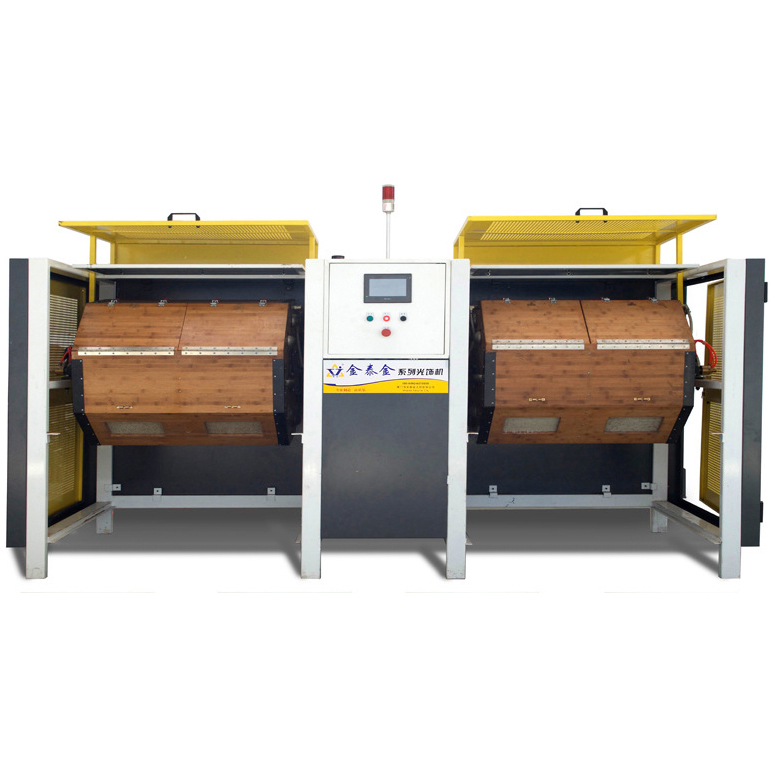
| Machine route | Where it fits | What it will not do |
|---|---|---|
| Dry polishing machine and dryer | Removing residual moisture after a wet cycle and reducing water spotting on aluminium and stainless surfaces with pockets and threads | A finishing step only; a dry part can still carry compound film, fines and media dust, so it is not a cleanliness release |
| Tub vibrator | Long parts such as linear-axis beams, manifolds and welded frames that cannot rotate in a bowl | Lower energy per unit area so heavy burrs take longer, and large tubs need floor space and a reliable part support method |
| Centrifugal barrel finishing machine | Small precise parts and short cycles with high contact pressure, such as spools, small inserts and compact machined components | Rounds edges and can distort thin unsupported sections quickly; results are sensitive to charge weight, speed and stop time |
| Disc finishing machine | Fast, high-energy edge breaking and surface refinement on small robust parts and uniform batches of gripper jaws, blocks and fittings | High impingement and edge-loss risk on thin, soft or aluminium parts, and the geometry must suit the disc working gap |
Compound carries debris away, keeps the media from loading and buffers the chemistry against the metal. Alkaline and neutral families are common for general deburring and cleaning; acidic families may be chosen where a descale or brightening effect is wanted; silicate-bearing products can leave a tenacious film that is hard to remove from a bore or a sealing land. On aluminium an effective corrosion inhibitor usually matters, because the wrong chemistry darkens the surface during or after the cycle. Concentration, flow and temperature shift the result, so dosing should be metered rather than judged by eye, and rinse water hardness, chloride content and suspended solids all affect foaming and what remains behind. Where an anodise or paint step follows, the film and smut left by the cycle become the buyer's problem, so define how the surface will be checked.
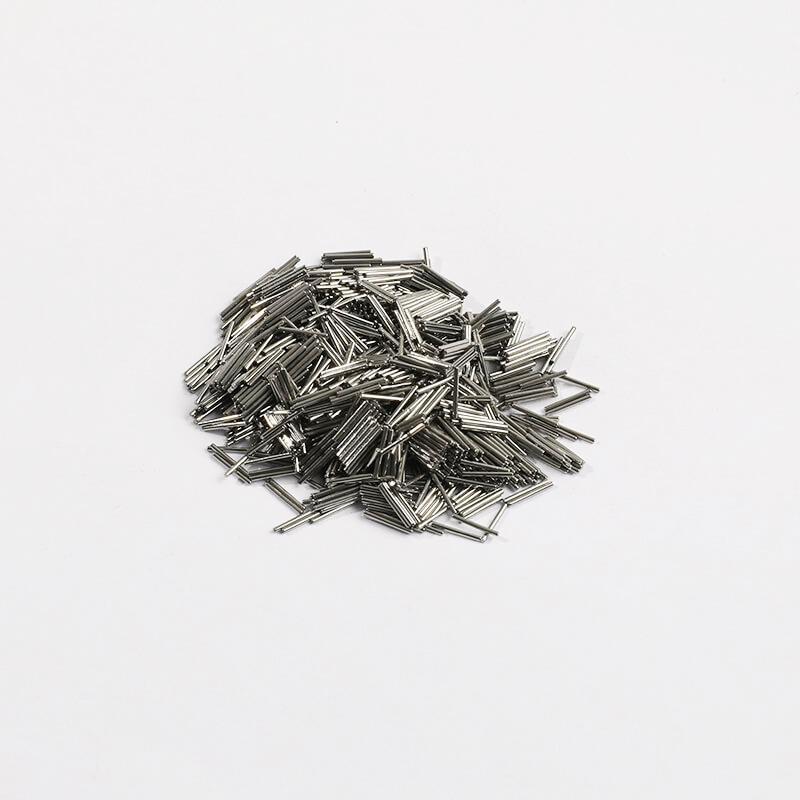
| Media | Best fit | Watch out for |
|---|---|---|
| Magnetic finishing pins and fine magnetic media | Small precise items such as spools, orifice plates, small valve parts and fine slot arrays where tumbling media cannot reach the feature | Limited working envelope, pins lodge in the same fine features they are chosen to reach, and the surface signature differs from tumbling |
| Steel media, including balls and shaped pins | Bright finishing and edge blending on stainless automation components where appearance and a burnished surface matter | Transfers iron to aluminium and carbon steel, needs a corrosion-inhibiting compound, and must be separated magnetically or by screen at unload |
| Dry media such as walnut shell and corn cob | Drying assistance and light surface polish after a wet cycle, particularly on parts with pockets and threads that must not stay wet | Does not deburr or refine metal significantly, generates dust, and must not be treated as a cleanliness step |
| Heavy-cut ceramic, angle-cut triangles in a coarse size class | Removing a substantial milled or turned burr from open external edges and pockets on steel and stainless automation parts before a refinement stage | Cuts functional edges and corners aggressively, leaves a coarse surface on aluminium, and lodges in slots whose width approaches the media section |
Parts can pass a finish check and still fail because something moved. Thin machined webs, long beams and unsupported walls relax or distort under tumbling loads, so a housing that measured flat before the cycle fails a flatness or position check afterwards, and a soft aluminium part can pick up a bow that only shows on a surface plate. At the same time, media that cannot reach deep pockets, internal corners or the shielded side of a flange leave the original machining marks intact while the exposed faces are fully refined, and the difference becomes obvious once the part is assembled against a mating surface. Both outcomes are caught by measurement rather than by looking harder at the finish: record flatness, wall thickness and critical dimensions at the same points before and after, inspect at defined locations, and treat the batch record as the first place to look for the cause.
| Failure mode | Likely cause | How to catch it |
|---|---|---|
| Compound film, smut or tenacious residue left on a face or in a bore | A film-forming or silicate-bearing compound, insufficient rinse volume, or drying a part before it is genuinely clean | Magnify the suspect surface, wipe a defined area with solvent against a clean reference, and confirm with the buyer's own cleanliness method |
| Water spotting, mineral rings or haze left after wet processing and drying | Hard or high-chloride rinse water, slow or uneven drying, or parts stacked wet so moisture is trapped in pockets and threads | Inspect dried parts under angled light for rings and haze, check the rinse water source and the drying method, and confirm that pockets and tapped holes drain before packing |
| Uneven finish with unrefined pockets, internal corners or the shielded side of a flange | Media cannot reach the feature at the chosen size or orientation, charge circulation is blocked, or the part was never repositioned during the cycle | Inspect at defined locations rather than judging the whole part, photograph the same feature before and after, and measure roughness only at the surfaces the drawing controls |
| Colour change or darkening on an aluminium face after the cycle | Compound chemistry unsuitable for aluminium, no effective corrosion inhibitor, or a delay between finishing and drying | Compare the finished face with an unprocessed coupon of the same alloy under the agreed light, and review the compound product, dose and rinse sequence for the lot |
Venice's industrial identity is built on the port system and on the Porto Marghera industrial zone on the mainland. The port authority reports that the lagoon port handled 24,220,555 tonnes of goods in the twelve months to March 2023, a fall of 3.6% year on year, with 517,781 TEU of containers and a decline in refined petroleum products that it attributes both to the green conversion of the Marghera pole and to the effects of sanctions on Russia (s1). The authority describes the Veneto port system as multipurpose, with the ports of Venice and Chioggia working agro-food, steel, chemical and energy supply chains as well as commercial and tourist traffic, and Chioggia holding national standing in fishing (s2). Alongside this, Murano retains a concentrated glass manufacturing base: the Consorzio Promovetro represents more than 40 artisan and industrial glass firms on the island (s3).
The nearest part of that base to this brief is energy: The port authority attributes the fall in refined petroleum products to the green conversion of the Porto Marghera pole and to sanctions on Russia, and lists the energy supply chain among those the Venice and Chioggia ports work with.
The Venice-area finishing problem is split between metal and glass. In the Marghera and port-related industrial zone, ship repair, steel and process-plant work create deburring and weld-dressing requirements on large fabrications, where the constraint is access and part size rather than cycle time. On Murano the requirement is different again, because glass finishing is about cold working, edge polishing and surface defect control where a metal-media process is not applicable; a supplier should be clear about which of the two it is being asked to solve.
The first distinction to settle is whether the part is a metal fabrication or a glass article, because almost nothing about the process carries over between them. For the Marghera and port-side industrial work, the practical questions are whether the part can be moved to a machine at all and what the acceptance criterion for weld dressing or edge condition will be.
Freight context: Porto di Venezia (Marghera), Porto di Chioggia, Porto di Fusina (ro-ro). The lagoon port system is the freight gateway: 24,220,555 tonnes of goods in the twelve months to March 2023 with 517,781 TEU of containers, and ro-ro units at Fusina up 11.5% (s1). The authority describes the ports as multipurpose and working agro-food, steel, chemical and energy supply chains (s2), so Marghera is the natural point of discharge for a machine or a pallet of sample parts destined for the Venice-Padua industrial area. Venice Marco Polo airport was not verified in this session and is therefore not listed as a confirmed hub.
The customs authority is the Agenzia delle Dogane e dei Monopoli (ADM), which is the regulatory, supervisory and control authority for customs and collects the duties. Goods arriving from China are cleared by customs before they can enter the single market and are released into free circulation by means of a customs declaration; the date of acceptance of that declaration is the date used to calculate and apply the import duty and any VAT or excise duty. Importers should settle in advance who lodges the declaration and under which VAT and EORI arrangements, and must ensure the machine carries CE marking and is supported by the EU declaration of conformity and technical file. Because the CE mark is compulsory for machinery covered by the EU machinery legislation and forbidden for products outside it, the conformity route must be settled before shipment rather than at the border.
Italy applies the EU's common commercial policy to imports from China, so Chinese industrial machinery enters under the EU Common Customs Tariff, where the duty rate depends on the type and origin of the goods and the working tariff is TARIC. Istat's August 2026 extra-EU trade release records a 16.0% year-on-year increase in Italian purchases from China, alongside strong growth from India, OPEC and Mercosur, so China remains one of the fastest-growing sources of Italian imports. Anti-dumping and other trade-defence measures apply case by case to specific product categories rather than to finishing machinery in general, so the applicable rate must be checked against the specific commodity code before a quotation is finalised.
SurfacePolish supplies from Xiamen, China. The buyer's own destination rules, conformity marking, tariff classification and documentation responsibilities stay with the buyer; confirm them against the authorities named above before ordering.
Roughness is only comparable when the measurement conditions are fixed. State the location by distance from a reference feature, the traverse direction relative to the machining or media marks, the cut-off and the evaluation length, then use the same conditions for the first article and for production checks. A reading taken along a bore axis and one taken around its circumference describe different surfaces. Curvature limits how a skid or shoe sits on the work, particularly in a small bore or on a narrow land, and a poorly seated pickup is not evidence. Take readings at several stations, because the ends of a part and the middle of a part often differ. Where visual appearance is what the customer sees, pair the number with a physical reference viewed at an agreed distance, since a surface can measure inside a band and still look wrong.
Scale-up is mostly about holding what produced the trial result. In production that means a media charge kept at a target mass, screened on a schedule with undersize and broken pieces removed and fresh media added to a recorded level. Compound should be metered to a concentration rather than poured by eye, and rinse water quality should be known and stable. Every lot needs an identity: part numbers, quantity, machine, media charge, compound, cycle time, operator, inspection result and disposition. Where the same machine handles aluminium and stainless, define the changeover, including media purge, machine cleaning and compound replacement, and record when it happened. Cycle counting is a simple control that is often skipped: a charge that has run a known number of hours can be scheduled for replacement before wear starts producing lodged media or a drifting finish.
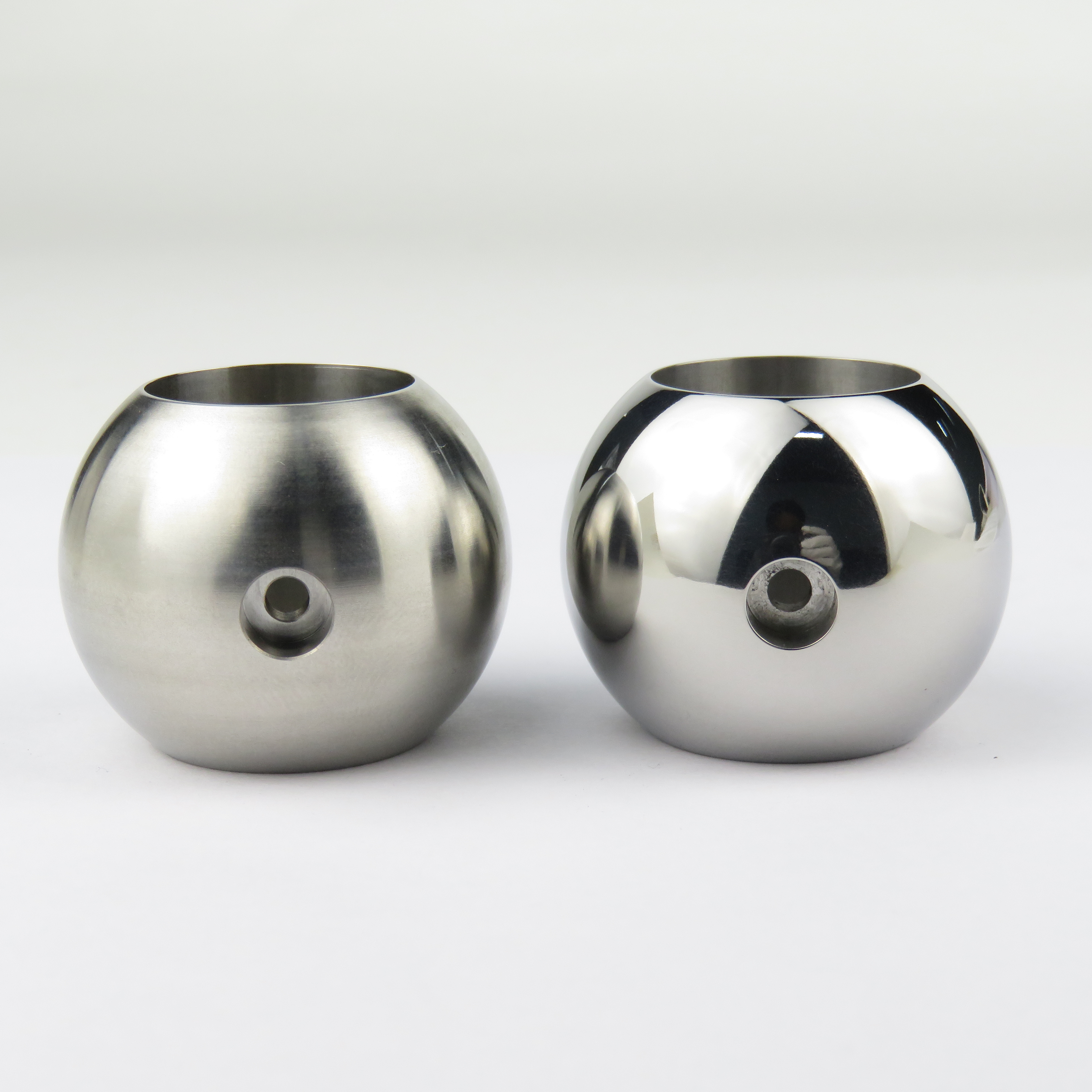
Size the medium well below the smallest opening the charge could enter, and treat every passage as a retrieval point rather than assuming it stays clear. Map the tightest tapped hole, keyway or cross-drilling first, then choose a size class against that geometry instead of an average part. Add a defined check such as a pin or thread gauge on holes, a borescope at an agreed angle and a rinse collected through a filter. For a trial, send the part with the smallest opening so the media choice is tested on the real feature. SurfacePolish reports what was observed on the tested parts; the release decision remains with your own quality function in Italy.
Cycle time depends on the starting burr, the alloy and temper, the media size class, the compound and how much edge refinement is wanted, so no figure can be quoted in advance. A part that needs only a light edge break runs very differently from one that must shed a milled burr or a recast layer before refinement, and a two-stage route has to count both stages. The useful approach is to test one or two defined stop points on representative parts and record what changed at each. SurfacePolish does not promise cycle times or capacity; treat any timing on returned parts as an observation from that run rather than a production commitment.
A trial shows what a given machine, charge and setting did to the parts tested, which is useful evidence but not a sizing study. Machine size depends on the largest envelope and mass in the family, the smallest part that must meet the same appearance, the load ratio you intend to run, and how many stages the part needs. Those are planning questions that belong in a line-concept discussion alongside the trial result. A part tested on a small machine may behave differently in a larger chamber, and a part run in a full production load may come out differently from one run in a light trial batch. Record both the settings and the load.
Use Venice, Italy as the destination on the enquiry and state whether the deliverable is equipment, media and compound, a representative sample review or a line concept. A destination does not imply local stock, a local service point or a local delivery time.
Italian buyers reference UNI and the ISO/EN surface-texture, tolerancing and cleanliness standards transposed into it, while glass and ceramic producers work to product standards rather than to metal-finishing standards. In the Venice industrial area the finish requirement usually arrives inside the individual order from the shipyard's or plant operator's own specification, so it has to be read off the customer's drawing and inspection plan rather than from a generic default.
Sources were retrieved on 2026-09-29 and describe the local industrial and trade context only. They do not evidence any SurfacePolish project, shipment, installation or service in Venice.
The buyer needs the cut edges deburred and the visible face given an even appearance without warping the thin plate or marking the countersinks.
Send the material, dimensions, approximate weight, batch quantity, the incoming condition and photographs of the difficult features. Mark which features must not be contacted by media and state how the result will be inspected. This form carries source reference PSEO-0490; quote it if you prefer an additional manual reference.
Open the SurfacePolish enquiry form Email a prepared enquiry
No price, lead time, certification or result is promised here. Confirm whether a sample trial is available for the specific part and what the trial can and cannot show.
Page PSEO-0490 · revised 2026-09-29 · cross-border equipment, media and scoped sample review. City context is sourced and cited above.
Use this local checker to identify missing part and inspection information. It prepares a technical-review brief; it does not approve a machine, process recipe or production result.
Complete the part details to prepare a review brief.
Email : info@surface-polish.com


 IPv6 network supported


 +86-592-2381506